
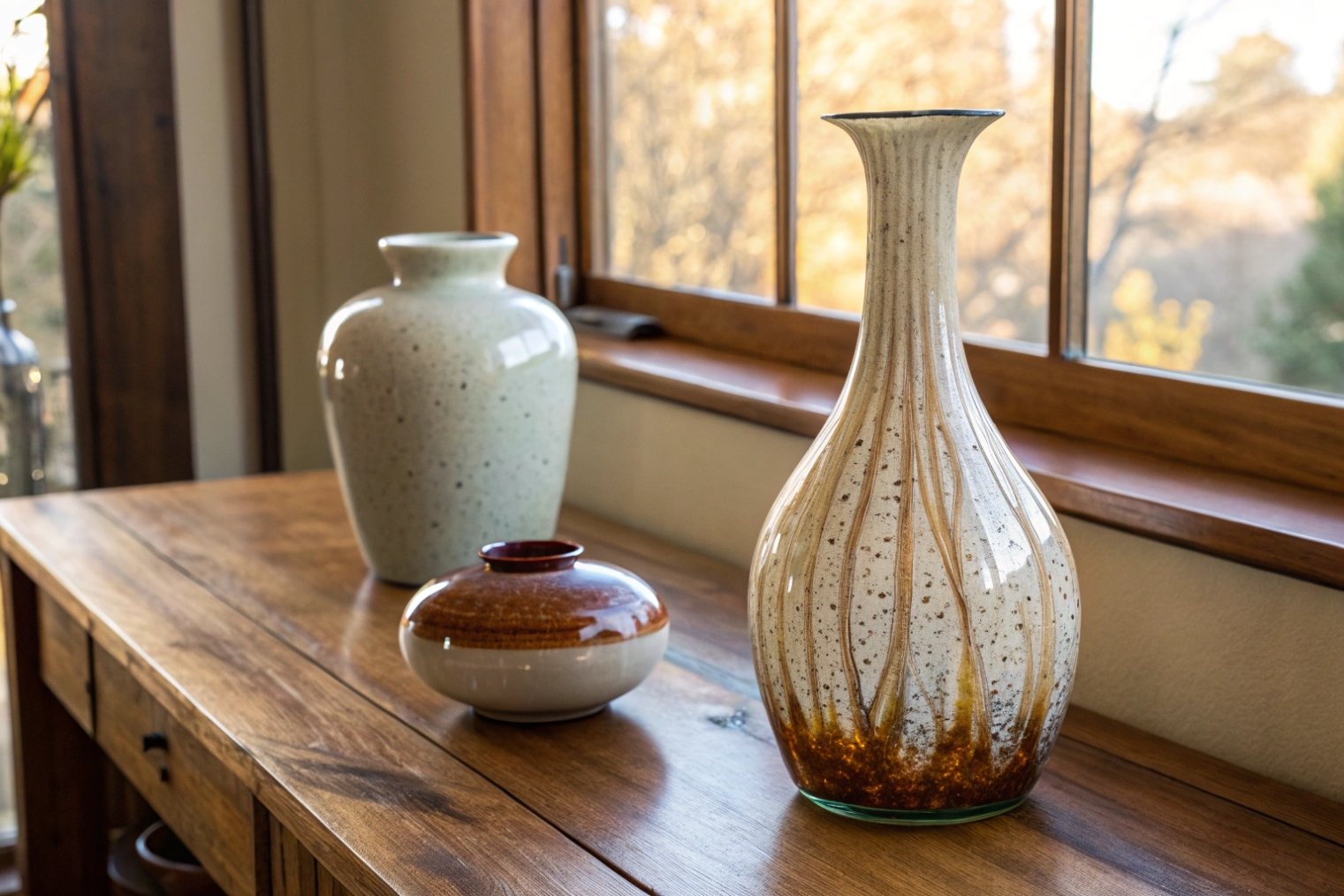
Hand-blown glass vases sit between décor and art. They feel alive in a way machine-made pieces rarely match.
Hand-blown vases stand out because every piece is slightly different in shape, bubbles, and color flow, with thicker, weighty bases and visible craftsmanship that machine production cannot truly copy.
A factory vase can look perfect but anonymous. A studio vase carries the maker’s decisions in its curve, balance, and color. For retailers and importers, that difference affects pricing, packing, and how a collection scales.
Can artisanal forming deliver unique shapes and textures?
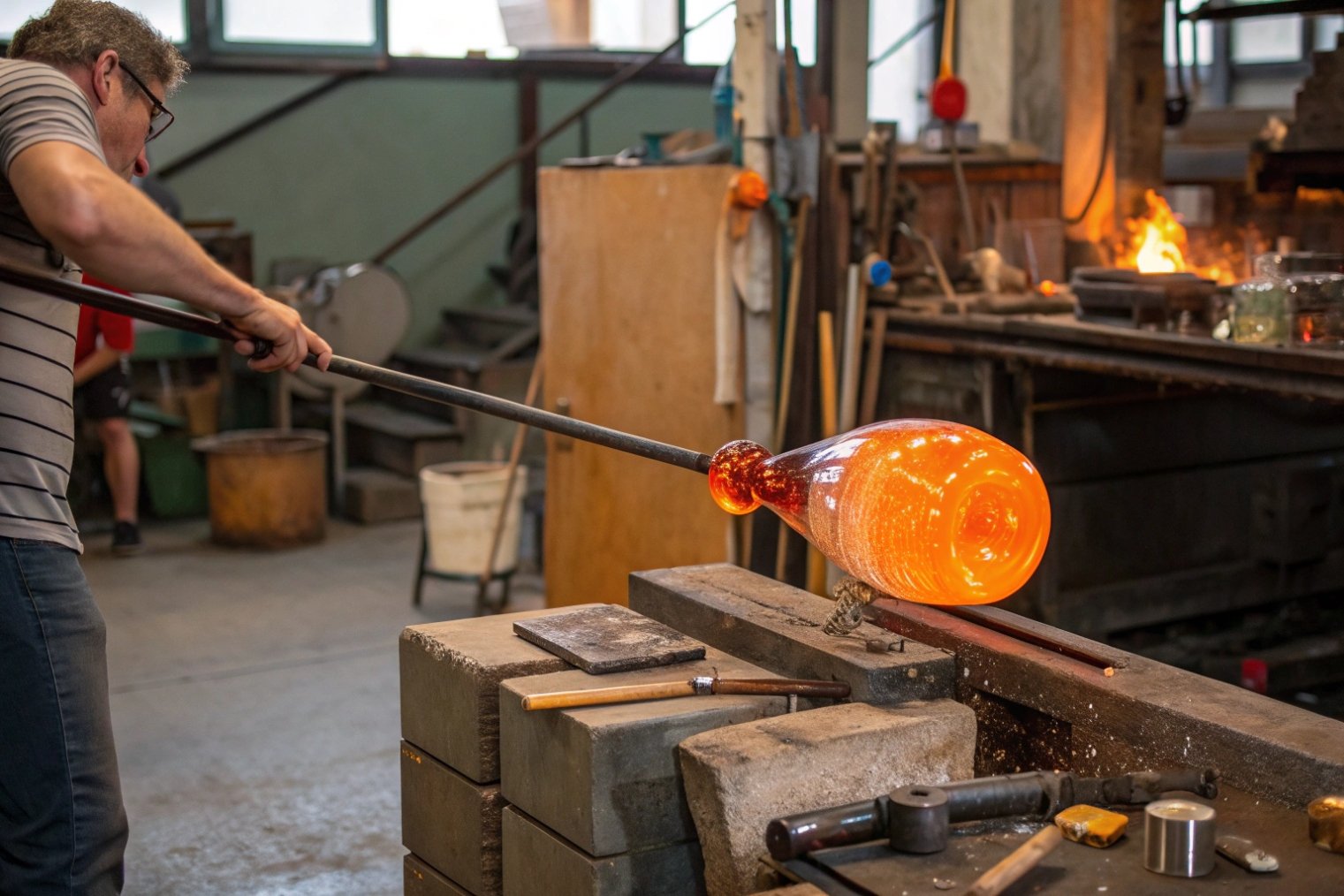
Hand forming starts with a gather of molten glass on the blowpipe in the glassblowing process 1. From this point on, the piece follows the glassblower’s timing, breath, and tools, not a fixed mold cycle.
Artisanal blowing creates natural variation in silhouette, wall flow, bubbles, and tool marks, so each vase feels like a one-off object instead of a cloned SKU.
How hand-blowing changes the silhouette
In a press-and-blow machine, the glass follows the mold cavity exactly. In hand-blowing, the shape develops through small choices:
- How long the glass hangs before entering a block or mold.
- How strongly the maker blows or swings the piece.
- When the form returns to the bench for marvering or shaping.
This freedom allows:
- Asymmetric necks or offset shoulders that still feel balanced.
- Organic “droplet”, “wave”, or “shell” silhouettes.
- Extra-thick lips, rolled rims, or flared openings for flowers.
Small differences in timing change the curve of the wall or the tilt of the mouth. For interior designers and boutique buyers, this gives a more “human” look on the table or shelf.
Texture, bubbles, and “imperfections” as design
Hand-blown vases often include air bubbles, trails, or subtle ripples in the surface. In mass production, these are defects. In studio work, they become part of the story:
- Intentionally trapped bubbles in lines or clusters.
- Hammered or optic textures from patterned molds.
- Cased layers where color moves differently from clear glass.
You can steer these effects by process choice:
| Feature | How it is created in hand-blown work | Visual result |
|---|---|---|
| Random fine bubbles | Higher moisture, specific tools or frit | Sparkling, lively internal texture |
| Optic ribs / diamonds | Blowing into optic molds 2 before final shaping | Light-catching surface pattern |
| Thick, heavy base | Extra gather and careful blocking | Stable vase with “luxury” weight |
| Rolled or thick lip | Reheated rim and tooled edge | Soft, comfortable, premium rim detail |
For premium décor lines, these differences help justify higher price points and give each piece “gift” value. They also support storytelling around craft, which is hard to fake with a standard machine item.
How do small-batch finishes compare to machine-made QC?
Buyers often worry that “hand-made” means “uncontrolled.” In reality, good studios follow quite strict routines, just with different tools and metrics than a large factory.
Small-batch, hand-finished vases can show richer polishing, cleaner rims, and better visual grading, but size and weight tolerances are looser than machine-made mass production.
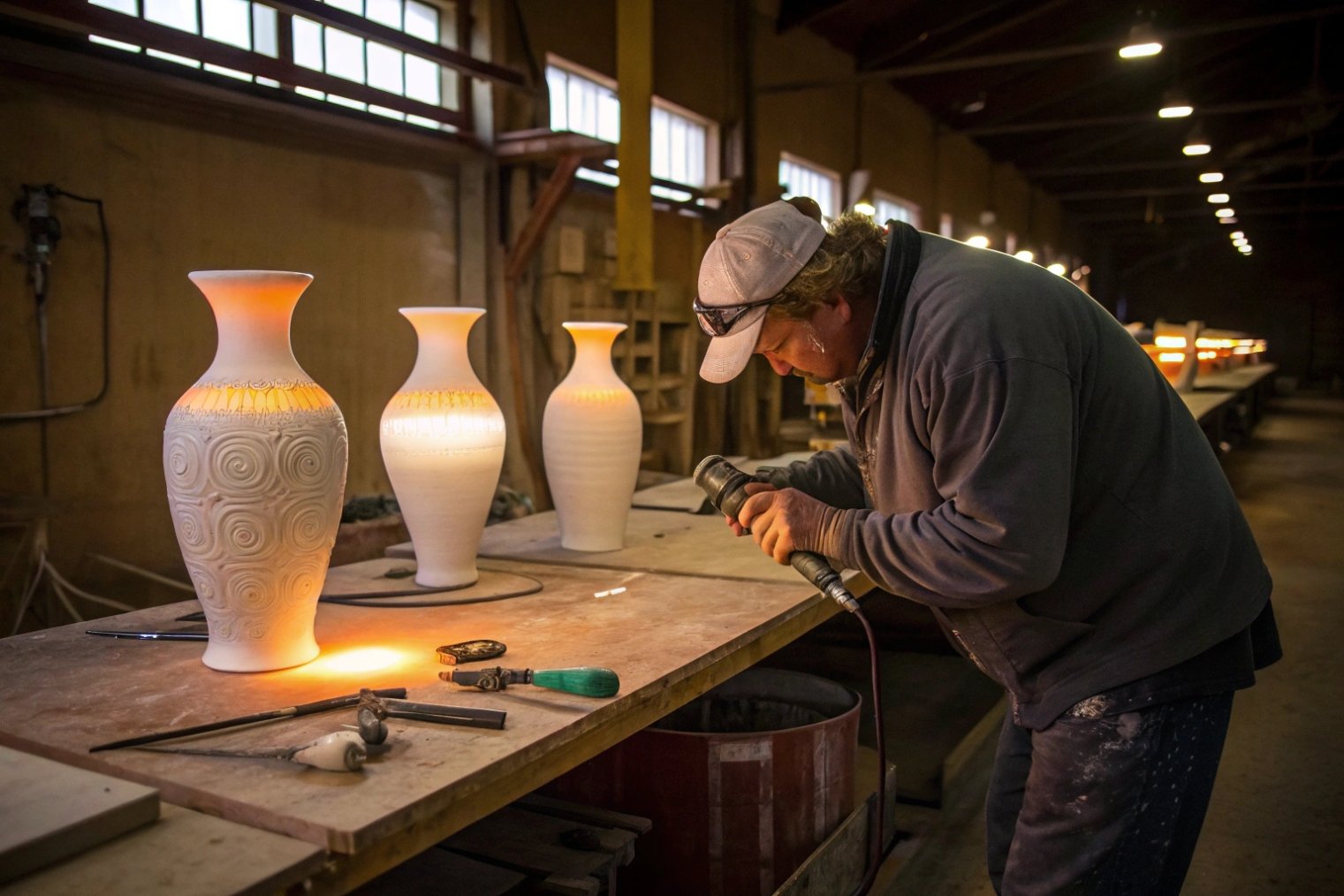
Finishing steps in studio vs factory
After blowing and annealing, both hand-blown and machine-made vases need finishing. In small batches, artisans often:
- Cut or grind the rim to height, then fire-polish 3.
- Flatten or polish the base for stable standing.
- Cold-work edges, facets, or signature marks.
- Inspect visually under good light, piece by piece.
Machine lines focus more on:
- Automated fire-polishing of rims.
- Conveyor-based base treatments or coatings.
- High-speed camera inspection for cracks, inclusions, and dimensions.
- Statistical acceptance based on AQL sampling 4.
The result: studio vases may have a softer, more refined touch in the hand, while machine pieces excel in repeatable size and weight.
Tolerance and quality expectations
You can think of quality on two axes: technical and aesthetic.
| Aspect | Small-batch hand-blown vases | Machine-made vases |
|---|---|---|
| Height / diameter tolerance | Looser, often a few mm variation | Tight, often within small fixed ranges |
| Wall thickness | Varies along the piece, usually thicker | More uniform, often thinner |
| Rim flatness | Finished and checked by hand, very tactile | Good, but optimized for speed |
| Visual grading | Human eye and touch, piece by piece | Cameras plus sampling |
| Character | Visible individuality, signed or marked | Consistent, anonymous |
Proper controlled annealing cycles 5 become very important in hand-blown work. A good studio uses controlled annealing cycles so internal stresses relax. This supports long life even when thickness varies.
For retail chains, the key is to define acceptable ranges clearly:
- Height range (for example ±5 mm).
- Mouth opening tolerance.
- Weight range per size.
- Allowed level of bubbles or color swirls.
Once these are agreed, small-batch production can hit them reliably, but product images and catalog notes should explain that each piece is slightly different by design.
What packing methods reduce breakage in export shipments?
Hand-blown vases often have long necks, heavy bases, and asymmetric shapes. They travel further than local studio customers, so packaging design matters as much as the glass design.
To reduce export breakage, use tight inner packing around neck and base, strong double cartons with dividers, and palletization that stops movement and prevents point loads.
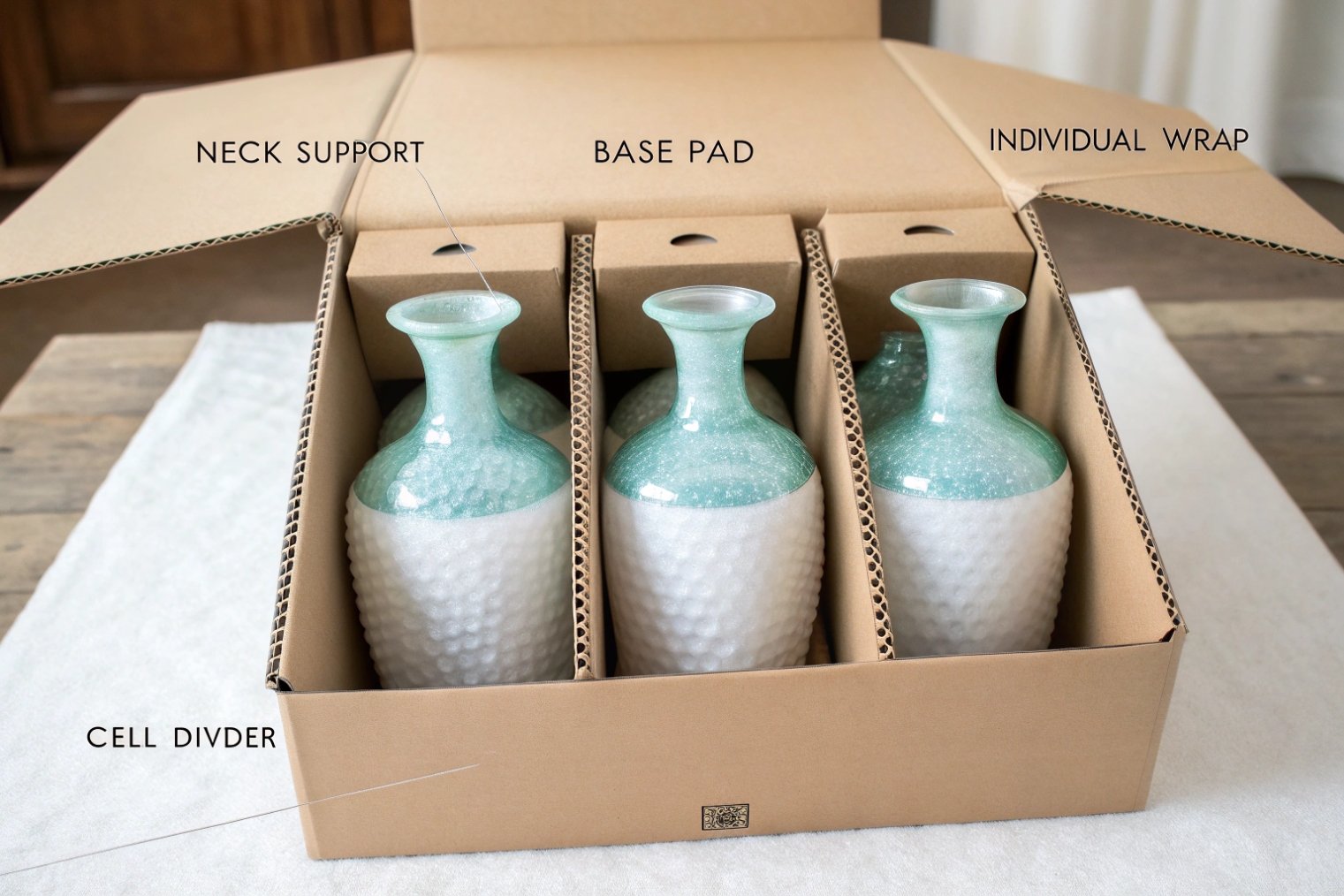
Inner packing: protect neck, shoulder, and base
The main breakage risks are:
- Side impact on the neck or shoulder.
- Concentrated loads on the base edge.
- Vases touching each other inside the carton.
A simple inner-pack system usually includes:
- A soft sleeve or paper wrap around each vase.
- Extra protection around the neck (foam collar, bubble ring, or molded pulp).
- Base pads so glass never contacts the carton directly.
- Cell dividers or custom inserts that keep pieces separated.
You can think of it as building a “nest” for every vase.
| Packing element | Purpose | Tips for hand-blown vases |
|---|---|---|
| Individual wrap | Prevents scuffing and point contact | Use tissue + bubble or soft foam |
| Neck support | Protects the weakest area | Foam rings or die-cut corrugated collars |
| Base pad | Spreads vertical loads | Use dense board or foam under each base |
| Cell divider / insert | Stops vases touching each other | Custom die-cuts matched to vase profiles |
| Void fill | Stops movement in the master carton | Avoid loose fill that can shift |
For irregular, sculptural vases, custom die-cut inserts or molded pulp are often worth the tooling cost once volumes grow.
Outer packing and palletization
At carton level:
- Use double-wall corrugated 6 for export.
- Seal bottoms and tops with strong tape in H-patterns.
- Print “this side up” and “fragile glass” but do not rely only on markings.
On pallets:
- Keep all cartons upright and aligned.
- Use slip sheets between layers to spread loads.
- Strap and stretch-wrap the pallet so cartons cannot slide.
- Protect corners with edge boards.
Drop tests and ISTA transport tests 7 help refine the design before the first container shipment. A small adjustment, like adding a neck collar or thicker base pad, can cut breakage dramatically and protect margins.
Are custom colors and gradients scalable for retail lines?
Retail buyers love soft gradients, multi-color swirls, and layered glass. The key question is always the same: “Can you repeat this at scale and keep the look consistent enough for shelves?”
Custom colors and gradients are scalable when color recipes and processes are standardized, but exact one-to-one matches are impossible; retailers should sell the variation as a feature, not a defect.
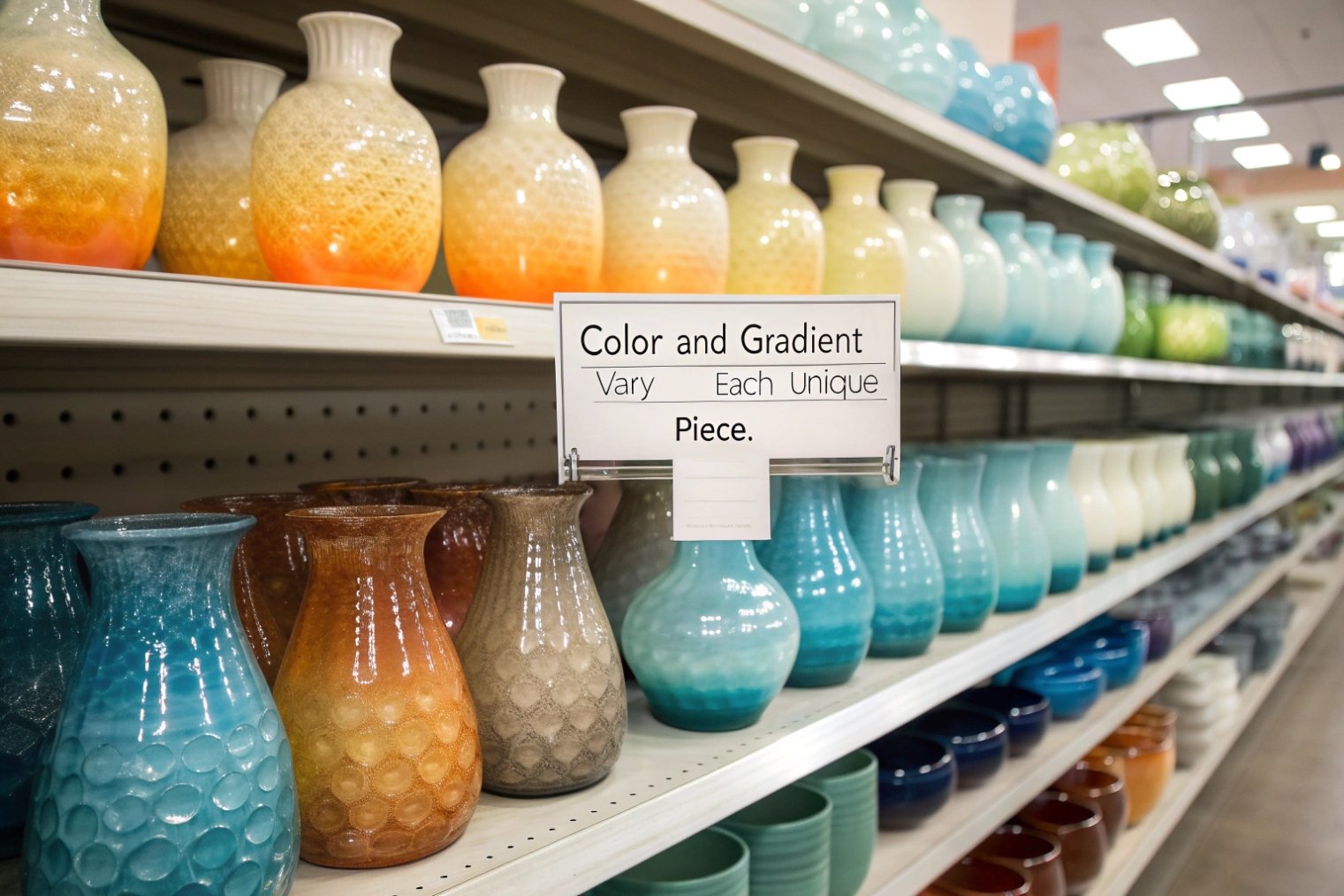
Color methods and their scalability
In hand-blown vases, color can be added in several ways:
- Colored batch: the whole molten glass is tinted.
- Casing / overlay: a clear core with a colored outer layer.
- Frit and powder: chunks and powders rolled onto the hot gather.
- Trails and spots: threads or dots of contrasting color.
Gradients often come from how the glass is gathered, rolled, stretched, and blown rather than from digital-style “printed” gradients.
Here is how different methods scale:
| Color method | Look and effect | Scalability for retail lines |
|---|---|---|
| Colored batch | Uniform tone through the piece | Very scalable, consistent tone |
| Casing / overlay | Clear + rich outer color, depth effect | Scalable with good control and timing |
| Frit / powder | Speckles, clouds, soft gradients | Scalable, but pattern varies piece to piece |
| Trails / threads | Lines, spirals, accents | Scalable; placement will vary slightly |
| Multi-color overlay | Strong gradients, “sunset” or “ocean” looks | Scalable in concept, high variation |
The workshop can fix:
- Color recipes and suppliers.
- Heating and reheating cycles.
- Typical gather size and shaping steps.
But the exact swirl and gradient line will always change. That is the charm and the challenge.
How to use variation in a retail program
To make custom colors and gradients work at scale:
-
Define the “family look.”
Instead of expecting identical pieces, define what the collection should feel like: for example “teal to clear fade with white speckles near the base.” -
Approve a range, not a single master.
Review a group of samples and agree which ones are “in range” and which are too far off. Use that as a visual standard for QC. -
Explain uniqueness to customers.
On hangtags or online listings, state clearly that each vase is unique in swirl, bubble pattern, and gradient line. -
Plan production in color campaigns.
Run one colorway at a time so the furnace and team settle into a stable rhythm. This improves repeatability and lowers waste.
With this approach, custom colors and gradients can support full retail lines, from small boutiques to larger chains that accept controlled variation.
Conclusion
Hand-blown glass vases trade perfect uniformity for character, weight, and story; with clear specs, smart packing, and realistic color standards, that trade becomes a strong advantage in retail and export programs.
Footnotes
-
Overview of the glassblowing process and tools used to form hand-blown pieces. ↩︎ ↩
-
See how optic molds create ribbed patterns that catch light in hand-blown glass. ↩︎ ↩
-
Explanation of fire polishing and why it produces smooth, safe rims and edges. ↩︎ ↩
-
Quick reference to AQL/acceptance sampling concepts for setting inspection limits on handmade variations. ↩︎ ↩
-
Learn why glass annealing relieves internal stress and prevents delayed cracking. ↩︎ ↩
-
Basics of corrugated fiberboard and why double-wall cartons improve shipping strength. ↩︎ ↩
-
Understand ISTA transport testing and why it helps validate packaging against real distribution hazards. ↩︎ ↩






