
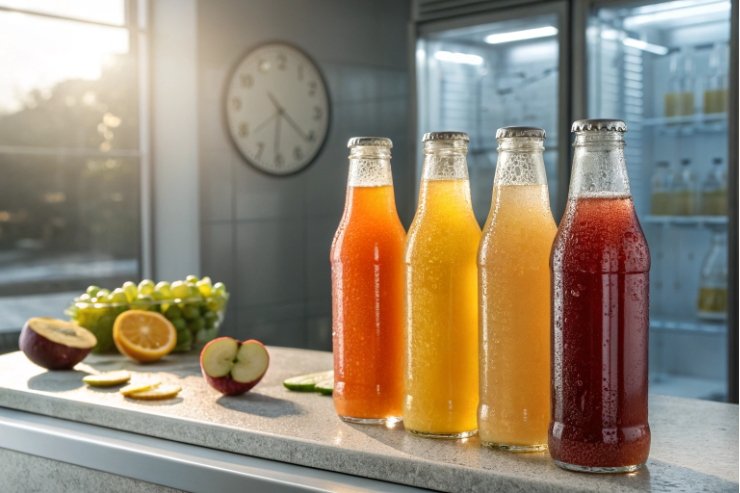
Fruit drinks are fragile. Light, oxygen, and bad packaging can turn bright flavor into something dull and flat much faster than most people expect.
Glass bottles protect fruit drinks with an inert barrier, handle hot-fill and pasteurization well, and use transparent, premium-looking designs plus tight closures to keep aroma, vitamins, and carbonation stable on shelf.
When the bottle is wrong, you add sugar, flavors, or heavy processing to hide damage. When the bottle is right, the juice itself can stay closer to what left the press or concentrator. Glass lets you work with the product, not against it—starting with the inert barrier of glass packaging 1. {#fnref1}
Do glass barriers preserve aroma and vitamin content?
Fruit drinks are full of aroma and vitamins that oxygen and light love to destroy. If the barrier is weak, the best recipe in the world will still fade.
Yes. Glass is non-reactive and almost impermeable to oxygen and moisture, so it slows aroma loss and vitamin breakdown and keeps fruit drinks tasting fresher for longer than most plastics or cartons.
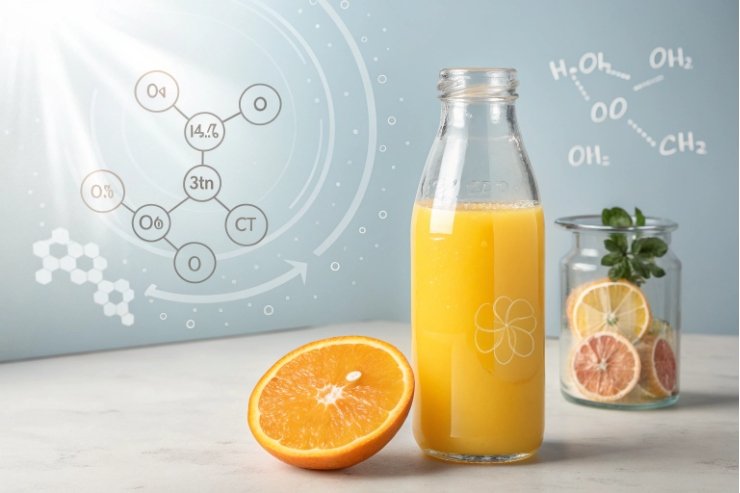
Why aroma disappears so fast in the wrong pack
Fruit drinks carry a mix of:
- Volatile aroma compounds (esters, terpenes, aldehydes)
- Sensitive vitamins (especially vitamin C)
- Natural colorants (carotenoids, anthocyanins)
Oxygen and light attack all three. In a weak barrier:
- Oxygen slowly seeps in through the walls or seals.
- Aroma molecules oxidize and lose their bright notes.
- Vitamin C sacrifices itself as an antioxidant and drops.
- Color drifts towards brown or dull orange.
In practical shelf-life work, vitamin C loss often tracks the oxygen-barrier properties of the package 2. {#fnref2}
How glass behaves differently
Glass has three big advantages here:
-
Inert surface
The juice touches only glass and the liner. Glass does not leach, swell, or absorb oils from citrus, berry, or tropical blends. That means less flavor scalping and fewer recipe changes to “fight the pack”. -
Strong barrier to gases and moisture
Oxygen and water vapor cannot move through the glass wall. The only real paths are the closure and tiny defects if quality is poor. With a good cap and liner, dissolved oxygen climbs much slower than in many other materials. -
Stable under storage conditions
Glass does not creep or thin over time. Its barrier performance on day 300 looks like day 1, as long as the closure is sound.
How this shows up in real products
You see the impact most clearly in three cases:
- Not-from-concentrate juices with strong, fresh notes. These stay closer to their original profile in glass.
- Fortified juices where you must hit vitamin claims at end of shelf life—especially when studies show vitamin C loss is higher in plastic than glass 3. {#fnref3}
- Aromatic blends (mango, passionfruit, citrus) where smell sells the product.
A simple comparison:
| Property | Glass bottle | Typical plastic bottle | Carton (with barrier) |
|---|---|---|---|
| Oxygen barrier | Excellent | Medium to good (depends) | Good, can be light-sensitive |
| Aroma scalping by wall | Very low | Medium | Low to medium |
| Vitamin C retention support | Strong, if cold chain ok | Depends on wall and cap | Good if kept dark and cool |
So, formula work and cold chain still matter. But glass gives your fruit drink more time before quality starts to slide.
How do hot-fill and flash-pasteurization specs fit glass?
Juices and fruit drinks often need heat to stay safe. That heat can easily deform or stress the wrong container, which creates leaks, vacuum loss, and complaints.
Glass handles hot-fill and flash pasteurization very well, as long as you match bottle design and processing conditions so temperature changes are controlled and mechanical loads stay within safe limits.
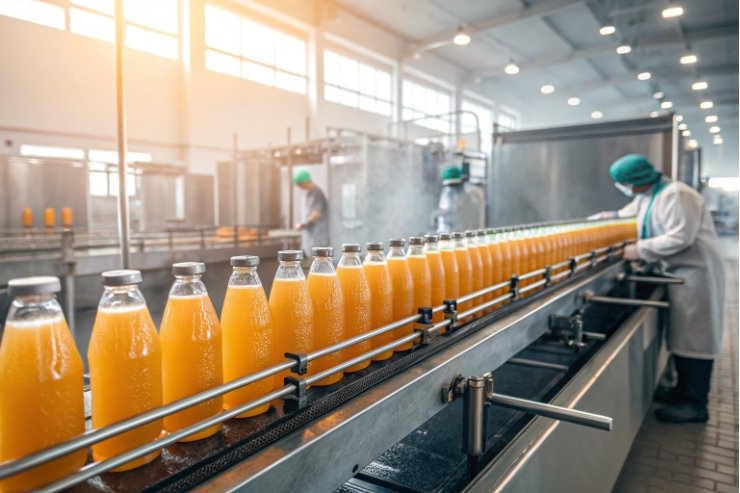
What hot-fill and flash pasteurization do to a container
In hot-fill and similar processes, the product might:
- Reach 80–95 °C at filling for high-acid juices.
- Sit briefly at temperature to kill pathogens.
- Cool down to ambient or chilled conditions.
This means:
- The container wall sees a big temperature jump.
- Internal pressure and vacuum change as the juice cools.
- Closures and liners must stay sealed through all this.
Materials that soften with heat, or warp under load, struggle with this routine.
Why glass suits these processes
Glass gives you:
- High thermal resistance: it stays rigid at hot-fill temperatures that would deform many plastics.
- Dimensional stability: it holds its shape, so cap and thread geometry stay correct as the product cools.
- Good compatibility with pasteurization tunnels: it can move through spray or water tunnels without shrink, tilt, or paneling.
If you want a quick process-level overview of where glass fits, this guide on hot filling, cold filling, and container choice 4 is a helpful primer. {#fnref4}
There are limits. You still need to manage:
- Thermal shock: avoid pouring very hot juice into cold glass, or hitting hot bottles with cold spray too fast—because thermal shock is driven by rapid temperature change 5. {#fnref5}
- Line handling: hot glass is a little more fragile, so conveyor speeds and guides must be tuned.
Designing glass and process together
In practice, I look at hot-fill and glass as a pair, not two separate choices. A simple view:
| Factor | What we set for glass | Why it matters |
|---|---|---|
| Bottle design | Uniform wall, reinforced base, smooth shoulders | Spreads thermal and mechanical stress |
| Glass type and weight | Food-grade, validated hot-fill rating | Reduces breakage and micro-cracks |
| Fill temperature | High enough for safety, not higher | Limits thermal shock and energy use |
| Cooling profile | Gradual, controlled spray or tunnel | Avoids cracking and closure stress |
Flash pasteurization followed by filling into glass at lower temperatures is also common. In that setup, the bottle sees less heat, and line speeds can be higher, while the glass still gives strong shelf protection.
For brands that want clean labels, moderate heat plus glass is a powerful combo. You can skip heavy preservatives and let the pack do more of the work.
When people choose juice, they buy with their eyes first. Color, pulp, and clarity all send messages before they even read “100% juice” on the front.
Yes. Clear and lightly tinted glass make fruit drinks look fresher and more honest, but you must manage light exposure with shelf design, tints, or sleeves so visual appeal does not come at the cost of quality.
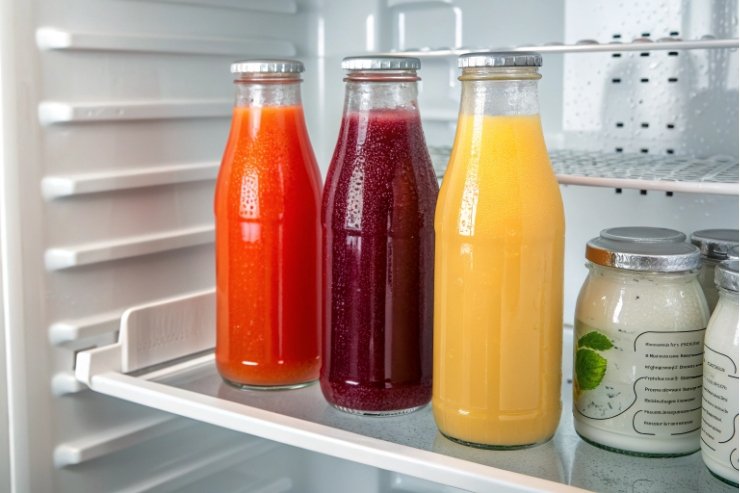
Why seeing the juice matters
Transparency helps in three simple ways:
-
Trust
Shoppers can see if pulp settles, if there is sediment, and if the color looks natural. That reduces fear of “hidden” ingredients. -
Freshness cues
Bright oranges, deep reds, and cloudy apple tones all suggest real fruit and recent production, especially when combined with chilled display. -
Premium perception
A clean, heavy glass bottle that shows the liquid feels more upscale than an opaque or flimsy pack, even when the price is similar.
For cold-pressed or not-from-concentrate lines, this visual honesty is part of the brand promise.
Managing light risk at the same time
The problem is that the same light which makes the juice look attractive can slowly fade it. Vitamin C and natural colorants are both light-sensitive.
To balance this:
- Use tinted glass (light flint, dead-leaf green) for products with long ambient shelf life.
- Keep clear-glass juices in chilled, shaded display rather than sunlit or warm shelves.
- Add sleeves or large labels that cover part of the bottle but still leave a “window” to the juice.
- Control warehouse and transport lighting so exposure before the store is limited.
A simple comparison of visual vs protection:
| Glass choice | Visual effect | Protection level | Best for |
|---|---|---|---|
| Clear flint | Maximum visibility, modern look | Lowest | Chilled, fast-turn premium juices |
| Light tinted (e.g. pale green) | Good visibility, softer tone | Medium | Ambient fruit drinks with moderate turnover |
| Darker amber or green | Limited visibility | Higher | Sensitive blends, long shelf life, export |
Your marketing team will often push for clear. Your quality team will prefer tint. The best answer usually lives in the middle, with smart display and realistic shelf lives.
Transparency alone is not enough. You need structure and graphics that support it:
- Slim, tall bottles read as more “crafted” than bulky shapes.
- Clean labels with short ingredient lists support the visual story.
- Embossed fruits or brand marks in the glass connect touch with sight.
Glass is very good at combining all this: transparency, weight, and precise decoration. That mix is hard to copy in cheaper materials, which helps you defend a higher price.
Which caps and liners reduce O₂ ingress and leaks?
Good glass can still be let down by a bad cap. For fruit drinks and juices, the closure is often the main oxygen and leak path, not the bottle wall.
Use matched closures and liners designed for juices: lug or twist-off caps with quality compound for still drinks, crown or specialty caps for sparkling variants, and always validate oxygen ingress, torque, and leak resistance together with the bottle.
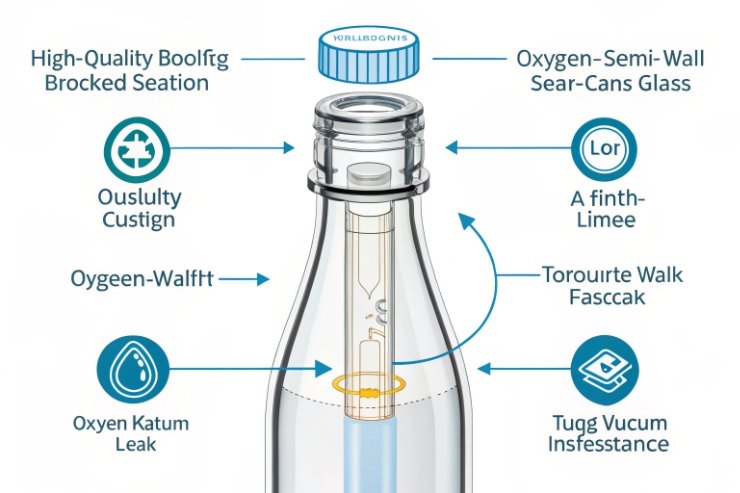
Closure options for fruit drinks in glass
Most juice projects revolve around a small set of closure types:
- Twist-off / lug caps for single-serve and multi-serve still drinks.
- ROPP (roll-on pilfer proof) caps for some premium or wine-style juices.
- Crowns for sparkling juices, sodas, or lightly carbonated fruit drinks.
- Special spouts or sports caps for certain functional beverages.
If you want a closure baseline that matches hot/cold fill and focuses on oxygen barrier, start with twist/lug metal closures for food and beverage 6. {#fnref6}
Why the liner is just as important as the cap
Inside the cap sits the liner or sealing compound. This small ring does most of the technical work:
- Seals against the glass finish to stop leaks.
- Controls how much oxygen can pass over time.
- Handles hot-fill temperatures and cooling-induced vacuum.
Common liner types for fruit drinks include:
- PVC-free compounds designed for hot-fill and good oxygen resistance.
- Oxygen-scavenging liners for very sensitive products or long shelf life.
- Compounds tuned for CO₂ retention in lightly sparkling drinks.
If the liner is wrong, you may see:
- Ring leaks under hot-fill conditions.
- Rust on the cap from trapped juice.
- Fast flavor loss due to high oxygen ingress.
Putting bottle, cap, and process together
When I match closures for fruit drinks, I always check:
-
Finish dimensions
Bottle threads and sealing surface must match cap specification exactly. Small deviations cause weak seals or chipped finishes. -
Process conditions
Hot-fill temperature, hold time, and cooling rate must all be inside the liner’s comfort zone. Some compounds are not meant for repeated high heat. -
Desired shelf life
Oxygen ingress needs to be low enough that the drink meets taste and vitamin targets at the end of its life.
A simple closure table:
| Product type | Closure choice | Liner focus |
|---|---|---|
| Still fruit juice, hot-fill | Lug / twist-off metal | Hot-fill grade, low O₂ ingress |
| NFC juice, premium | ROPP or high-spec lug | Strong seal, clean opening feel |
| Sparkling juice / soda | Crown or specialty cap | CO₂ retention, pressure resistance |
| Cold-pressed short shelf life | Lug with fridge-friendly liner | Good seal in chill, moderate O₂ ok |
Glass is flexible here. Its finishes support all these closures with high precision. That lets you tune the closure system to the drink instead of forcing the drink to fit one limited cap type.
Conclusion
For fruit drinks and juices, glass bottles combine neutral taste, heat resistance, strong barriers, and premium shelf presence in a way that protects real product quality instead of trying to hide its losses—and they stay endlessly recyclable in mature collection systems 7. {#fnref7}
Footnotes
-
Confirms glass is inert and nonporous, so it won’t taint juice flavor or absorb aromas. ↩ ↩
-
Explains why vitamin C loss correlates with package oxygen barrier and oxygen exposure in storage. ↩ ↩
-
Shows measured vitamin C loss differences across glass, plastic, and other packs in juice storage. ↩ ↩
-
Practical overview of hot-fill/cold-fill processes and why glass works well for high-temperature filling. ↩ ↩
-
Defines thermal shock and prevention basics, useful for setting safe heating/cooling ramps with glass. ↩ ↩
-
Details twist/lug closures, including oxygen-barrier sealing and compatibility with pasteurization and hot/cold fill. ↩ ↩
-
Summarizes why glass is recyclable and stable, supporting long-term sustainability claims for beverage packaging. ↩ ↩






