
Many brands choose “glass” and assume all glass behaves the same. Then a hot-fill crack or a haze line after cleaning shows up and the plan breaks.
Borosilicate bottles handle fast temperature swings and harsh formulas better than soda-lime. They cost more, yet they can cut thermal shock risk, reduce leaching, and support premium reuse use-cases when the process is demanding.
Borosilicate is not a magic upgrade for every bottle. It is a material choice that fits certain stress profiles: high heat, fast cooling, repeated washing, and chemically sensitive fills. The best way to judge it is to map the real “abuse” the bottle will see, then price the risk.
How do low CTE and ΔT tolerance reduce thermal shock?
A bottle can look perfect at room temperature, yet crack right after hot fill or during rapid cooling. That failure feels random, but it usually is not.
Borosilicate lowers thermal stress because its expansion is much lower, so the same temperature jump creates less strain inside the glass.
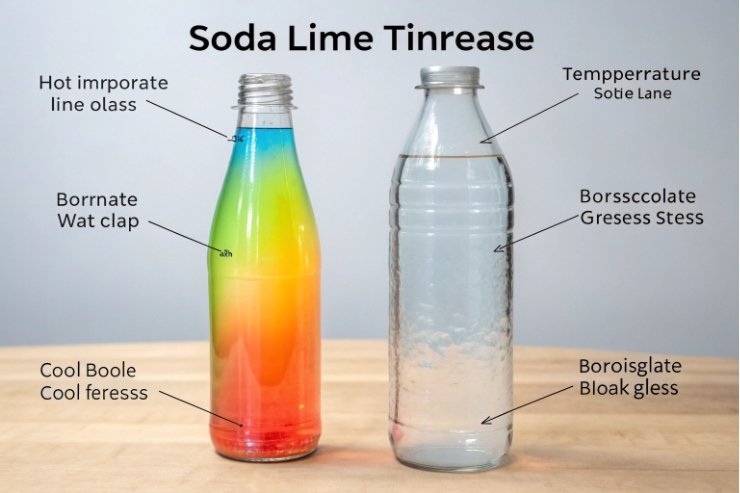
Thermal shock is stress from uneven temperature
Thermal shock 1 happens when one part of the bottle changes temperature faster than another part. The inside wall may be hot, while the outside wall is cooler. That creates a temperature gradient through the thickness. Glass does not like that gradient. It creates stress.
A simple way to think about it is this: stress rises when expansion rises. Expansion rises when the coefficient of thermal expansion 2 is higher. So if CTE is lower, stress is lower for the same ΔT.
In practical terms, borosilicate can survive a larger “sudden temperature change” before cracks start. Many teams describe this as higher ΔT tolerance. It is not just one number, because it depends on shape, wall thickness, and how fast heat moves.
Why low CTE helps on real production lines
Hot-fill lines and pasteurization lines create several shock points:
- filling hot product into a cooler bottle
- moving bottles from hot air to cold water zones
- placing hot bottles on cold metal guides
- rinsing or cleaning with cold spray right after heating
Low CTE reduces the stress at all of those moments. It also helps dimensional stability. That matters when a label panel must stay flat, or when a closure torque target is tight.
Borosilicate is also often specified as borosilicate glass 3.3 3 in standards language, which helps buyers align on measurable properties instead of vague “heat-resistant glass” claims.
What still matters even with borosilicate
Low CTE is a big lever, but it does not cancel other risks:
- Wall thickness: thicker walls can increase thermal gradients.
- Sharp corners: corners and heels concentrate stress.
- Residual stress: poor annealing can leave “hidden stress” that cracks faster.
- Handling impact: a small chip can become a crack starter under heat.
| Thermal factor | What increases crack risk | How borosilicate helps | What to still control |
|---|---|---|---|
| High ΔT events | hot-to-cold changes | lower CTE lowers stress | keep cooling curve steady |
| Thick sections | larger temperature gradient | helps, but gradient still exists | avoid heavy heels when possible |
| Poor annealing | trapped residual stress | does not fix it | specify stress checks, supplier QA |
| Chips and scratches | crack starters | helps a little | protect in handling and packing |
In one hot-fill project, the real gain was not “higher heat rating.” The gain was fewer random cracks during line stops, when temperature swings become messy. That is where borosilicate can pay back fast.
Is chemical durability superior for high-pH and acidic fills?
A bottle can be clear and strong, yet still change the product over time. This is a quiet problem. It shows up as taste shift, haze, or trace ions in stability tests.
Borosilicate usually shows better chemical durability than soda-lime for many food, cosmetic, and pharma fills, but strong alkalis can still attack any glass.
What “chemical durability” means for a bottle
Chemical durability is about how the glass surface behaves when it touches the formula for months or years. Two things matter:
- Leaching: ions leaving the glass into the product.
- Corrosion/etching: the surface becoming rough, hazy, or weakened.
Soda-lime glass contains more alkali content. In many applications, this is fine. But when a formula is sensitive, soda-lime can show higher extractables compared with borosilicate. That is one reason borosilicate is widely used as Type I glass 4 in pharmaceutical packaging discussions, where low interaction is a core goal.
For regulated contexts, it also helps to understand how glass containers are evaluated in USP <660> Containers—Glass 5, because buyers often need consistent test language across suppliers.
Borosilicate can also offer excellent hydrolytic resistance 6 (resistance to water-driven ion exchange), which matters when products face steam, hot water, or repeated sterilization.
Acidic fills vs high-pH fills
Most food acids are not aggressive to glass. Vinegar, citric acid, and many fruit acids generally sit well in glass. The bigger risk is not that the acid eats the glass fast. The bigger risk is flavor interaction and metal ion pickup in very sensitive products. Borosilicate tends to be safer for “clean taste” positioning because it is more inert.
High-pH fills are trickier. Strong alkaline products can attack glass surfaces over time. This is true for borosilicate too. High-pH cleaners and some industrial fluids can etch glass and create a dull look. So borosilicate is “better,” but it is not “immune.”
A practical view:
- For acidic beverages and sauces, borosilicate is very stable and tends to lower leaching risk.
- For high-pH products, borosilicate is often preferred, but it still needs compatibility testing and sometimes coatings or different packaging.
Real-world signals that glass compatibility is a risk
- The formula has high salt, high pH, or reactive solvents.
- The product must pass strict extractables and leachables 7 standards.
- The brand story depends on “pure taste” and long shelf life.
- The bottle is reused and washed many times with detergents.
| Fill type | Typical glass risk | Borosilicate benefit | Extra step to reduce risk |
|---|---|---|---|
| Acidic food and drink | low corrosion, possible trace leach | strong inertness, stable taste | run shelf-life taste panels |
| Oil-based and aroma-heavy | flavor pickup from closures, not glass | glass stays neutral | focus on closure liner choice |
| High-pH cleaners | surface etch, haze over time | better durability than soda-lime | do soak tests, consider coatings |
| Solvent-based formulas | compatibility varies | often improved stability | validate with long-term testing |
If the product is regulated, the right question is not “is borosilicate better.” The right question is “can it pass our stability and leachables targets with margin.” Borosilicate often makes that easier.
Are weight and clarity benefits worth higher cost?
Many buyers hear “borosilicate” and expect a lighter, clearer, stronger bottle in every way. The truth is more mixed.
Borosilicate can support premium clarity and long-term cleanliness, yet cost is higher and mechanical drop resistance is not automatically better than soda-lime.
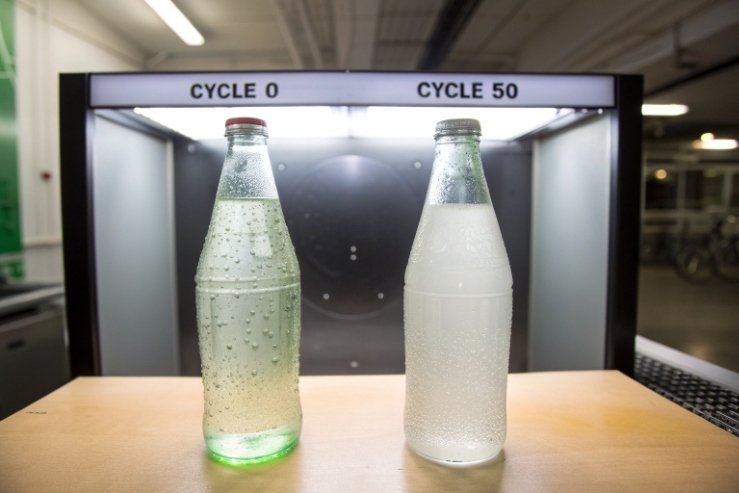
Clarity and “clean look” over time
Both soda-lime and borosilicate can be very clear. The difference shows up after abuse:
- repeated dishwashing
- repeated sterilization
- high-alkaline cleaning cycles
- frequent handling and reuse
Borosilicate tends to hold a “lab clean” look longer in reuse scenarios. It can show less haze under harsh cleaning compared with many soda-lime bottles, especially when the use case includes repeated hot water and detergents.
Scratch performance is also about surface quality, not only glass type. A good anneal and good handling controls can make soda-lime look great for a long time. Still, borosilicate often performs well when reuse cycles are the real product feature.
Weight is not a guaranteed win
The density difference between borosilicate and soda-lime is not dramatic. So the material alone does not make a bottle much lighter.
Weight savings usually come from design freedom:
- thinner walls while staying safe under thermal cycling
- less need for “extra thickness” to survive hot-fill shocks
But packaging lines and distribution rules still limit how thin a bottle can be. Drop tests, pallet compression, and consumer handling all matter. So it is safer to say: borosilicate can enable lighter designs in some cases, but it does not always do so.
Why cost is higher
Borosilicate costs more due to:
- raw material mix and melting requirements
- stricter forming control for quality
- less commodity-scale supply compared with soda-lime container glass in many regions
Also, fewer suppliers can mass-produce borosilicate containers at large volumes. That can raise lead times and reduce pricing leverage.
| Value area | What borosilicate can improve | When it is worth it | When it is not worth it |
|---|---|---|---|
| Premium clarity over reuse | less haze, stable look | refill programs, durable goods | single-use mass retail |
| Thermal performance | fewer thermal shock cracks | hot-fill, sterilization, lab use | ambient fill, no heat cycling |
| Perceived quality | “premium science” signal | high-end positioning | price-sensitive categories |
| Unit cost | usually higher | when failures are expensive | when logistics cost dominates |
A simple budget lens helps: if one cracked bottle creates refunds, cleanup, and brand damage, the “cheap bottle” is not cheap. If the product is low value and shipped long distances, higher bottle cost can be hard to recover.
Which applications justify borosilicate over soda-lime?
Borosilicate is best when the bottle is part of the process, not just a container. If the bottle must survive heat, cleaning, and chemistry, it earns its place.
Borosilicate is justified when thermal cycling, sterilization, or chemical sensitivity drives risk or compliance, while soda-lime is usually enough for standard foods and beverages without harsh stress.
The clearest “yes” cases
Borosilicate often makes sense for:
- Pharma and lab liquids where extractables are tightly controlled
- Reagent bottles and diagnostic fluids
- Hot-fill products with sharp temperature transitions or frequent line stops
- Products designed for reuse with repeated dishwasher or sterilization cycles
- High-value cosmetics with sensitive actives, strong solvents, or “zero interaction” claims
- Specialty beverages where consumers pour boiling water or add ice directly in the bottle
In these cases, the bottle reduces failure risk. It also supports a product story: purity, safety, durability.
The “maybe” cases
Borosilicate can be a fit, but only with a full TCO view:
- premium sauces that are hot-filled and premium priced
- kombucha, cold brew, and functional drinks with strong flavor claims
- concentrate bottles that face repeated open-close cycles and cleaning
Here, soda-lime may work too, but borosilicate can create a safety margin if thermal swings or reuse is real.
The “no” cases most of the time
Soda-lime usually wins for:
- mass-market sauces and condiments with standard distribution
- ambient-fill products with no rapid temperature changes
- high-volume beverage where commodity supply and low unit cost matter most
- e-commerce heavy channels where weight drives freight and protection cost
Borosilicate will not solve drop damage by itself. If breakage in transit is the main pain, the first fix is shipper design, partitions, and handling controls. Material change alone rarely fixes logistics problems.
| Application | Stress profile | Best default choice | Why |
|---|---|---|---|
| Pharma Type I style needs | low leachables, compliance | borosilicate | stability margin and standards fit |
| Lab reagents and solvents | chemical sensitivity | borosilicate | better durability in harsh contact |
| Hot-fill with fast cool | thermal shock risk | borosilicate | low CTE reduces crack risk |
| Standard sauces, retail pallets | moderate stress | soda-lime | cost and supply scale |
| E-commerce singles | drop and vibration | depends | focus on shipper + closure, not only glass type |
| Reuse and refill programs | many wash cycles | borosilicate | better long-term cleanliness and thermal cycling |
A good decision method is to rate the project on four axes: thermal cycling, chemical sensitivity, reuse cycles, and failure cost. When two or more are high, borosilicate tends to justify itself.
Conclusion
Borosilicate bottles reduce thermal shock risk and support chemically sensitive, reusable, or regulated applications, but higher cost only pays back when heat, chemistry, or lifecycle demands are truly high.
Footnotes
-
Practical causes and prevention steps for thermal-shock cracking in real glass handling. ↩ ↩
-
Definition and examples of thermal expansion for understanding why low CTE reduces stress. ↩ ↩
-
Official ISO overview of borosilicate glass 3.3 properties for writing purchase specs. ↩ ↩
-
Quick primer on Type I vs other glass families used in packaging decisions. ↩ ↩
-
USP briefing on glass container performance and quality expectations for pharmaceutical packaging. ↩ ↩
-
Technical summary of hydrolytic resistance and chemical data for borosilicate glass selection. ↩ ↩
-
USP overview of extractables/leachables concepts to plan stability testing and risk controls. ↩ ↩






