
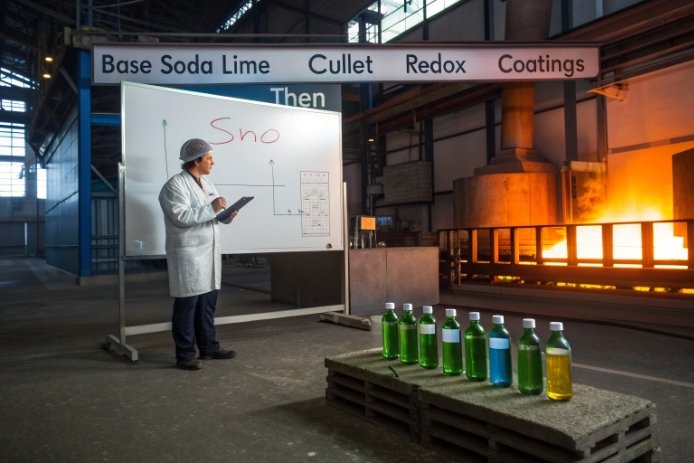
A bottle can look fine and still fail. Seeds, haze, and color drift show up late, and they raise rejects fast.
Trace SnO₂ is not essential in most container glass, but it can be a useful “process stabilizer” for fining and redox control when seed counts, foam, or color drift cannot be fixed by sulfate fining and furnace control alone.
What SnO₂ really does in container glass
SnO₂ is easy to misunderstand because it has two very different “lives” in container production. One life is inside the melt as a redox-active oxide. The other life is on the bottle surface as a hot-end tin-oxide coating made from tin chlorides. These two are related by chemistry, but they behave differently in the plant.
SnO₂ as a redox fining helper, not a “magic fining agent”
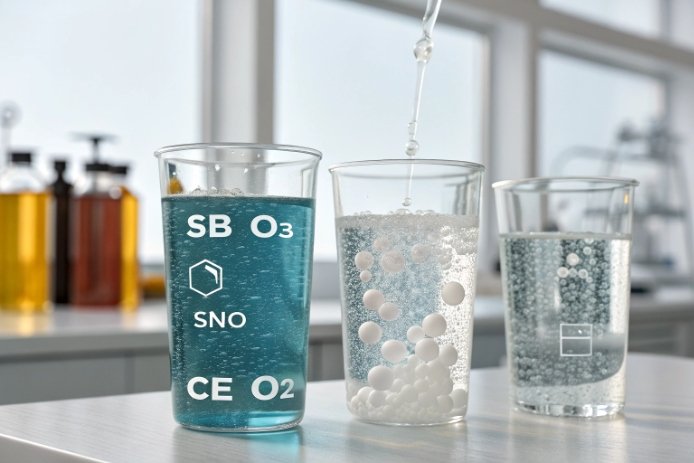
In the melt, Sn can change valence (Sn⁴⁺ ↔ Sn²⁺). That matters because multivalent oxides can release oxygen during reduction. Oxygen release can help small bubbles grow and rise when viscosity is low enough for bubbles to escape. This is why SnO₂ is discussed as a “chemical fining” option in some glass families 1. It is also why Sn is often compared to Sb₂O₃ and CeO₂ in fining discussions.
Still, most soda-lime container glass 2 already fines well with sulfate systems plus good temperature and residence time. In those lines, SnO₂ is usually optional. The plant only feels value from SnO₂ when seed reduction is limited by redox timing, foam behavior, or an unstable cullet stream.
When SnO₂ is not essential
For high-throughput soda-lime furnaces that already have:
- stable SO₃ carry and foam control
- stable combustion and oxygen potential
- strong homogenization in the forehearth
- clean, consistent cullet streams
SnO₂ often adds cost and complexity without a clear payback. A clean sulfate fining program plus stable redox can deliver very low seeds with no tin addition.
What to measure before adding SnO₂
The decision should start with facts, not with a new additive. The most useful checks are:
- seed count trend (not a single-day number)
- foam height and stability
- FeO/Fe(total) trend (redox stability)
- cord/striations near the surface
- cullet organics and color contamination
If seeds spike only when cullet changes, SnO₂ is not the first fix. Cullet control 3 is.
| Production problem | SnO₂ might help when… | Better first lever when… |
|---|---|---|
| High seed count | seeds persist even with stable SO₃ and temperature | seed spikes track cullet contamination or fining feed swings |
| Color drift | redox swings are small but still visible in flint tone | combustion and pull rate swing daily |
| Foam problems | oxygen release timing improves bubble removal | sulfate carryover and batch blanket issues dominate |
| Haze/defects | bulk melt is clean but still has tiny seeds | haze is from stones, devit, or coating issues |
If the melt is already stable, SnO₂ is rarely “essential.” If the melt is unstable, SnO₂ can become a helpful support tool, but it will not replace basic control.
A good next step is to compare SnO₂ directly against Sb₂O₃ and CeO₂ in the same decision language: what changes, what risks, and what operators will feel on the line.
This is where most teams decide if tin is worth it.
Does micro-dosed SnO₂ improve fining, oxidation control, and seed reduction compared with Sb₂O₃ or CeO₂?
Seeds are expensive because they trigger rejects and force slower speeds. That pressure makes “new fining agents” sound attractive.
Micro-dosed SnO₂ can reduce seeds in some melts by shifting oxygen release into the right viscosity zone, but it is not automatically better than Sb₂O₃ or CeO₂. The best choice depends on redox timing, foam behavior, and customer limits on antimony or other additives.
Why “timing” matters more than “oxygen amount”
Chemical fining works best when gas is released while the melt is still fluid enough for bubbles to rise. If oxygen releases too early, it can create foam and trap bubbles. If it releases too late, bubbles cannot rise and seeds stay. Recent work comparing tin and cerium behavior in melts highlights this timing problem and notes that CeO₂ can release gas at higher viscosities, which can increase foam risk in some cases 4. Tin redox can be more favorable in certain systems because reduction can occur when viscosity is already low enough for bubbles to escape 4.
Sb₂O₃: strong fining, but tougher customer acceptance
Sb₂O₃ is a well-known fining aid in many glass applications. It is powerful, but many brands prefer to avoid antimony where possible. Even when glass is not under the same rules as plastics, customers often apply their own “no Sb / no As” policies. Also, antimony has specific migration limits in EU plastics regulation 5, which keeps it in the spotlight for food-contact discussions and corporate risk reviews 6.
CeO₂: a multi-role tool with side effects
CeO₂ can act as an oxidizer and can support color control in flint. It can also support fining in some systems, but it may change foam behavior and color interactions in melts that already contain polyvalent ions like iron 7. In practice, CeO₂ is best when the plant needs both oxidation support and tone control, and can hold redox stable.
A practical way to compare in plant trials
Instead of asking “which is best,” I prefer this trial question:
- Which additive reduces seeds without increasing foam, cords, or color drift?
That means the trial needs:
- seed counts and seed size distribution
- foam height trends
- color coordinates (L, a, b*) and UV-Vis where relevant
- redox indicators (FeO/Fe total)
| Additive | Main action | Best fit | Main risk |
|---|---|---|---|
| SnO₂ (micro-dose) | redox fining support; oxygen release via reduction | seed reduction when redox timing is the issue | cost; mis-control can shift redox and color |
| Sb₂O₃ | strong redox fining | tough seed problems in stable specialty runs | customer policy pushback; risk perception |
| CeO₂ | oxidizer + tone tool; can influence fining | flint tone control plus oxidation support | foam and color interaction if unstable |
SnO₂ can be a good choice when the plant needs a small, steady “buffer” against seed spikes. It is not essential when sulfate fining and furnace control already do the job.
Now, even if SnO₂ helps seeds, it still must not break color. Color is where ppm-level redox shifts become visible.
How do ppm-level SnO₂ additions affect color neutrality (Fe²⁺/Fe³⁺ balance) in flint, amber, and green bottles?
A small redox change can be invisible in a lab melt. It can be obvious in a full day of production, especially in flint.
At ppm levels, SnO₂ mainly affects color by nudging furnace redox and iron valence. In flint it can shift green/yellow balance, in amber it can change depth and stability, and in green it can amplify or mute Fe/Cr tone depending on the melt’s oxygen potential.

Flint: neutrality is a redox stability test
Extra-flint and high-white flint show small changes fast. If SnO₂ is used, the key is not the tin number alone. The key is whether Fe²⁺ rises or falls. Fe²⁺ tends to push a greener look, while Fe³⁺ can push a warmer or yellow note. So the main control targets are:
- steady FeO/Fe(total) trend
- steady CIE b (yellow-blue) and a (red-green)
- steady UV-Vis curve at real bottle thickness
If the plant uses Se/Co micro-trims for tone, SnO₂-driven redox drift can force daily trim changes. That usually makes color worse over time, not better.
Amber: protect the amber chemistry from “over-correction”
Amber depends on a controlled redox state 8 and sulfur chemistry. If SnO₂ is added as a strong oxidation “push,” amber can become lighter or can drift in an unstable way. If the melt swings between more oxidizing and more reducing zones, cords can appear as shade bands. So in amber, the practical rule is: use only what the furnace can hold steady.
Green and emerald: Fe/Cr systems are sensitive to redox drift
Green bottles often use Fe/Cr systems. Chromium is powerful, so a small chemistry shift can change shade. Tin-driven redox changes can shift how iron expresses color, and that changes the final green tone. In green, the best approach is to lock the cullet stream first and then evaluate tin effects.
| Color family | What SnO₂ changes first | What to track daily | What usually fixes drift faster |
|---|---|---|---|
| Flint | Fe²⁺/Fe³⁺ balance and b* | FeO/Fe total, CIE b*, haze | combustion stability + cullet purity |
| Amber | amber depth and uniformity | UV-Vis, shade ΔE, cords | SO₃ stability + redox uniformity |
| Green | shade and saturation | ΔE, Fe/Cr input stability | cullet color control + batch accuracy |
If SnO₂ is used, it should be treated like a redox knob that must not move. The plant should never “chase” color by changing tin daily. That makes tint drift permanent.
Next, there is a common confusion: people mix up bulk SnO₂ additions with hot-end tin oxide coatings. They are not the same lever.
Will SnO₂ interact with hot-end coatings (SnCl₄/SnO₂) to enhance surface strength or cause haze and defects?
Coating problems look like glass problems. Glass problems look like coating problems. This is where teams waste months.
Bulk SnO₂ at ppm levels usually does not meaningfully change hot-end coating deposition. Hot-end coatings are surface tin oxide layers formed from tin chloride precursors, and their performance depends more on coating control and surface cleanliness than on bulk tin content.
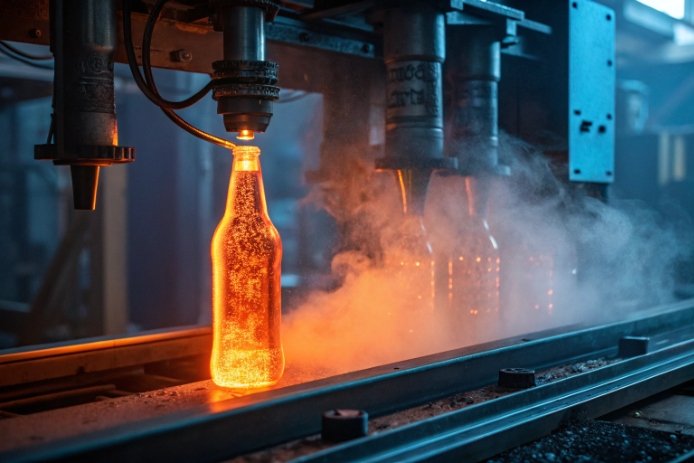
Bulk tin and hot-end tin oxide are different systems
Hot-end coatings create a very thin tin oxide layer on the outside surface to improve handling and support cold-end coating anchorage 9. That coating is applied after forming, when the bottle surface is still hot. Bulk SnO₂ additions change the melt chemistry. They do not “deposit” a coating by themselves. So, in most cases, bulk tin does not enhance coating strength directly.
What can still interact indirectly
There are indirect links:
- If bulk SnO₂ changes redox, it can change surface condition and salt behavior.
- If fining changes foam and carryover, it can change surface cleanliness, which matters for coating adhesion.
- If SnO₂ creates undissolved particles (rare at true ppm, but possible if poorly dispersed), those can show up as haze or points that disrupt coating.
Haze and defects: usually a process issue, not tin itself
Haze and coating defects in container lines are most often caused by:
- poor fining (seeds and cords)
- devitrification skins from cold zones
- dirty surface (carryover salts, dust, oil)
- coating hood instability (over/under application)
Tin in the melt is not the first suspect. The coating hood is.
| Symptom | Most common root cause | What to check first | Tin-related check (secondary) |
|---|---|---|---|
| milky haze | devit skins, stones, poor melting | forehearth profile, raw material purity | undissolved additions, mixing method |
| peeling cold-end coating | weak hot-end layer or dirty surface | hot-end hood control, washing | redox-driven surface salts |
| random scuffing | coating under-dose or handling | hot-end/cold-end settings, conveyors | none in most cases |
| “sparkle” seeds | fining instability | SO₃ feed, temperature, pull | redox timing and additive interactions |
The right way to manage this is to separate the systems:
- Treat SnO₂ in the melt as a fining/redox tool.
- Treat hot-end coating as a surface process tool.
Mixing the two explanations slows root-cause work.
Now the last question is the most practical one: if SnO₂ is optional, why use it at all? The answer depends on cost, policy, and process trade-offs.
What are the cost, regulatory, and process trade-offs of using SnO₂ versus alternative clarifiers in large-scale production?
Every additive decision must survive purchasing, audits, and operations. If it cannot survive those, it will not stay in the recipe.
SnO₂ is often chosen when a plant needs a low-dose fining/redox buffer and wants to avoid Sb₂O₃ optics or policy risk, but it can raise raw material cost and requires tighter redox control. Alternatives like CeO₂ can be cheaper or multi-purpose, but they may raise foam or tone-control challenges in some melts.
Cost and supply reality
SnO₂ can be more expensive per kg than some traditional fining aids, so the business case depends on dosage and yield improvement. If micro-dosing reduces reject rate and stabilizes speed, the payoff can be real. If the line already runs clean, SnO₂ becomes a cost with no return.
Regulatory and customer acceptance
Most large beverage and cosmetic brands now ask about heavy metals and “restricted substances.” Even if a substance is not banned, customer policies can still block it. Antimony is a common example. Antimony has specific migration limits in EU plastics rules, so it stays visible in food-contact risk discussions, even outside plastics 6. This visibility can drive customers to prefer “no Sb / no As” approaches. Tin can be more acceptable in those supplier questionnaires, but the full answer always depends on the brand’s policy.
Process trade-offs operators will feel
- Redox sensitivity: SnO₂ works through redox behavior, so the furnace must hold oxygen potential steady.
- Color knock-on effects: small redox shifts can force decolorizer trims in flint, or shade control in amber and green.
- Cullet loop: if tin is added, it returns in cullet. That is usually fine, but it means the plant should track tin in the material balance so “micro-dose” does not quietly climb over time.
- Fining balance: SnO₂ does not replace SO₃ discipline. It must fit the fining system, not fight it.
A simple decision framework that works in production
1) Lock cullet quality and SO₃ stability first.
2) Prove the seed problem is not from temperature or residence time.
3) If seeds still persist, trial SnO₂ vs CeO₂ vs “no change” on the same furnace conditions.
4) Approve only if seed reduction comes with stable color and no foam penalty.
| Choice | Why pick it | When to avoid it |
|---|---|---|
| SnO₂ micro-dose | need seed buffer; want to avoid Sb optics | furnace redox is unstable; color is already difficult |
| Sb₂O₃ | strong redox fining | customer policies restrict Sb; risk perception is high |
| CeO₂ | oxidation + tone support; may help fining | foam risk or tone drift in unstable redox melts |
| “No additive change” | melt already stable; seeds manageable | seeds drive high rejects and cannot be solved by process fixes |
SnO₂ is not essential for most container glass. It is a tool. It earns a place only when it solves a defined problem with fewer side effects than the alternatives.
Conclusion
SnO₂ is rarely mandatory, but it can be a smart micro-dose tool for seed and redox stability when the furnace is already well controlled and customer policies push away from Sb-based fining 10.
Footnotes
-
Discusses chemical additives used to remove bubbles during melting. ↩
-
The standard glass type for bottles, typically fined with sulfates. ↩
-
Importance of managing recycled glass to prevent defects. ↩
-
Comparison of redox behavior and bubble release timing for fining agents. ↩ ↩
-
EU regulation referencing specific migration limits for substances like antimony. ↩
-
Risk assessments often flag heavy metals, influencing customer preference. ↩ ↩
-
Cerium oxide’s dual role in oxidation and fining can complicate control. ↩
-
The balance of oxidation states, crucial for stable glass color and quality. ↩
-
Surface layers applied to glass for protection, distinct from bulk additives. ↩
-
Traditional antimony fining, which some customers avoid due to policy/risk. ↩






