
A cap can be “on torque” at the capper and still leak on the pallet. That does not mean the operator did something wrong. It means the closure system changed after temperature changed.
Yes. Thermal expansion is linked to torque because temperature changes shift finish geometry and, more importantly, change liner stiffness and cap load retention. Torque is the tool used to create liner compression, but heat cycling can reduce that compression even when initial torque is correct.
Torque is a proxy for seal load, and temperature changes that load
Torque is not the seal by itself. Torque is a method to generate axial compression on the liner and stabilize thread engagement. Once temperature changes, three things happen:
1) Materials expand differently (glass vs cap vs liner).
2) Liners soften and creep at elevated temperature (compression set).
3) Pressure/vacuum cycles load the seal during hot-fill cooling.
So torque must be set with a time dimension: not only “right now at capping,” but also “after heat soak,” “after cool-down,” and “after aging.”
A simple estimate shows that glass finish expansion is small, but not zero. A 28 mm finish with soda-lime coefficient of linear expansion 1, heated by 60°C, expands about 15 µm in diameter. That usually does not dominate the system. The dominating factor is how the liner and cap change with heat and time.
The best torque strategy is to build a compression margin. That margin accounts for predictable torque loss after a hot-fill-hold process 2 and for cavity-to-cavity finish variation. Then the plant verifies that margin with a repeatable audit plan.
| Temperature-driven change | What it does to torque/seal | When it is worst | Common symptom |
|---|---|---|---|
| Cap expansion (plastic > metal) | reduces thread clamp and retention | heat-in and warm hold | low back-off torque |
| Liner softening + creep | reduces axial seal load | warm hold | micro-leaks, loss of vacuum |
| Glass finish expansion (small) | slightly shifts seating geometry | heat-in | minor drift |
| Cooling vacuum | pulls on seal | cool-down | air ingress, cap back-off |
Now the detailed answers to your four questions.
How does temperature change affect neck finish dimensions and liner compression, and what does that mean for target application torque?
Most torque settings fail because they assume the liner behaves the same at 80°C as it does at 20°C. It does not.
Temperature slightly increases neck finish dimensions, but the key effect is liner compression loss at heat. Target application torque should be set to ensure adequate liner compression after thermal relaxation, not only at the moment of capping.
What glass dimension change means in practice
Finish OD expansion is typically in the microns. It is measurable but small versus normal finish tolerance bands. Still, when finish ovality and land waviness exist, any change can shift where the liner contacts first. That can create local low-pressure zones on the sealing surface (land) 3.
What liner compression change means in practice
As temperature rises:
- liner modulus drops,
- liner creeps under load,
- compression set characteristics 4 increase,
- friction behavior changes.
So a torque that creates strong compression at capping can translate into much lower compression after a hot hold. The correct torque target is the torque that leaves enough compression after the worst heat window.
What this means for target torque
A good torque target is defined as a range with three checks:
- application torque at capping,
- back-off torque after heat soak,
- back-off torque after cool-down and storage.
The target should be based on the minimum liner compression needed for seal integrity, plus a safety margin for finish variation.
| Torque stage | Why it matters | What it should prove | Typical mistake |
|---|---|---|---|
| Application torque | initial seating and compression | cap is seated correctly | only measuring this stage |
| Hot back-off torque | seal load during soft liner phase | no short-term micro-leaks | ignoring heat window |
| Cold back-off torque | long-term retention | vacuum retention, no back-off | ignoring 24–72h set |
If the closure system is used for hot-fill or pasteurization, torque targets must be validated in that same temperature profile.
Why can correct torque at capping still lead to torque loss or cap back-off after cooling from hot filling?
This is the most common confusion in audits: “We hit the torque spec, so why did it leak?” Because torque is not constant through a heat cycle.
Correct capping torque can still lead to torque loss because liners creep at heat and cap materials expand. During cooling, vacuum and shrinkage can shift loads and allow small cap back-off if thread retention is weak. The seal can lose compression even though the initial torque was correct.

The three main torque-loss mechanisms after hot-fill
1) Liner creep (compression set)
The liner relaxes under compression at high temperature. When it cools, it does not fully recover. The clamping force drops. Back-off torque drops.
2) Cap expansion and contraction
At heat, the cap expands and can reduce thread friction and retention. On cooling, the cap contracts, but by then the liner may have set. The system does not return to the original clamp load.
3) Vacuum loading during cooling
Vacuum pulls on the seal interface and can draw air in through micro-channels. If the cap has low retention, vibration and handling can rotate it slightly (cap back-off). That small rotation can reduce liner compression further.
Why cap back-off looks random
Back-off often happens more in bottles with subtle finish defects (ovality, tilted land, thread seating inconsistency). Practical guidance on bottle and closure compatibility 5 helps explain why some cavities leak while others pass.
| Root cause | Why it causes torque loss | Typical symptom | Best prevention lever |
|---|---|---|---|
| Liner compression set | clamp load decays | low back-off torque at 24h | select hot-fill liner |
| Plastic cap creep | retention weakens | caps feel loose | cap design/material |
| Finish ovality | uneven contact + load | leaks only in some cavities | finish roundness control |
| High capping temp | liner too soft at application | wide torque scatter | cap at controlled finish temp |
| Vibration/handling | promotes rotation | back-off marks | reduce accumulation pressure |
The solution is not “always increase torque.” Over-torque can chip the finish and create stress cracks. The solution is to set torque ranges that survive cycling and to choose liners that keep compression after heat.
How should you set and verify torque ranges for different closure types (ROPP, lug/twist-off, continuous thread) under thermal cycling?
Each closure type converts torque into seal load differently. So the torque range must be set using the closure’s mechanics and the product cycle.
Set torque ranges by defining minimum seal integrity after thermal cycling and maximum torque that avoids finish damage. Verify ranges with time-based torque retention and leak tests under the real hot-fill/pasteurization cycle. ROPP needs strong finish roundness control, lug closures need vacuum retention focus, and CT systems need torque retention focus, especially for plastic caps.
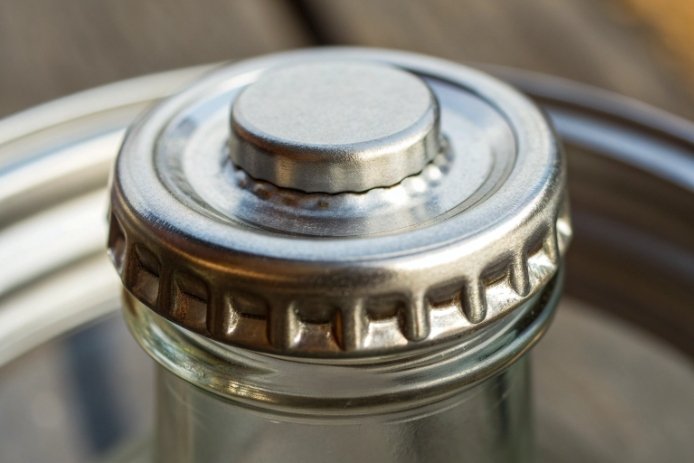
ROPP (roll-on pilfer-proof aluminum)
How to set:
- Define a torque window that achieves proper roll formation and liner compression.
- Control finish OD/roundness tightly because the cap is formed to the glass.
How to verify: - Check application torque and roll quality.
- Check hot and cold back-off torque.
- Run leak tests after cycling.
Common implementation notes for Roll-On Pilfer Proof (ROPP) caps 6 are useful when troubleshooting “formed fit vs. compression” problems.
Lug / twist-off
How to set:
- Define a torque window that gives proper compression and vacuum retention after cooling.
- Focus on capper setup and lug engagement consistency.
How to verify: - Confirm vacuum retention after cool-down.
- Run dye ingress or vacuum decay tests.
- Check back-off torque after 24–72 hours.
Background on why metal lug closures 7 are common for hot-filled glass helps align torque targets with vacuum behavior.
Continuous thread (CT)
How to set:
- Separate metal CT and plastic CT strategies.
- Plastic CT often needs a larger compression margin due to creep.
How to verify: - Time-based torque retention curve (0 min, hot hold, cool-down, 24h).
- Leak tests at heat and after cool-down.
A clear definition of continuous thread (C-T) closures 8 helps when comparing CT vs lug engagement and expected retention.
| Closure type | What torque must achieve | What thermal cycling attacks | Best verification focus |
|---|---|---|---|
| ROPP | formed fit + liner compression | uneven finish + liner set | roll quality + leak after cycle |
| Lug/TO | compression + vacuum holding | vacuum pulls on weak spots | vacuum retention + dye ingress |
| CT (metal) | stable thread clamp | liner set | torque retention + leak |
| CT (plastic) | clamp despite creep | cap creep and expansion | multi-time torque audit |
The most practical output of this work is a “torque spec sheet” per SKU that includes temperature conditions and time points, not only one value at the capper.
What tests should you run to confirm torque and seal performance (torque audit, removal torque, leak test, vacuum/pressure test)?
A closure program is reliable only when tests match the time and temperature profile. The seal must pass when the liner is soft and when vacuum forms.
Confirm torque and seal performance with a multi-time torque audit (application and back-off), removal torque checks after aging, leak detection at heat and after cool-down, and vacuum/pressure tests matched to the product. Add thermal cycling and stress inspection to catch weak finish geometry and annealing drift.
1) Torque audit plan (the core control)
Measure:
- Application torque at the capper
- Immediate back-off torque (0–5 minutes)
- Back-off torque after heat soak (when liner is soft)
- Back-off torque after cool-down
- Back-off torque after 24–72 hours
Record by cavity and cap lot if possible. This reveals whether failures are geometry-driven or closure-lot-driven.
A standardized way to trend these results is ASTM D2063 torque retention 9 (especially for continuous thread systems).
2) Removal torque and retention after storage
Removal torque after aging matters for customer experience and for leak safety. It also reveals compression set trends.
3) Leak tests at the right times
- Leak test while warm (worst liner softness)
- Leak test after cool-down (vacuum stage)
- Dye ingress for micro-leaks
- Pressure decay for pressurized products
- Vacuum decay for vacuum-sealed products
A widely used reference for vacuum decay is ASTM F2338 vacuum decay method 10, which is useful for finding temperature-driven micro-leaks.
4) Thermal cycling and line simulation
Qualification should include:
- realistic hot-fill/pasteurization cycles
- stop-start events if the line sees them
- worst-case bottle start temperature
- worst-case cooling steps
5) Stress inspection and finish metrology
A polariscope check on finish stress and a finish roundness/land flatness check improves repeatability and reduces “mystery” torque scatter.
| Test | What it proves | Best timing | Pass indicator |
|---|---|---|---|
| Application torque | correct seating | every shift | within target window |
| Back-off torque (multi-time) | torque retention | routine + after changes | stays above minimum at each time |
| Leak test (warm + cold) | seal integrity across cycle | per lot sampling | no decay beyond limit |
| Dye ingress | micro-channel sensitivity | qualification + audits | no dye penetration |
| Vacuum retention | shelf-life protection | after cool-down | vacuum above target |
| Pressure test | safety under internal pressure | qualification | meets proof/burst margin |
A strong specification uses both torque and leak performance. Torque is the control knob. Leak performance is the proof.
Conclusion
Thermal expansion links to torque because temperature changes alter cap/liner behavior and reduce seal compression over time. Set torque ranges using hot-cycle retention and validate with time-based torque audits plus leak and vacuum/pressure testing before shipment.
Footnotes
-
Soda-lime expansion data for estimating finish OD change in microns during hot-fill cycles. ↩ ↩
-
Explains hot-fill-hold time/temperature profiles that drive liner softening, pressure spikes, and vacuum formation. ↩ ↩
-
Defines the sealing surface (“land”) and why flatness and defects directly impact leak risk. ↩ ↩
-
Official ISO reference for compression set testing, a key predictor of liner relaxation after heat soak. ↩ ↩
-
Practical notes on finish/closure fit problems that cause “some cavities leak” even when torque is correct. ↩ ↩
-
Describes how ROPP caps form threads during application and why forming quality affects seal load. [↩](#how-should-you-set-and-verify-torque-ranges-for-different-closure-types-ropp-lugt twist-off-continuous-thread-under-thermal-cycling) ↩
-
Overview of lug closures and why they’re common in hot-filled, heat-processed glass with vacuum retention needs. ↩ ↩
-
Defines continuous thread closures and contrasts CT vs lug engagement, useful for setting torque retention expectations. ↩ ↩
-
ASTM method for measuring torque retention over time, supporting multi-time back-off torque audits. [↩](#what-tests-should-you-run-to-confirm-torque-and-seal-performance-torque-audit-removal-torque-leak-test-vacuumpres sure-test) ↩
-
ASTM vacuum decay leak detection method used to detect micro-leaks warm and after cool-down. [↩](#what-tests-should-you-run-to-confirm-torque-and-seal-performance-torque-audit-removal-torque-leak-test-vacuumpres sure-test) ↩






