
A bottle can pass your color check and still fail at customs. Heavy-metal limits are the silent clause that can freeze an export order.
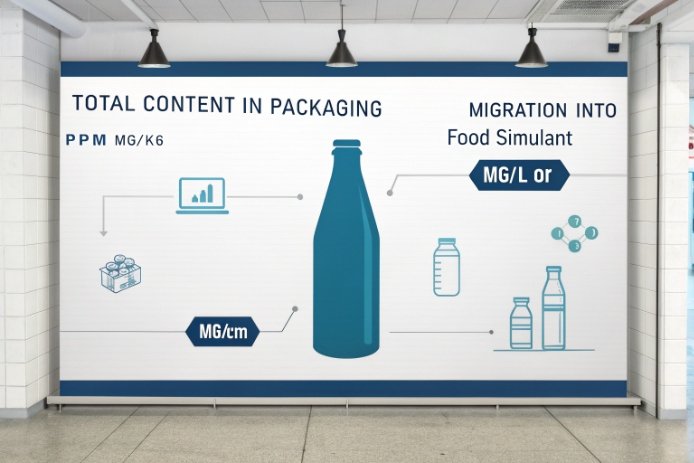
“Heavy-metal limits” usually mean two things: total metal content in packaging components and how much can migrate or leach from the finished bottle. Both matter, and they are not interchangeable.
How do I read a heavy-metal spec without guessing?
Heavy-metal limits look simple on a purchase order, but the words often hide different legal worlds. One customer writes “≤100 ppm heavy metals.” Another writes “Pb and Cd migration must pass.” A third adds “no intentional addition” plus a long restricted-substances list. All of them can be valid, but they are not the same test and not the same risk.
Two limit families buyers must separate
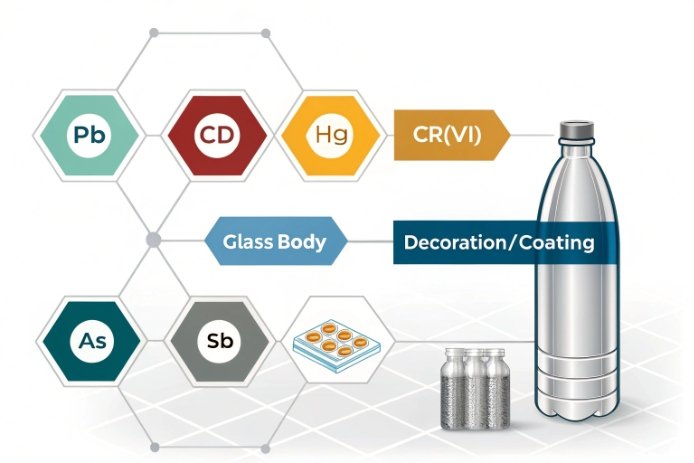
Content limits are about what is inside the packaging material. The classic set is four metals: lead (Pb), cadmium (Cd), mercury (Hg), and hexavalent chromium (Cr(VI)) 1. Many packaging rules use a combined limit for these four metals.
Migration/leach limits are about what can move out of the bottle into food, drink, or product. For glass, this risk is often low for plain bottles, but it becomes real when the bottle is decorated, coated, or uses vitrified labels, or when the product is acidic and stored for a long time.
Where bottle glass can “fail” in real life
A plain, undecorated soda-lime bottle can meet a content limit and still face questions if the buyer needs food-contact evidence. Also, a decorated bottle can pass a bulk-glass test and still fail because the ink or enamel is the problem, not the glass.
A simple decoding table I use in procurement reviews
| Spec phrase on the PO | What it usually means | What to test | Common buyer mistake |
|---|---|---|---|
| “Heavy metals ≤100 ppm” | Packaging content limit for four metals | Total Pb+Cd+Hg+Cr(VI) in packaging component | Testing only the glass and ignoring inks/caps |
| “No intentional Pb/Cd/Hg/Cr(VI)” | No added heavy metals in manufacturing | Supplier declarations + process audit | Accepting a statement with no traceability |
| “Lead-free / Cadmium-free” | Often marketing language unless defined | Numeric results with reporting limits | Accepting “ND” without a number |
| “Food-contact compliant” | Must not transfer harmful substances | Migration/leach test plan + documentation | Using only a content test to claim food-contact safety |
| “Decorated bottles compliant” | Ink/enamel must also be safe | Release test on the finished decorated bottle | Testing base glass only |
If the spec is unclear, the safest move is to ask: Is this a content limit, a migration limit, or both? Then match the test method and detection limits to that answer.
Keep reading, because the next sections show how to audit these limits without wasting money on the wrong tests.
What do “heavy-metal limits” cover in packaging glass?
Packaging teams often say “heavy metals,” but the legal language usually targets a narrow group first, then expands through brand standards.
In most packaging rules, “heavy-metal limits” primarily cover the sum of Pb, Cd, Hg, and Cr(VI) in the packaging or packaging component. Many buyers also add extra metals (like As, Sb, Ni, Co) in internal restricted-substance lists, especially for cosmetics and pharma.
The “big four” and why they show up
The four-metal set exists because these metals cause long-term environmental and health concerns, and packaging becomes a large waste-stream 2 input. For glass bottles, the practical meaning is:
-
The glass body must not carry excessive incidental heavy metals.
-
The decoration system (inks, enamels, hot-stamping foils) must also stay within limits because it is part of the packaging component 3.
-
The “component” scope can include closures, droppers, caps, and even labels if they ship together as a set.
Why glass bottles are special under content limits
Glass can contain recycled content 4, and recycled streams can carry trace metals. Many markets still keep the 100 ppm combined limit because it is simple to enforce. Some jurisdictions allow limited exemptions or special handling for recycled materials, but buyers should never assume an exemption applies. The buyer should demand that the supplier states, in writing, whether an exemption is being used and which law allows it.
What buyers should include in the packaging scope statement
When a supplier says “the bottle is compliant,” that is not enough for a full packaging program. A clear scope statement should list:
-
bottle glass body (bulk glass),
-
decoration system (if any),
-
coatings (if any),
-
closure and accessory parts (if included in the shipment).
A quick scope checklist
| Item | Included in “packaging component” audits? | Why it matters for heavy metals |
|---|---|---|
| Bottle glass body | Yes | Cullet and raw material trace metals |
| Screen printing / ceramic enamel | Yes | Pigments can drive Pb/Cd risk |
| Sprayed coatings | Yes | Coating chemistry varies by vendor |
| Cap / pump / dropper | Often yes | Mixed materials can fail content limits |
| Labels / adhesives | Often yes | Inks and pigments can introduce metals |
Most disputes happen because the buyer tested only the bottle glass, while the regulator or retailer evaluated the full packaging component. A good PO avoids this by defining scope upfront.
Next, the reason these limits matter for food-contact compliance becomes clearer, because food-contact focuses on transfer risk, not only content.
Why do these limits matter for food-contact compliance?
Food-contact compliance is not only about what is in the material. It is about what can move into food or drink over time.
These limits matter because food-contact rules require packaging to be inert enough that it does not transfer harmful substances to the product. Heavy-metal limits help prove control of risk, and migration/leach tests become critical for decorated or coated bottles.
Content vs transfer: the key compliance gap
A content test answers: “Is lead present in the packaging component above a defined threshold?”
A migration/leach test answers: “Can lead move into the product under realistic contact conditions?”
For plain glass, transfer risk is often low, but it is never smart to treat it as impossible. Acidic products, long shelf life, and high storage temperatures increase extraction potential. For cosmetics, fragrance oils and solvents can also act differently than water-based food simulants. For pharma, the word “leachables” 5 carries serious weight because product stability and patient safety are linked.
Where food-contact problems actually come from
In bottle programs, the most common heavy-metal surprises are:
-
decorations that use the wrong pigment system,
-
vitrified labels that were not qualified for the destination market,
-
uncontrolled cullet that adds trace metals and creates audit questions,
-
multi-vendor workflows where the decorator is not held to the same compliance standard as the bottle manufacturer.
What “food-contact compliant” should look like in documents
A buyer should expect:
-
a written compliance statement for the destination market framework,
-
traceability for one step back and one step forward in the supply chain,
-
supporting test reports that match the actual finished article, not only a raw material.
A practical risk filter by industry
Food and beverage brands worry about consumer exposure and retailer rules. Cosmetics brands worry about both exposure and brand reputation, plus many bottles are decorated. Pharma buyers add strict change control and validation expectations.
| End use | Heavy-metal risk trigger | What the buyer should demand |
|---|---|---|
| Food & beverage | acid products, long shelf life, export retailer audits | migration plan + lot documentation |
| Cosmetics | decoration, coatings, fragrance/oil contact | finished-article testing on decorated bottle |
| Pharma | extractables/leachables, change control | validated supplier system + strict COA + change notice |
If the goal is to reduce risk, the buyer should not argue whether content limits or migration limits are “more important.” Both are needed, but they serve different questions.
Next is the part most buyers ask for: how to audit correctly using migration and leach tests without paying for tests that do not match the spec.
How should buyers audit limits using migration and leach tests?
Many buyers overspend on testing and still miss the real risk. The fix is to link each test to a decision point.
A strong audit uses a three-layer test plan: screening (fast), confirmatory total metals (accurate), and migration/leach testing on the finished article (real-world). Detection limits should be low enough to prove control, not just “pass.”

Layer 1: Screening to catch obvious problems
For incoming inspection, fast screening helps prevent expensive surprises. Screening is useful for:
-
verifying no high-lead decoration system is present,
-
checking random samples from each lot,
-
checking high-risk areas like printed logos and enamel zones.
Screening does not replace lab confirmation. It is a gate that saves time.
Layer 2: Confirmatory total metals on glass and decoration (when needed)
For packaging content limits, a reliable lab method with clear reporting limits 6 is the backbone. The buyer should request:
-
numeric results for Pb, Cd, Hg, and Cr(VI) (and any extra metals in the buyer spec),
-
the method reference,
-
reporting limits (RL) and how samples were prepared.
For bulk glass, the sample prep matters. Poor prep can under-report metals. For decorated bottles, test both the glass body and the decoration component if the law treats them as part of the packaging component.
Layer 3: Migration or leach testing on the finished bottle
This is where the buyer proves “food-contact style” behavior. The test design should match the product reality:
-
define the contact area (inside glass surface, lip area, or decorated areas if they can contact product),
-
define time and temperature that reflect storage,
-
choose a suitable simulant or extraction approach based on product type.
For bottles used in food packaging 7, many buyers lean on standardized release methods for lead and cadmium in glass articles. This works best when the buyer also defines acceptance limits and requires the test to be run on the actual finished article.
What detection limits buyers should request
A buyer should ask for reporting limits that make sense for risk control:
-
For content limits like 100 ppm combined, a lab should report well below that number so the result is meaningful. A “ND” that could still be 50 ppm is not helpful.
-
For migration/leach tests, the reporting limits should be well below the buyer acceptance limit. If the limit is tight, the lab must show it can measure at that level.
A buyer-friendly audit plan
| Audit target | Sample type | Test outcome | What it protects |
|---|---|---|---|
| Packaging content limit | glass + decoration components | ppm result + combined sum | legal packaging compliance |
| Food-contact transfer risk | finished bottle | mg/L or equivalent release result | consumer exposure risk |
| Recycled content variability | multiple lots over time | trend chart, not one result | batch-to-batch stability |
If the supplier refuses to share reporting limits, that is a signal the program is not built for export-grade compliance. Clear reporting limits are part of trust.
Next, the bigger question: are markets converging, or are they drifting apart?
Are international limit thresholds converging across major markets?
Buyers want one global spec. Reality gives two trends: content limits are converging, while food-contact testing approaches remain mixed.
Packaging heavy-metal content thresholds are largely converging around a combined 100 ppm (or 100 mg/kg) limit for Pb, Cd, Hg, and Cr(VI) in many major markets. Food-contact migration expectations are less harmonized, so buyers often rely on standardized test methods plus destination-market documentation.

Where convergence is strong: packaging content limits
Many regions and brand standards use a familiar number for the four metals combined. This convergence is driven by:
-
recycling stream protection,
-
easy enforcement across materials.
For bottle procurement, this is good news. A single content spec can cover a wide set of destinations, as long as the supplier treats inks, enamels, and coatings as packaging components too.
Where convergence is weaker: migration and leach expectations
Food-contact frameworks often share the same safety principle, but they do not always share the same exact test and limit for glass packaging. Some markets lean on:
-
general “no harmful transfer” obligations,
-
specific migration limits for certain materials,
-
or recognized test standards 9 used by industry and labs.
This is why large buyers often run a global internal standard: one test method, one acceptance limit, and a documented link to destination market expectations. It reduces debate and makes supplier management easier.
A realistic buyer strategy in 2026
Instead of waiting for perfect global alignment, a buyer can build a stable program:
-
Use one global packaging content spec for the four metals.
-
Add migration/leach testing for high-risk SKUs: decorated bottles, coated bottles, lip-area printing, and long shelf-life acidic products.
-
Add a destination-market checklist in the PO: documents required for EU, US states, and any special market rules.
A convergence snapshot
| Topic | Converging? | What buyers should do |
|---|---|---|
| Four-metal packaging content limits | Yes, mostly | set a global ≤100 mg/kg combined spec |
| “No intentional addition” rules | Yes, mostly | require declarations + change control |
| Glass-specific food-contact migration limits | Not fully | use recognized test methods + buyer acceptance limits |
| Decorated bottle expectations | Increasingly strict | test the finished decorated article, not only base glass |
The markets are getting closer on packaging content limits 10. Food-contact proof still needs planning, especially for decorated and premium designs.
Conclusion
Heavy-metal limits are content limits plus migration proof. Define scope, match tests to claims, demand reporting limits, and lock compliance with lot traceability across every packaging component.
Footnotes
-
Safety information regarding this specific toxic heavy metal form. ↩
-
Flow of materials moving into disposal or recycling processes. ↩
-
Any individual part of the package, including ink/labels. ↩
-
Materials recovered from waste and reused in manufacturing. ↩
-
Compounds that migrate from packaging into the product. ↩
-
The lowest concentration a lab can reliably measure. ↩
-
Materials used to contain and protect food products. ↩
-
Strategies and regulations for handling waste materials. ↩
-
Validated technical procedures for material analysis. ↩
-
Legal restrictions on chemical substances in packaging materials. ↩






