
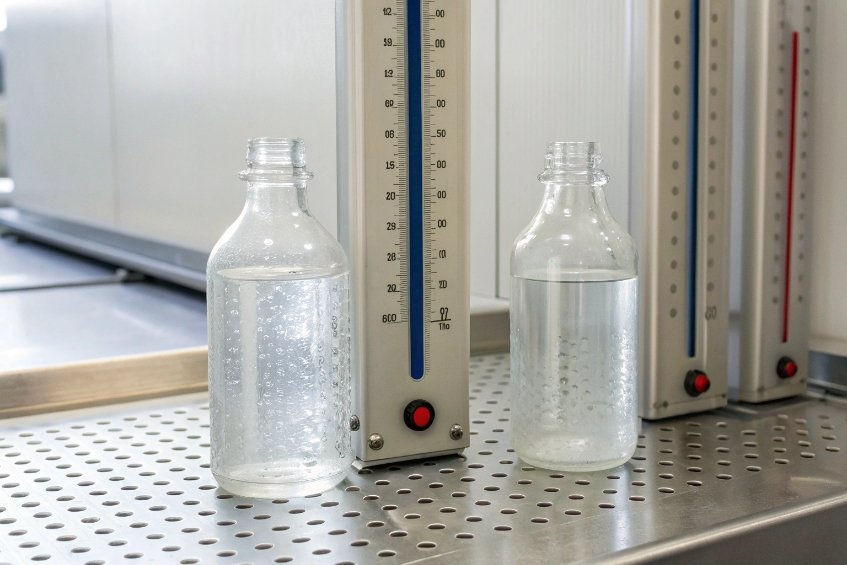
Glass bottles do not usually break because they get hot. They break because they get hot or cold too fast, and different parts of the wall move by different amounts.
In practice, standard soda-lime bottles pass thermal shock around 40–60 °C ΔT in lab tests, while high-borosilicate bottles and labware can reach ΔT ratings near 150–160 °C. :contentReference[oaicite:0]{index=0}
So the real question is not “can glass take heat,” but “how big a temperature jump can this specific bottle take, with its design, composition, and handling?”
What typical ΔT ranges can soda-lime vs. high-borosilicate bottles withstand?
Different glass families do not expand the same way under heat. The coefficient of thermal expansion (CTE) 1 sets how much stress grows when temperature changes fast. This is why soda–lime glass 2 and borosilicate glass 3 bottles live in very different ΔT ranges.
Typical commercial soda-lime packaging bottles are qualified for thermal shock resistance around 40–60 °C ΔT in standardized hot–cold water bath tests. High-borosilicate bottles and labware, with much lower CTE, can reach rated thermal shock resistances around 150–160 °C ΔT under similar principles. :contentReference[oaicite:1]{index=1}
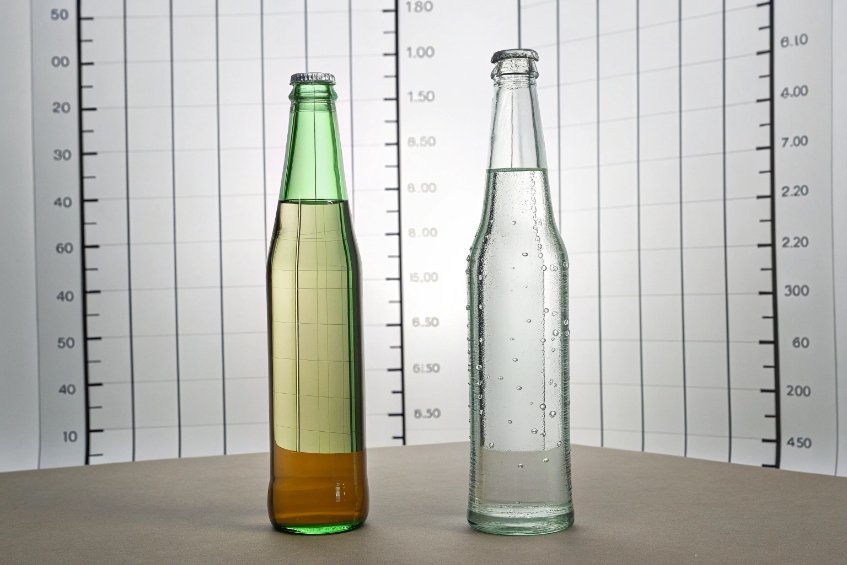
How the ranges look in real numbers
Standard tests like ASTM C149 4 or ISO 7459 5 use an upright basket of bottles, a hot bath, and a cold bath. Bottles soak in hot water, transfer in about 15 seconds, then plunge into the cold bath for a fixed time. The temperature difference between baths is ΔT. :contentReference[oaicite:2]{index=2}
From industrial and lab data, a simple picture emerges:
| Container type / glass family | Typical lab ΔT range (thermal shock resistance) | Notes |
|---|---|---|
| Standard soda-lime beverage bottles | ≈ 40–45 °C | Common pass level for beer / CSD QA :contentReference[oaicite:3]{index=3} |
| Soda-lime hot-fill bottles | ≈ 50 °C (sometimes a bit higher) | Hot-fill QC target for juices / teas :contentReference[oaicite:4]{index=4} |
| Generic soda-lime lab bottles (wide mouth) | ≈ 30–40 °C rated thermal shock | Many are only 30 K in catalog specs :contentReference[oaicite:5]{index=5} |
| High-borosilicate lab bottles / beakers | ≈ 150–160 °C ΔT | Typical spec for DURAN / PYREX type :contentReference[oaicite:6]{index=6} |
| High-borosilicate consumer cookware, kettles etc. | Often marketed 120–160 °C ΔT | Depends strongly on brand and wall profile :contentReference[oaicite:7]{index=7} |
Two important points hide behind these nice round numbers:
- These are lab values under controlled water baths. Real lines add mechanical shock, coating wear, labelers, and conveyors on top.
- “Thermal shock endurance” is a population concept. It is the ΔT where 50% of samples fail. Stronger designs and better processing push that point higher. :contentReference[oaicite:8]{index=8}
So, when a beer bottle is specified for 42 °C ΔT, that does not mean every single bottle dies at 43 °C. It means this temperature gap is already a conservative limit with a safety margin above the real use case.
How do hot-fill, tunnel pasteurization, and rapid cooling affect failure risk?
Thermal shock in production is not one event. It is a stack of heating and cooling steps, each with its own gradient and speed. Hot-fill, tunnel pasteurization 6, and rapid cooling can all push a bottle closer to its ΔT limit.
Hot-fill and tunnel pasteurization push soda-lime bottles near their designed ΔT margins, especially when the product is hot, the environment is cool, and spray patterns or cycle times are not tuned. Rapid, uncontrolled cooling multiplies this risk and often triggers real breakage. :contentReference[oaicite:9]{index=9}
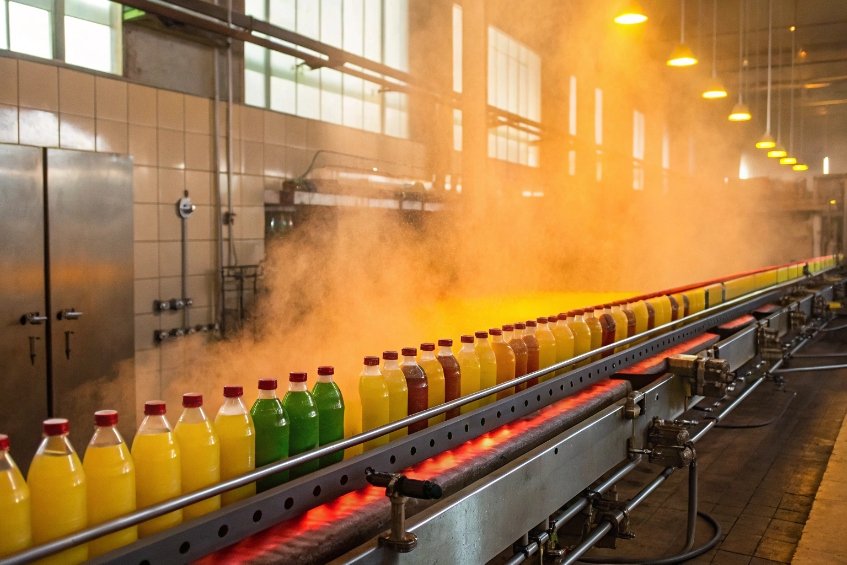
How each process stresses the bottle
Let me break each major process into the thermal story behind it.
1. Hot-fill
Typical hot-fill lines run product at about 85–95 °C into bottles that may be near room temperature. The inside wall sees hot product; the outside still “feels” ambient air and any spray. That creates an inside-hot / outside-cool gradient that loads the inner surface in compression and the outer surface in tension.
Key drivers here:
- Bottle preheat (or not).
- Actual product temperature at fill.
- Fill time and dwell before external cooling sprays.
- Ambient temperature and drafts near the filler.
If ΔT between product and bottle body climbs toward the 50 °C design level, even small extra stresses from poor annealing or scratches can tip bottles into failure.
2. Tunnel pasteurization
Tunnel pasteurizers move already-filled bottles through zones of rising, holding, and then falling water temperatures. The bottle skin sees fast changing spray conditions; the liquid core heats and cools more slowly.
Critical aspects:
- Rate of temperature rise and fall (°C per minute).
- Spray uniformity across lanes and along the tunnel.
- Cold spots, where some bottles see more extreme changes than others.
Even when the total pasteurization curve looks mild, local rapid cooling sprays right after the hot zone can create steep outside-cold / inside-still-hot gradients. That type of shock is especially dangerous because it pulls the outer surface into tension, which glass hates. :contentReference[oaicite:10]{index=10}
3. Rapid external cooling (line or consumer)
On the line, this can be a strong cold-water rinse right after hot-fill. In real life, it can be a customer putting a warm drink straight into an ice bath or fridge.
Risks grow when:
- The bottle was already near its ΔT design level in the process.
- The bottle has local thick zones at heel or shoulder, which cool slower and trap stress.
- Coatings are worn and the surface is scratched, so crack starters already exist.
This is why thermal shock resistance must always be read together with use conditions. A soda-lime bottle that passes 42 °C ΔT in ASTM C149 cannot live through arbitrary “boiling to ice water” abuse.
Which handling best practices (preheat, controlled quench) cut breakage rates?
Good design and good glass composition only set the ceiling of possible performance. Daily handling and thermal control decide whether production actually runs near that ceiling, or far below it with random breakage.
Preheating containers, controlling heating and cooling rates, keeping coatings healthy, and reducing surface damage are the most effective, low-cost levers to cut thermal shock failures in soda-lime bottles. :contentReference[oaicite:11]{index=11}
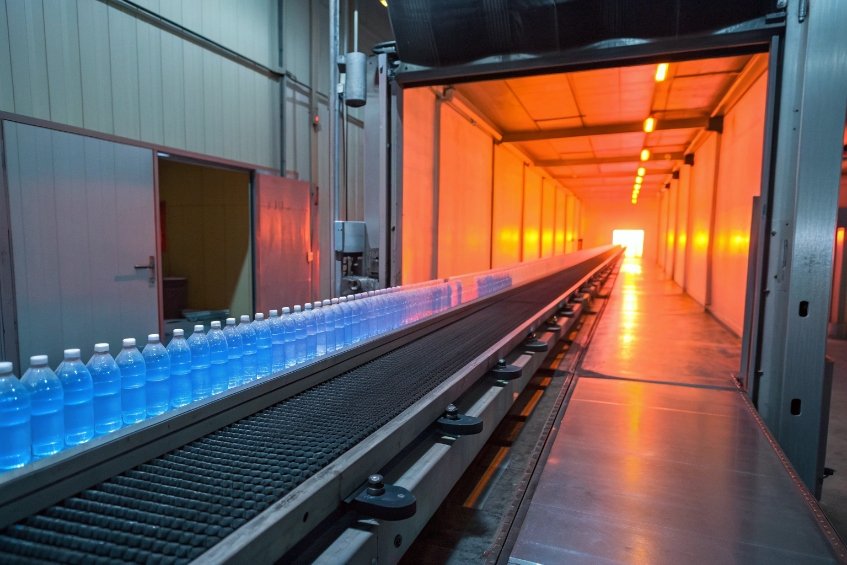
Practical handling habits that really move the needle
On paper, guidelines talk about ΔT and CTE. On the plant floor, small changes in handling often give the biggest wins.
1. Control starting temperature (preheat)
If a bottle starts closer to the hot-fill or pasteurization temperature, the effective ΔT is smaller, so stress is lower.
Typical methods:
- Warm-air or infrared preheat tunnels before hot-fill. Even raising bottle temperature from 20 °C to 35–40 °C cuts ΔT sharply.
- Avoiding cold drafts from doors, open windows, and aggressive HVAC on the depalletizer / infeed path.
- Managing warehouse conditions, so bottles do not enter the line straight from a very cold storage area.
Even a modest 10–15 °C preheat gain can turn a borderline design into a stable one, especially for lightweighted bottles.
2. Keep heating and cooling rates smooth
The ASTM C149 lab method intentionally uses a severe step change from hot to cold water. Real lines should try to do the opposite: spread the temperature changes out in time and space. :contentReference[oaicite:12]{index=12}
That means:
- In tunnel pasteurization, tune zone temperatures so the bottle does not see steep “cliffs” of temperature.
- After hot-fill, use staged cooling sprays (high temperature water first, then cooler) instead of jumping directly to very cold water.
- Avoid sudden contact with cold metal guides or rollers right after hot treatment.
3. Protect coatings and surfaces
Thermal shock strength collapses when the surface is scratched. Studies on bottle breakage and thermal shock show that abrasion and contact damage sharply increase crack initiation under tension. :contentReference[oaicite:13]{index=13}
Helpful practices:
- Proper hot-end and cold-end coating control. Low coating weight often shows up later as thermal or impact failure.
- Gentle conveying speeds and well-aligned guides to avoid hard glass-to-metal impacts.
- Controlled bulk depalletizing, with divider sheets and low drop heights.
4. Monitor annealing and stress
Residual stress from poor annealing adds directly to any thermal stress. If a bottle is already “pre-stressed,” less external ΔT is needed to reach the breaking point. Good annealing lehr 7 settings, verified by stress meters, keep this under control. :contentReference[oaicite:14]{index=14}
So, best handling is not one magic step. It is a small discipline in each station: preheat a bit, cool a bit more gently, protect surfaces, watch annealing. Together, these steps push thermal shock failures down dramatically.
Can lightweighting maintain ΔT performance without adding cost?
Lightweighting is often seen as a “risk move” for thermal shock: less glass, so weaker bottles. The reality is more nuanced. Thinner walls change both stress distribution and defect tolerance.
With good design, stable forming, and strong coating/annealing control, lightweight bottles can keep similar ΔT performance to heavier ancestors. But the safety margin shrinks if surface protection and process discipline do not improve at the same time. :contentReference[oaicite:15]{index=15}
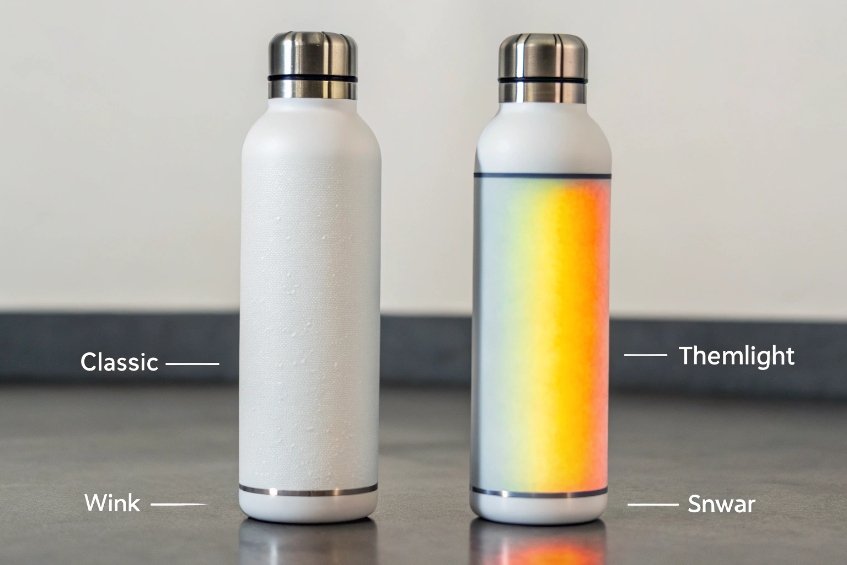
How less glass interacts with thermal shock
Let me split the effect into two sides.
1. The “good news” side
- Thinner walls mean smaller through-thickness gradients for the same heating or cooling step. Heat gets through faster, so inner and outer surfaces reach a similar temperature more quickly. That reduces internal stress for the same ΔT between product and environment.
- More uniform thickness is easier to achieve when targeting lightweight designs with strong process control, compared to old “over-built” designs that sometimes had large, uncontrolled lumps.
So in pure thermal mechanics, there is an argument that well-designed thin walls can even help thermal performance.
2. The “bad news” side
However, thinner glass also means:
- Lower mechanical strength margin against surface flaws and impact. A scratch that was harmless on a thick wall can become critical on a thin one.
- Higher sensitivity to process scatter. If the forming process sometimes creates local thick or thin areas, the thin design has less tolerance for these errors.
- Less room for residual stress. Any leftover stress from annealing or local chill is a bigger share of the total capacity.
This is why thermal shock projects for lightweighting usually link three tracks:
- Geometry optimization – heel and shoulder radii, push-up, and wall distribution designed using stress simulations and broken-bottle analysis.
- Coating and handling upgrades – stronger focus on hot-end / cold-end coating, reduced conveyor abuse, better bulk handling, sometimes even secondary protective sleeves in logistics. :contentReference[oaicite:16]{index=16}
- Annealing tuning – more careful lehr curves and tighter stress limits because thinner glass cannot “hide” residual stress.
From a cost view, lightweighting saves material and transport cost. Extra cost shows up in process control, QA, and sometimes better coatings. When these are already in place or shared across many SKUs, the net can still be cost-neutral or positive.
So my answer is yes: lightweighting can maintain ΔT performance, but only when it comes together with smarter geometry, better coatings, and tighter process discipline. If the only change is “less glass, same everything else,” thermal shock performance almost always drops.
Conclusion
Thermal shock resistance is not fixed by glass type alone; it is the sum of composition, design, annealing, coatings, and handling that decides how much real-world temperature abuse a bottle can survive.
Footnotes
-
Defines CTE and links it to dimensional change per degree—key to understanding thermal stress. ↩ ↩
-
Explains soda–lime glass chemistry and why it dominates mass-market bottle production. ↩ ↩
-
Summarizes borosilicate glass properties and why it survives larger temperature jumps. ↩ ↩
-
ASTM method reference for thermal shock resistance testing of glass containers. ↩ ↩
-
ISO standard reference for comparable thermal shock resistance testing of glass containers. ↩ ↩
-
Practical overview of tunnel pasteurization vs hot fill and why process curves matter for breakage. ↩ ↩
-
Clear explanation of annealing/lehr purpose and how residual stress affects thermal shock failures. ↩ ↩






