

Base cracks are the ones that hurt the most. They create sudden breakage, hard-to-find microchecks, and expensive returns because the bottle often fails after it leaves the plant.
Base design must account for thermal expansion because the heel and push-up create the strongest thermal gradients and the highest stress concentration. A base that is stable under temperature change uses smooth radii, controlled mass, and uniform thickness transitions so thermal strain cannot “hinge” into tensile stress.

Thermal expansion becomes dangerous at the base because the base is a cold anchor
A hot-filled bottle heats from the inside, but the base cools from the outside. The base touches metal conveyors and starwheels. It also has thicker glass mass than the sidewall. That combination makes the base a thermal “anchor.” The wall above it wants to expand and shrink faster than the base can follow—especially when coefficient of thermal expansion 1 mismatch exists across the system and the temperature gradient 2 persists at the heel.
The push-up adds another layer of complexity. Push-up geometry creates thickness gradients and changes the direction of stress flow. If the push-up has sharp transitions or local thick spots, it creates points where tensile stress spikes during cooling. That is why base checks often start at the base corner or at a ring line above the push-up transition.
Base design also affects handling stability. A perfectly smooth and lightweight base might be thermally friendly but may fail in vertical load, internal pressure, or line stability—especially if filling line impacts exceed defined impact specifications for glass containers 3. So base design must balance:
- thermal shock resistance
- top load and impact resistance
- standing stability
- weight and cost
- forming capability and defect risk
A good base design is not just “thicker.” Many thermal failures come from thick mass and sharp steps. The best base designs are consistent, smooth, and predictable.
| Base feature | Thermal stress effect | Most common defect if wrong | What improves it |
|---|---|---|---|
| Heel radius | controls stress concentration | heel crack, base check | larger radius, smooth blend |
| Base mass | controls gradient duration | delayed base checks | reduce mass, spread thickness |
| Push-up step | creates stress hinge | ring checks | gradual transitions |
| Contact cooling | chills outer base | base corner cracks | staged cooling, warmer contact |
| Scuff band | creates crack starters | late breaks | surface protection + conveyor control |
The next sections answer your four questions in detail.
Why is the bottle base (heel and push-up) the most vulnerable area for thermal stress during hot fill and cooling?
The base is where gradients and geometry line up. That is why so many hot-fill failures trace back to the heel.
The heel and push-up are most vulnerable because they combine thick glass mass, strong contact cooling, and sharp geometry transitions. During hot-fill, the inside heats quickly while the outer base stays cool. During cooling, the outer base chills first while the inner base stays warm. These gradients create tensile stress at the heel and base corner, where cracks start easily.
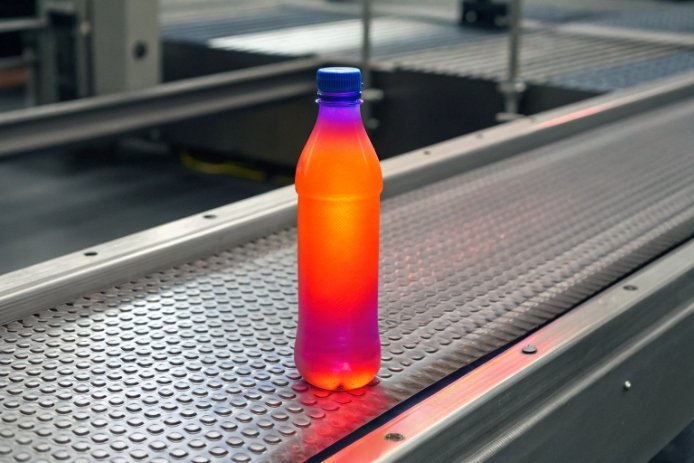
The base is a heat sink and a cold sink
- Thick glass heats slowly, so temperature differences stay longer.
- Conveyor and starwheel contact pulls heat away from the base.
- Cooling sprays and air often hit lower zones first.
So the base sees the steepest and most persistent gradients.
The heel is a built-in stress concentrator
Even with good thickness control, the heel is a curvature transition. Curvature concentrates stress. If the heel radius is small, the stress concentration factor 4 rises sharply. Any heel scuff becomes a crack starter.
Push-up geometry can create ring stress
Push-up shapes can create a “ring” where thickness changes quickly. Thermal stress concentrates along that ring during cooling. That is why base checks often appear as partial rings or short cracks near the base edge.
Residual stress multiplies base risk
If the bottle leaves the lehr with higher stress at the base or heel, thermal stress has less margin. A small process change (cooling earlier, colder rinse, more contact pressure) can trigger a sudden reject spike—especially if the annealing lehr 5 profile is drifting.
| Vulnerability driver | Why it is strong at the base | What it causes | What to monitor |
|---|---|---|---|
| Thick mass | slow equalization | delayed cracks | base thickness map |
| Contact cooling | fast outer-wall cooling | base corner checks | conveyor/stars temperature |
| Curvature transition | stress concentration | heel cracks | heel radius and scuff rate |
| Push-up gradients | stress hinge ring | ring checks | push-up profile consistency |
Base risk is highest in the first minutes after fill and during early cooling. If the base survives that window without microchecks, long-term reliability improves a lot.
How do push-up geometry, heel radius, and thickness distribution reduce thermal stress concentration?
The goal is simple: stop the base from acting like a rigid anchor with a sharp hinge. Good geometry spreads stress and reduces gradients.
Push-up geometry, heel radius, and thickness distribution reduce thermal stress by smoothing transitions, increasing radii, and avoiding localized thick spots. A gradual thickness gradient allows temperatures to equalize more uniformly, reducing tensile stress peaks at the heel and base corner.

Push-up geometry: choose smooth transitions over deep steps
A push-up is often needed for strength and stability. Still, push-up designs can reduce thermal stress when they:
- avoid sharp step lines
- use gradual slopes
- keep thickness changes smooth
- minimize local thick “lumps” from tooling or forming drift
A deep push-up with a sharp transition can create a ring stress concentrator. A gentler push-up reduces that effect.
Heel radius: the highest ROI design change
A larger heel radius reduces stress concentration. It also improves forming robustness and reduces crack initiation at scuffed zones. The heel radius should blend smoothly into both the sidewall and the base.
Thickness distribution: uniform beats heavy
A base that is uniformly thick in the right places is more reliable than a base with thick lumps and thin valleys. Thermal gradients form around those differences.
Key thickness rules:
- reduce sudden thickness steps at the heel
- avoid thin “knife edges” at the base corner
- avoid very thick nodes that trap temperature
- balance thickness around circumference to reduce one-side stress
| Design lever | What it does to thermal stress | What it does to defects | Practical design intent |
|---|---|---|---|
| Larger heel radius | lowers stress concentration | fewer heel checks | smooth blend, no sharp corner |
| Gentler push-up slope | reduces ring hinge stress | fewer ring cracks | gradual thickness change |
| Uniform base thickness | reduces gradient mismatch | fewer one-side breaks | stable parison distribution |
| Controlled base corner | avoids knife-edge tension | fewer star cracks | stable radius and finish |
| Reduced base mass | shortens gradient duration | fewer delayed checks | weight where needed only |
A good base design is measured by crack origin results. If cracks move away from the heel after a design update, the design is working—and confirming origin with basic fractography 6 makes that conclusion much more defensible.
What base design trade-offs affect stability, weight, and thermal shock resistance for different bottle types?
Base design always lives inside a trade triangle: stability, weight, and thermal performance. Changing one side affects the others.
Trade-offs include: heavier bases improve standing stability and some mechanical strength but increase thermal gradients and delayed base checks; deeper push-ups can improve pressure performance but can create stress hinges; lightweight bases improve thermal response but can reduce stability and increase scuff sensitivity. The best choice depends on the bottle type and process: hot-fill, carbonated, or spirits.

Hot-fill bottles
Hot-fill needs thermal shock resistance first. That usually favors:
- moderate base mass (not extreme thick)
- smooth heel radius
- controlled cooling and contact conditions
Lightweighting is possible if thickness distribution remains uniform.
Carbonated and pressurized bottles
Internal pressure adds hoop stress. Bases often require:
- strong geometry and controlled push-up for pressure and stability
- careful thermal management if pasteurization or warm storage exists
The base must survive both pressure and thermal gradients.
Thick bases are popular for premium look. Thermal risk rises because the base is a strong cold anchor. These bottles can still work if:
- the heel transition is very smooth
- thickness changes are gradual
- the line avoids cold shocks and hard contact cooling
- surface protection prevents heel scuffs
Small bottles vs large bottles
Large bottles and wide-mouth jars have larger thermal mass and often larger panel areas. They are more sensitive to gradients and vacuum deformation. Small bottles often tolerate cycles better, but heel scuff damage can dominate.
| Bottle type | Base goal | Main trade-off | Best thermal-safe choice |
|---|---|---|---|
| Hot-fill beverage | thermal shock margin | weight vs stability | smoother radii + staged cooling |
| Hot-fill food | vacuum + thermal | paneling vs mass | controlled push-up + stable cooling |
| Carbonated | pressure + stability | deep push-up vs hinge stress | gradual transitions + uniform thickness |
| Premium spirits | appearance | thick base increases gradients | smooth heel + low scuff handling |
| Pharma/cosmetic (pump) | finish alignment + stability | top-heavy packs | stable base contact + uniform base |
When a customer asks for a thick-base premium look and also wants hot-fill performance, the solution is usually a smarter geometry, not maximum mass. A thick base can be safe when the stress hinges are removed.
Which tests and inspections verify base safety under temperature change (stress inspection, thermal shock testing, and base-check monitoring)?
Base safety cannot be proven by one visual check. Microchecks can hide. A good QA plan forces them to show up before shipment.
Verify base safety with polariscope stress inspection focused on heel/base zones, thermal shock or hot-fill simulation testing that includes real cooling steps, thickness mapping of the base profile, and structured base-check monitoring (crack origin tracking by cavity and time).

1) Stress inspection (polariscope)
Stress inspection helps catch:
- under-annealing at the base
- lane imbalance in the lehr
- cavity-level stress outliers
This should be done by cavity, not only by average, and it should follow the basics of how polariscopes reveal residual stress patterns 7.
2) Thermal shock testing (comparative screening)
A thermal shock step test provides:
- a baseline ΔT tolerance ranking
- a way to compare mold sets and design variants
- a QC method to detect drift over time
For standardization and comparability, align the procedure to ASTM C149 thermal shock resistance of glass containers 8.
3) Hot-fill and cooling simulation (real-world proof)
Thermal shock tests are useful, but base failures often depend on timing:
- when cold rinses start
- how the base contacts cold metal
- how stop/start events change gradients
So base safety needs a simulation that replicates:
- bottle start temperature (including cold-start worst case)
- fill temperature and hold
- cooling curve and timing
- contact cooling and airflow pattern
4) Base-check monitoring and crack origin mapping
Base check monitoring should include:
- inspection after cooling and after short aging
- classification of defect type (base check vs heel crack vs star crack)
- origin mapping (base corner, heel line, ring zone)
- correlation to cavity number and line station
To keep defect language consistent across teams and plants, many operations reference inspection terminology like Base Check in container inspection guides 9.
5) Thickness and surface condition inspection
Thermal cracks love scuffs. Pair thermal tests with:
- base thickness mapping (heel, corner, push-up)
- heel scuff rate monitoring
- surface treatment verification if used, including whether cold end coating for scuff protection 10 is being applied and controlled correctly
| Verification method | What it catches | Frequency | Best pass indicator |
|---|---|---|---|
| Polariscope at base | residual stress margin | each shift (subset) | stable low-stress pattern |
| Thermal shock step test | comparative thermal tolerance | qualification + audits | stable ΔT threshold |
| Hot-fill + cooling simulation | real base survival | qualification + changes | zero base checks in sample |
| Base-check monitoring | hidden microchecks | continuous QA | defect rate trend flat |
| Thickness mapping | stress hinge risk | per mold/cavity checks | variation within target band |
| Scuff monitoring | crack starters | daily | low scuff rate at heel band |
A base design is “thermal-safe” when it passes thermal testing and stays stable in real line simulation, and when base-check monitoring stays low across cavities and seasons.
Conclusion
The base is the thermal weak point because it is thick, cooled by contact, and full of transitions. Smooth heel radii, gentle push-ups, uniform thickness, and staged cooling—verified by stress and thermal tests—prevent base checks and cracks.
Footnotes
-
Soda-lime glass property sheet with CTE values used to estimate thermal mismatch in base/heel regions. ↩ ↩
-
Explains how temperature gradients create thermal stress, supporting why the base behaves like a “cold anchor.” ↩ ↩
-
Practical guidance on filling line impacts and handling limits that influence base stability and breakage risk. ↩ ↩
-
Stress concentration tables showing how small radii amplify peak stress—useful for justifying larger heel radii. ↩ ↩
-
Describes annealing/lehr stress relief and why base zones are sensitive to cooling profile drift. ↩ ↩
-
NIST reference for reading fracture origins and crack features, helpful for confirming whether failures start at heel/base. ↩ ↩
-
Explains annealing, tempering, and polariscope inspection basics used for residual stress screening in glass containers. ↩ ↩
-
The core standard test method for comparing thermal shock resistance of commercial glass containers (bottles and jars). ↩ ↩
-
Defines and illustrates inspection defect terms like base check, supporting consistent classification and monitoring. ↩ ↩
-
Technical overview of surface treatments (including cold-end coatings) that reduce scuffing and crack initiation at the heel/base. ↩ ↩






