
Aesthetics sell the bottle on the shelf, but physics determines if it survives the factory floor. Choosing the wrong shape for hot filling guarantees high breakage rates and production nightmares.
To survive hot filling, a glass bottle must be designed with thermal dynamics in mind. Prioritize cylindrical shapes with gentle radii over sharp corners, ensure uniform wall thickness to prevent stress concentration, and select a robust finish that can withstand the torque and vacuum pressure of the cooling process.
Which hot-fill temperature, hold time, and cooling method set the real design limits for bottle geometry?
Designing a bottle without knowing the exact thermal profile of your filling line is engineering malpractice. The bottle is a vessel that must expand and contract without failing.
The upper limit of the fill temperature (typically 85°C–95°C) and the shock of the cooling tunnel define the maximum Delta T ($\Delta T$) the glass must endure. The hold time dictates how deeply the heat penetrates the glass wall, meaning thicker designs may retain heat too long, complicating the cooling phase.
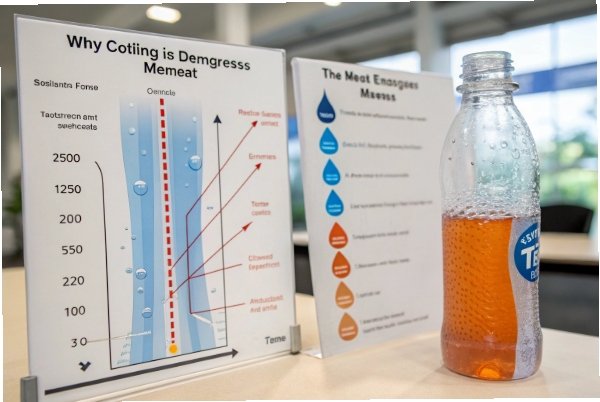
The Thermal Envelope
At FuSenglass, we start every custom mold project by asking: "What is your fill temp, and what is your cooling water temp?"
The most dangerous moment for a bottle is not the filling (where it heats up), but the cooling.
- Filling: The inner wall expands. The outer wall is cool. Tension is on the outside.
- Hold Time: The heat soaks through. The entire bottle reaches ~85°C. The glass is now thermally expanded.
- Cooling Tunnel: Cold water hits the outside. The outer skin contracts instantly. The inner core is still hot and expanded. This puts the outer surface in tension again.
If the bottle has thick, heavy sections (like a heavy decorative base), those sections stay hot while the thin walls cool. This differential contraction rips the bottle apart. Therefore, the Cooling Rate sets the limit on how thick we can make the glass—especially in a multi-zone bottle cooling tunnel 1 designed to reduce thermal shock.
Design Limits based on Process
| Process Step | Condition | Design Constraint |
|---|---|---|
| Hot Fill | 90°C Liquid vs 20°C Glass | Max $\Delta T$ ~70°C. Requires pre-heating or very uniform walls. |
| Hold Time | 2-3 Minutes | Avoids "heat sinks" (masses of glass) that won’t cool down in time. |
| Cooling | 3-Zone Spray (60°/40°/25°C) | Shape must shed water; water trapped in a deep "punt" creates thermal shock. |
For process owners, the safest target is to define the cooling tunnel’s “temperature ladder” using a documented gradual cooling zone strategy 2 rather than a single cold-water hit.
What structural features (shoulder angle, heel radius, base design, wall-thickness uniformity) best reduce thermal-shock breakage?
Stress loves a corner. In the world of glass physics, any sharp transition is a focal point for energy that leads to cracks.
Round bottles with sloping shoulders and generous heel radii are vastly superior to square or angular designs for hot filling. These features distribute thermal stress evenly, while uniform wall thickness prevents the "push-pull" effect of differential expansion that snaps bottles in half.
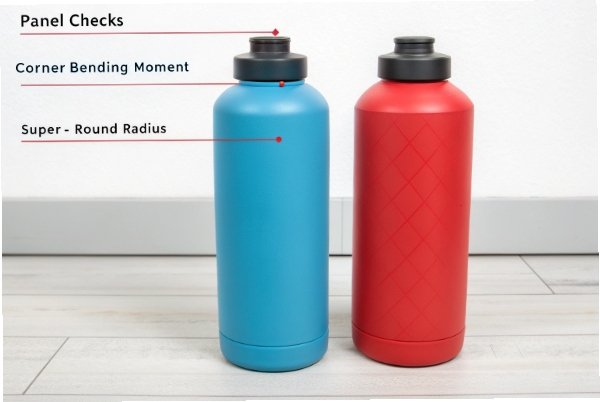
The "Round" Advantage
A cylinder expands uniformly in all directions. A square bottle does not.
In a square bottle, the flat panels are usually thinner than the corners. When hot liquid hits:
- The Panel: Expands fast.
- The Corner: Expands slow.
This creates a bending moment at the corner. We often see "panel checks" (vertical cracks) in square hot-fill bottles. If you must have a square look, we design "super-round" corners (large radius) to mimic the physics of a cylinder.
If you need a quick refresher on why rapid temperature gradients crack glass, this overview of thermal shock in glass containers 3 explains the stress mechanism clearly.
Shoulder and Heel Geometry
- Shoulder Angle: A 90-degree flat shoulder is a "stress trap." It acts like a hinge. We prefer a sloped shoulder (champagne style) or a rounded ogive. This allows the vertical expansion of the bottle to dissipate without shearing the neck off.
- Heel Radius: The bottom corner is where the bottle takes the most abuse (conveyor impact). A sharp heel is weak. A compound radius (a curve that blends two arcs) distributes impact energy and thermal stress.
The Importance of the "Push-Up"
A flat bottom is terrible for hot filling. It warps under vacuum pressure (the "oil-canning" effect) and traps heat.
We design a "Push-Up" or Punt in the base. This dome shape:
- Strengthens the structure against vacuum pull-down.
- Ensures the bottle sits on a "bearing ring" (the rim) for stability.
- Allows cooling water to flow underneath (if designed with vent channels).
Structural Feature Checklist
| Feature | Best Practice | Avoid |
|---|---|---|
| Cross-Section | Circular / Oval | Sharp Squares / Rectangles |
| Shoulder | Sloped (>20°) / Rounded | Flat (90°) / Sharp Edges |
| Heel (Base Corner) | Large Radius (>3mm) | Tight Radius (<1mm) |
| Glass Distribution | Even (Max ratio 2:1) | Heavy Bottoms / Thin Necks |
How should the neck/finish design be matched with closures and capping torque to avoid leaks and finish cracks after cooling?
The neck is the seal’s foundation. If the foundation shifts or cracks under thermal load, the product inside will spoil.
The finish (neck) must be robust enough to resist the high application torque of steam cappers and the "hoop stress" generated by thermal expansion. Lug finishes (Twist-Off) are standard for hot fill because they allow steam venting and maintain a secure vacuum seal without over-stressing the glass threads.
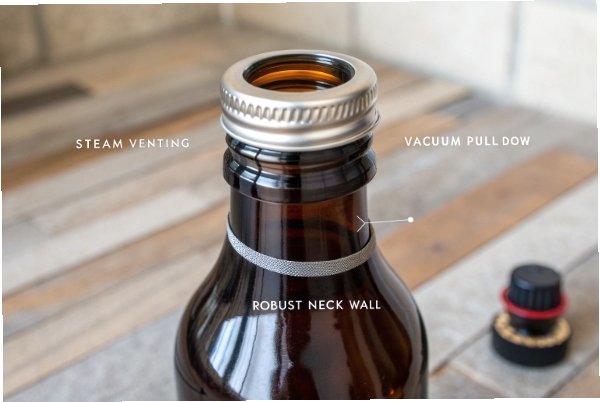
Lug vs. Continuous Thread (CT)
For hot fill, we almost exclusively use Lug Finishes (e.g., specific GPI or FD standards). When teams want a simple reference for what “2040 / 2030 / 2020” actually means, this finish specification guide 4 is a fast way to align glass and cap procurement.
- CT (Screw Cap): Requires many turns. Hard to vent air/steam.
- Lug (Twist-Off): Engagement is quick (1/4 turn). The lugs grip the glass threads securely. Crucially, the liner is designed for the "vacuum pull-down."
Torque and Thermal Expansion
When you cap a hot bottle, the glass neck has expanded slightly. The metal cap is also hot (from steam).
If the torque is too high ("over-application"), the metal lugs dig into the glass. When the bottle cools, it shrinks. The metal cap shrinks too, but at a different rate. This constriction can shear the glass threads right off ("stripped finish").
We design the finish with a thick wall and a prominent transfer bead (a ring below the threads) to absorb the gripper force and prevent the neck from ovalizing.
To keep sealing consistent, specify closures built for hot-fill vacuum—most commonly lug/twist-off caps with plastisol liners 5.
Vacuum Retention
As the product cools from 90°C to 20°C, a vacuum forms. This is good—it keeps the lid on. But if the "Land" (the top sealing surface of the glass) is chipped, uneven, or too narrow, the vacuum will pull air in through the defect.
We require a "Fire Polish" on the sealing surface during manufacturing to ensure it is perfectly smooth for the plastisol liner.
Finish & Closure Matching
| Component | Recommendation | Why? |
|---|---|---|
| Finish Type | Lug (Twist-Off) | Compatible with high-speed steam cappers. |
| Liner Material | Plastisol (High Heat) | Softens to mold to glass; hardens to lock seal. |
| Application Torque | Specify "Warm Removal" | Account for liner softening; don’t over-tighten. |
| Neck Wall | Reinforced | Prevents cracking under capper side-load. |
What supplier specs and validation tests should be required to approve a hot-fill bottle shape for mass production?
Never launch a new bottle shape based on a 3D render. You must validate the physical limitations of the glass through destructive testing.
Before mass production, require Thermal Shock Resistance (TSR) testing to survive a $\Delta T$ of 42°C, internal pressure testing, and vertical load analysis. Demand "Limit Samples" from your supplier to define the acceptable range of glass distribution and cosmetic defects.
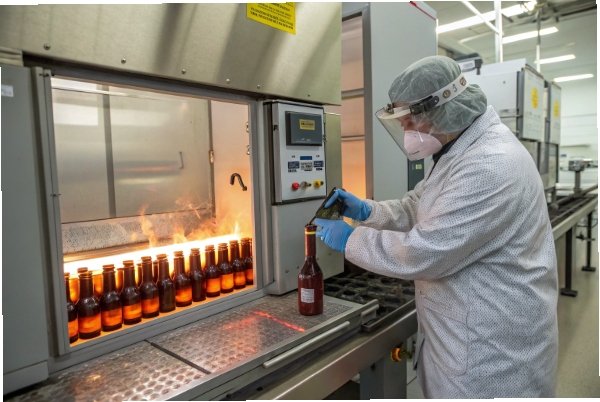
The Golden Rule: TSR Testing
The Thermal Shock Resistance (TSR) test is the ultimate pass/fail for hot-fill ware.
- The Test: Heat bottle to 65°C. Drop into 23°C water. $\Delta T$ = 42°C.
- The Requirement: 100% Pass rate for the sample set.
This “42°C” acceptance is commonly referenced for container glass, and the underlying standardized approach is described in ISO 7459 thermal shock test methods 6. In North American QA labs, many teams also reference ASTM C149 thermal shock testing 7 when specifying equipment and procedures.
Sectioning and Distribution
We cut bottles in half vertically to measure "Glass Distribution."
A bottle might look fine on the outside, but have a paper-thin shoulder on the inside.
- Specification: No point on the sidewall shall be less than X mm (e.g., 1.8mm).
- Ratio: The ratio of thickest to thinnest point on the same horizontal plane should not exceed 2:1.
Vertical Load (Stacking Strength)
Hot filled bottles are often stacked on pallets while still warm (softening the cardboard boxes). The bottle itself must bear the load.
We use a crush tester to ensure the bottle can withstand typical warehousing loads (e.g., 400kg – 800kg depending on size).
Validation Summary Table
| Test | Standard | Critical For |
|---|---|---|
| Thermal Shock (TSR) | $\Delta T$ 42°C | Preventing bottom-out at filler/cooler. |
| Internal Pressure | > 10 Bar (if carb) / Vacuum | ensuring seal integrity. |
| Vertical Load | > 6 kN | Pallet stacking safety. |
| Annealing Grade | Grade 2 or better | Ensuring low residual stress. |
If you want to reduce “mystery breakage” before it reaches your line, require proof that the supplier’s lehr profile controls residual stress—this overview on why annealing removes internal stress 8 is a good technical baseline.
Finally, because finish cracking often shows up only after cooling and vacuum pull-down, include closure QA: adopt a documented torque method like ASTM D3198 application/removal torque testing 9 and track drift between application torque and warm removal torque.
Conclusion
Selecting a bottle for hot filling is a science, not an art. By favoring round geometries, enforcing uniform glass distribution, and validating with TSR testing, you ensure that your packaging performs as well as your product. Don’t let a bad design break your bottom line.
If you need an industry-wide perspective on why glass remains a leading hot-fill package (and how standards and recycling shape supply), the Glass Packaging Institute (GPI) 10 is a useful reference hub.
Footnotes
-
Shows why multi-zone cooling tunnels use staged water temperatures to prevent thermal shock. ↩ ↩
-
Illustrates practical cooling tunnel zoning and gradual cooling concepts for hot-filled glass. ↩ ↩
-
Explains thermal shock mechanics and why sharp geometry and fast cooling cause glass failures. ↩ ↩
-
Quick reference for common lug finish codes (e.g., 2040) to match bottles and closures. ↩ ↩
-
Summarizes lug/twist-off closures and plastisol liners commonly used for hot-fill vacuum sealing. ↩ ↩
-
Official ISO entry point for ISO 7459 thermal shock resistance/endurance test methods. ↩ ↩
-
Practical overview of ASTM C149 testing for thermal shock resistance of bottles and jars. ↩ ↩
-
Explains annealing/lehr control for reducing residual stress that can trigger breakage during hot-fill cooling. ↩ ↩
-
Provides a standard method for measuring application and removal torque for threaded or lug closures. ↩ ↩
-
Industry association resource hub on glass packaging standards, performance, and recycling context. ↩ ↩






