
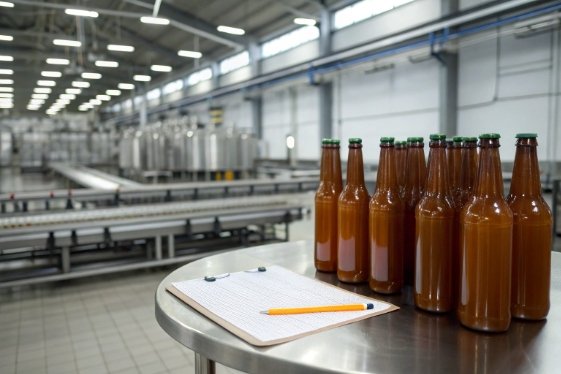
A UV-coated bottle can look perfect in sampling, then fail after a few heat-cool swings. That gap creates rework, claims, and brand damage.
There is no single “cycle count” that fits all UV-coated bottles. The coating survives the number of cycles defined by your test protocol, temperature range, dwell time, and pass criteria.
Thermal cycle resistance is a spec you define, not a number you guess
“Thermal shock” vs “thermal cycling” for coatings
Thermal shock is a sudden temperature jump. Thermal cycling is repeated heat and cool steps. A UV coating can survive one shock and still fail after many smaller cycles. That is why “it passed one hot-fill trial” does not prove long-term stability.
For coatings, the goal is not only “no cracks in the film.” The goal is “no loss of adhesion, no whitening, and no cosmetic change that breaks your brand standard.” A coating can stay stuck but turn cloudy. It can keep color but start edge lifting. These are different failure modes, so the test plan must measure more than one property.
A practical baseline that works in B2B conversations
When a buyer asks “how many cycles,” the only honest answer is: “tell me the cycle profile.” Then I choose a baseline standard and adjust it to match the real use case.
One widely used reference in coatings is a thermal cycling practice 1 that runs a defined cold step, a hot step, and sometimes a water immersion step, for a fixed number of cycles. It does not tell you your pass criteria. It tells you the stress recipe. That is why pairing it with adhesion, appearance, and abrasion checks is critical.
Why the glass matters even if the coating is the topic
The coating sits on a substrate that expands and contracts. If the bottle has high residual stress, the coating may fail earlier. If the bottle sees aggressive thermal shock 2 in service, the glass can crack and the coating becomes a distraction. So I always treat the project as a “bottle + coating + process” system.
| What you are trying to prove | What can go wrong | What you must measure | What a buyer should write in the PO |
|---|---|---|---|
| Coating survives heat cycles | micro-cracks, peeling, haze, yellowing | adhesion + appearance + abrasion | cycle profile + pass/fail limits |
| Bottle survives heat cycles | glass crack at shoulder/heel | thermal shock resistance + stress | bottle spec + anneal/stress limits |
| Both remain stable lot to lot | drift in cure, thickness, prep | batch traceability + trend checks | COA + test frequency |
If the protocol is clear, the answer becomes clear. If the protocol is vague, the “cycle count” will always be a surprise.
Some buyers keep reading at this point because they want the exact tools to write a protocol and stop arguing with suppliers later. That is what the next sections cover.
What test methods and pass/fail criteria define “thermal cycle resistance” for UV-coated glass bottles?
A coating can survive the oven and still fail in water. A coating can also pass adhesion and still turn white. Both outcomes hurt sales.
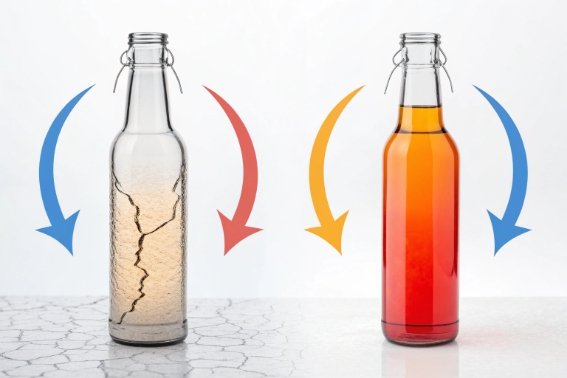
Thermal cycle resistance is defined by a cycling method (temperature steps, dwell time, medium, number of cycles) plus pass criteria on adhesion, appearance, and wear. Without pass criteria, a cycle test is only a stress exposure.
Test method options that buyers can actually use
For UV-coated bottles, two test layers matter:
1) Coating-focused thermal cycling
This checks whether cycling weakens adhesion or film integrity. A common approach is a cold step, a hot step, and optional immersion, repeated for a defined number of cycles.
2) Bottle-focused thermal shock
This checks whether the container survives the kind of sudden temperature change seen in washing, pasteurization 3, or hot-pack use. If the glass fails first, coating results do not matter.
Pass/fail criteria that stop supplier debates
A strong spec uses pass criteria that are easy to measure and hard to argue:
-
Adhesion after cycling: cross-hatch adhesion 4 rating, plus a “no peel” threshold.
-
Appearance: no whitening, no blistering, no visible cracking, no edge lifting, gloss change within limit.
-
Color stability (if tinted UV coating): color shift limit (ΔE) after cycles.
-
Abrasion / scuff resistance after cycling: coating should not become soft or chalky.
The key detail is timing. Many failures show up after the samples cool back to room temperature. Some show up 24 hours later when moisture leaves the film. So evaluation should be at multiple checkpoints.
A simple “inspection schedule” that works in practice
-
Inspect immediately after the final hot step.
-
Inspect after full cool-down to room temperature.
-
Inspect again after 24 hours conditioning.
| Metric | When to check | Why it matters | Common pass/fail wording |
|---|---|---|---|
| Adhesion rating | after cool-down + 24h | delayed adhesion loss is common | “No worse than X rating” |
| Whitening / haze | after cool-down | moisture and microvoids show here | “No visible whitening at 50 cm” |
| Cracking / crazing | after final cycle | thermal mismatch shows early | “No cracks under 10×” |
| Gloss / color shift | after 24h | stabilization can change look | “Within agreed tolerance” |
A buyer does not need a perfect laboratory plan. A buyer needs a plan that matches the real thermal stress and produces repeatable results across lots.
Which factors most affect UV coating performance in thermal cycling?
Thermal cycling failures often look like “bad coating.” In reality, the cause is usually a mix of thickness, cure, and surface prep.
Film thickness, curing energy, and surface preparation usually decide thermal cycling performance. Glass type and bottle stress level also matter because they set the expansion and strain the coating must follow.
Film thickness is a stress multiplier
A thicker film carries more internal stress during expansion and contraction. It can also shrink more during cure. That increases the risk of micro-cracking and edge lift. A very thin film reduces stress but may sacrifice coverage, hide power, and abrasion resistance. This is why thickness should be a controlled window, not a loose “typical.”
Cure quality is not only “hardness”
UV curing 5 is about conversion and crosslink density. Under-cure leaves the film soft and more sensitive to heat, water, and detergent. Over-cure can create a brittle film that cracks during cycling. Real production also has cure variation because lamp aging, conveyor speed, and bottle geometry change UV dose at different points on the bottle.
A practical habit is to validate cure with a simple indicator that the factory can run every shift. Hardness alone is not enough, but it helps as a quick screen.
Surface prep decides whether the coating bonds or only “sits”
Glass is smooth and chemically stable. Many organic UV coatings need help to bond well. Surface prep may include washing, hot air, flame, plasma treatment 6, or primers like silane systems. If the surface carries mold release residues, dust, or moisture, the coating can pass initial adhesion yet fail after cycles.
Glass type and bottle stress still show up in coating results
If the bottle has higher coefficient of thermal expansion (CTE) 7 or higher residual stress, the coating experiences higher strain during temperature changes. Even with the same coating, results can differ between soda-lime and borosilicate, and between well-annealed and high-strain lots.
| Factor | What it changes | Typical symptom after cycling | Practical control for mass production |
|---|---|---|---|
| Film thickness | stress and shrinkage | micro-cracks, edge lift | thickness window + sampling plan |
| UV dose and cure | brittleness vs softness | cracking (brittle) or whitening (soft) | lamp monitoring + line speed lock |
| Surface prep | chemical bonding | peeling, flaking, tape pull failure | cleaning SOP + surface energy checks |
| Glass stress | strain at surface | random cracks start under coating | polariscopic strain limit |
| Bottle geometry | local UV exposure + stress zones | failures at shoulder/heel | rotate cure, targeted inspection |
When these variables are stable, cycle performance becomes predictable. When they drift, cycle failures look random and expensive.
What are the most common failure modes after repeated heat-cool cycles, and how can they be prevented?
A UV coating can fail in ways that do not show up on day one. Thermal cycling is good at exposing those hidden weak points.
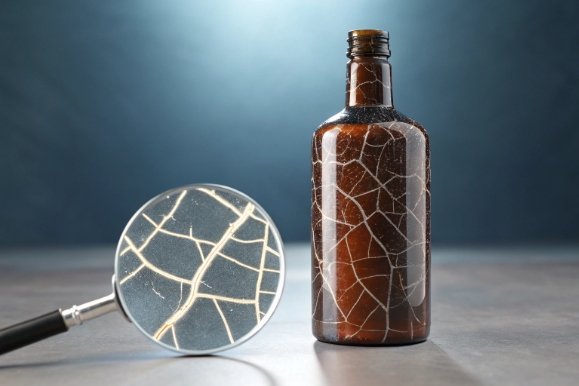
The most common failure modes are micro-cracking/crazing, peeling at edges, whitening (blushing), and yellowing. Prevention comes from matching coating flexibility to the cycle, controlling cure, and using strong surface prep and primers.
Micro-cracking and crazing
This usually comes from thermal expansion mismatch 8 and a brittle film. The film cannot follow the glass movement, so it forms fine cracks. These cracks may be cosmetic, but they can also become paths for moisture and detergents, which then accelerate whitening and adhesion loss.
Prevention
-
Avoid over-cure that makes the film too brittle.
-
Use a formulation with enough flexibility for the temperature range.
-
Keep thickness moderate and consistent.
-
Watch sharp edges and emboss zones where stress concentrates.
Peeling and edge lifting
Peeling often starts at edges, the heel, or high-contact areas. Thermal cycling drives interface shear. Water steps and detergent accelerate it. Poor cleaning is a common root cause, even when the coating itself is good.
Prevention
-
Lock surface cleaning and drying steps.
-
Use a primer or adhesion promoter designed for glass.
-
Add an edge inspection rule, not only flat-body inspection.
Whitening or blushing
Whitening is often moisture-related. Under cycling, water can enter microvoids or small defects and change how light scatters. Some UV coatings show this quickly after a hot-to-cool step, especially when cooling involves water.
Prevention
-
Improve cure and reduce residual monomer.
-
Choose resins with better hot-wet resistance.
-
Add a wet-heat aging step before final evaluation.
Yellowing
Yellowing can come from heat aging, UV exposure, or chemistry issues in the coating. Thermal cycling can speed it up if the hot step is high enough or long enough. For clear premium bottles, even small yellowing can be rejected.
Prevention
-
Use heat-stable photoinitiators 9 and additives.
-
Avoid over-baking during any post-cure step.
-
Set a color limit in the spec, not a “looks OK” rule.
| Failure mode | Fast root cause check | Best prevention lever | Buyer-friendly acceptance wording |
|---|---|---|---|
| Micro-cracking | look under 10× at stress zones | flexibility + thickness control | “No crazing under 10×” |
| Peeling | tape pull at edges after cycles | surface prep + primer | “No edge lift; adhesion ≥ target” |
| Whitening | inspect after cool-down + 24h | cure + wet resistance | “No visible whitening at 50 cm” |
| Yellowing | measure color shift | heat-stable formulation | “ΔE within agreed limit” |
If the coating fails after cycling, the next step should not be “blame the UV coating.” The next step should be “map where it fails and match that location to a process cause.”
How should B2B buyers specify a thermal cycling protocol for hot-fill, pasteurization, or dishwasher use before mass production?
If the protocol is vague, the factory will test a gentle cycle and call it a pass. Then your production line becomes the real test lab.
A good buyer protocol copies the real thermal story: temperatures, dwell time, heating and cooling medium, and number of cycles. The spec must also lock evaluation methods (adhesion, appearance, abrasion) and sampling rules across lots.
Step 1: Write the use case as a temperature timeline
Hot-fill packaging 10 is not only “90°C product.” It is fill temperature, hold time, cap-on time, cooling profile, and whether there is a cold rinse. Pasteurization is a long ramp with humidity. Dishwasher is many repeats with detergent, spray, and dry heat.
So the protocol should include:
-
high temperature setpoint,
-
low temperature setpoint,
-
dwell time at each step,
-
transfer time between steps,
-
and medium (air, water, steam, detergent solution).
Step 2: Choose a cycle count that matches risk
For first qualification, I like a “screening” cycle count that is enough to show weak adhesion. Then I move to a “confirmation” cycle count that matches expected consumer or process repeats.
If the product sees only one hot-fill cycle, a massive 200-cycle protocol may not be needed. If the product claims dishwasher-safe, a short 10-cycle protocol is not honest.
Step 3: Lock pass/fail and sampling rules
Buyers should specify:
-
sample quantity per lot,
-
which locations to test (body, shoulder, heel),
-
which tests after cycling (adhesion, appearance, abrasion),
-
and what counts as a fail (one bottle fail vs percentage).
Example protocols as starting points (adjust to your line)
These are templates. They must be tuned to your real temperatures and your real cooling method.
| Use case | Cycle profile (example) | Cycles | What to check after cycles |
|---|---|---|---|
| Hot-fill | hot soak near fill temp → cool in air/water like your line | 10–30 | adhesion, whitening, edge lift |
| Pasteurization | warm/humid exposure → controlled cool-down | 10–30 | adhesion after 24h, haze, color |
| Dishwasher claim | hot wash + detergent → dry heat → cool | 20–50+ | abrasion + adhesion + appearance |
Step 4: Add batch traceability and change control
Thermal cycling results are useless if they are not linked to the production lot. The PO should require:
-
coating batch number,
-
UV line settings (lamp power, speed),
-
glass lot or furnace campaign ID,
-
and a change notice if any of these change.
| Control item | What to require | Why it protects you |
|---|---|---|
| Protocol document | temperatures, dwell, transfer, medium, cycles | keeps testing honest and repeatable |
| Pass/fail sheet | adhesion rating, appearance limits, abrasion limits | stops “looks OK” debates |
| Sampling plan | per lot quantity and locations | catches drift early |
| Traceability | COA + lot IDs + process settings | links results to shipments |
| Retest triggers | lamp change, primer change, glass supplier change | prevents silent performance drop |
A UV coating can absolutely survive thermal cycling. The “how many cycles” answer becomes stable only after the protocol is written, repeated, and tied to traceable production lots.
Conclusion
UV coatings do not have a universal cycle limit. Define the thermal cycle profile, set clear pass criteria, and lock thickness, cure, prep, and traceability before mass production.
Footnotes
-
Standard industry practice for evaluating coating resistance to thermal cycling stress. ↩
-
How rapid temperature changes create stress that leads to glass container failure. ↩
-
The thermal process used to extend shelf life and its impact on packaging integrity. ↩
-
A widely used test method for assessing coating adhesion strength via tape pull-off. ↩
-
The process of using ultraviolet light to instantly dry and harden liquid coatings. ↩
-
Surface modification technique to improve coating adhesion on non-porous glass. ↩
-
Technical definition of how materials expand with heat and why this predicts interface stress. ↩
-
Why differing expansion rates between substrate and coating cause cracking and delamination. ↩
-
Chemical compounds that initiate the curing reaction and influence coating stability. ↩
-
Explanation of the hot-fill process and the thermal demands it places on bottles. ↩






