
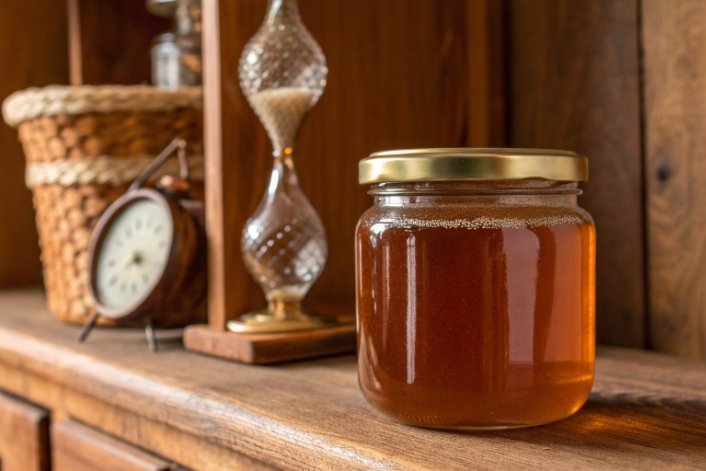
A sticky question can cost you wasted product and upset customers.
Properly sealed honey in glass can remain safe to eat indefinitely. Quality may slowly drift, but true spoilage is rare when moisture stays low and the jar stays closed.
Most labels show a “best by” window to set expectations, even though properly stored honey has a very long shelf life 1. That date guides flavor and color, not safety. You can sell longer when storage is right, the cap seals well, and the honey starts at low moisture.
What shelf life can sealed honey achieve at room temperature?
People throw away good honey because the date looks scary.
Sealed honey at 64–75°F in a dark, dry place can keep quality for years and stay safe even longer. Crystallization is normal and reversible, not a sign of spoilage.
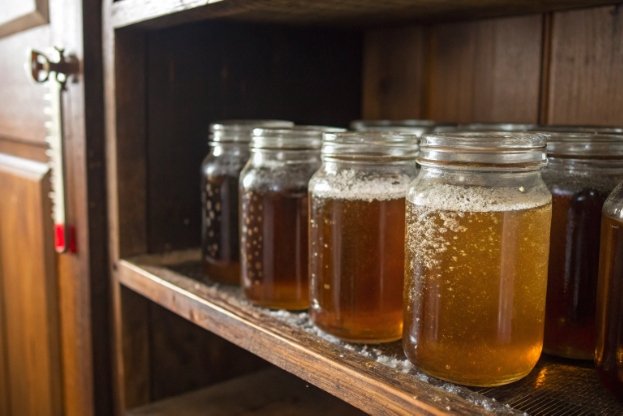
Why “forever safe” and “finite quality” can both be true
Honey is a low-moisture, acidic, sugar-dense food 2. That gives microbes a hard time. In a properly sealed glass jar, water activity stays too low for yeast growth. So safety holds. Quality is a separate path. Over months and years, color darkens and aroma shifts. Enzymes like diastase drop. HMF, a heat-and-age marker 3, rises. These are slow at room temperature and much faster with heat.
Practical shelf-life targets you can print on labels
| Label claim you print | What it communicates | Typical range | Notes for buyers |
|---|---|---|---|
| “Best by” date | Quality window | 18–24 months | Flavor and color peak. Not safety. |
| “Store at room temp” | Handling advice | 64–75°F | Avoid direct sun, avoid heat. |
| “If crystallized, warm gently” | Reassurance + remedy | Always | Place jar in warm water ≤40–45°C. |
| “Do not refrigerate” | Moisture control | Always | Cold drives crystallization; not harmful, just inconvenient. |
Signs of spoilage that really matter
- Fermentation: sour or alcohol smell, foaming, pressure hiss when opening.
- Layering with unusually runny top in a high-moisture batch.
- Mold on the surface (rare; often confounded with pollen scum—check smell).
When moisture is controlled and the cap is tight, these signs are unlikely. If they appear, discard or rework only if you can test moisture and yeast.
How do light, heat, and humidity affect honey stored in glass?
A perfect jar can still lose quality in a bad pantry.
Heat speeds darkening and HMF growth. Light bleaches or dulls aroma. Humidity pushes moisture into the headspace and can enable fermentation after opening. Glass helps, but conditions still matter.
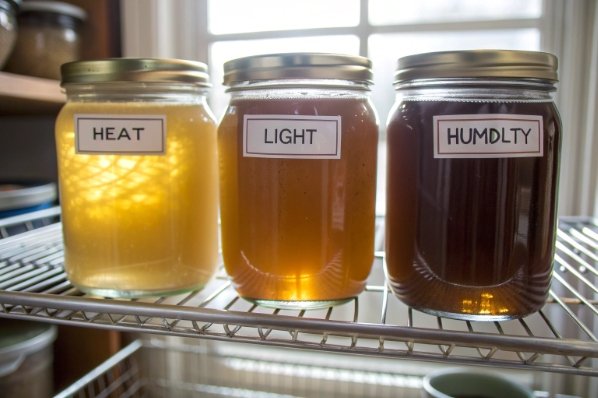
The enemies and the thresholds
| Factor | Mechanism | What to aim for | What to avoid |
|---|---|---|---|
| Heat | Speeds Maillard reactions, enzyme loss, HMF rise | 64–75°F (18–24°C) | >86°F (30°C) for long periods |
| Light | Photo-oxidation of aroma compounds | Dark pantry; amber glass | Direct sun, window shelves |
| Humidity | Raises water activity after opening | Dry storage; quick cap close | Wet utensils, steam, dishwashers nearby |
HMF and temperature in plain words
HMF rises with age and heat. Many markets use 40 mg/kg as a quality cap (80 mg/kg for some tropical origins). If storage sits near 34°C for months, a low-HMF honey can cross that line fast. Room temperature slows that curve. Amber glass reduces light stress but does not fix heat. So room temperature matters more than glass color for HMF control.
Crystallization, moisture, and why jars sometimes fizz
Crystallization is a natural sugar re-ordering 4. It does not mean spoilage. Yet it can raise the free water in the remaining liquid phase. If the honey started too wet, that liquid phase can pass the yeast growth threshold. Then mild fermentation can start. You can prevent this with good harvest practices and moisture checks before bottling 5.
Simple controls that work
- Use amber glass for retail shelves with light exposure 6.
- Keep filled cases off hot walls and away from windows.
- Maintain warehouse below 25°C when possible.
- Train staff to cap immediately after fill, wipe threads dry, and keep lids dry.
- Add desiccant in shipping cartons for humid routes.
Should I bottle raw or pasteurized honey for longer stability?
This choice affects flavor, clarity, and growth risks.
Raw honey keeps well when moisture is low and yeast counts are small. Pasteurization extends clarity and delays crystallization, but heat raises HMF and mutes aroma. Choose based on your moisture and your market.
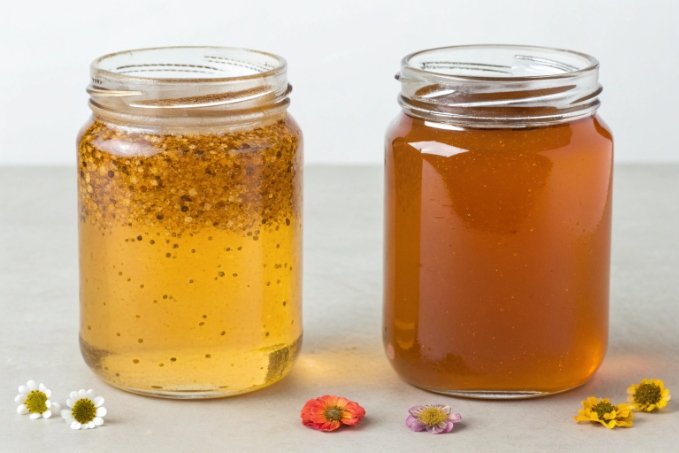
Raw honey keeps well when moisture is low and yeast counts are small, as long as it is properly handled and stored 7.
Trade-offs at a glance
| Attribute | Raw honey | Pasteurized honey (e.g., ~63–77°C short time) |
|---|---|---|
| Flavor and aroma | Brighter, more floral | Softer, sometimes “cooked” notes |
| Enzymes | Higher at fill | Reduced by heat |
| Clarity | May show fine particles, pollen | Clearer; microbubbles reduced |
| Crystallization rate | Faster in many varietals | Slower; heat dissolves crystals |
| Yeast reduction | None beyond filtration | Lower; helps with high-moisture lots |
| HMF impact | Lower at fill | Higher; rises with time + heat |
A simple decision path
- Measure moisture. If ≤17–18%, raw is usually stable and safe when sealed.
- Know the varietal. Rapeseed and clover crystallize fast. If your buyers want clear bottles, consider gentle heat and fine filtration.
- Check yeast and pollen load. If you see fermentation events in raw lots, pasteurization or UV can help.
- Protect quality. If you heat, do it short and controlled. Keep total heat exposure low, especially during storage.
A practical raw-first strategy
Start with raw bottling for low-moisture, low-yeast batches. Offer a second SKU that is gently warmed and finely filtered for the “always clear” market. Label both with clear storage tips and a crystallization note. This approach keeps aroma lovers happy while giving clarity seekers an option.
How do cap types and liners impact shelf life and leakage rates?
A great jar fails when the cap fails.
Choose closures that block moisture and oxygen, hold torque, and resist back-off in transit. Induction seals and well-mated liners cut leaks and keep aroma tight. Poor liners raise returns and HMF drift.
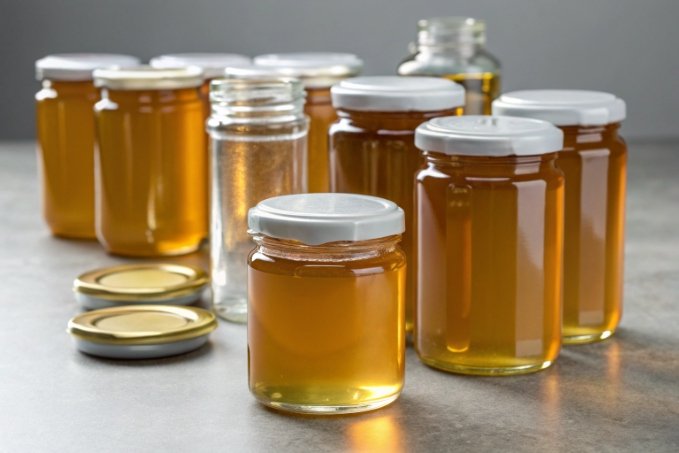
Closure basics you can rely on
| Closure | Where it shines | What to watch |
|---|---|---|
| Lug caps (twist-off) with plastisol | Classic look, strong seal on lug jars | Proper vacuum or hot-fill needed to seat liner |
| Continuous thread (CT) caps | Easy torque control, many liner options | Match finish (e.g., 58-400) precisely |
| Induction seal + CT cap | Highest tamper evidence, seal integrity | Needs compatible foil and flat land; requires sealer |
| Flip-top drizzlers | Convenience for squeeze use | Higher leak risk; not ideal for long storage |
Liner options compared
| Liner | Barrier & seal | Pros | Cons |
|---|---|---|---|
| Plastisol (lug) | Excellent on glass | Proven, cost-effective | Needs heat/vacuum to seat |
| Pulp/Vinyl (CT) | Good moisture barrier | Conforms to glass | Can absorb odor over time |
| Foam PE (CT) | Basic seal | Inexpensive | Lower barrier; not for long storage |
| Pressure-sensitive (PS) | Tamper-evident without equipment | Easy to apply | Seal weaker on rough rims |
| Induction foil (foil + pulp) | Superior seal and barrier | Leak-proof, tamper-evident | Requires induction sealer |
Torque, leaks, and real-world handling
Under-torque leads to back-off and moisture ingress. Over-torque can warp liners and warp caps. Set torque with a simple capper and verify with a handheld gauge. Keep finish threads clean. Wipe rims. Avoid sticky threads that trap sugar crystals, since they compromise seals later. When shipping, use dividers, shrink, and upright orientation. For hot-fill or warm-fill processes, test vacuum after cooling. For induction seals, confirm peel strength and seal continuity.
Shelf-life wins from better closures
- Lower humidity ingress after first opening.
- Less aroma loss over months.
- Lower leakage rates in courier systems.
- Fewer returns for crystallized “stuck cap” issues when you pair the right liner with the right finish.
Dive deeper: Room-temperature shelf life, in numbers and practice
Crystallization scares buyers, but it is only sugar structure change. Face it directly. Explain it at point of sale and on labels. Show the fix: warm water bath below 40–45°C, remove from heat when fluid. Simplicity builds trust. At the same time, set a quality window that you can defend. A common approach is a 24-month “best by” at 64–75°F. That window keeps color, aroma, and enzyme claims in a comfortable zone. Safety outlives the date when caps stay tight.
Moisture, water activity, and the “line you cannot cross”
Yeast struggles below a water activity near 0.60, which aligns with moisture in the high-teens. If your harvest runs 19–20% moisture, your risk is higher, especially after crystallization. You can blend down with drier lots. You can delay bottling until moisture drops. You can use gentle heat to dissolve seed crystals and filter out nucleation points, though heat cannot fix high moisture. A handheld refractometer is a tiny investment for a big risk cut. It pays back on the first avoided fermentation claim.
Enzymes, HMF, and how to keep quality claims honest
Enzymes like diastase drop with time and heat. HMF rises. Many buyers do not know these markers, but importers and co-packers do. Store filled product under 25°C. Do not pallet next to heaters. Use a first-in, first-out system. Split inventory between a fast-moving retail SKU and a bulk/foodservice SKU if your rotation slows. The same honey survives, but the faster channel maintains a tighter quality profile.
A quick table for actions you can take
| Risk | What you do before filling | What you do after filling |
|---|---|---|
| Fermentation | Check moisture; blend to ≤18% | Store cool and dry; train customers to cap tight |
| HMF rise | Minimize heating; short warm only | Keep cases away from heat; move stock quickly |
| Light fade | Use amber glass; avoid clear on sunny shelves | Keep displays away from windows |
| Leaks | Match finish and cap; set torque | Ship upright; use dividers; audit returns |
Dive deeper: Environment controls for light, heat, and humidity
Environment is your quiet co-packer. It works all day. It either protects your honey or erodes your claims. Heat is first to manage because it speeds every unwanted change. Even a few weeks at high temperatures can age your product months. So treat your warehouse and store room like a spice room. Keep air moving. Keep pallets off hot walls. Avoid stacked pallets to the ceiling when the roof bakes.
Light is simple to tame
Light damage focuses on aroma compounds and subtle color. An amber jar helps, especially for shelf displays. A kraft carton helps more. If your retail partners put jars near windows, give them a display card that explains why shade keeps flavor. Offer amber as the base SKU and clear only for gift packs with fast turn.
Humidity sneaks in when jars are open
Pre-opening, a good cap stops moisture ingress. Post-opening, behavior matters. Steam from a kettle, a wet spoon, or even a dishwasher can add enough water to push activity over the line. Your label can save the day. One line does the job: “Use a dry spoon. Cap tight after use.” For foodservice, switch to pump tops only if the pump can be kept dry and cleaned, or stick with narrow-mouth jars plus dry ladles.
Build a simple storage SOP
- Receive: Record lot, temperature, and warehouse zone. Reject hot pallets.
- Store: 18–24°C target, <60% RH if you can. Amber glass for light-exposed zones.
- Pick/Pack: Keep upright, add desiccant sachets for humid shipping lanes, add “Do not freeze” and “Keep from heat” labels.
- Retail: Provide a shelf talker about crystallization and gentle warming.
These moves cost little. They extend quality and reduce claims.
Dive deeper: Raw vs pasteurized—finding the right balance
This choice sets your brand voice. Raw promises nature and aroma. Pasteurized promises clarity and slow crystallization. Stability is strong in both when moisture is low. The difference lies in optics and timing.
When raw makes sense
Raw is best when your honey is low moisture and clean. Buyers who want varietal character taste the difference. You can support them with a small “crystallization is natural” icon and simple re-liquefy steps. You can go further with a fine mesh or gravity settling to reduce particles that seed crystals, while staying “raw” in spirit and in label claims where regulations allow.
When pasteurization helps
If your lots run near the moisture edge or if you see early fermentation in a climate you cannot control, pasteurization cuts risk. It also stretches the clear-window for gift and gourmet shelves. Keep temperatures as low as you can while hitting your clarity and microbial goals. Track HMF to prove you are not cooking the life out of it. Consider complementary technologies like microfiltration or short-time high-temperature with rapid cooling.
A hybrid plan that reduces regret
Bottle most of your production as raw in amber glass. For venues that insist on water-clear honey for months, offer a pasteurized line with induction-sealed caps and prominent tamper bands. Tell the truth on the label. Buyers will self-select. Your returns will fall. Your brand will feel coherent, not confused.
Dive deeper: Caps, liners, torque, and leakage in real shipments
Closures are your last defense. The right match between jar finish and cap makes shelf life predictable. The wrong match turns pallets into a sticky mess. Start with finish codes. A 58-400 CT cap needs a 58-400 jar. A 63-TW lug cap needs a 63-TW finish. Mixing close sizes often “sort of” threads on the bench and fails in transit.
Liners and their behavior with honey
Honey is viscous, aromatic, and tacky. It likes to cling to threads. It can carry aroma into porous liners. Pulp/Vinyl liners conform well to glass and hold torque, but they can slowly absorb scent. Foam PE liners are fine for low-risk, fast-turn channels, yet they are not great for long storage or hot corridors. Plastisol in lug caps makes a great hermetic when you have a little heat or vacuum to seat it. Induction seals give you the best barrier and tamper evidence, plus they block aroma loss.
Torque and cap stability
Set torque by spec, not by feel. Use a simple bench capper for repeatability. Then audit with a torque gauge one hour after capping and again after 24 hours. Glass threads differ by mold and batch, so test each new jar lot. Record results. If you get back-off events, increase liner compressibility or reduce thread friction by keeping threads clean and fully dry before capping.
Shipping realities and leak testing
Do an upside-down leak test on a sample from each run. Hold for 24 hours at room temperature. For induction seals, also do a peel test for a few jars. When shipping by courier, use partitions, kraft wrap, and “This Side Up” labels. Palletize with slip sheets. Avoid top-stacking under roof heat. These small choices reduce leakage rates and protect shelf life because the seal stays intact from plant to pantry.
Conclusion
Honey stays safe for years in sealed glass; control moisture, temperature, light, and cap integrity to keep quality strong.
Footnotes
-
National Honey Board honey storage FAQ – guidance on shelf life and storage conditions. ↩︎ ↩
-
Scientific review of honey composition and properties – explains acidity, low moisture, and natural preservation. ↩︎ ↩
-
Apimondia overview of HMF as a honey quality marker – links heat, age, and quality limits. ↩︎ ↩
-
Michigan State University guide to safely decrystallizing honey – explains crystallization and gentle warming methods. ↩︎ ↩
-
Practical advice on honey moisture testing and storage – helps prevent fermentation and spoilage. ↩︎ ↩
-
Why amber glass protects foods from light damage – summarizes UV-blocking benefits for packaged honey. ↩︎ ↩
-
National Honey Board “Honey Science” overview – covers raw honey handling and stability basics. ↩︎ ↩






