
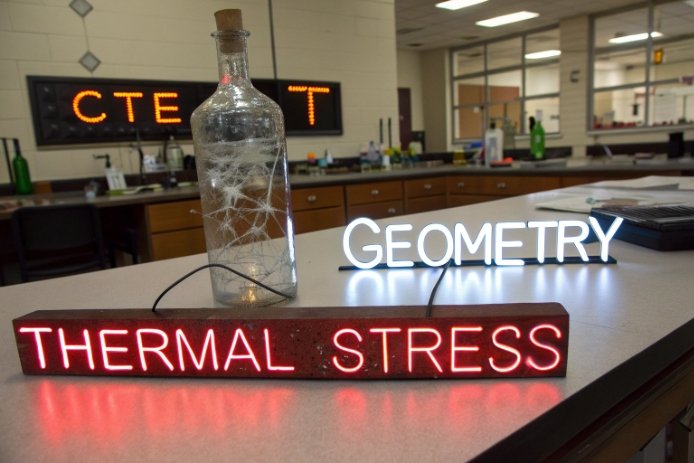
Thermal cracks can hit even when the bottle looks perfect. The weak link is often a hidden stress spike during fast heating or cooling.
Thermal shock rating is the bottle’s ability to survive a temperature change without cracking. CTE shapes thermal stress, but design, thickness uniformity, and residual stress usually decide whether the rating is truly high.
Thermal expansion and thermal shock: the core link
Thermal expansion performance and thermal shock rating 1 are linked through thermal stress. When a bottle heats unevenly, the hot zone expands first. The cooler zone resists. That mismatch creates stress. A simple way to express the idea is: thermal stress rises with elastic stiffness 2 and CTE, and it rises with the temperature difference across the wall. Glass fails when tensile stress becomes too high at a weak point.
In practical terms, thermal shock rating is often reported as a maximum safe ΔT under a defined test method. CTE matters because it sets how much strain the glass tries to create per degree. Lower CTE usually helps because the same ΔT creates less strain. Still, a bottle does not crack in a lab equation. It cracks at a heel corner, at a shoulder transition, or at the finish, where geometry and thickness drive stress concentration. Residual stress 3 from poor annealing can also pre-load the bottle, so a smaller thermal event can cause failure.
Another key point is that a “rating” is only meaningful when the test is defined. A hot-fill event heats from the inside. A quench test cools from the outside. Pasteurization and sterilization add cycles. Each one creates different gradients and different crack origins. So the link between CTE and rating stays true, but it is filtered through heat transfer and design reality.
What CTE controls directly
-
How much thermal strain is created per degree temperature change
-
How sensitive the bottle is to the same ΔT when all other factors stay equal
What CTE does not control
-
Where the temperature gradient forms
-
How fast the gradient forms
-
How much residual stress the bottle already carries
-
How sharp the stress concentration is at design transitions
| Driver | What it changes | Why it matters for thermal shock rating | Typical control owner |
|---|---|---|---|
| CTE (composition) | strain per °C | sets baseline thermal stress | batch and melt control |
| Thickness uniformity | gradient size + stress hinges | thick zones lag, thin zones race | design + forming |
| Geometry (radii, push-up) | stress concentration | cracks start at sharp transitions | design + tooling |
| Residual stress (annealing) | starting stress level | pre-load reduces safety margin | lehr + QA |
| Process ramp rate | ΔT per second | faster ramps create higher stress peaks | filling/retort process |
The next sections answer the common decision questions: whether lower CTE always equals higher rating, how design and stress change performance beyond CTE, which test methods are used, and how to write a purchase spec that ties everything together.
If the goal is fewer cracks, the best approach is to manage CTE and stress in one system, not as separate topics.
A lower CTE helps, but a stable thermal shock rating comes from stability across recipe, design, annealing, and the customer process.
Is a lower CTE always equal to a higher thermal shock rating for glass bottles?
Cracking problems often lead to one request: “Give a lower CTE bottle.” That sounds simple, but the result can still disappoint.
Lower CTE usually improves thermal shock rating, but it is not a guarantee. Thermal shock rating also depends on strength, thickness gradients, heat transfer, and residual stress, so a low-CTE bottle can still fail if those factors are weak.
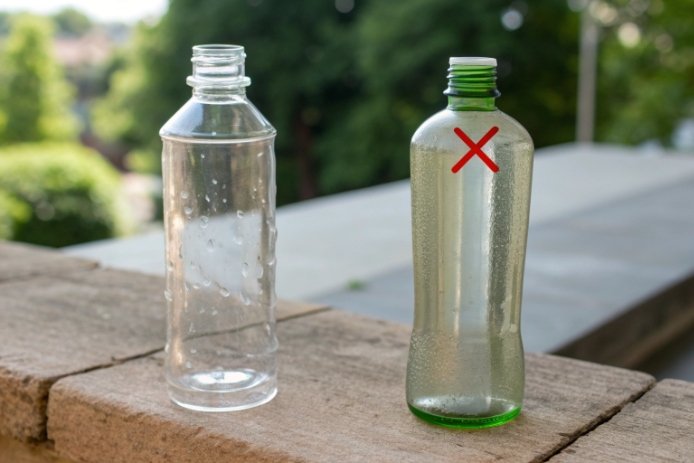
Lower CTE reduces the thermal strain created by a given temperature change. This is why borosilicate families 4, with much lower CTE than soda-lime, are often chosen for harsh thermal cycles. Still, “rating” is a pass/fail outcome under a specific heating or cooling pattern. The same low-CTE bottle can fail if the design concentrates stress, if the bottle is under-annealed, or if the process creates extreme gradients.
Lower CTE can also come with trade-offs that affect the rating indirectly. If a recipe change raises viscosity too much, the furnace may run hotter to keep forming stable. That can increase seed risk, cords, or stones. In thermal shock, defects matter because they act as crack starters. A glass with a lower CTE but a higher stone rate may perform worse in real life.
Another common trap is thickness. A thick-bottom premium bottle can crack more than a uniform lightweight bottle, even if both share the same CTE. The thick base heats and cools slowly, so gradients stay high. Thermal shock rating for a container is not only a material rating. It is a product rating.
A practical way to decide is to compare two options under the same test:
-
Option A: keep soda-lime, improve annealing, control thickness, and manage ramps
-
Option B: move to lower CTE glass family, and still control annealing and thickness
Option B can raise the safety margin, but Option A can often solve hot-fill failures at lower cost when the process is not extreme.
When lower CTE helps the most
-
Fast inside heating and fast outside cooling
-
Repeated thermal cycles
-
High peak temperatures or large ΔT
When lower CTE is not enough
-
Sharp heel corners and thick base mass
-
High residual stress from lehr drift
-
Inclusions, cords, or devit stones
-
Uncontrolled cooling sprays or stop-start conditions
| Scenario | CTE change impact | Real limiter | Best first move |
|---|---|---|---|
| Mild hot-fill cracks | moderate | residual stress + ramp | annealing + cooling control |
| Retort sterilization failures | strong | ΔT severity | consider borosilicate, plus design checks |
| Cracks only in certain cavities | low | uneven annealing/cooling | cavity-level stress control |
| Cracks start at heel corner | low | geometry stress concentration | increase radius, smooth transitions |
| Cracks with many stones | negative | crack starters | reduce inclusions before changing CTE |
Lower CTE is a powerful tool, but the best thermal shock rating comes from the full stack: clean glass, low residual stress, smooth design, and controlled ramps. A purchase decision should treat CTE as one clause, not the whole contract.
How do bottle design, wall thickness uniformity, and residual stress affect thermal shock performance beyond CTE?
A bottle cracks where stress stacks up. Design and annealing decide where that stack becomes dangerous.
Design and thickness uniformity control thermal gradients and stress concentration. Residual stress from cooling can pre-load the bottle. Together they can dominate thermal shock performance, even when the composition-based CTE is correct and stable.
Thermal shock failure is often a heel story. Thick-bottom designs create slow heat flow. The inner surface warms first during hot-fill, while the outer base stays cool due to conveyor contact and airflow. The hot layer wants to expand. The cool layer resists. This creates tensile stress at the heel and base corner, especially where the wall transitions from thick to thin.
Thickness uniformity matters because it controls how evenly the bottle heats. A thin wall heats quickly and more evenly. A thick wall heats slowly and builds a larger temperature gradient. The worst condition is not simply “thick.” It is uneven. A step change in thickness acts like a stress hinge. A bottle can be lightweight and still crack if one side is thicker than the other, because the bottle expands unevenly around the circumference.
Residual stress is the hidden amplifier. A bottle leaves the lehr with some stress pattern. Good annealing keeps that stress low and symmetric. Under-annealing leaves tensile stress locked into the glass, often at the finish and heel. During hot-fill or sterilization, thermal stress adds to that residual stress. The bottle can crack at a lower ΔT than expected, and the failures can look random because stress varies by cavity, lane position, or airflow.
Design choices that often raise thermal cracking risk:
-
sharp heel radii and sharp base corners
-
heavy push-up with abrupt transition lines
-
thick finish rings with rapid cooling at capping
-
embossing that creates local thickness peaks
Process choices that often raise risk:
-
cold rinses immediately after hot-fill
-
fast cool-down steps in pasteurization or retort
-
frequent line stops that create overheating, then shock cooling
-
uneven lehr loading or airflow imbalance
| Factor beyond CTE | What it does to stress | Common crack origin | Practical control |
|---|---|---|---|
| Thick base mass | increases ΔT across wall | heel/base corner | reduce mass, improve radii |
| Thickness step change | creates stress hinge | transition line | smooth thickness gradient |
| Shoulder transition | concentrates stress | shoulder checks | soften geometry, stable parison |
| Residual stress | reduces safety margin | finish and heel | lehr profile + stress inspection |
| Uneven circumference thickness | uneven expansion | side cracks, splits | cavity tuning, alignment |
To improve thermal shock without changing glass family, the highest ROI usually comes from:
1) tightening thickness variation,
2) reducing residual stress through better annealing,
3) smoothing the highest-risk radii and transitions,
4) then tuning hot-fill or retort ramps.
This is how thermal shock performance becomes stable, not only “sometimes passing.”
Which thermal shock standards and test methods are used to rate glass containers for hot-fill and sterilization?
A “thermal shock rating” only means something when the test method is defined. Without that, two suppliers can claim success and still ship different risk.
Glass container thermal shock is often evaluated with standardized methods like ASTM C1525, plus customer-specific thermal cycling that replicates hot-fill, pasteurization, or sterilization profiles. The best method matches the real heating direction, ramp rate, and cooling steps of the customer line.
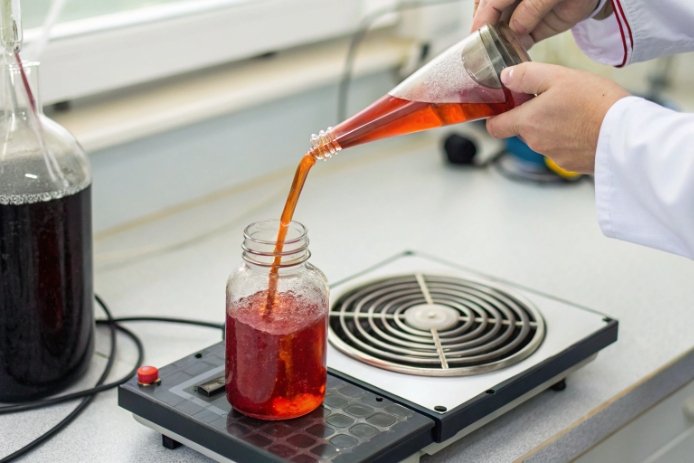
There are two common approaches to rating container thermal shock:
1) Standardized thermal shock test for glass containers
A container-focused standard test gives a structured way to compare designs and batches. ASTM C1525 5 is widely referenced for determining thermal shock resistance of glass containers. It typically uses a controlled temperature difference and defined procedure to identify the ΔT that causes failure under set conditions. This helps internal QA and supplier comparisons, because the method is consistent.
Even with a standard method, it is important to remember the limitation: the test may not match the customer’s exact heat path. Hot-fill heats from the inside. Some tests simulate heating or cooling from outside. The ranking can shift if the direction changes.
2) Application-specific hot-fill / pasteurization / retort simulation
Many container programs rely on process simulation tests because the real risk comes from the real cycle:
-
Hot-fill simulation: controlled fill temperature, hold time, and defined cooling or rinse steps, including stop-start events
-
Pasteurization simulation: controlled heat-up and cool-down cycle, often repeated cycles
-
Sterilization/retort simulation: full cycle replication, including pressurized stages and aggressive cool-down steps
This approach gives the most actionable rating because it answers the real question: “Will this bottle survive the customer line?”
Supporting tests that make thermal shock results trustworthy
Thermal shock testing is stronger when paired with:
-
residual stress inspection by polariscope
-
thickness mapping at heel, shoulder, and finish
-
cavity-level traceability (because one cavity can be the failure driver)
| Test type | Best use | Output | What it misses if used alone |
|---|---|---|---|
| ASTM C1525-style rating | compare containers under one method | ΔT threshold under standard conditions | may not match customer ramps |
| Hot-fill simulation | beverages, sauces | pass/fail at real fill profile | needs strict control of cooling conditions |
| Pasteurization cycling | repeat-cycle products | survival over cycles | may not expose worst stop-start shocks |
| Retort/sterilization replication | harsh thermal programs | real-world survival | requires careful lab equipment control |
| Polariscope stress check | every batch control | stress pattern and trend | does not prove survival by itself |
For purchasing and QA, the best practice is to define one standard comparison test and one application simulation test. That creates a stable baseline and also a real-world proof.
How can you specify CTE, annealing quality, and thermal shock testing together in a purchase specification for glass bottles?
Many purchase specs list only dimensions and basic strength. That leaves thermal risk hidden until the first customer complaint.
A strong purchase specification combines: a CTE requirement with method and temperature range, an annealing quality limit using stress inspection, and a thermal shock test requirement that matches the customer process with clear sampling rules.

A practical purchase specification should treat heat resistance as a three-part system:
1) CTE clause: define material baseline and reporting rules
-
Glass family: soda-lime-silica, borosilicate class, or aluminosilicate grade
-
Mean linear CTE range, and the exact temperature interval (example: 20–300°C)
-
Sampling location and preparation (specimen from bottle sidewall or base, annealed specimen)
This makes CTE comparable across suppliers and across time.
2) Annealing quality clause: set a residual stress limit and inspection method
-
Stress inspection tool: polariscope or strain viewer
-
Inspection zones: finish, shoulder, heel, base
-
Acceptance criteria: reference images and a defined max stress pattern level
-
Frequency: per shift and per cavity rotation
-
Escalation rule: lehr change, mold change, or line speed change triggers extra checks
This protects the thermal shock margin that CTE alone cannot provide.
3) Thermal shock clause: prove performance under real cycles
-
Define the customer profile: fill temperature, hold time, cooling steps, and worst-case stop/start event
-
Define the pass/fail: zero cracks under X bottles tested, or a max failure rate with confidence rules
-
Define cycle count for pasteurization/retort
-
Define conditioning and handling between cycles
4) Sampling and traceability clause: prevent “average pass, worst fail”
-
Sample across cavities and time windows (start/middle/end of run)
-
Include worst-case thickness group (heavy base, high variation)
-
Require lot ID and cavity ID marking or traceability
| Spec section | What to write | Why it prevents disputes | Owner in execution |
|---|---|---|---|
| CTE requirement | range + method + interval | apples-to-apples comparison | lab + QA |
| Annealing limit | stress pattern limit + zones | controls pre-load stress | lehr + QA |
| Thermal shock test | method + profile + pass rule | proves real survival | QA + customer engineering |
| Sampling plan | cavity/time coverage | catches weak cavities | QA + production |
| Change control | triggers for re-qualification | prevents drift after changes | QA + engineering |
A simple template clause set can look like this in plain language:
-
“Mean linear CTE shall be X–Y × 10⁻⁶/K when measured over A–B°C by Method M.”
-
“Residual stress shall meet the approved polariscope reference limit at finish, shoulder, heel, and base.”
-
“Bottles shall pass the defined hot-fill/retort thermal cycle with no cracking under the stated sample plan.”
When these clauses are combined, heat resistance becomes a managed requirement, not a hopeful assumption.
Conclusion
Thermal shock rating is built on CTE, but it is controlled by gradients, design, and residual stress. Specify all three, and verify with stress and thermal testing before shipment.
-
The ability of a material to withstand sudden temperature changes without failing. ↩
-
Stiffness property that determines stress generated by expansion. ↩
-
Internal stress remaining in glass after cooling processes. ↩
-
Glass types designed for high thermal shock resistance. ↩
-
Standard test method for glass container thermal shock resistance. ↩
-
ISO standard for determining mean linear thermal expansion of glass. ↩






