

Many people talk about thermal shock and lehr curves, but very few really look at CTE data. This is risky, because one wrong assumption about expansion can damage a whole batch of bottles.
For packaging glass, we usually measure CTE by push-rod dilatometry under ASTM/ISO-type methods over a defined range such as 20–300 °C, and report mean α in ppm/°C, using standards like ASTM E228 and ISO 7991 to keep data accurate and comparable.
In practice, most bottle labs anchor their procedure to the ASTM E228 push-rod dilatometer method 1{#fnref1} and the ISO 7991 mean linear thermal expansion method for glass 2{#fnref2}. When CTE is measured in a stable, consistent way, it becomes a powerful tool. It helps us tune annealing, design hot-fill cycles, and keep closures, liners, and coatings safe under thermal stress. When the method is weak, CTE looks like “lab noise” and no one trusts it. So method and standards matter as much as the number itself.
Which methods—push-rod dilatometry or thermomechanical analysis—are most common?
Many engineers know the CTE value on a data sheet, but they do not know how the lab measured it. This is a problem, because two different methods on the same glass can give slightly different numbers.
For bottle glass, classical push-rod dilatometry is still the main method for CTE, guided by ASTM E228, ISO 7991, DIN 51045 and related EN 821 standards. Thermomechanical analysis (TMA) is used too, but more often for polymers, coatings, and special glass work.
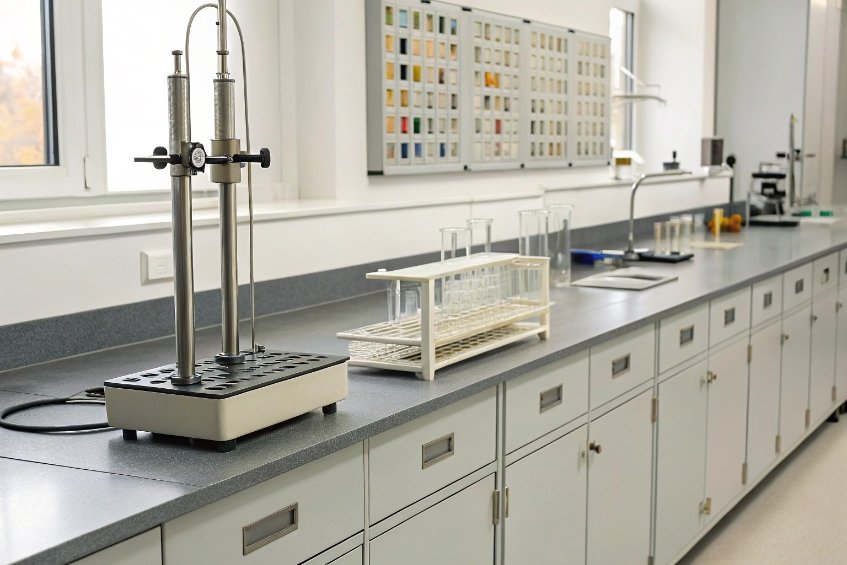
How push-rod dilatometry works for bottle glass
In push-rod dilatometry, we place a small bar of glass in a furnace. A low-force push rod rests on the sample. As the furnace heats or cools, the sample gets longer or shorter. The push rod transfers this movement to a displacement sensor. From this, we get length change versus temperature.
Key details for packaging glass:
- The push rod is often made from fused silica or alumina, so its own expansion is small and well known.
- The furnace can cover a wide range, from room temperature up to and past the glass transition, but CTE for bottles is usually reported in the elastic, solid-like range well below Tg.
- The method measures linear expansion, so we cut the sample as a simple prism or rod.
In many instrument setups (especially in EU supply chains), labs also reference documents like DIN 51045 (dilatometer method) listings 3{#fnref3} and EN 821-1 thermal expansion standards 4{#fnref4} to keep apparatus requirements and calibration expectations aligned.
Thermomechanical analysis uses a similar idea, but it often runs with a lower load, more flexible sample geometry, and can combine expansion with other events such as softening or creep. It is very useful for coatings, seals, and thinner glass parts.
For bottle plants, the picture is simple:
| Method | Typical Use in Packaging Glass | Main Standards Involved |
|---|---|---|
| Push-rod dilatometry | Routine CTE check on soda-lime bottle glass | ASTM E228, ISO 7991, DIN 51045 |
| TMA (thermomechanical) | Special studies, thin glass, coatings, R&D | ISO 11359 series, ASTM E831 |
| Interferometry / optical | High-precision lab work, specialty compositions | ASTM C1300 and related methods |
So in daily production work, when someone in the plant says “we measured CTE”, they almost always mean a push-rod dilatometer that follows something close to ASTM E228 or ISO 7991.
What temperature ranges and ramp rates are used for packaging glass?
If the lab sets the wrong temperature range or ramp, the CTE result no longer matches real bottle behavior. It may look fine on paper, but it does not help with hot-fill, pasteurization, or lehr settings.
For soda-lime bottle glass, CTE is usually reported as a mean value over a range like 20–300 °C with controlled heating rates, often 2–5 °C/min, keeping well below transformation temperature so the glass stays in the elastic, solid-like state.

Typical CTE ranges and thermal programs
Soda-lime bottle glass has a CTE of roughly 8–9 × 10⁻⁶ K⁻¹ in the elastic range. But this is never just one number. It is always tied to a temperature window and a ramp program.
For packaging glass, common practice looks like this:
- Start temperature: close to room temperature, often 20 °C.
- End temperature: 250–300 °C, sometimes 350 °C, but always below Tg and the annealing point.
- Heating rate: 2–5 °C/min is typical. Some labs use 10 °C/min for faster work, but lower rates reduce gradients and noise.
- Cooling cycle: sometimes measured as well, to check hysteresis and verify that the glass is stable and stress-free.
The mean CTE α is then calculated over this window by:
[
\alpha = \frac{\Delta L}{L_0 \cdot \Delta T}
]
where ΔL is the change in length between the two temperatures, L₀ is the original length at the lower temperature, and ΔT is the temperature difference.
In practice, the instrument records continuous data and the software fits a curve, so we can also report segment values such as 20–100 °C or 100–300 °C if needed.
Typical thermal programs for bottle glass:
| Test Type | Range (°C) | Heating Rate (°C/min) | Purpose |
|---|---|---|---|
| Standard CTE (mean value) | 20–300 | 2–5 | Specs, closure matching, lehr input |
| Low-range CTE | 20–150 | 2–5 | Cold-end shock, refrigeration tests |
| Extended CTE (near Tg, R&D) | 20–500+ | 2–3 | Study of transition, new recipes |
By keeping the test in the solid-like range and using moderate ramp rates, we get CTE data that matches how a bottle behaves in hot-fill, pasteurization, and normal service, without mixing in softening or viscous effects.
How should samples be prepared and reported (ppm/°C, 20–300 °C)?
If we cut samples the wrong way, or report CTE without a clear range, the number loses meaning. Two labs can test the same glass and still “disagree” simply because they used different sample shapes or temperature windows.
For CTE on bottle glass, we usually cut small bars from the wall or finish, anneal them to remove stress, measure along the main forming direction, and report the mean CTE α in ppm/°C for a stated interval, for example: α20–300 °C = 8.9 × 10⁻⁶ K⁻¹.

Practical sample prep and reporting for bottle plants
In real production, we rarely test whole bottles. We cut samples from them. Good practice follows a few simple rules.
Sample preparation
-
Sampling location
- Take pieces from the body wall for general CTE.
- For special checks, take samples near the finish or other critical areas where stress or special composition might differ.
-
Cutting and shaping
- Cut strips with a diamond saw or water-cooled blade to avoid local heating.
- Grind and polish the surfaces so the sample has flat, parallel faces and clean ends.
- A common size is a few millimeters thick and several millimeters long, as required by the dilatometer.
-
Stress removal
- Re-anneal the small bars using a controlled cycle, then cool them slowly.
- This removes residual stress from both bottle forming and cutting, so the CTE curve reflects true composition, not locked-in strain.
-
Reference length
- Measure the length at room temperature with a caliper or the instrument’s own pre-load length measurement.
How to report results
Once the instrument records the expansion curve, we can calculate and report:
- The mean linear CTE over a defined range.
- Any non-linearity or slope change in the tested interval.
A clear report line looks like this:
Soda-lime bottle glass: α = 8.7 × 10⁻⁶ K⁻¹ (20–300 °C, heating, 5 °C/min, ASTM E228)
Key reporting points:
| Item | Good Practice Example |
|---|---|
| Units | ppm/°C or ×10⁻⁶ K⁻¹ |
| Temperature range | 20–300 °C (or other clearly stated interval) |
| Direction | Axial or radial (if anisotropy is of interest) |
| Scan mode | Heating, or heating/cooling both |
| Method / standard | ASTM E228, ISO 7991, DIN 51045, etc. |
In bottle qualification and SPC, we track small shifts in this mean CTE. A drift of even 0.1–0.2 × 10⁻⁶ K⁻¹ can indicate a change in batch chemistry, such as alkali or lime content, and can influence thermal shock performance and closure stress.
Which ASTM/ISO protocols guide CTE testing and data accuracy?
Without clear standards, every lab would run CTE tests in its own way. Then buyers, closure suppliers, and coating partners could not compare data. This is why we lean on ASTM, ISO, DIN, and EN documents when we set up methods.
For glass bottles, CTE tests usually follow ASTM E228 for push-rod dilatometry, ISO 7991 for glass in the solid state, and DIN 51045 / EN 821 series for ceramic and glass dilatometry, with ISO 11359 and ASTM E831 used when TMA is involved.
Main standards used in glass bottle CTE work
For soda-lime packaging glass, we mainly see four groups of standards.
1. Push-rod dilatometry standards
These form the core for bottle glass:
- ASTM E228 – Standard test method for linear thermal expansion of solid materials by push-rod dilatometer.
- ISO 7991 – Determination of the mean linear CTE of glass in the solid state, well below the transformation temperature.
- DIN 51045 / EN 821 – Widely referenced by instrument makers and EU test labs for dilatometry practice.
These documents give rules for calibration using reference materials with known CTE, such as standard glasses or metals. They also set requirements for temperature measurement accuracy and uniformity along the sample.
2. Thermomechanical and optical methods
When we use TMA or optical systems, we look at:
- ASTM E831 thermomechanical analysis (TMA) expansion method 5{#fnref5}
- ISO 11359-2 TMA method for linear thermal expansion 6{#fnref6}
- ASTM C1300 interferometric thermal expansion method 7{#fnref7}
These methods are more common in R&D or in suppliers that develop special glass types, frits, or advanced coatings that must match bottle CTE very closely.
3. Accuracy, uncertainty, and comparability
Standards do not only tell us “how to run” the test. They also:
- Require regular calibration of both the furnace and the displacement system.
- Set limits on acceptable temperature gradients across the sample.
- Describe how to estimate measurement uncertainty and report it.
This matters a lot in supply chains. For example:
- A bottle maker and a closure supplier may both test CTE on their own materials.
- If they both follow aligned documents, their data sets are more comparable.
- This reduces risk of leaks or stress cracks when the filled product goes through heat cycles such as pasteurization or hot-fill.
In short, standards are the link between the lab and the filling line. They turn a CTE curve from one plant into a number that partners in other countries can trust and use in their own design work.
Conclusion
CTE testing looks like a small lab detail, but it shapes annealing, thermal shock resistance, and closure safety. When we follow solid methods and standards, CTE becomes a reliable tool for safer, more stable glass bottles.
Footnotes
-
Official scope and requirements for push-rod dilatometry CTE measurement used for rigid solids. ↩ ↩
-
ISO method defining mean linear expansion of glass in the elastic, solid-like state below transformation temperature. ↩ ↩
-
DIN reference commonly cited for dilatometer-based thermal expansion testing procedures and practice in labs. ↩ ↩
-
EN standard listing for thermal expansion measurement by dilatometry in technical ceramic materials and related setups. ↩ ↩
-
ASTM standard describing CTE measurement using thermomechanical analysis (TMA) techniques. ↩ ↩
-
ISO TMA method for linear thermal expansion, useful when evaluating coatings, polymers, or hybrid layers on glass. ↩ ↩
-
Interferometric method reference used for high-precision thermal expansion of glassy frits and ceramic materials. ↩ ↩






