
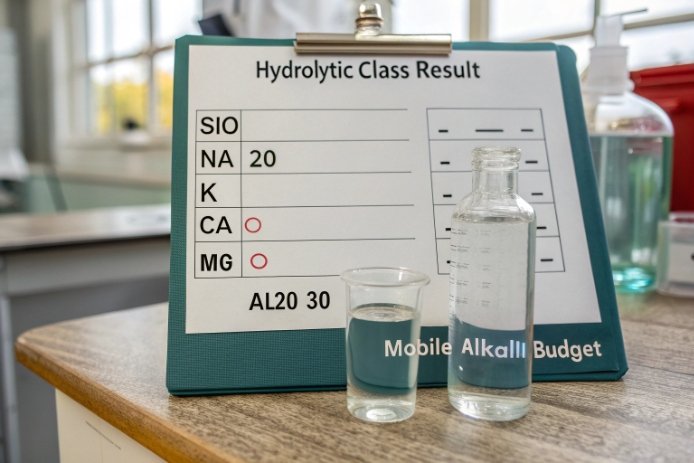
Hydrolytic failures hide until filling. Then pH drifts, haze shows up, and hospitals reject lots. A tighter recipe and cleaner cullet stop the damage early.
Hydrolytic class is a performance grade that reflects how much alkali and other ions a bottle’s inner surface releases into water under a defined test. Composition drives it through total alkali, silica-to-modifier balance, stabilizers (CaO/MgO), and network strength (Al₂O₃/B₂O₃).
Hydrolytic class is a surface-response that your oxide balance creates?
What “hydrolytic attack” looks like on real bottles
Hydrolytic attack starts as ion exchange 1. Water pulls alkali ions (mainly Na⁺ and K⁺) out of the surface and replaces them with H⁺. This can cause pH shift in the product and create a hydrated surface layer. The surface layer can get softer and more reactive. If the product sits long enough, the reaction can expose weak spots, especially where the glass has cords, phase-separated streaks, or devitrified particles 2. That is why two bottles with the “same recipe” can still test differently if melt homogeneity is poor.
Why composition shows up as “extractables”
Hydrolytic class is basically the bottle’s extractables 3 behavior under controlled conditions. The glass network decides how easily ions move. Higher SiO₂ at a fixed modifier level improves hydrolytic resistance because the network has fewer weak sites. Lower total alkali reduces leachable ions, so the bottle moves toward a better class. CaO and MgO stabilize the Na₂O–SiO₂ network and reduce ion exchange, so the surface releases less alkali during testing. Moderate Al₂O₃ strengthens the network and improves hydrolytic behavior, but it must stay inside a meltable window or it can create unmelted specks that ruin uniformity.
What procurement should connect to hydrolytic class
A hydrolytic class target should never stand alone. It should sit on top of oxide windows, cullet rules, and melt-quality controls. Excess alkali from cullet can downgrade hydrolytic class by enriching the surface with easily extractable ions. High sulfate or ionic fining residues can also increase extractables and worsen the apparent class. Compositions that avoid devitrified or alkali-rich secondary phases keep leachable sites low and stabilize the class.
| Composition lever | What it changes at the surface | Hydrolytic class direction | Production watch-out |
|---|---|---|---|
| Higher SiO₂ / lower modifiers | fewer weak sites, tighter network | improves | higher melting demand |
| Lower (Na₂O+K₂O) | fewer mobile ions to exchange | improves | harder melting, viscosity rise |
| Balanced CaO/MgO | stabilizes non-bridging oxygens | improves | devit risk if ratio drifts |
| Moderate Al₂O₃ | stronger network, lower leaching | improves | unmelted alumina if poor mixing |
| Lower fining residues (SO₃/others) | fewer ionic extractables | improves | fining must still be effective |
The key point is simple: hydrolytic class is a measured surface outcome, but the surface outcome is built by composition and melt discipline.
A clear definition of the classes makes buyer–supplier specs easier, so the next section lays out what Class (Type) I–III actually mean for bottles.
What are hydrolytic classes I–III for bottles?
Many teams use “Class I–III” like a shortcut. Then a lab report arrives with different labels, and everyone argues about what was tested.
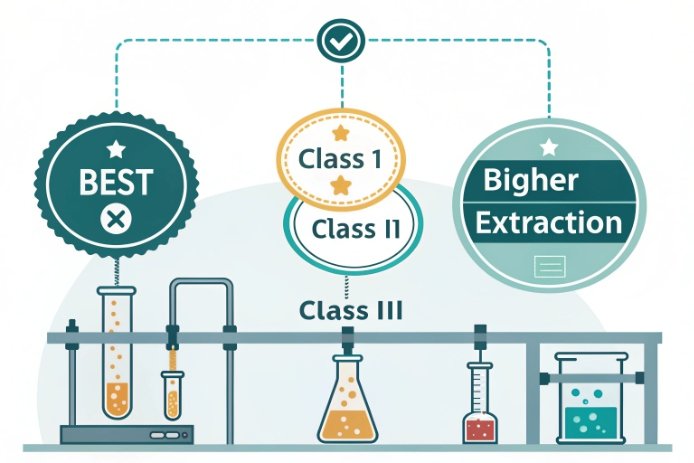
In pharma packaging language, Type I has the highest hydrolytic resistance, Type II is surface-treated soda-lime with improved inner-surface resistance, and Type III is standard soda-lime with moderate resistance. The exact class is assigned by standard test methods, not by guesswork.
Type I, II, and III in buyer language
Type I is typically associated with borosilicate 4 or other high-performance compositions that meet the highest hydrolytic resistance requirements. Type II is usually soda-lime glass 5 that has been treated to improve the inner surface hydrolytic resistance, so it can behave closer to Type I at the surface. Type III is untreated soda-lime glass that has moderate hydrolytic resistance and is used widely where the product is less sensitive.
A practical way to explain it to non-lab teams is:
-
Type I = the glass itself is highly resistant.
-
Type II = the base glass is soda-lime, but the surface is upgraded.
-
Type III = standard soda-lime surface performance.
Why standards matter more than the label
Hydrolytic resistance is commonly determined using standardized tests for inner surface and sometimes glass grains. Different standards use different class names, so the purchase spec must state the method. For bottles, the inner-surface method is often more relevant than grain testing because products touch the inner surface, not crushed grains.
Where each type is commonly used
Type I is often demanded for the most sensitive or regulated liquids. Type II is common when the customer wants improved surface resistance but still wants soda-lime economics and forming flexibility. Type III is used for many food, beverage, and general packaging products where long-term leaching risk is lower and the product has better tolerance.
| Class (Type) | Typical glass route | Hydrolytic resistance level | Common use case | Key note for buyers |
|---|---|---|---|---|
| Type I | borosilicate / high-resistance families | highest | injectables, critical pharma liquids | verify by method and lot |
| Type II | treated soda-lime surface | high at inner surface | many parenterals 6 and sensitive aqueous | surface treatment must be stable |
| Type III | standard soda-lime | moderate | many non-parenterals and general packaging | product compatibility still matters |
This is why contracts should specify both the Type and the test method used to assign it.
The next question is why hospitals and fillers push so hard for Class I surfaces, even when Type II or Type III can look fine in short tests.
Why do hospitals and fillers demand Class I surfaces?
A hospital does not want a “maybe.” A filler does not want recalls. Hydrolytic instability is a slow failure that can become a fast crisis.
Hospitals and sterile fillers demand Class I (Type I) surfaces because they minimize ionic extractables, reduce pH drift, and lower the risk of instability in sensitive formulations. Type I also provides the widest safety margin across sterilization, long storage, and different drug chemistries.
Risk is higher in medical use, even if the bottle looks perfect
In medical and sterile filling, small changes matter. A small rise in pH can destabilize an active ingredient. A small ion release can trigger precipitation or interaction with buffers. Even when the liquid is stable, regulators expect proof that container-contact risks are controlled. Type I surfaces give the most predictable performance across many products, so hospitals and pharmaceutical suppliers choose it as the default safe option.
Sterilization and heat cycles raise the surface challenge
Many medical containers face heat and moisture cycles. Heat accelerates ion migration. Water attack becomes faster at higher temperature. So a container that seems fine at room temperature can show stronger extractables after sterilization 7 or accelerated aging. This is a big reason Type I is used as a “lowest risk baseline.”
What this means for procurement and change control
Hospitals and fillers often require strict change control 8 because surface performance can shift with cullet chemistry, furnace redox, and fining residues. A supplier can accidentally change surface behavior by changing cullet sources or raw materials. This is why Type I programs usually require stronger lot traceability, retained samples, and re-validation triggers.
| Buyer segment | Why they push Class I | Failure they fear | Extra requirement that often appears |
|---|---|---|---|
| Hospitals | patient safety margin | instability, particulates | strict documentation and traceability |
| Sterile fillers | process and recall risk | pH drift, precipitation | lot-to-lot hydrolytic reports |
| Pharma brand owners | regulatory exposure | audit findings | change control and re-qualification |
| High-value biologics | extreme sensitivity | micro-shifts in ions | extended leach panels and aging |
In short, Type I is a risk-control choice. It costs more, but it often costs less than failures.
Once the “why” is clear, the next step is the practical part: which oxide ratios actually upgrade hydrolytic resistance in production.
Which oxide ratios upgrade hydrolytic resistance in production?
Many recipes get changed in a hurry. Then formability changes, defects rise, and the class still does not improve. Ratio thinking keeps the change clean.
Hydrolytic resistance improves when the silica-to-modifier ratio rises, total alkali drops, CaO/MgO stabilizers stay adequate, and Al₂O₃ is added in a meltable range. The best upgrade path is small steps with tight ratio windows, not big swings.

Ratio 1: raise SiO₂ at fixed modifiers
Higher SiO₂ at fixed modifiers tightens the network and reduces leachable sites. This is a classic move when a bottle needs to pass tighter hydrolytic limits without changing color. The tradeoff is higher melting demand and higher viscosity 9, so the furnace and forehearth must support it.
Ratio 2: reduce total alkali, not just Na₂O
Lower total alkali (Na₂O + K₂O) reduces mobile ions. This directly supports better hydrolytic class. In many plants, the safest change is not a sudden drop. It is a controlled reduction paired with stronger melting control, so unmelted batch does not increase defects. A mixed-alkali approach (mostly Na₂O plus a small K₂O portion) can reduce ion mobility in some systems at the same total alkali, but it must be validated by the actual hydrolytic test used in your contract.
Ratio 3: balance alkali with CaO/MgO and support with Al₂O₃
Adequate CaO and MgO tie up non-bridging oxygens and reduce ion exchange. This helps meet stricter hydrolytic limits. Higher MgO often improves long-term weathering and detergent resistance, but pushing CaO/MgO too far can raise devitrification risk. Pairing boron with slightly higher Al₂O₃ can also stabilize the modified network when the glass family allows it.
| Upgrade lever | Ratio idea to track | Hydrolytic benefit | Main production risk |
|---|---|---|---|
| Lower alkali | (Na₂O+K₂O) target band | less ion exchange, lower pH drift | melting and viscosity impact |
| Stronger stabilization | keep (CaO+MgO) adequate | slower leaching | devit if balance drifts |
| Better network | Al₂O₃ in a narrow window | tighter surface, more uniform results | unmelted alumina seeds |
| Cleaner chemistry | keep SO₃/residual salts low | fewer ionic extractables | fining must still work |
| Homogeneity | reduce cords/phase streaks | uniform test results | needs mixing and stable pull rate |
A stable hydrolytic upgrade is a controlled recipe window plus stable melting, not a single “add more of X” rule.
The last question is about cullet, because cullet is now the biggest swing factor in many bottle plants.
Will low-alkali cullet enable higher hydrolytic grades?
Cullet can help, but it can also sabotage the target. A “green” cullet plan that drifts chemistry can downgrade the hydrolytic class without warning.
Low-alkali cullet can support higher hydrolytic grades if it is consistent, segregated, and low in contaminants. It helps by reducing total alkali drift and keeping the silica-to-modifier balance stable. Mixed or contaminated cullet can do the opposite and downgrade the class.

When low-alkali cullet helps
If cullet is truly low-alkali and consistent, it can pull a recipe toward better hydrolytic behavior. It can also reduce lot-to-lot swings that come from raw variability. In my audits, the best hydrolytic stability usually appears when the cullet stream is closed-loop and chemically predictable. A stable cullet stream also keeps the furnace calmer, which helps homogeneity. Better homogeneity often gives more uniform hydrolytic results because there are fewer alkali-rich streaks.
When cullet hurts
Cullet often brings hidden risks:
-
mixed glass families that change durability behavior
-
ceramics and refractory fragments that create defects and local chemistry pockets
-
organics that shift redox and can change surface chemistry behavior
-
ionic residues that can increase extractables
Even if total alkali looks fine on average, “pockets” can exist. Those pockets can fail hydrolytic tests and create surprises in bulk shipment.
How to make cullet a controlled tool
A strong procurement spec treats cullet like a raw material with rules:
-
approved sources only
-
contamination limits with screening and sorting proof
-
chemical limits and trend charts
-
change control and re-qualification triggers
| Cullet strategy | Potential benefit | Main risk | Control that makes it safe |
|---|---|---|---|
| Closed-loop low-alkali cullet | stable hydrolytic performance | supply constraint | COA + periodic verification |
| Mixed external cullet | lower cost | chemistry pockets, contamination | strict sorting + rejection rules |
| High-cullet campaigns | lower energy | redox drift and extractables drift | lock redox policy and test frequency |
| “Any cullet” policy | none in strict programs | class downgrade | avoid for Type I/II projects |
Cullet 10 can help, but it can also sabotage the target. Low-alkali cullet can be a real enabler, but only when it is treated as a controlled input, not as a dumping channel.
Conclusion
Hydrolytic class is a measured surface leaching outcome built by oxide balance and melt uniformity. Higher SiO₂ and Al₂O₃, lower alkali, and stable CaO/MgO plus clean cullet are the upgrade path.
Footnotes
-
[Process where ions in liquid swap with ions in solid, affecting chemical composition.] ↩
-
[The unwanted crystallization of glass which creates weak spots and visual defects.] ↩
-
[Chemical compounds that can migrate from packaging into the product under storage conditions.] ↩
-
[Glass type with silica and boron trioxide, known for high thermal and chemical resistance.] ↩
-
[The most common commercial glass, used for bottles and windows, made from silica, soda, and lime.] ↩
-
[Medicinal products administered via injection or infusion, bypassing the digestive tract.] ↩
-
[Process of eliminating all forms of microbial life, critical for medical safety.] ↩
-
[Formal system to ensure that changes to product or process are introduced in a controlled manner.] ↩
-
[Measure of a fluid’s resistance to flow, critical for glass forming and melting.] ↩
-
[Recycled broken or waste glass used to facilitate melting and reduce energy consumption.] ↩






