
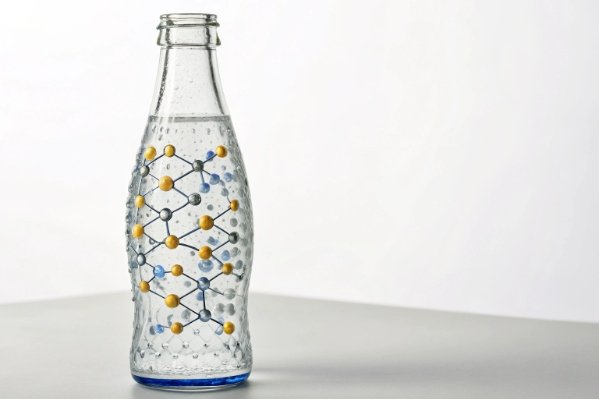
Acidic drinks sell well, but one haze complaint can ruin a premium look and force a costly recall.
A bottle’s acid resistance depends on how tightly its glass network is built, which oxides can leach out first, and how consistent the melt stays from batch to batch.
Acid resistance is a “network design” problem, not a luck problem
Acid resistance is not a single number. It is a balance between what the product tries to pull out of the glass and what the glass can hold in place. Most container glass is soda-lime-silica 1. The strong backbone is SiO₂. The easier-to-leach parts are usually Na₂O/K₂O, and sometimes CaO/MgO. When an acidic beverage or sauce sits in the bottle, H⁺ ions in the liquid exchange with those mobile ions at the surface. This is selective leaching 2. It can be slow, but it does not stop. It can also change the surface into a thin, silica-rich layer that looks dull or traps residues after washing.
The formulation decides how fast that first step happens. A more “polymerized” network, with the right amount of Al₂O₃ (and in some glass families, B₂O₃), tends to slow ion movement. A network with too much alkali tends to leak faster. The stabilizers (CaO/MgO) matter too. They can improve durability, but the balance is sensitive. A recipe that melts easily is not always the recipe that holds up best in an acidic shelf life test.
From a buyer view, acid resistance is also a consistency issue. A great formula still fails if the batch drifts, the cullet stream 3 changes, or the furnace conditions push defects and inhomogeneity into the surface. That is why a serious program links three things: glass chemistry, melt control, and validation testing on the real product.
What the formulation is really controlling
| What the buyer wants | What the glass must do | Which oxide family matters most |
|---|---|---|
| No haze after months | Slow ion exchange and keep a smooth surface | SiO₂ + Al₂O₃ balance |
| No taste shift | Minimize alkali release into product | Na₂O/K₂O control |
| Stable look across batches | Keep composition and melt quality steady | Cullet + furnace control |
| Handles hot-fill / pasteurization | Resist faster reactions at high temperature | Network strength + surface quality |
If this sounds abstract, it becomes simple once the oxides are tied to real symptoms: leaching, dull gloss, surface haze, and batch-to-batch drift.
Stay with me, because the next sections turn those oxide names into practical buying rules.
Which glass oxides most strongly improve acid resistance (SiO2, Al2O3, B2O3), and why?
A “clear” bottle can still be chemically weak, and the weakness often starts in the recipe.
SiO₂ is the backbone, Al₂O₃ tightens the network and slows ion movement, and B₂O₃ can improve chemical durability in borosilicate-style designs when balanced with the right modifiers.
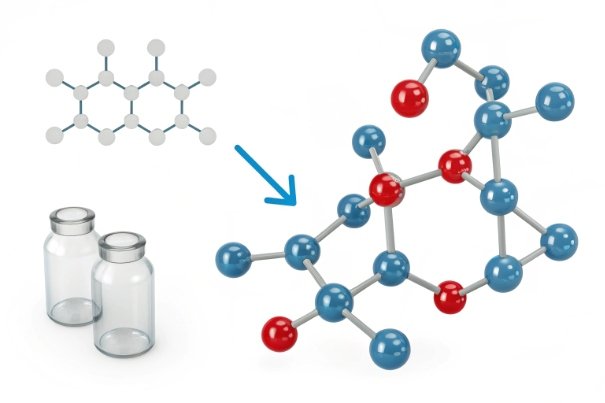
SiO₂: the backbone that acids usually cannot attack fast
SiO₂ forms the main glass network. Most food acids do not dissolve silica fast at room temperature. That is why glass is trusted for vinegar, tomato products, and many fruit drinks. Still, the surface of real container glass is not pure silica. It has modifiers. Acid first targets those weaker points. So higher SiO₂ content often helps, but only when the modifiers are controlled.
Al₂O₃: the durability booster with a real cost
Al₂O₃ is a key “network intermediate” 4. In practical terms, it makes the structure harder for ions to move through. That slows acid leaching and helps keep the surface smooth. Many durability upgrades in soda-lime systems come from careful alumina tuning.
The trade-off is production. More Al₂O₃ often raises melting and forming difficulty. That can raise cost and increase forming defects if the plant is not set up for it. In other words, Al₂O₃ improves durability, but it must fit the furnace and forming window.
B₂O₃: best understood as part of a glass family choice
B₂O₃ is famous in borosilicate glass 5. In many borosilicate formulations, B₂O₃ helps create a network with strong chemical durability and low thermal expansion. For acidic foods, this can be a strong option when the brand needs premium performance and can accept higher material and processing cost.
In soda-lime container glass, small B₂O₃ additions can help, but results depend on the whole recipe. B₂O₃ is not a “magic sprinkle.” If alkali is high or the modifier balance is poor, acid resistance still suffers.
A practical ranking (for most food and beverage bottles)
| Oxide | Main role | How it improves acid resistance | What can go wrong |
|---|---|---|---|
| SiO₂ | Primary network former | Makes the backbone hard to dissolve | Too little makes the network open |
| Al₂O₃ | Network intermediate | Slows ion diffusion and strengthens surface | Higher melt temperature, harder forming |
| B₂O₃ | Network former/intermediate | Helps borosilicate durability and thermal stability | Needs correct modifier balance |
When buyers ask for “more durable glass,” the clean request is not “add alumina” or “add boron.” The clean request is “show a durability class and a test report that proves lower leaching in my product conditions.”
How do alkali oxides (Na2O/K2O) and alkaline earth oxides (CaO/MgO) affect acid leaching and surface haze?
Many haze complaints are not “acid eating silica.” They are “acid pulling ions out, then the surface looks tired.”
Na₂O/K₂O are the first ions to leach in acid, while CaO/MgO act as stabilizers; the wrong balance speeds leaching and makes the silica-rich layer uneven, which looks like haze.
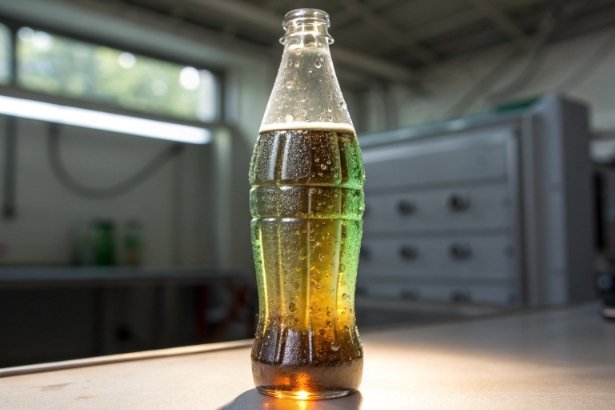
Na₂O/K₂O: easy melting, easy leaching
Na₂O and K₂O help glass melt and form. They also create non-bridging oxygen sites 6 that make the network less tight. In acidic contact, H⁺ exchanges with Na⁺/K⁺ at the surface. That is why these ions often show up first in extract tests.
More alkali usually means:
-
faster early leaching,
-
higher risk of small taste drift in very sensitive drinks,
-
and a higher chance of a silica-rich altered layer that changes optics.
This does not mean “low alkali is always best.” It means alkali must be controlled and balanced.
CaO/MgO: stabilizers that protect, but only in the right dose
CaO and MgO are often called stabilizers for a reason. They can reduce water penetration and improve durability. In acid exposure, they can still be extracted, but usually more slowly than Na/K. If the acid is complexing (citric, tartaric), it can keep pulling calcium out and prevent the surface layer from becoming stable.
A stable surface layer is important. When the altered layer is smooth and uniform, it can act like a barrier. When it is porous and uneven, it scatters light and looks hazy.
Why haze can look worse after washing
A small surface roughness makes water wet the glass differently. It also holds residues. So a bottle can look fine while filled, then look cloudy after the consumer washes it. That is a classic sign of a surface that has changed on a micro scale.
Formulation signals that often link to better shelf appearance
| Oxide group | Typical effect on acid performance | What the buyer sees |
|---|---|---|
| Higher Na₂O/K₂O | Faster ion exchange and higher extractables | More risk of dull gloss over time |
| Balanced CaO/MgO | Better surface stability | Less haze growth in warm storage |
| More Al₂O₃ (within process limits) | Lower ion mobility | Cleaner look across shelf life |
One internal story from a past project still stands out: a citrus beverage showed a faint haze ring at the shoulder after summer storage. The glass met normal specs, but the formula had higher alkali than the previous batch. Once the oxide window was tightened and we re-ran warm storage tests, the ring dropped to near zero. That one lesson keeps repeating: small chemistry drift can create big visual drift.
Does increasing recycled cullet content change acid resistance consistency across batches?
Sustainability goals push cullet higher, and that is good. But buyers still need stable performance.
Higher cullet content can be consistent when the cullet stream is clean and controlled, but it can also increase batch variability if contaminants or mixed compositions creep into the melt.

What cullet changes in real container glass production
Cullet is not just “old glass.” It is a mix of sources. If the plant uses a controlled internal cullet loop, the chemistry can be very stable. If it uses post-consumer cullet with variable contamination, chemistry and melt quality can drift.
The main risks to acid resistance consistency are:
-
composition drift (small Na₂O/CaO swings matter),
-
inclusions (stones, ceramics, cords) that create local weak zones,
-
and surface defects driven by melting or fining changes.
Acid resistance is a surface event, so surface defects matter more than many people expect. Even if the bulk composition is fine, local inhomogeneity can give local leaching, local roughness, and local haze.
What “good cullet control” looks like
A strong cullet program usually includes:
-
sorting by color and source,
-
contamination limits for ceramics and metals 7,
-
periodic chemical checks (often XRF),
-
and batch correction rules so the final oxide window stays tight.
With those controls, higher cullet can be a net win. It often stabilizes melting behavior and reduces raw material variability. Without those controls, a high cullet target can create creeping drift and more customer complaints.
Buyer-friendly way to discuss cullet and consistency
| Cullet situation | Acid resistance risk | What to ask the supplier |
|---|---|---|
| Internal cullet loop, controlled source | Low | Oxide window + COA trend over time |
| Mixed post-consumer cullet, strong sorting | Medium | Contamination limits + XRF frequency |
| Mixed cullet, weak sorting or unknown stream | High | Batch-to-batch oxide data + defect KPI |
A brand does not need to reject high-cullet glass. The smarter move is to require proof of control. When a supplier can show oxide trends and defect rates over months, the “green” choice stays safe for acidic SKUs.
What test methods and QC documents should B2B buyers request to confirm acid resistance for acidic beverages and sauces?
Many purchase contracts mention “food grade glass,” but that phrase does not prove acid durability for a hot-filled, long-life acidic product.
Buyers should request a recognized acid resistance test report, a hydrolytic inner-surface report, and batch QC documents that show oxide limits, trend control, and food-contact compliance statements.
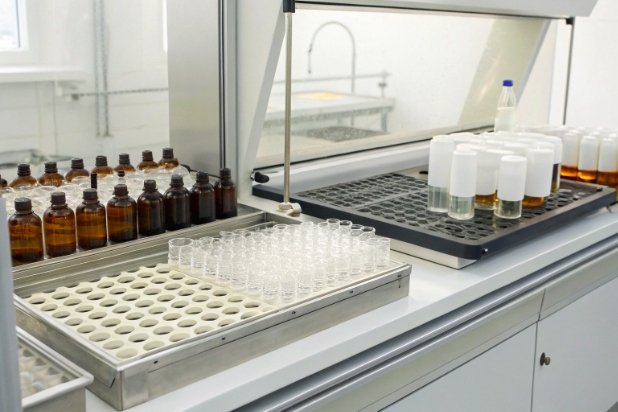
Test methods that actually help in purchasing decisions
For acid resistance, two testing layers work best.
Layer 1: Standard method for supplier comparison
-
A recognized acid attack method 8 that ranks or classifies resistance, so different suppliers can be compared.
-
A report that includes test conditions, sample prep, and the measured release values.
Layer 2: Application simulation for your real SKU
-
Fill the real product (or a realistic simulant).
-
Store at realistic time and temperature, plus an accelerated warm condition.
-
Check both chemistry and appearance.
For appearance, simple tools like haze or gloss measurement can turn a “looks fine to me” debate into a clear pass/fail decision.
What to measure (not only what to run)
A solid validation set for acidic beverages and sauces often includes:
-
extracted ions (Na, K, Ca) by ICP analysis 9 or similar,
-
visual haze or gloss change,
-
and inspection for shoulder rings or fill-line marks after warm storage.
QC documents that reduce risk before mass production
A buyer package should include more than one PDF. The most useful documents are the ones that show control over time.
| Document | What it proves | What to check |
|---|---|---|
| Certificate of Analysis (COA) | The batch met key specs | Include oxide window or key indicators |
| Acid resistance test report | Resistance under defined acid conditions | Method name, limits, lab name, date |
| Hydrolytic inner surface report | Inner-surface alkali release in water | Classification and trend stability |
| Batch trend chart (optional but powerful) | Consistency across weeks/months | Na₂O, CaO, Al₂O₃ drift limits |
| Food-contact compliance statement | Market access basics | EU and other target market references |
Compliance language that buyers often request
For EU sales, it is common to ask for declarations aligned with the EU framework 10 for food contact materials and GMP rules. For US sales, buyers often request a clear statement on food-contact regulatory status and migration risk approach. For certain retail channels, decorated glass may need extra heavy metal testing and labeling review.
The best buying habit is simple: ask the supplier to show (1) the standard method report, (2) a product-specific simulation, and (3) batch control evidence. When those three match, acid resistance stops being a guess and becomes a managed spec.
Conclusion
Acid resistance comes from a tight network and stable batch control. Use oxide windows, control cullet quality, and demand test reports that match real shelf life and heat.
Footnotes
-
The most common commercial glass, composed of silica, soda, and lime, offering moderate chemical resistance. ↩
-
A process where specific ions are extracted from a solid material by a liquid solvent. ↩
-
Recycled glass added to the batch to reduce energy consumption and raw material usage. ↩
-
Chemical species that modify the glass network structure, improving properties like durability. ↩
-
A type of glass with high thermal and chemical resistance due to boron oxide content. ↩
-
Structural disruptions in the glass network that increase susceptibility to chemical attack. ↩
-
Solid impurities in glass that can cause stress and weaken the container. ↩
-
Standardized testing protocols to determine the resistance of glass to acid attack. ↩
-
Inductively Coupled Plasma, a technique used to detect trace metals in solutions. ↩
-
Regulations ensuring materials in contact with food do not transfer harmful substances. ↩






