
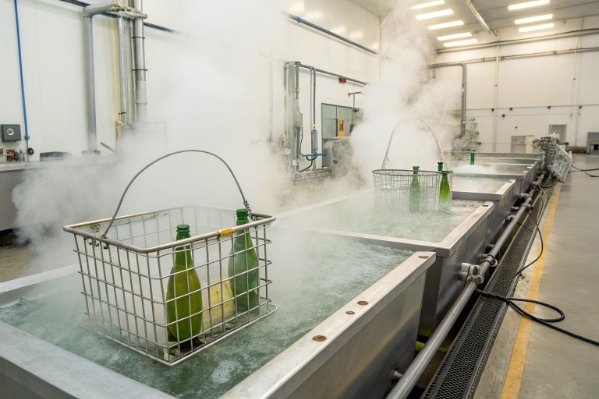
Many brands assume glass is invincible to heat, only to face catastrophic breakage when a filling line runs too hot or a cooling tunnel runs too cold.
Soda-lime glass is heat-stable but thermally fragile. While it can physically withstand gradual heating up to 450°C without deforming, its poor thermal shock resistance limits its sudden temperature change ($\Delta T$) capability to approximately 42°C, making rapid heating or cooling a high risk.
The Difference Between "Hot" and "Shocked"
At FuSenglass, I often have to clarify the definition of "Heat Resistance" to our clients. There are two distinct physical properties at play here:
-
Static Heat Resistance: This is the temperature the glass can endure if heated slowly in an oven. Soda-lime glass 1 (the standard material for 90% of bottles) has a softening point around 700°C. So, theoretically, you could bake a bottle at 250°C, and it would be perfectly fine—as long as you cooled it down incredibly slowly.
-
Thermal Shock Resistance: This is the real-world limit. It measures the ability to survive a sudden temperature drop or spike. Because soda-lime glass has a relatively high Coefficient of Thermal Expansion 2 (CTE), it expands rapidly when heated. If the inside expands while the outside stays cool (or vice versa), the mechanical stress rips the bottle apart.
For most beverage, food, and cosmetic applications, the "Melting Point" is irrelevant. The "Shock Limit" is the only number that matters. A bottle that survives a 121°C autoclave 3 cycle might shatter instantly if taken out and placed on a cold metal table.
Thermal Capability Overview
| Property | Value for Soda-Lime Glass (Type III) | Practical Meaning |
|---|---|---|
| Softening Point | ~ 720°C | It won’t melt in standard industrial processes. |
| Annealing Point | ~ 550°C | Stress is relieved at this temperature. |
| Max Working Temp | ~ 450°C (Gradual) | Safe for baking if heating/cooling is slow. |
| Shock Limit ($\Delta T$) | 42°C (Standard) | The safe gap between glass temp and liquid temp. |
What temperature range can soda-lime glass bottles typically withstand in real filling and storage conditions?
In practical manufacturing environments, the limits are defined not by the glass’s melting point, but by the safety margins of the filling equipment and handling procedures.
In real-world operations, soda-lime bottles effectively handle storage temperatures from -20°C to 50°C and filling temperatures up to 90°C, provided the glass is pre-heated to keep the thermal differential below the critical fracture threshold.
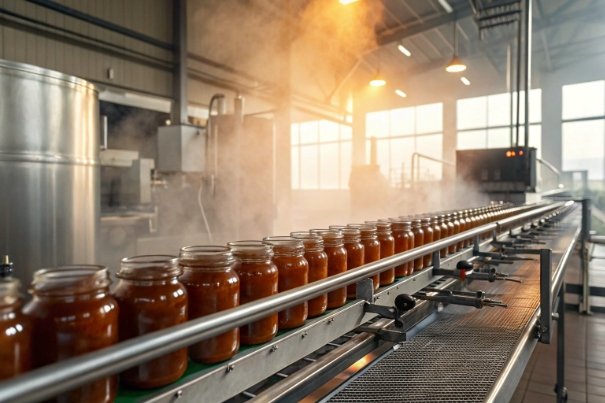
Operational Temperature Zones
We divide the temperature life-cycle of a bottle into three zones. Understanding these helps you set your production specifications correctly.
1. Storage & Transport (-20°C to 60°C):
Soda-lime glass is totally inert to freezing or warehouse heat. The risk here isn’t the glass itself, but the contents. If a water-based liquid freezes, it expands. Since glass doesn’t stretch, the bottle bursts. This is a volume issue, not a thermal resistance issue.
2. Hot Filling (60°C to 95°C):
This is the danger zone. Products like jams, sauces, or hot-pour candles are filled between 80°C and 90°C. Soda-lime glass can handle this heat easily conceptually, but mechanically, the sudden contact is the threat.
- Rule of Thumb: If your product is 90°C, your bottle must be at least 50°C before filling.
3. Sterilization (> 100°C):
Processes like autoclaving or retorting 4 take bottles up to 121°C. Soda-lime glass can survive this, but only if the pressure is balanced (to prevent caps popping) and the cooling cycle is ramped down slowly.
Typical Process Limits
| Process | Typical Temp | Soda-Lime Suitability | Requirement |
|---|---|---|---|
| Cold Filling | Ambient (20°C) | Excellent | None. |
| Pasteurization | 65°C – 85°C | Good | Gradual heating tunnel required. |
| Hot Filling | 85°C – 95°C | Conditional | Pre-heating of bottles mandatory. |
| Retort/Autoclave | 121°C | Risky | Requires specialized control & slow cooling. |
| Freezing | -18°C | Conditional | Requires headspace for liquid expansion. |
How does soda-lime glass perform in thermal shock (hot-to-cold changes), and what ΔT limits should buyers specify?
The "Delta T" ($\Delta T$) is the single most critical specification for glass safety; ignoring it is the leading cause of exploding bottles on the production line.
Soda-lime glass typically withstands a thermal shock ($\Delta T$) of 42°C. Buyers should strictly specify a "Thermal Shock Resistance of $\ge 42°C$" in their purchasing contracts and ensure their production line temperature gaps never exceed this limit to avoid immediate structural failure.
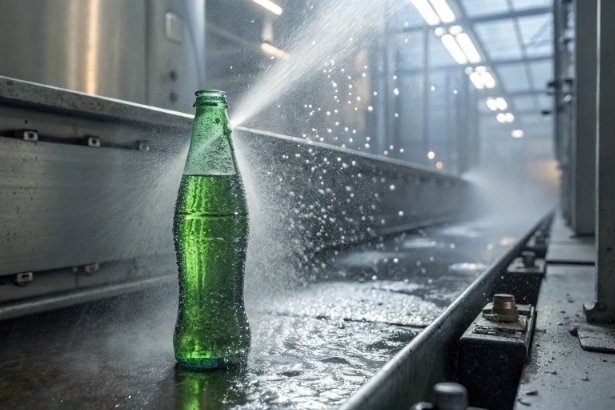
The Mechanics of Shock
Why is 42°C the magic number? It represents the tensile strength of the glass surface relative to its expansion coefficient.
The "Cold Shock" Scenario (Most Dangerous):
This happens when a hot bottle (e.g., just pasteurized at 80°C) is sprayed with cold water (e.g., 20°C) to cool it down.
-
$\Delta T = 80 – 20 = 60^\circ C$.
-
Result: The outer surface contracts instantly. The inner core remains expanded. The outer skin tears apart under tension. Failure.
The "Hot Shock" Scenario:
This happens when a cold bottle (e.g., 10°C from a winter warehouse) is filled with hot liquid (e.g., 90°C).
-
$\Delta T = 90 – 10 = 80^\circ C$.
-
Result: The inner surface expands. The outer shell restricts it. The bottle bursts from the inside. Failure.
At FuSenglass, we advise clients to set a safety margin. Ideally, aim for a thermal shock 5 of 35°C in operation, even if the glass is rated for 42°C.
Thermal Shock Management
| Scenario | Bottle Temp ($T_{glass}$) | Liquid/Env Temp ($T_{env}$) | $\Delta T$ | Risk Level | Mitigation |
|---|---|---|---|---|---|
| Winter Filling | 10°C | 85°C (Jam) | 75°C | CRITICAL | Pre-heat bottle to 50°C. |
| Cooling Tunnel | 80°C (Post-Pasteur) | 20°C (Spray water) | 60°C | HIGH | Use stepped cooling (50°C first). |
| Warm Rinse | 25°C | 60°C (Wash water) | 35°C | SAFE | None needed. |
| Candle Pour | 20°C | 70°C (Wax) | 50°C | MODERATE | Warm jars slightly. |
Can soda-lime glass bottles handle hot-fill, pasteurization, or sterilization processes, and what risks should brands watch for?
Soda-lime glass is the industry workhorse for preserved foods, but it requires "Tunnel" processing rather than "Batch" processing to manage thermal stress.
Yes, soda-lime bottles are widely used for hot-fill and pasteurization, provided the temperature ramp-up and cool-down are gradual. The primary risks are thermal shock during the cooling phase and internal pressure buildup (headspace expansion) causing caps to pop or bases to crack.
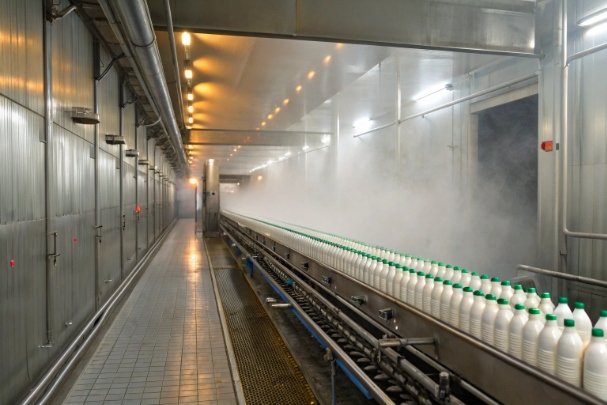
Process Compatibility
Hot Fill:
This is standard for juices and sauces. The key is the Pre-Heat Tunnel. Before the filler, bottles pass through a steam or hot air tunnel to raise their body temperature to within 30-40°C of the fill temperature. If your fill is 90°C, your bottle target is 50-60°C.
Pasteurization (Tunnel vs. Batch):
-
Tunnel Pasteurizers: Excellent for soda-lime. The bottle moves through zones: 30°C -> 50°C -> 70°C -> 50°C -> 30°C. The gradual change protects the glass.
-
Batch/Pot Pasteurization: Dangerous. Dropping jars into boiling water creates massive shock. Soda-lime often fails here unless a rack is used to keep jars off the direct heat source (bottom) and water is heated with the jars.
Sterilization (Retort):
This is difficult for soda-lime because of the pressure. At 121°C, water turns to steam. If the external pressure isn’t managed, the internal pressure will blow the cap off or crack the bottle neck. We usually recommend specific "heavyweight" bottle designs for retort applications.
Risk & Prevention Strategy
| Hazard | Cause | Prevention Strategy |
|---|---|---|
| Base Cracking | Thermal shock (Thick base retains heat). | Use "Tunnel" cooling zones; ensure uniform glass distribution. |
| Neck Cracks | Thermal shock (Finish cools fastest). | Avoid cold air drafts on the filling line. |
| Explosion | Internal Pressure > Glass Strength. | Ensure sufficient headspace 6 (min 10%); control cooling pressure. |
| Cap Popping | Vacuum failure during cooling. | Use lug caps designed for venting/resealing. |
How can manufacturers improve soda-lime bottle heat resistance through formula tweaks, annealing control, and wall-thickness design without switching to borosilicate?
Switching to expensive borosilicate isn’t always necessary; optimizing the geometry and stress-relief of soda-lime glass can significantly boost its survival rate.
Manufacturers improve heat resistance by designing bottles with uniform wall thickness to prevent thermal gradients, ensuring "Grade 1" annealing to remove all residual stress, and using "light-weighting" techniques, as thinner glass actually withstands thermal shock better than thick glass.
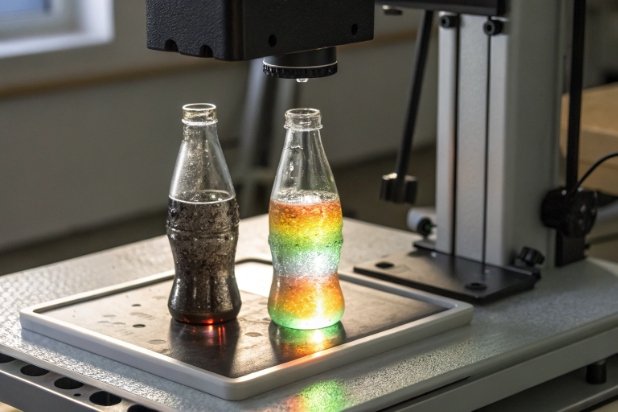
Optimizing Soda-Lime Performance
If you need better thermal performance but can’t afford Type I glass, we focus on engineering.
1. The "Thinner is Better" Paradox:
Clients often ask for thicker glass to handle heat. This is wrong. Thick glass creates a larger temperature difference between the inside and outside surfaces (thermal gradient). Thin, uniform walls transfer heat instantly, equalizing the temperature and reducing stress.
- Action: We aim for a "Blow-Blow" or "Press-and-Blow" process that ensures sidewalls are even, avoiding the "heavy bottom" defect.
2. Geometry and Radii:
Sharp corners are stress concentrators. A square bottle is far more likely to crack during hot-fill than a round one.
- Action: We increase the radius of the heel (where the wall meets the bottom) and the shoulder. A gentle curve distributes thermal expansion stress more evenly.
3. Precision Annealing:
A bottle that leaves the mold has high internal tension. It passes through the Lehr 7.
-
Standard: Grade 2 Temper (acceptable for cold fill).
-
Heat-Resistant Spec: We slow down the Lehr belt to achieve Grade 1 Temper. This removes virtually all pre-existing tension, giving the bottle its maximum possible structural integrity to fight thermal shock.
Improvement Checklist
| Factor | Standard Approach | Heat-Optimized Approach | Why it Works |
|---|---|---|---|
| Wall Thickness | Heavy / Variable | Lightweight / Uniform | Reduces thermal gradient across the wall. |
| Base Design | Flat / Thick | Push-up (Punt) | Reduces mass in the center; allows expansion. |
| Corner Radius | Sharp / Square | Large Radius / Round | Eliminates stress concentration points. |
| Annealing | Standard Cycle | Extended Cycle | Removes residual stress that compounds shock. |
Conclusion
Soda-lime glass is a capable partner for hot products, provided you respect its boundaries. By maintaining a strict $\Delta T$ of under 42°C and ensuring your bottles have Grade 1 annealing and uniform walls, you can safely hot-fill without the premium cost of borosilicate 8 glass.
Footnotes
-
The most common commercial glass type, composed primarily of silica, soda, and lime. ↩
-
A physical property measuring the fractional change in size per degree of temperature change. ↩
-
A strong, heated container used for chemical reactions and other processes using high pressures and temperatures. ↩
-
The thermal processing of food in sealed containers to achieve commercial sterility. ↩
-
Mechanical stress caused by a rapid change in temperature, leading to potential material failure. ↩
-
The unfilled space in a container above the product, allowing for thermal expansion. ↩
-
A specialized temperature-controlled kiln used for annealing glass to remove internal stresses. ↩
-
A type of glass with silica and boron trioxide as the main glass-forming constituents. ↩






