
Glass failure isn’t just about chemistry; invisible forces can tear bottles apart from the inside. We must manage surface stress to prevent catastrophic chemical breakdown during storage and washing.
Surface tensile stress significantly reduces chemical resistance by lowering the activation energy required for bond breakage. This mechanical tension accelerates acid leaching and alkali etching at surface flaws, turning minor chemical interactions into rapid Stress Corrosion Cracking (SCC) and premature container failure.
The Invisible Catalyst of Corrosion
At FuSenglass, I often explain to quality managers that glass is a material "born in tension." When molten glass cools, it fights against itself. If this fight isn’t managed correctly during the manufacturing process, the bottle ends up with residual stress.
While most people associate stress with physical breakage (like dropping a bottle), its role in chemical failure is equally destructive but far more insidious. Surface stress acts as a catalyst for corrosion. It takes a stable glass bottle and makes it chemically hyper-reactive at specific weak points.
Imagine a rubber band. When it is relaxed, you can poke it, and it holds together. When you stretch it to its limit (tension), even a tiny nick with a knife causes it to snap instantly. The glass surface works the same way. If the surface is under Tensile Stress, the atomic bonds are stretched. They are "energetically eager" to break.
When an acid or alkali molecule approaches a relaxed glass bond, it has to work hard to break it. But if it approaches a stretched bond, the work is already half done. The chemical just finishes the job. This synergy between mechanical stress and chemical attack is what we call Stress Corrosion. It is the reason why a bottle might hold pressure fine on the production line but burst three months later while sitting on a shelf filled with carbonated soda.
Stress States and Chemical Impact
| Stress Type | Mechanical State | Chemical Consequence | Desirability |
|---|---|---|---|
| Compression | Atoms pushed together. | Protective. Cracks are held closed; chemicals cannot enter. | High. (Ideally 100% of surface). |
| Tension | Atoms pulled apart. | Destructive. Cracks open; bonds are easily severed. | Zero. (Must be avoided on surface). |
| Neutral | Relaxed. | Baseline. Standard chemical leaching rates. | Acceptable. |
| Transient | Temporary (Thermal Shock). | Spike. Temporary vulnerability during hot-fill/wash. | Manageable via process control. |
| Shear | Twisting force. | Micro-cracking. Creates new surface area for attack. | Dangerous. |
To prevent this silent failure mode, we need to zoom in on the atomic battleground where stress and chemistry collide.
Why can tensile surface stress accelerate chemical attack and stress-corrosion cracking in acidic or alkaline environments?
A stressed bottle is a ticking time bomb. Chemicals exploit physical tension to slice through the glass silicate network like a hot knife through butter.
Tensile stress pulls the atomic network apart, physically widening microscopic surface flaws. This opening allows corrosive agents like water, acids, or alkalis to penetrate deeper and attack the strained siloxane bonds at the crack tip, propagating fractures exponentially faster than in relaxed glass.
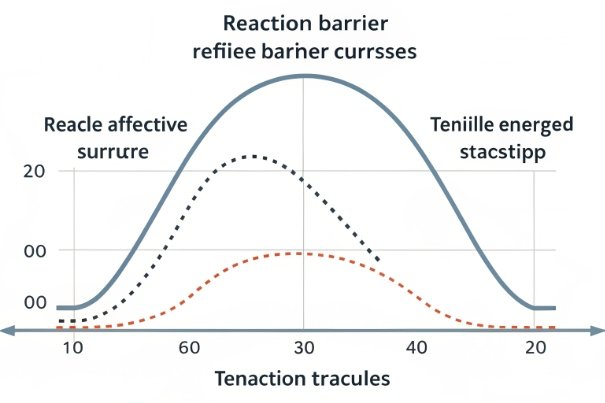
The Mechanism of Stress Corrosion Cracking (SCC)
The term "Stress Corrosion Cracking" 1 (SCC) is well known in metallurgy, but it is the primary cause of "delayed breakage" in the glass industry.
1. The "Zipper" Effect at the Crack Tip:
Every glass bottle has microscopic flaws on its surface (Griffith Flaws 2). In a bottle under Compression, these flaws are squeezed shut. The chemistry can’t get in.
However, under Tension, the flaw is pulled open.
- The Attack: Water molecules, Acid protons ($H^+$), or Hydroxyl ions ($OH^-$) diffuse into the crack.
- The Reaction: They reach the very tip of the crack where the Silicon-Oxygen ($Si-O$) bond is stretched to its maximum limit.
- The Snap: The chemical reacts with the strained bond, severing it (hydrolysis).
- The Growth: Once the bond breaks, the stress pulls the crack open a little wider, exposing the next bond. The chemical moves forward.
2. Accelerated Alkali Etching:
In alkaline environments (like bottle washing), tension creates "differential etching."
- Stressed glass has higher potential energy than relaxed glass.
- The alkali dissolves the high-energy (stressed) areas faster.
- This creates deep, sharp grooves rather than smooth, uniform erosion. These grooves become stress concentrators 3, weakening the bottle dramatically.
3. Acid-Enhanced Leaching:
While acids typically cause ion exchange, tension opens the network structure (increases free volume).
- This allows the sodium ions to migrate out faster and the protons to migrate in faster.
- Result: A thicker, weaker "silica gel" layer forms on the surface. This layer can flake off (delamination) or craze (crack) as it dries, ruining the bottle’s appearance.
Chemical Attack Multipliers
| Factor | Relaxed Glass | Glass under Surface Tension | Multiplier Effect |
|---|---|---|---|
| Crack Tip Geometry | Closed / Blunt | Open / Sharp | 10x – 100x faster propagation. |
| Activation Energy | High (Hard to break bond) | Low (Bond wants to break) | Chemical reaction happens at lower energy. |
| Diffusion Rate | Standard | Elevated | Corrosive agents penetrate deeper. |
| Failure Type | Surface Haze | Catastrophic Cracking | Critical Safety Risk. |
Stress doesn’t appear by magic. It is manufactured. We must identify where in the production line we are creating these vulnerabilities.
Which production factors create risky surface stress (annealing/lehr settings, tempering, mold cooling, and surface treatments)?
Stress is born in the fire. Poor manufacturing controls lock dangerous tension into the glass skin before it even reaches the customer, creating weak points ready for chemical exploit.
Risky surface tension arises primarily from uneven cooling rates in the mold or improper annealing in the lehr. Rapid cooling of the skin relative to the core creates tension, while aggressive surface treatments or thermal tempering, if uncontrolled, can introduce localized stress concentrations that invite chemical attack.
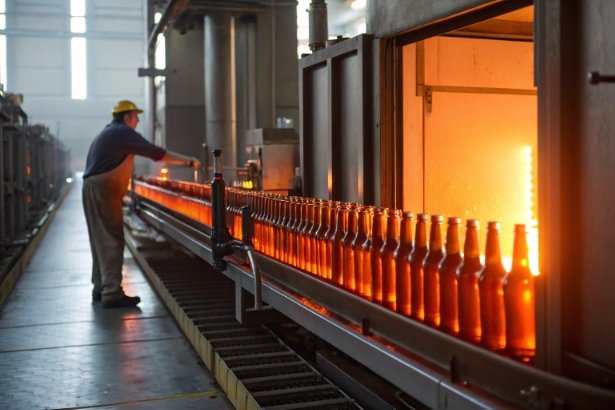
The Origins of Surface Tension
At FuSenglass, managing thermal history is our obsession. Here are the three production stages where "good glass" goes bad:
1. Uneven Mold Cooling (The "Skin" Effect):
When molten glass (1000°C) hits the iron mold (400°C), the skin freezes instantly.
- The Risk: If one side of the mold is colder than the other (poor cooling wind balance), one side of the bottle solidifies while the other is still moving. As the hot side finally cools, it pulls on the cold side.
- Result: Permanent tension streaks on the bottle surface. These streaks are highly susceptible to alkali etching in the washer.
2. The Annealing Lehr (The "Relaxation" Zone):
The Lehr is designed to remove stress.
- The Failure: If the belt moves too fast, the bottle doesn’t spend enough time at the "Annealing Point" 4 (approx 550°C). The stress isn’t relieved.
- The Consequence: The bottle leaves the factory with "Residual Stress" (Grade 4 or 5). This tension aids the "Leaching Spike" during hot-fill processes.
3. Thermal Tempering (The Double-Edged Sword):
Sometimes we intentionally stress glass (Tempered Glass 5) to make it stronger physically.
- How: We blast the surface with cold air to create Compression on the skin and Tension in the core.
- The Risk: If the "Compression Layer" is too thin, a deep scratch can penetrate through to the Tension Zone. Once the chemical reaches the Tension Zone, the bottle explodes (spontaneous fragmentation).
4. Surface Treatments (De-alkalization):
We often treat bottles with sulfur or fluorine to improve chemical resistance (Type II Glass).
- The Irony: These treatments work by stripping surface alkali. However, if done too aggressively at high temperatures, they can induce micro-cracking (crazing 6) on the surface, creating a network of flaws that actually traps chemicals later.
Production Variable Impact
| Production Stage | Control Variable | Defect if Uncontrolled | Chemical Impact |
|---|---|---|---|
| Forming (IS Machine) | Mold Cooling Balance | Uneven Wall Thickness | Thin spots are high-stress; corrode faster. |
| Annealing (Lehr) | Belt Speed / Temp Curve | Residual Tension | Assists Stress Corrosion Cracking (SCC). |
| Surface Treatment | Chemical Dosage | Surface Crazing | Micro-cracks trap acid/alkali. |
| Cold End Coating | Spray Uniformity | Friction Damage | Scratches become nucleation sites for SCC. |
You cannot see stress with the naked eye. You need to visualize the invisible forces to stop them.
How can you detect and quantify surface stress before chemical resistance failures (polariscopy, stress mapping, and failure analysis)?
Relying on visual inspection guarantees that defective bottles slip through. We must use optical physics to map the stress fields and ensure the bottle skin is under protective compression.
We detect invisible stress using polariscopes, which visualize tension as colored interference fringes (birefringence). For precise surface quantification, we use Scattered Light Photoelasticity (SCALP) to map the stress profile through the glass thickness, verifying that the outer skin remains in safe compression rather than dangerous tension.
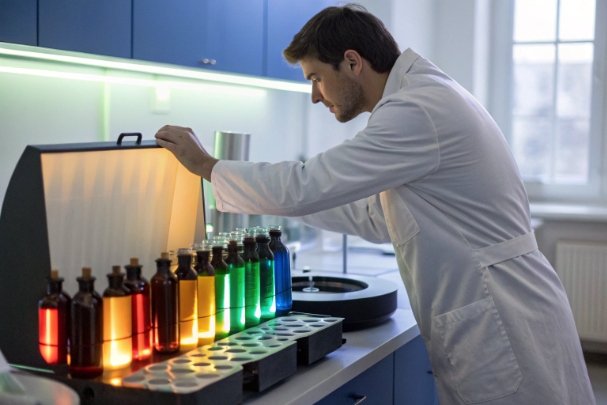
The Toolkit for Stress Detection
In the lab, we don’t guess. We measure.
1. The Polariscope (Qualitative Check):
This is the standard "Go/No-Go" test.
- Method: Place the bottle between two polarized filters.
- What we see: Stress creates "birefringence" 7—it changes the speed of light passing through the glass. This appears as colored rainbows.
- Interpretation:
- Black/Grey: Low stress (Good).
- Orange/Red/Blue: High stress (Bad).
- Maltese Cross: A distinct cross pattern on the bottom indicates concentric stress. We analyze its symmetry.
2. SCALP (Quantitative Surface Measurement):
"Scattered Light Photoelasticity" 8 (SCALP) is the advanced tool for surface engineering.
- The Problem: A polariscope shows total stress through the whole bottle. It can’t tell you if the surface is in tension or compression.
- The Solution: SCALP shoots a laser into the glass and measures stress at different depths (e.g., 50 microns deep vs. 2mm deep).
- Why it matters: For chemical resistance, we need the surface to be in compression. We don’t care as much about the core. SCALP proves the surface is safe.
3. Fractography (Failure Analysis):
If a bottle breaks, we look at the shards under a microscope.
- The Mirror Radius: The smoothness of the break origin tells us the stress level at the moment of failure.
- The Origin: If the break started at a chemically etched pit, we know it was Stress Corrosion. If it started at a bruise, it was impact. This distinction allows us to fix the root cause.
Detection Method Comparison
| Method | What it Measures | Output | Best For |
|---|---|---|---|
| Polariscope | Total Residual Stress (Through-wall) | Color Fringes (ASTM Grade 1-5) | Routine QC (Every 2 hours). |
| SCALP | Stress Profile (Surface vs Core) | Graph (MPa vs Depth) | R&D; Process Troubleshooting. |
| Scratch Test | Surface Fragility | Force to Crack | Coating Evaluation. |
| Fractography | Origin of Breakage | Failure Mode ID | Post-Mortem Analysis. |
How do you put this into a contract? You need robust validation protocols.
Don’t wait for a leak to audit your glass. Proactive stress specifications, combined with "simulated use" torture tests, prevent costly recalls and protect your brand reputation.
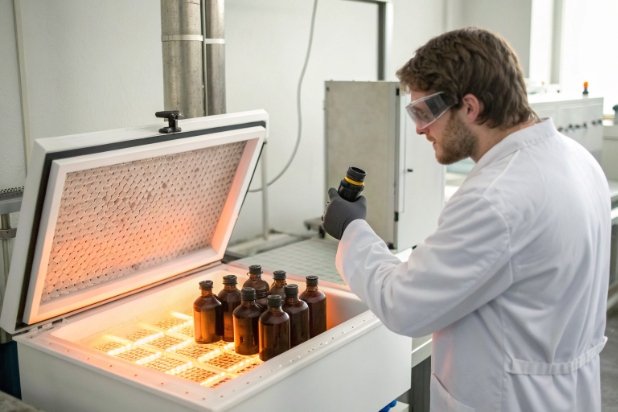
Buyers must mandate ASTM C148 for residual stress limits (Grade 3 max) and combine it with ASTM C149 Thermal Shock testing. Crucially, require "simulated use" testing where bottles undergo thermal cycling while filled with the specific chemical product to reveal potential stress-corrosion weaknesses.
The Buyer’s Validation Protocol
As a ghostwriter for your QA manual, here is the stress-corrosion protocol I recommend to our global partners.
1. The Material Spec (The Baseline):
- Standard: ASTM C148 9 (Polariscopic Examination).
- Requirement: "Average annealing grade of 2; No single sample exceeding Grade 3."
- Why: This ensures the "background stress" is low enough to prevent static fatigue.
2. The Thermal Shock Proxy (ASTM C149):
Thermal shock breaks bottles using tension. If your bottle survives thermal shock, it generally proves that the surface is not under dangerous tension.
- Requirement: "Must survive $\Delta T$ of 42°C (Soda-Lime) or 100°C (Borosilicate)."
- Logic: A bottle with high surface tension will shatter instantly in this test. It effectively screens out the "ticking time bombs."
3. The "Torture Test" (Simulated Stress Corrosion):
This is the most valuable test for brands using hot-fill or aggressive cleaners.
- Setup: Fill 20 bottles with your actual product (or a simulator like Citric Acid/NaOH).
- Cycle: Heat to 60°C (1 hour) $\rightarrow$ Cool to 20°C (1 hour). Repeat for 7 days.
- Why: This combines Chemical Attack + Thermal Stress + Time.
- Pass Criteria: Zero breakage. Zero visible haze. Zero leaks.
4. The Decor Adhesion Check:
For painted/plated bottles.
- Test: Dishwasher cycle (Alkali + Heat).
- Check: Cross-hatch tape test after 10 cycles.
- Why: Stress corrosion often attacks the interface between the glass and the coating first, causing peeling.
Specification Checklist
| Test Parameter | Method | Acceptance Limit | Frequency |
|---|---|---|---|
| Residual Stress | ASTM C148 | < Grade 3 | Every Lot (AQL 2.5). |
| Thermal Shock | ASTM C149 10 | Pass $\Delta T$ 42°C | Every Lot. |
| Chemical Durability | ISO 719 | HGB 3 | Annual / Process Change. |
| Simulated Use | Custom Cycling | No Leaks/Breaks | New Product Validation. |
| Pressure Test | ASTM C147 | Internal Pressure > Spec | Carbonated Bev Only. |
Conclusion
Surface stress is the invisible accomplice to chemical failure. By understanding that tension creates the "open door" for corrosive agents, and by enforcing strict annealing (ASTM C148) and thermal shock (ASTM C149) standards, you can ensure that your FuSenglass bottles remain robust fortresses, immune to the combined forces of physics and chemistry.
Footnotes
-
A failure mechanism caused by the environment, particularly chemical attack combined with tensile stress. ↩
-
Microscopic flaws on the surface of materials that serve as initiation points for cracks. ↩
-
A location in an object where stress is significantly higher than the surrounding area. ↩
-
The temperature at which glass viscosity allows for stress relief within minutes. ↩
-
Glass processed to increase strength by inducing surface compression. ↩
-
A network of fine cracks on the surface of a material, often a precursor to failure. ↩
-
The optical property where a material refracts light in two different directions based on stress. ↩
-
A non-destructive method using polarized light to analyze stress distribution in glass. ↩
-
Standard test methods for polariscopic examination of glass containers. ↩
-
Standard test method for thermal shock resistance of glass containers. ↩






