
The terms “soda-lime” and “ordinary glass” confuse a lot of buyers. They sound different, but in most real projects they actually point to the same material.
In everyday use, “ordinary glass” almost always means soda-lime silica glass; the real differences come from variants (float, container, tempered) and from specialty families like borosilicate that add extra performance at higher cost.
So instead of asking “soda-lime vs ordinary”, it makes more sense to ask: which glass family am I using, how is it heat-treated, what additives does it carry, and when soda-lime glass 1 belongs in the conversation?
Is “ordinary glass” basically just soda-lime glass?
Most people use “ordinary glass” to mean whatever is in their windows or bottles. Technically, that is almost always soda-lime silica.
Yes. In modern industry, “ordinary glass” is soda-lime silica: silica sand plus soda ash and limestone. Variants exist for containers, float, and tableware, but they all sit inside the soda-lime family.
What “ordinary glass” actually is
When someone says “regular glass” or “ordinary glass”, they usually mean:
- Windows (float glass 2)
- Bottles and jars (container glass)
- Everyday drinkware and tableware
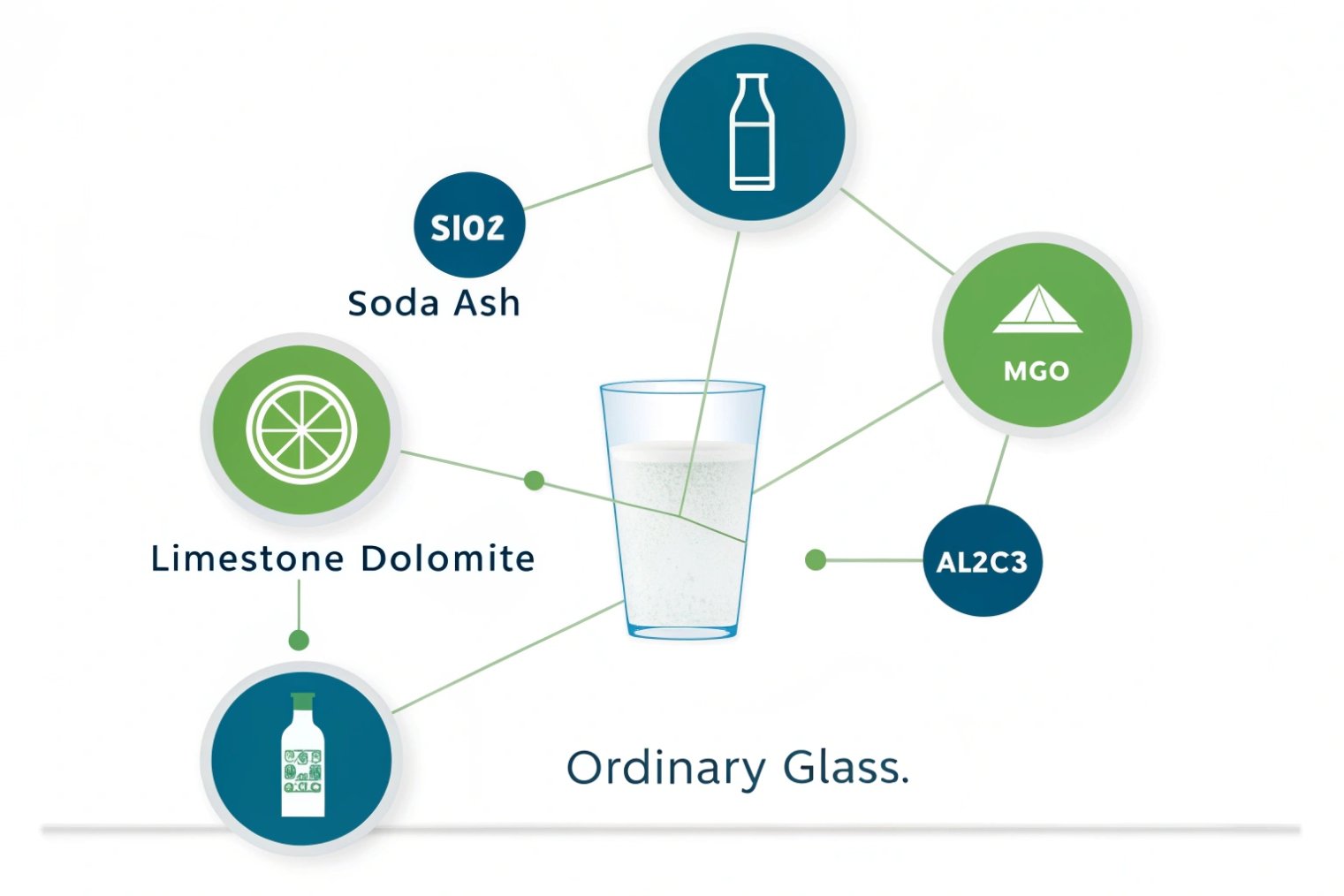
All three are soda-lime based. In simple terms, most everyday “ordinary glass” starts from silica sand plus soda ash 3 and limestone.
All three are soda-lime based. The core recipe looks like:
- SiO₂ (silica) from sand – the backbone of the glass network.
- Na₂O (soda) from soda ash – lowers melting temperature, makes the melt workable.
- CaO (lime) from limestone/dolomite – stabilizes the glass and improves durability.
On top of that, manufacturers tweak:
- MgO, Al₂O₃ to improve durability and viscosity.
- Small amounts of colorants (iron, selenium, cobalt, chromium) to get clear, amber, green, etc.
So when we say “soda-lime glass”, we are just using the technical name for what most people call “ordinary glass”.
Variants inside the soda-lime family
Within this one family you already have distinct “looks” and behaviors:
- Float glass – ultra flat sheets for windows, mirrors, furniture.
- Container glass – tuned for bottles and jars, with good forming characteristics and impact strength.
- Tableware glass – sometimes with higher alumina for better durability and dishwasher resistance.
- High-flint / extra-white – very low iron for high clarity, often used in spirits and cosmetics bottles.
In marketing, these can be described as “crystal-look”, “extra clear” or “premium flint”, but chemically they are still soda-lime silica, not borosilicate or lead crystal.
So the short version is simple: “ordinary glass” = soda-lime in almost every everyday product.
How do tempering and annealing affect performance?
Two pieces can share the same chemistry but behave very differently in use. The reason is their heat treatment, not their oxide recipe.
Annealing relaxes internal stress in soda-lime (“normal” glass), while tempering adds strong surface compression for higher impact and thermal-shock resistance; both operate on soda-lime as well as on some specialty glasses.
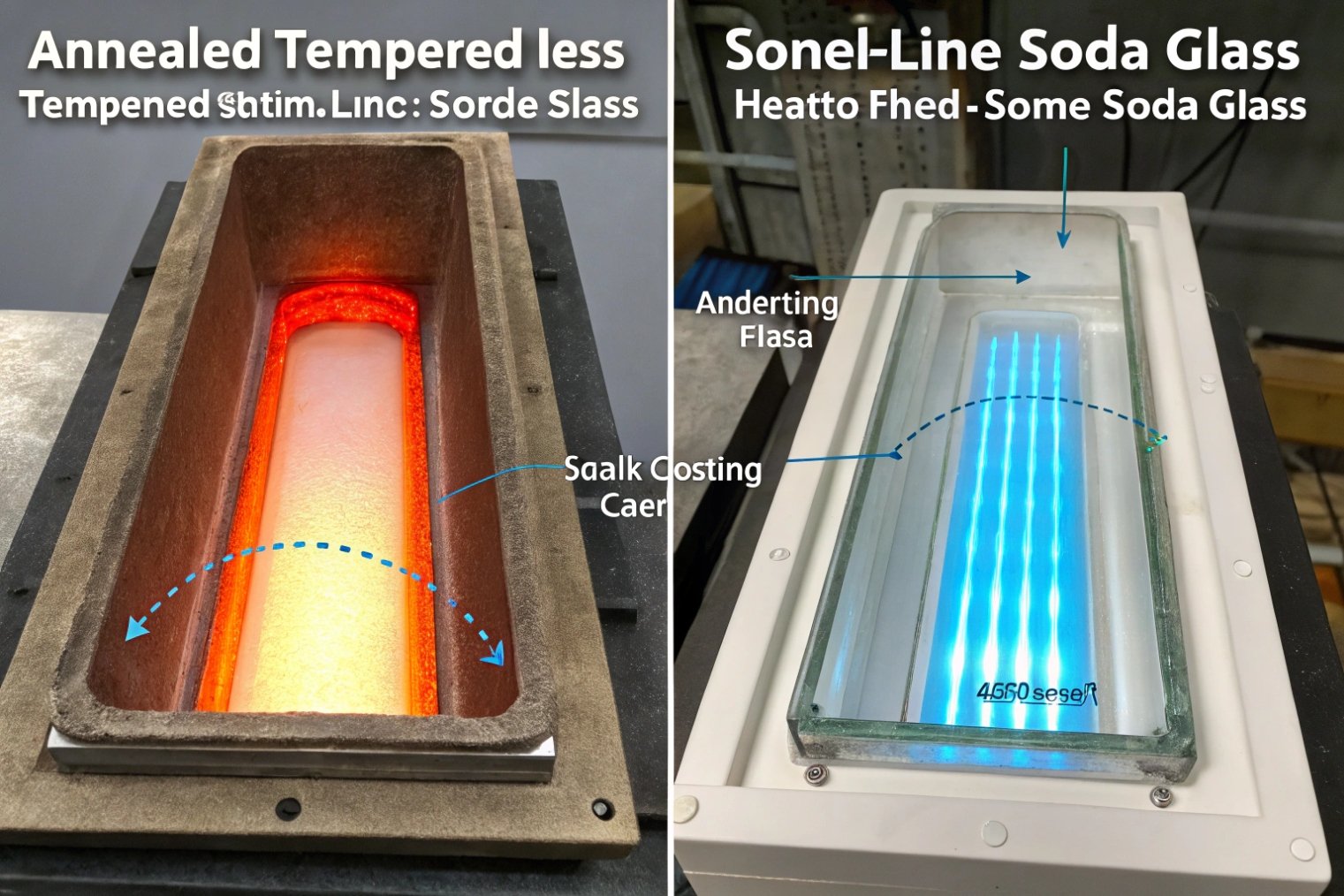
Annealed vs tempered “ordinary” glass
Freshly formed glass cools from a very high temperature. If this cooling is not controlled, frozen-in stress makes the piece fragile.
-
Annealed glass
-
Tempered glass (toughened)
- First formed and annealed, then reheated near its softening range.
- Outside surfaces are cooled rapidly while the core stays hot.
- This leaves the surface in compression and the core in tension.
The surface compression makes tempered glass:
- Much more resistant to bending and impact.
- More tolerant of thermal shock (hot–cold switches).
- When it finally fails, it breaks into small cube-like fragments rather than long sharp shards.
This is why shower doors, side car windows, some cookware, and many phone-screen covers use tempered glass 5, often still in the soda-lime family.
Soda-lime vs high borosilicate under heat treatment
Both soda-lime and borosilicate are:
- Annealed to release internal stress.
- Sometimes heat-treated to change performance.
The key differences:
-
Soda-lime
- Higher thermal expansion.
- Gains a lot from tempering when you need impact resistance and some extra thermal-shock margin.
- Common in tempered consumer “pyrex” in some markets.
-
High borosilicate
- Lower thermal expansion from the start.
- Already has strong thermal-shock resistance as an annealed glass.
- Can also be tempered, but the main advantage is in its chemistry and structure, not only in the heat treatment.
There is a common confusion: some consumer bakeware branded “pyrex” is actually tempered soda-lime, not borosilicate. It handles impacts better than lab beakers, but the thermal-shock envelope is still smaller than true borosilicate labware.
So when we talk about performance, we always ask two questions:
- Which family? (soda-lime vs borosilicate vs others)
- Which state? (annealed vs tempered vs special treatments)
Which additives tune hardness, chemical resistance, and color?
Once you have the basic soda-lime recipe, small amounts of other oxides turn “ordinary” glass into clear, tough, or colorful packaging and tableware.
Minor additives like alumina, magnesia, and surface treatments improve hardness and chemical resistance, while metal oxides like iron, chromium, cobalt, and selenium control color from flint to amber and green.
Hardness and durability modifiers
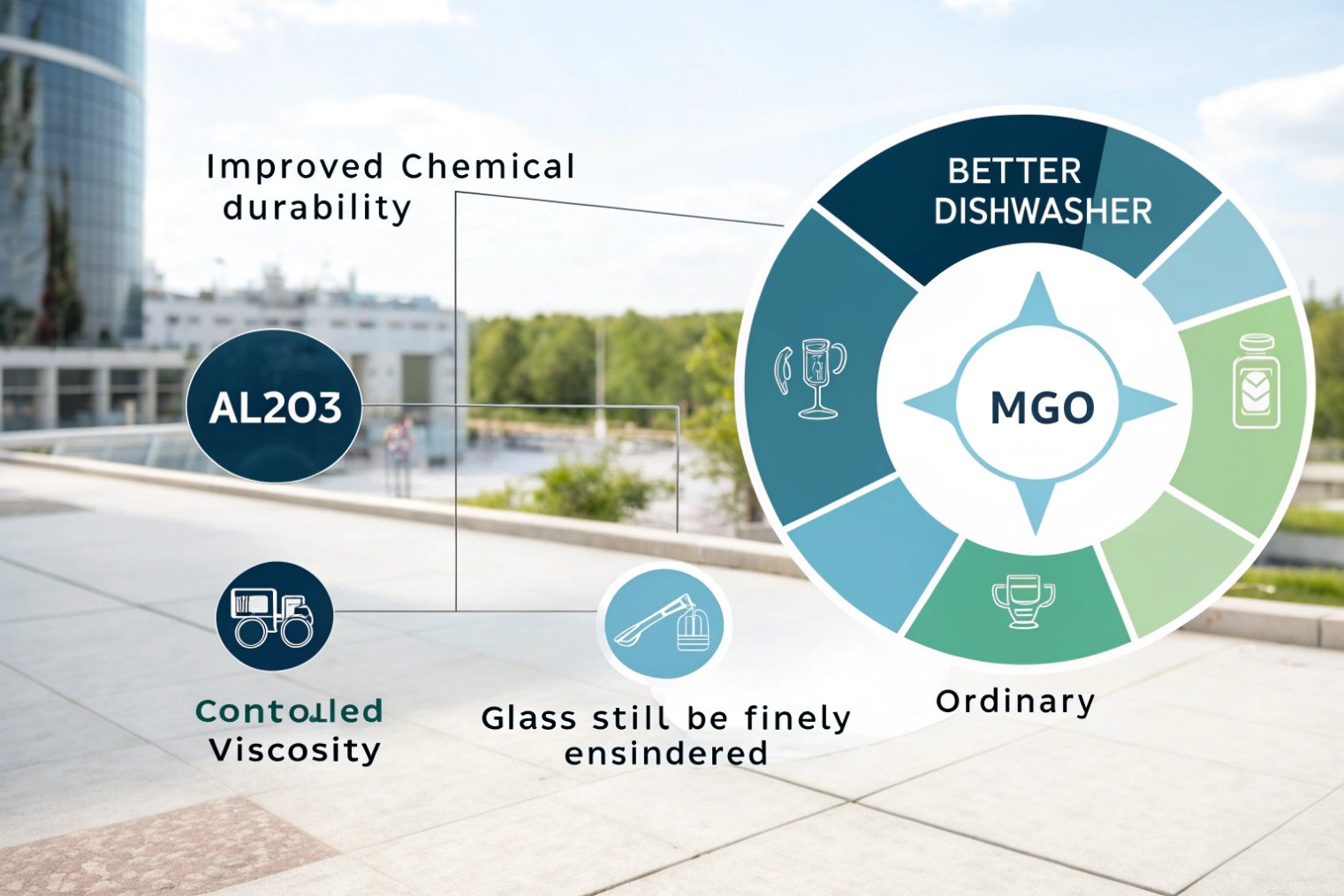
Inside soda-lime, you can shift properties with a few percent of extra oxides:
-
Al₂O₃ (alumina)
- Increases chemical durability.
- Helps control viscosity at forming temperatures.
- Improves resistance to caustic washing and dishwasher cycles.
-
MgO (from dolomite)
- Works with CaO to stabilize the glass network.
- Affects hardness and devitrification behavior.
-
Surface treatments
- Tin and sulfur atmospheres at the hot end.
- Cold-end coatings (like polyethylene) to reduce scratching and improve conveyor behavior.
For most “ordinary” uses, these tweaks are enough to keep soda-lime strong and durable without jumping to a special glass family.
Color control with metal oxides
Color is where consumers see the effect of additives most clearly. Typical systems in soda-lime include:
-
Iron (Fe₂O₃)
- Present as an impurity in sand.
- Gives a natural greenish tint in thicker flint glass.
-
Selenium + cobalt (tiny doses)
- Used as decolorizers in flint glass.
- Selenium shifts color toward pink, cobalt toward blue; together they balance iron’s green and give a neutral clear look.
-
Amber (brown)
- Mix of iron, sulfur, and carbon in a controlled redox environment.
- Produces a strong brown color that also blocks UV and blue light—ideal for beer and light-sensitive products.
-
Green
- Mainly from chromium oxide (Cr₂O₃), sometimes with iron.
- Ranges from pale to deep emerald.
-
Blue
- From cobalt oxide (CoO), extremely powerful as a colorant.
With these tools, soda-lime can go from extra-clear premium flint to deep amber, green, and cobalt blue, all inside the “ordinary” glass family.
Tuning “ordinary” without leaving soda-lime
By adjusting:
- Al₂O₃ and MgO for durability and hardness,
- colorants and decolorizers for appearance and light protection,
- surface treatments for scratch resistance and handling,
manufacturers can cover most packaging and tableware needs while staying in soda-lime. There is no need to switch to borosilicate unless the environment becomes much more demanding (autoclaves, flame, extreme chemistry).
Where does borosilicate fit in the “ordinary vs special” debate?
This is the heart of the confusion: people say “regular glass” and “borosilicate glass” as if they were neighbors in the same street. In reality, they live in different parts of the city.
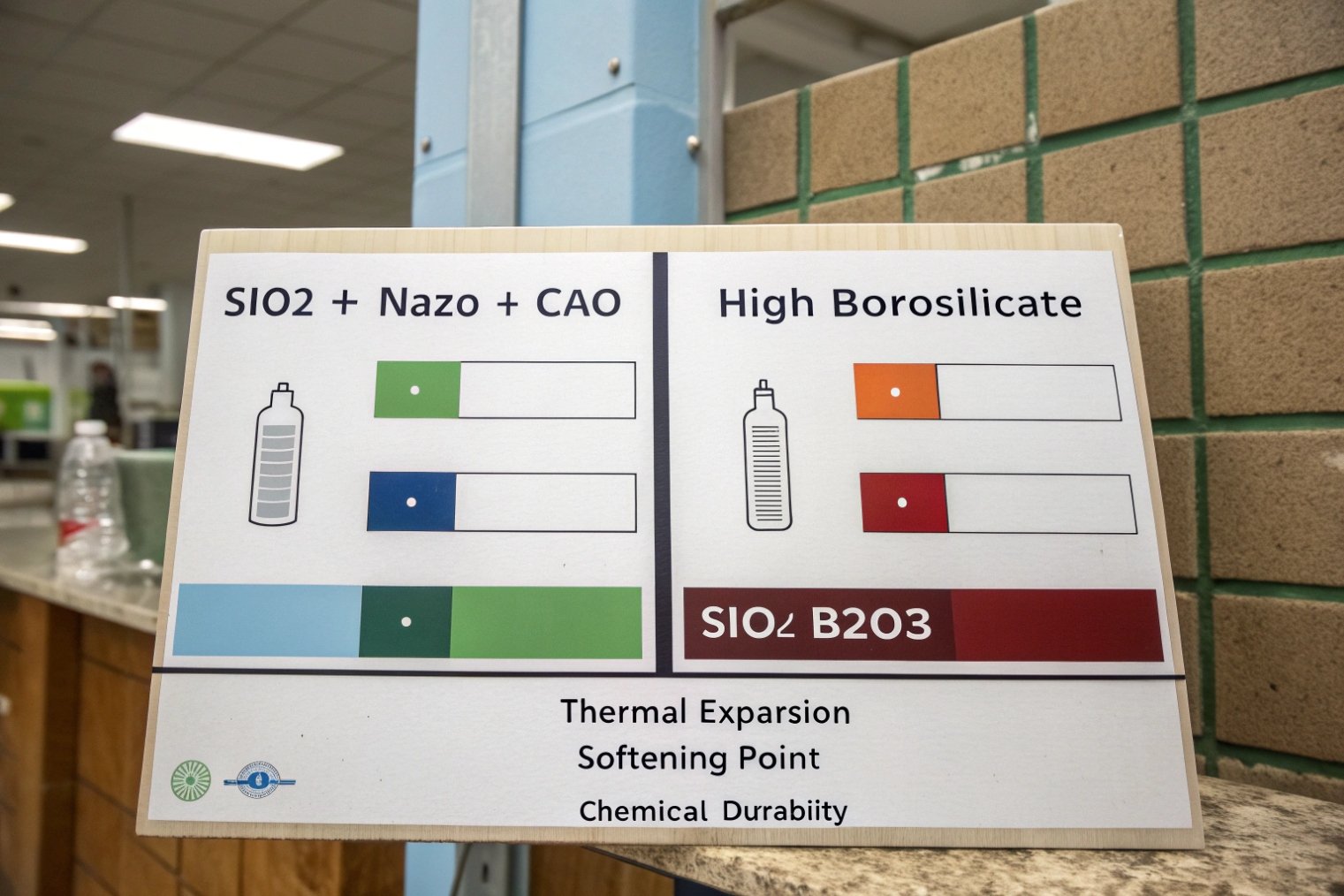
Borosilicate is a specialty glass that swaps much of the soda and lime for boron oxide, cutting thermal expansion and boosting chemical resistance; for bottles and windows soda-lime remains the “ordinary” standard, while borosilicate serves labware, cookware, and some pharma.
Composition and property jump
Compared with soda-lime, borosilicate glass 6 achieves much lower expansion largely because its coefficient of thermal expansion (CTE) 7 is substantially lower.
Compared with soda-lime:
- High borosilicate 3.3
- Higher silica content plus roughly 12–13% boron trioxide.
- CTE around 3.3×10⁻⁶/K (about one-third of soda-lime).
- Softening and working points at higher temperatures.
- Excellent resistance to water, many acids, and solvents.
This gives:
- Very strong thermal-shock resistance.
- Very good chemical durability.
- Good behavior in autoclaves, ovens, and direct heating.
But it also brings:
- Higher melting and forming complexity.
- Higher raw-material cost.
- Recycling incompatibility with soda-lime cullet streams.
Where borosilicate is “special” on purpose
You see borosilicate where normal soda-lime would struggle:
- Laboratory beakers, flasks, media bottles.
- Type I pharmaceutical vials and ampoules.
- Heat-resistant cookware and oven dishes.
- Sight glasses in high-temperature or corrosive processes.
In these cases, the extra cost is justified by the environment: strong thermal gradients, high purity demands, or aggressive cleaning and sterilization.
For everyday packaging—water, beer, sauces, cosmetics—conditions are much milder. Here:
- Soda-lime is cheaper.
- Soda-lime has better integration with recycling.
- Soda-lime has more color and design options at high volume.
So in the packaging world, soda-lime = ordinary, borosilicate = special.
“Ordinary vs special” in one picture
| Question | Ordinary answer | Special answer |
|---|---|---|
| What are most bottles and windows? | Soda-lime (“ordinary” glass) | – |
| What needs flame, autoclave, oven? | Sometimes tempered soda-lime | Often high borosilicate |
| Where do we focus recycling systems? | Soda-lime container glass | Separate streams, small volumes |
| What do consumers call “regular glass”? | Usually soda-lime, whatever the product | They recognise borosilicate as a premium or lab material |
So instead of thinking “soda-lime vs ordinary”, it is more useful to think:
- Ordinary = soda-lime family, in many variants and heat treatments.
- Special = borosilicate and other engineered glasses, used when the job really needs their extra performance.
Conclusion
Soda-lime is the “ordinary” glass family behind most bottles, jars, and windows; borosilicate sits beside it as a higher-performance, higher-cost option for real heat and chemistry challenges, not for everyday packaging.
Footnotes
-
Soda-lime glass overview: composition, properties, and common uses. ↩︎ ↩
-
How float glass is made and why it dominates window and mirror production. ↩︎ ↩
-
What soda ash (sodium carbonate) is and why it’s used in glassmaking. ↩︎ ↩
-
Lehr explanation: how controlled cooling reduces internal stress after forming. ↩︎ ↩
-
Tempered glass basics: strength benefits and safer fracture behavior. ↩︎ ↩
-
Borosilicate glass summary and why it’s used for labware and heat-resistant products. ↩︎ ↩
-
Learn how CTE relates to thermal stress and thermal-shock cracking risk. ↩︎ ↩






