
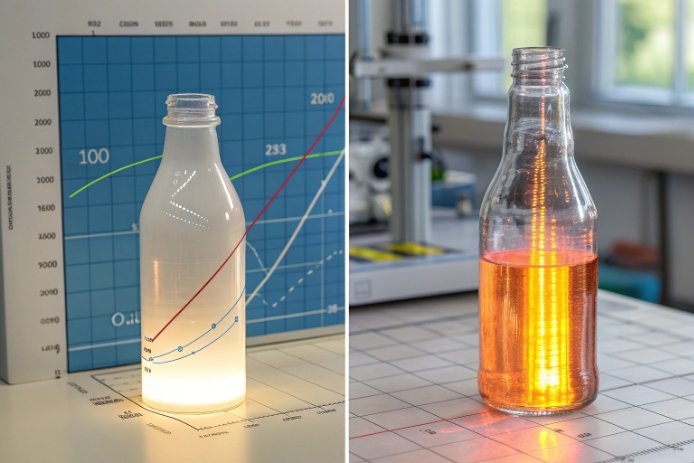
When a bottle slumps, ovalizes, or shows panel distortion, the line pays twice: scrap goes up, and customer trust goes down. The fix often starts in the batch.
Glass composition controls how fast viscosity drops as temperature rises, so it decides when a bottle starts to creep under load, and how much thermal stress it can survive without cracking.
What really controls “softening” in a glass bottle?
Glass does not melt at one clean temperature. It slowly moves from rigid to rubbery to viscous flow. For containers, the key is the viscosity–temperature curve 1 and the standard “viscosity points” used in QA: strain point 2, annealing point, and softening point. If the curve sits higher, the bottle keeps its shape longer at elevated temperature. If the curve is steeper, the process window gets narrow and hot-form stability becomes harder.
Heat deformation is mainly a creep problem
A bottle usually deforms when three things overlap:
-
The glass is warm enough for viscosity to drop.
-
There is mechanical load (stacking, conveyor pressure, clamping, internal pressure).
-
Time is long enough for creep (minutes in a tunnel, hours in a hot warehouse, repeated cycles for returnables).
Thermal shock is different. Thermal shock 3 failure comes from temperature gradients and stress, not from bulk softening. So the best composition often balances two goals: raise viscosity at service/process temperature and keep thermal stress low.
Composition levers and what they usually do
| Lever in composition | What it does to the network | Typical outcome for deformation | Typical outcome for thermal shock |
|---|---|---|---|
| More SiO₂ (network former) | More connected network | Higher viscosity at a given temperature, higher viscosity points | Often lowers CTE, helps shock |
| More Al₂O₃ (intermediate) | Strengthens network and ties up modifiers | Raises viscosity points and reduces creep | Often lowers CTE and improves durability |
| More alkali (Na₂O/K₂O/Li₂O) | Depolymerizes network | Lowers viscosity points, higher creep risk | Usually raises CTE and stress risk |
| Swap CaO ↔ MgO | Changes modifier field strength and packing | Can shift curve and liquidus, impacts creep | Can shift CTE and crack risk |
| Add B₂O₃ (where allowed) | Alters network, can lower CTE | Can improve shock, but must manage volatility and durability | Often improves shock if designed well |
A practical way to think about it is simple: deformation resistance tracks viscosity, while thermal shock tracks CTE + residual stress + strength uniformity. Composition influences both, but process control decides if the benefits actually show up on the line.
A bottle recipe can look strong on paper and still fail in production if annealing is off, wall thickness varies, or the liquidus 4 is too close to the forehearth temperature.
Which oxide ratios raise Tg and the annealing point to reduce softening at elevated temperatures?
If bottles soften too early, the first instinct is to “raise Tg.” That idea is directionally right, but for containers it is more useful to target the annealing point and strain point because they track where stress relaxes and where creep becomes noticeable during warm handling.
Raising SiO₂ and Al₂O₃ while controlling total alkali is the most direct way to lift the viscosity curve, which pushes the annealing and strain points upward and reduces creep at elevated temperatures.
What “ratio” means in container practice
For soda-lime container glass 5, most changes are small because melting cost, furnace wear, and devitrification 6 limits are real. The ratio mindset that works in real factories is:
-
(SiO₂ + Al₂O₃) / (Na₂O + K₂O): higher usually means higher viscosity points and less creep.
-
Al₂O₃ / total alkali: higher usually means better network stiffness and durability.
-
Total modifiers / network formers: lower usually means better hot stability, but melting gets harder.
A safe direction is often:
-
Slightly higher SiO₂
-
Al₂O₃ moved up within the container-friendly band
-
Total alkali trimmed, then compensated by furnace temperature or fining strategy, not by dumping more modifiers back in
Why this works
-
SiO₂ increases polymerization, so viscosity stays higher as temperature rises.
-
Al₂O₃ acts like a network “reinforcement.” It also ties up alkali and alkaline earth ions, so the structure resists flow longer.
-
Too much modifier makes the structure “looser,” so viscosity collapses sooner.
Practical target bands used in bottles (rule-of-thumb ranges)
These are not one-size-fits-all, but they help frame conversations with a batch engineer:
| Oxide group | Typical soda-lime bottle band | “Hotter stability” direction | Main tradeoff |
|---|---|---|---|
| SiO₂ | ~70–75% | Increase | Higher melt temperature, slower fining |
| Total alkali (Na₂O + K₂O) | ~12–15% | Decrease | Harder melting, higher energy |
| Al₂O₃ | ~1–3% (sometimes higher) | Increase | Higher viscosity in furnace, liquidus risk |
| Alkaline earth (CaO + MgO) | ~10–14% combined | Re-balance | Devitrification and durability balance |
A simple diagnostic that saves time
When deformation is reported, I like to separate two cases:
1) True softening/creep: deformation increases with time at warm temperature under load. Composition and viscosity points matter.
2) Stress-driven distortion: shape issues show up right after forming or in hot-end handling. Then annealing, thickness, and conveyor mechanics matter more than Tg talk.
So oxide ratios can raise viscosity points, but the plant still must prove it with creep-style tests, not only lab dilatometry.
Does boosting Al₂O₃ and balancing CaO/MgO improve thermal deformation limits and thermal-shock performance?
Many teams try Al₂O₃ 7 first because it can improve several properties at once. That instinct is good, but it needs a “guardrail plan” for melting and devit.
Adding Al₂O₃ can raise viscosity points and reduce creep, and a smart CaO/MgO balance can improve stability and thermal shock, but too much Al₂O₃ or the wrong CaO/MgO split can raise liquidus and create stones or cords.

Why Al₂O₃ often helps
Al₂O₃ does three helpful things for containers:
-
Raises viscosity points: better hot-form stability and less deformation under warm load.
-
Improves chemical durability: important for aggressive beverages, detergents, or returnable caustic washing.
-
Often reduces CTE a bit: that can reduce thermal stress during hot-fill or pasteurization.
But Al₂O₃ is not “free.” If it pushes the liquidus too high, the melt can crystallize more easily in the forehearth. That can lead to defects and unstable forming.
What CaO vs MgO balance really changes
Both CaO and MgO are modifiers, but they behave differently:
-
CaO is a strong stabilizer for soda-lime glasses. It helps durability and keeps the glass workable. Too much can increase expansion and can shift the viscosity curve in ways that do not always help deformation.
-
MgO can tighten packing and can help durability and sometimes lower CTE. It can also push the liquidus up in some systems, so devitrification control matters.
The best practice is not “more MgO.” It is a balanced modifier set that:
-
Maintains a safe gap between operating temperatures and the liquidus
-
Keeps fining stable
-
Keeps the viscosity curve where the forming machines want it
How to decide if the change actually improved thermal shock
Thermal shock performance is not only chemistry. It is also:
-
Residual stress after annealing
-
Thickness uniformity and heel design
-
Surface condition (abrasion, checks, coatings)
So when Al₂O₃ and CaO/MgO changes are proposed, the proof should include both material metrics and container tests.
| Change | Expected material shift | What to test on real bottles | Common failure mode if pushed too far |
|---|---|---|---|
| Increase Al₂O₃ | Higher viscosity points, better durability | Hot-load creep test, polarization stress check | Stones, high liquidus, unstable melting |
| Increase MgO share | Potentially lower CTE, change viscosity slope | Thermal shock cycle test, pasteurizer line trial | Devitrification, forming variation |
| Increase CaO share | Stability and durability, may raise CTE | Impact + thermal shock combo test | Higher thermal stress, crack sensitivity |
The best outcomes happen when the batch team and the forming team agree on one shared target: higher warm-load shape retention without shrinking the forming window.
How do alkali choices—Na₂O vs. K₂O/Li₂O—shift the viscosity–temperature curve and hot-form stability?
Alkali choices feel small on paper, but they strongly affect viscosity. They also affect CTE and stress, so they can quietly change hot-fill outcomes.
Na₂O usually gives a more forgiving, lower-viscosity melt for container production, while K₂O and Li₂O can shift the curve and properties in useful ways, but they add cost and can raise CTE or devitrification risk if not controlled.
Na₂O: the standard for a reason
Na₂O is common in bottles because it:
-
Lowers melting temperature and supports high pull rates
-
Keeps viscosity low enough for stable gob formation and forming
-
Is cost-effective and widely available
The downside is simple: more Na₂O tends to lower viscosity points and raise CTE. That can reduce deformation resistance at elevated temperature and can raise thermal stress during rapid temperature changes.
K₂O: similar role, different side effects
K₂O is also a modifier, but it often:
-
Increases CTE compared with the same molar Nahew of Na₂O in many soda-lime designs
-
Changes viscosity slope and can affect forming stability
-
Can improve some durability behaviors in specific compositions
In bottles, K₂O is often used in small amounts, not as a full swap, unless there is a specific reason.
Li₂O: powerful, but not casual
Li₂O is high-impact even at small additions because lithium has high field strength. In the right glass families (like lithium aluminosilicate), Li₂O can support low expansion and excellent thermal shock. In standard soda-lime bottle systems, Li₂O can:
-
Shift viscosity behavior
-
Change devitrification tendencies
-
Add cost and sourcing complexity
So Li₂O is usually considered for special containers, not commodity beverage bottles, unless the value case is clear.
The mixed-alkali lever that many teams miss
Mixing alkalis (Na₂O with K₂O, or small Li₂O additions) can create a mixed-alkali effect that changes ion mobility and can increase viscosity in some temperature ranges. This can help hot-form stability, but it can also complicate melting behavior and electrical properties in the furnace.
| Alkali strategy | Main benefit | Main risk | Where it fits best |
|---|---|---|---|
| Mostly Na₂O | Easy melting, stable forming | Higher CTE, lower viscosity points | High-volume beverage bottles |
| Add small K₂O | Property tuning, sometimes durability tuning | Higher CTE, curve shift can hurt forming | Niche tuning with strong process control |
| Add small Li₂O | Strong property shifts, possible shock gains in special designs | Devit risk, cost, narrow window | Premium/special heat-use containers |
| Mixed alkali design | Possible viscosity bump in mid-range | Complex melting/QA, unpredictable if uncontrolled | Plants with strong batch and furnace control |
When hot-form stability is the goal, the best move is often not a dramatic alkali swap. It is a small composition tune plus tighter control of gob temperature and thermal profile at the hot end.
What formulation targets and QA metrics (strain point, softening point, CTE) ensure reliable hot-fill and pasteurization?
Hot-fill and pasteurization failures rarely come from true softening. The temperatures are far below the softening region. Most real failures come from thermal stress, residual stress, and weak spots made worse by abrasion. Still, viscosity points matter because they correlate with how the glass relaxes stress during forming and reheating events.
For hot-fill and pasteurization, the most reliable approach is a balanced soda-lime (or upgraded) formulation paired with tight QA on CTE, stress state, and container-level thermal shock tests, not only lab numbers.
Formulation targets that usually work in practice
For most beverage and food bottles, the sweet spot is often:
-
Moderate-to-high SiO₂ for stiffness
-
Enough total alkali for melting efficiency, but not excessive
-
A healthy Al₂O₃ level for durability and viscosity point lift
-
A tuned CaO/MgO balance that avoids devitrification and controls CTE 8
If the product sees harsh thermal cycles or aggressive chemistry, a move toward borosilicate 9 or aluminosilicate designs can be justified, but that is a full system decision, not a quick batch tweak.
QA metrics that connect to real performance
Lab metrics are useful only if they predict container behavior. These are the ones that consistently matter:
1) CTE (Coefficient of Thermal Expansion)
Lower and consistent CTE reduces thermal stress during rapid heating and cooling. What matters most is not chasing the lowest number, but keeping it tight across production lots.
2) Residual stress after annealing
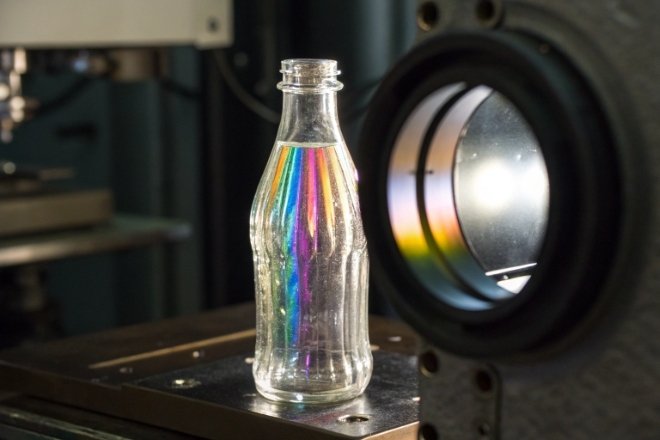
Even a good composition will fail if annealing leaves high stress. Use polariscopic inspection 10 and set a clear reject rule for outliers, not only for averages.
3) Strain point and annealing point consistency
Absolute values matter less than stability. A drifting annealing point is often a sign of batch variation or redox shifts. Those shifts show up as changing stress relaxation behavior in the lehr.
4) Softening point and creep-style container tests
Softening point is a useful reference, but deformation resistance should be proven with container tests that apply load at elevated temperature and measure dimensional change.
A practical QA scorecard for hot-fill and pasteurization
| QA item | What it protects against | How to measure | What “good” looks like |
|---|---|---|---|
| CTE (20–300°C range often used) | Thermal stress cracks | Dilatometry | Tight lot-to-lot control |
| Residual stress pattern | Spontaneous cracks in pasteurizer | Polariscopic check | Low and uniform stress |
| Thermal shock cycle test | Cracks during hot-fill/cool-down | Heat/cool cycling on filled bottles | Low break rate, consistent mode |
| Hot-load creep/sag test | Shape change in warm handling | Load + temperature hold | Minimal height/oval change |
| Top load + impact after thermal cycle | Real-world handling after heat | Mechanical tests after cycling | Strength retention |
A simple process note that often beats chemistry
Hot-fill and pasteurization success often improves more from:
-
Better wall thickness uniformity
-
Strong hot-end and cold-end coatings
-
Lower abrasion and better conveying
-
Correct lehr temperature profile and verified annealing
Composition sets the ceiling, but process sets the daily results. The best plants treat formulation targets and QA metrics as one closed loop.
Conclusion
Better heat deformation resistance comes from lifting the viscosity curve with SiO₂ and Al₂O₃, tuning modifiers with CaO/MgO and alkalis, and proving it with CTE, stress, and container-level creep and shock tests.
Footnotes
-
Viscosity of glass helps understand flow behavior at different temperatures. ↩
-
Strain point indicates the temperature below which glass behaves as a solid. ↩
-
Thermal shock explains fracture caused by rapid temperature changes. ↩
-
Liquidus temperature is the limit above which the material is completely liquid. ↩
-
Soda-lime glass is the most prevalent type of glass for containers. ↩
-
Devitrification is the unwanted crystallization process in glass. ↩
-
Aluminium oxide is a critical intermediate oxide for durability. ↩
-
Thermal expansion measures how volume changes with temperature variations. ↩
-
Borosilicate glass offers superior resistance to thermal shock. ↩
-
Polariscope is an optical tool used to visualize stress patterns. ↩






