

A furnace can look stable, then one pull change turns boosting wild. Conductivity shifts can be the hidden reason behind that chaos.
Glass-melt conductivity is mostly ionic. More mobile alkalis and higher temperature raise conductivity fast. Stable conductivity keeps boosting power, glass temperature, and quality more predictable.
A simple conductivity playbook for bottle-glass furnaces
Electrical conductivity 1 in bottle glass is not a lab curiosity. It is a control variable that decides how smoothly an electric boost system behaves and how evenly heat moves through the melt. Conductivity is also one of the easiest properties to “accidentally change” when cullet rises, when alkali sources change, or when forehearth temperatures drift.
The first step is to treat conductivity as an output of three things:
– Composition (mainly total alkali and which alkali is used)
– Temperature (conductivity rises very fast with temperature)
– Structure and redox (usually smaller than alkali and temperature for common soda-lime 2 melts, but still relevant in some cases)
A bottle plant rarely measures conductivity directly every minute. Still, the plant feels it every minute through booster current, voltage, electrode load, temperature stability, and sometimes defect rates. So the practical job is to control the inputs that move conductivity the most, then use fast signals to detect drift before it becomes a furnace problem.
What moves conductivity most in container glass
| Driver | What changes in the melt | Conductivity trend | What operators notice first |
|---|---|---|---|
| Temperature (melter/forehearth) | Ion mobility rises | Up fast | Booster current rises, power balance shifts |
| Total alkali (Na₂O + K₂O) | More mobile charge carriers | Up | Easier current flow, different boost efficiency |
| Alkali type mix | Mobility and “pathways” change | Can be non-linear | Small recipe changes cause surprises |
| Cullet percent and cullet chemistry | Alkali and impurities shift | Often up, sometimes unstable | Batch-to-batch electrical behavior changes |
| Water/volatiles in batch | Local melt chemistry shifts | Often transient | Short-term swings and hotspots |
A buyer spec should not demand “one conductivity number” without context. A better request is a stability plan: a composition window, a temperature window, and a method to detect conductivity drift early.
Now the key questions.
This next section explains what actually carries current in glass melts, because that mechanism guides every control decision.
What mechanisms govern ionic conduction in glass melts?
Small changes in alkali or temperature can look like small chemistry changes. In conductivity terms, they can behave like big electrical changes.
Ionic conduction in molten soda-lime glass is dominated by mobile cations, mainly Na⁺ and K⁺. Conductivity rises with temperature in an Arrhenius-like way because ion motion needs activation energy.

The core mechanism: ions hopping through a disordered network
Molten and high-temperature glass is an ionic conductor. The silica-based network provides a disordered structure. Alkali ions sit in that structure and move when thermal energy is high enough. When voltage is applied (like in electric boosting), the electric field biases that motion and a net current flows.
Two ideas explain most real plant behavior:
1) Charge carrier concentration
More alkali oxide usually means more mobile ions available. That raises conductivity.
2) Ion mobility
Mobility rises sharply with temperature. It also depends on how “open” the network is. A more modified network often lets ions move more easily.
Many melts show an Arrhenius 3-type temperature dependence: conductivity increases exponentially with temperature. In practical terms, a small temperature rise can cause a noticeable conductivity rise, which then changes current flow in boosting circuits.
Mixed-alkali behavior: why Na₂O and K₂O can surprise
Container glass often uses mostly Na₂O. Some recipes add K₂O or have K₂O variation from raw materials. Mixed-alkali systems can show non-linear transport behavior. That means a “small substitution” can create a conductivity minimum or an unexpected slope change. This matters when a plant changes soda ash source, feldspar source, or cullet blend and unintentionally shifts the Na/K ratio.
Why redox matters less (usually) than alkalis and temperature
For typical bottle soda-lime compositions, alkali content and temperature dominate conductivity. Redox can matter more in specialty systems with electronic conduction contributions or with multivalent ions that change charge state. In normal container operations, redox often shows up indirectly by changing temperature profiles, fining behavior, or foam, which then shifts conductivity through temperature and composition mixing.
A mechanism table that ties to control
| Mechanism piece | What it depends on | How it shows up | What to control |
|---|---|---|---|
| Carrier count | Na₂O + K₂O level, cullet chemistry | “Base” conductivity level | Alkali window, cullet grade |
| Mobility | Temperature, network openness | Sensitivity to temperature drift | Tight temperature control |
| Non-linear mixing | Na/K ratio, local structure | Unexpected drift during recipe changes | Manage substitutions and blends |
Once the mechanism is clear, the furnace reason becomes obvious: conductivity is not only a property. It is a stability lever.
Why does conductivity control matter for furnace stability?
A furnace can run smooth for months, then a few weeks of instability burn electrodes faster and increase defects. Conductivity drift is one common root cause.
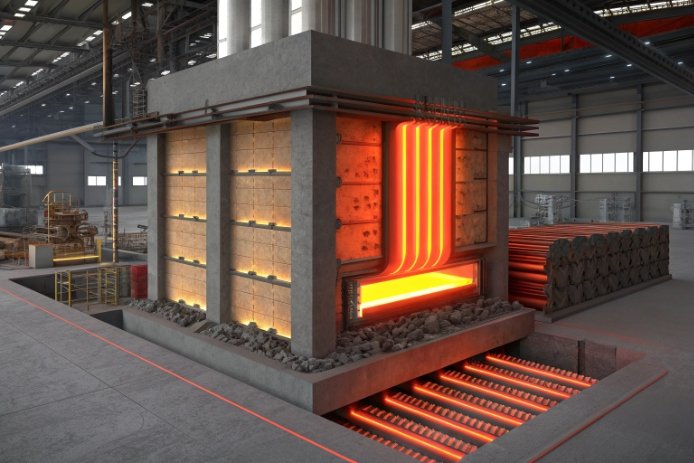
Conductivity control matters because electric boosting depends on current flowing through the melt. If conductivity rises or falls, the same boost setting can deliver different heating, shift thermal gradients, and create runaway behavior unless power control is tight.
Boosting is a “glass-as-a-resistor” system
Electric boosting heats glass by passing current through the melt. The melt behaves like a resistor. Heat is generated by Joule heating 4. So, if resistivity 5 drops (conductivity rises), current can rise at a given voltage. That changes:
– electrode loading,
– local heating near electrodes,
– convection patterns,
– temperature uniformity.
A stable furnace needs stable heat distribution. If conductivity drifts, heat distribution drifts too.
A positive feedback loop can appear:
1) A hot zone forms.
2) Hotter glass becomes more conductive.
3) More current flows through that zone.
4) That zone heats even more.
Modern power systems reduce this risk with controlled power electronics and careful electrode design, but the physics still exists. A recipe that becomes “too conductive” at operating temperature can make control more sensitive. A recipe that becomes “not conductive enough” can limit boost capability and reduce flexibility during pull changes.
Why container plants feel this more now
Many bottle plants push:
– higher cullet percent,
– higher pull rate flexibility,
– tighter energy targets.
All three increase the value of stable boosting and stable melt behavior. Cullet 6 helps energy but adds chemistry variability. Pull changes stress heat balance. Energy optimization reduces the safety margin. Conductivity control ties these together.
What stability looks like in operational terms
| Stability goal | Conductivity-related signal | Risk if uncontrolled | Practical safeguard |
|---|---|---|---|
| Stable glass temperature | Stable boost current/voltage patterns | temperature waves, cords | closed-loop boost power control |
| Stable electrode life | Lower current spikes and balanced load | electrode wear, downtime | alarm limits and ramp rules |
| Stable quality | Fewer thermal gradients | seeds, striae, color drift | smooth pull-change strategy |
| Stable energy | predictable kWh/ton with boosting | energy spikes | model-based setpoints |
Conductivity control is not only about “getting more heat.” It is about keeping heat predictable across time, batch, and cullet changes.
Next is the buyer-facing part: how to tune alkalis and temperature without breaking durability or formability.
How to tune alkalis and temperature to manage conductivity?
It is tempting to fix conductivity problems by adding alkali or increasing temperature. That approach can create new issues fast.
Conductivity is managed best by setting an alkali window, controlling Na/K mix, and holding a tight temperature window. Small changes should be validated with a property model or a controlled trial because conductivity responds sharply to temperature and Na₂O level.
Alkalis: the strongest composition knob
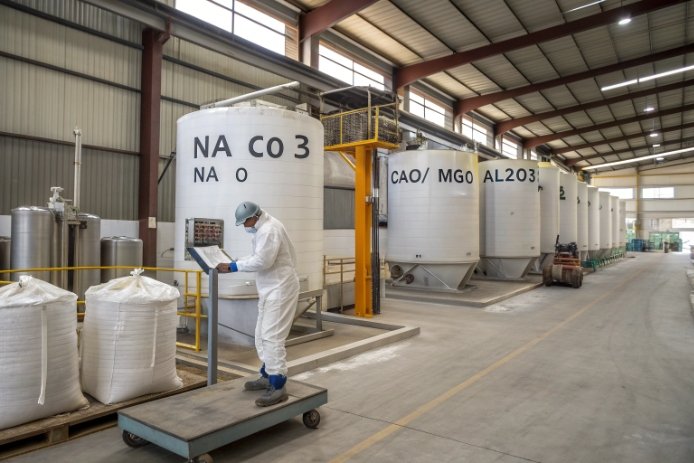
In soda-lime container glass, Na₂O is the main driver. Raising Na₂O tends to raise conductivity and lower resistivity. That can help boosting and melting, but it can also:
– increase thermal expansion 7,
– reduce chemical durability 8,
– increase volatility and carryover,
– shift redox needs.
K₂O can behave differently in mobility and can create mixed-alkali effects when combined with Na₂O. So it is safer to control total alkali and also control the ratio, not only one number.
A practical approach is to define three ranges:
– Na₂O target band
– K₂O maximum drift band
– total alkali band (Na₂O + K₂O)
Then the plant links these to cullet chemistry control. Many conductivity surprises come from cullet shifts, not from deliberate batch changes.
Temperature: the fastest lever, but also the most sensitive
Conductivity rises strongly with temperature. Temperature changes happen every day:
– pull rate shifts,
– burner tuning,
– batch blanket changes,
– electrode adjustments.
So temperature control should be viewed as a conductivity control tool. The best plants use smooth ramps and avoid sharp changes that create local hotspots and local conductivity spikes.
How to tune without hurting formability
A bottle furnace needs a stable viscosity 9 window at the working end. Changes that help conductivity can hurt viscosity. So, every tuning step should check:
– viscosity curve shift,
– liquidus/devitrification margin,
– forming temperature stability,
– defect trend.
A tuning decision table that stays safe
| Goal | Primary lever | Secondary lever | What must be watched |
|---|---|---|---|
| Boosting becomes “weak” | Slightly higher total alkali | Slightly higher operating temp | durability, expansion, volatility |
| Boosting becomes “too aggressive” | Reduce alkali drift from cullet | Reduce hotspots and smooth temp | electrode load, cords |
| Conductivity swings batch-to-batch | Tighten cullet grade and blend | tighten raw material substitution rules | chemistry trend charts |
| Need more output with stable quality | increase clean cullet + stable boost | model-based setpoints | stability during pull changes |
The safest path is to make changes small, then verify with measured signals. A big recipe change to chase conductivity often costs more than it saves.
Now the final question: can sensors and models predict conductivity shifts in real time?
Are inline sensors predicting conductivity shifts in real time?
Many plants want a simple “conductivity meter” for molten glass. The environment is harsh, but real progress exists.
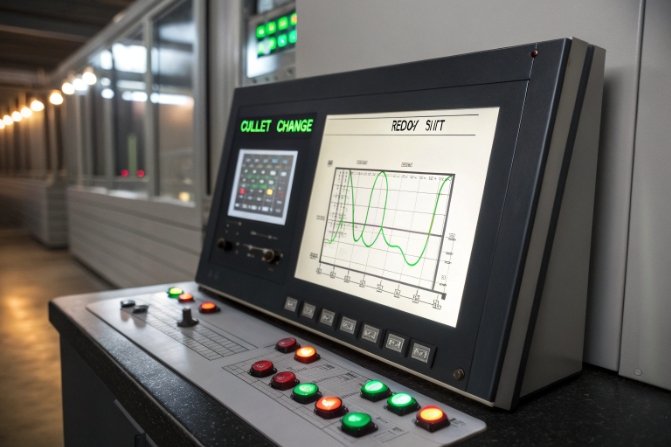
Real-time prediction is usually done with indirect signals (electrode voltage/current, temperature maps, batch chemistry trends) and a model that estimates resistivity. Direct in-melt probes exist in research and specialty melters, and electrical resistance tomography and impedance methods are proving that online monitoring is possible when hardware can survive.
What is realistic today in container operations
In most bottle furnaces with boosting, the best “inline conductivity signal” is already present:
– each electrode pair has measured current and voltage,
– power controllers and SCADA 10/PLC systems trend these values,
– temperature sensors trend melter and forehearth behavior.
From these, the plant can estimate effective resistivity in the electrode zone. This is not a perfect “whole furnace conductivity,” but it is extremely useful because it connects directly to the heating system.
A simple predictive setup uses:
– composition data (batch + cullet targets),
– temperature profile,
– historical electrode I/V data,
– a resistivity model to forecast how the next shift will behave.
This approach often catches drift early, before quality problems appear.
Direct sensors: possible, but still selective
Direct conductivity probes in molten glass exist in research and in some specialized melter environments. These probes typically use noble-metal electrodes and protective shafts. They can measure conductivity trends and detect events like crystal buildup or local property shifts. The barrier in container plants is durability, maintenance access, and the need to keep probes from becoming defect sources.
Electrical resistance tomography and multi-frequency resistance approaches are also being explored to infer melt state. These methods can provide richer information than a single point measurement. They also need robust installation and careful interpretation.
The smartest control pattern: hybrid sensing
A hybrid approach works best:
– Use electrode electrical data as the continuous signal.
– Use temperature imaging and thermocouples to detect hotspots.
– Use batch/cullet chemistry data to predict baseline conductivity.
– Use periodic glass composition checks to keep the model honest.
A practical “sensor stack” buyers can ask about
| Measurement layer | What it predicts | Update speed | Why it matters |
|---|---|---|---|
| Electrode current + voltage | effective resistivity near electrodes | seconds | protects electrodes and stabilizes boost |
| Furnace temperature profile | mobility and hotspot risk | seconds to minutes | prevents runaway zones |
| Batch + cullet chemistry tracking | carrier count trends | hours to days | avoids slow drift surprises |
| Periodic glass composition checks | model correction | daily/weekly | keeps predictions reliable |
Inline sensing is improving. The strongest gains come when the plant stops treating conductivity as a mystery and starts treating it as a modeled property tied to real electrical signals.
Conclusion
Bottle-glass conductivity is driven by mobile ions and temperature. Stable alkalis, stable temperature, and smart electrical trending keep boosting stable and quality predictable.
Footnotes
-
Electrical conductivity: A fundamental property measuring how easily electric current flows through a material, critical for efficient melting. ↩
-
Soda-lime: The most common commercial glass family, composed primarily of silica, soda, and lime, used for containers and windows. ↩
-
Arrhenius: A scientific equation describing how reaction rates and ion mobility increase exponentially as temperature rises. ↩
-
Joule heating: The process where the passage of an electric current through a conductor releases heat, the principle behind electric boosting. ↩
-
Resistivity: The inherent property of a material to resist the flow of electric current, inversely related to conductivity. ↩
-
Cullet: Recycled broken or waste glass added to the batch to lower melting energy and improve efficiency. ↩
-
Thermal expansion: The tendency of matter to change in volume in response to a change in temperature, affecting thermal shock resistance. ↩
-
Chemical durability: The ability of glass to resist corrosion by water, acids, and alkalis, ensuring long-term product integrity. ↩
-
Viscosity: A measure of a fluid’s resistance to flow, which determines how glass behaves during melting and forming. ↩
-
SCADA: Supervisory Control and Data Acquisition systems used for high-level process supervision and real-time data monitoring. ↩






