
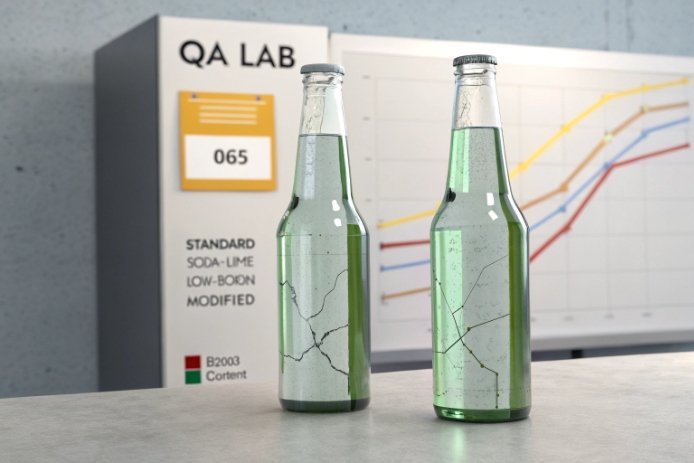
Heat failures feel unfair. A bottle looks fine on the pallet, then it cracks during hot-fill, pasteurization, or rapid cooling and stops the whole line.
Boron (B₂O₃) improves heat resistance mainly by lowering CTE and helping the glass network handle temperature gradients. The right boron level depends on whether the bottle is soda-lime hot-fill, boro-aluminosilicate, or true borosilicate.
Boron is a “thermal design lever” that must stay balanced with durability and formability
Heat resistance is not one property
When buyers say “heat resistance,” they usually mean one of these outcomes:
– The bottle survives hot-fill and cooling without cracking.
– The bottle survives pasteurization without stress failure.
– The bottle survives repeat heat–cool cycles without growing micro-cracks.
– The bottle keeps clarity and shape during heating steps, coating bake, or warehouse temperature swings.
B₂O₃ affects all of these, but it does it through a few core mechanisms. The biggest one is expansion. When expansion drops, thermal stress drops. That alone can change survival at thick zones like the heel and base. Boron also changes the network structure. It can create a network that tolerates gradients better than standard soda-lime glass 1, especially when the rest of the recipe supports it.
The buyer mistake: specifying boron without specifying performance
It is tempting to write “B₂O₃ = X%” in a purchase spec. That can help, but it is not the safest control method. Two glasses can share a similar B₂O₃ level and still have different CTE, viscosity, and durability because Na₂O, CaO, MgO, and Al₂O₃ differ.
The safer approach is to set performance targets first:
– target CTE window
– target thermal shock ΔT survival under a defined method
– target annealing stress pattern limits
Then use B₂O₃ as a tuning knob inside a qualified recipe family.
A practical map of what boron is doing
| What boron changes | What the line feels | What the buyer sees | What must stay controlled |
|---|---|---|---|
| Lower CTE | fewer thermal cracks | better hot-fill yield | cullet variability and redox drift |
| Lower melting temperature (often) | smoother melting and homogeneity | more consistent tint and clarity | fining system and seed control |
| Viscosity curve shift | different forehearth setpoints | more stable dimensions | forming window and gob stability |
| Network balance | better cycle resistance | fewer returns over shelf life | chemical durability and leach risk |
The sections below break the topic into four buyer questions. Each one is a real decision point in bulk bottle programs.
If boron is understood as a thermal design lever, it becomes easier to choose the right glass family and write the right controls.
What role does B₂O₃ play in thermal properties?
Thermal specs often fail because the team looks only at thickness or annealing and ignores chemistry. …The melt chemistry decides how the glass responds to temperature changes.
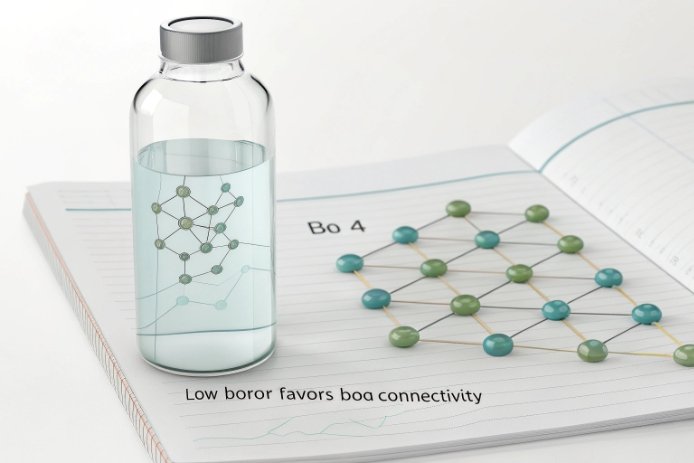
B₂O₃ improves thermal properties mainly by lowering CTE and tuning the glass transition and strain behavior, so thermal stress builds more slowly during heating and cooling.
Lower CTE is the core thermal benefit
When a bottle heats up, it expands. When it cools, it shrinks. The faster the change, the bigger the temperature gradient across the wall. Stress grows with that gradient and with CTE. Boron lowers CTE 2, so the same gradient creates less strain. This matters most at:
– thick bases and heels
– seam and shoulder transitions
– areas with residual stress 3 from forming
This matches what shows up in real claims. Many thermal cracks start at the heel or thick sections, not at the thin panels.
Boron also shifts “where stress relaxes”
Thermal resistance is not only about expansion. It is also about how the glass behaves near its strain and annealing range. Moderate boron levels can raise the strain and annealing points relative to expansion behavior in some boron-containing systems. This helps bottles survive hot-fill and pasteurization more reliably, especially when the annealing process is stable.
Still, this depends on balance. Excess boron without proper alkali and alkaline-earth balance can soften the glass and offset some gains. This is why pairing boron with slightly higher Al₂O₃ often helps. Al₂O₃ stabilizes the modified network and supports chemical durability 4.
A simple way to explain B₂O₃ thermal impact to procurement
| Thermal property | What it affects on the line | How B₂O₃ helps | What can go wrong if unbalanced |
|---|---|---|---|
| CTE | thermal stress magnitude | lowers expansion | poor melt balance can still crack |
| Strain/anneal behavior | residual stress control | improves stress tolerance window | viscosity shift can change anneal needs |
| Thermal shock resistance | hot-to-cold survival | reduces stress spikes | surface flaws still dominate failures |
| Homogeneity | consistent performance | supports clearer, steadier melt | poor fining can leave seeds |
Thermal performance starts with chemistry, then gets confirmed by process. B₂O₃ is one of the strongest chemistry levers for thermal response, but it only works when the recipe family is chosen correctly.
Why does boron improve thermal shock tolerance in production?
Thermal shock problems often get blamed on “operators” or “handling.” The deeper cause is stress buildup during fast temperature gradients.
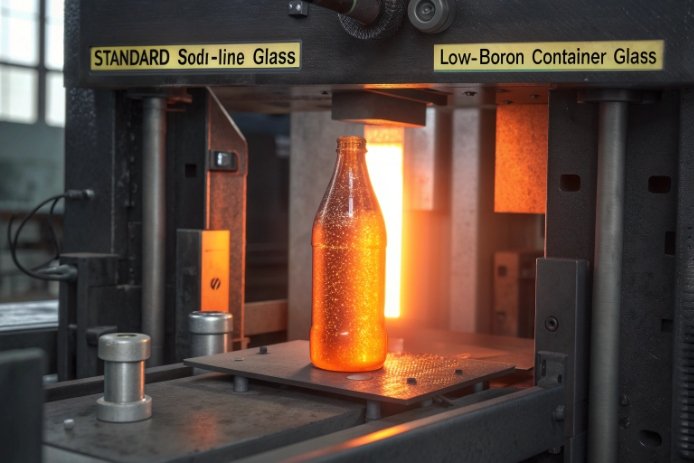
Boron improves thermal shock tolerance because lower CTE reduces stress, and the boron-modified network can tolerate gradients better than standard soda-lime glass at the same thickness.
Thermal shock is a gradient problem, not a temperature problem
A bottle can survive 85°C if it heats evenly. The same bottle can crack at a lower temperature if the inner wall heats fast and the outer wall stays cool. Hot-fill is exactly that scenario. Pasteurization ramps can also create gradients. Cold rinsing after hot-fill can reverse the gradient and create tension at the surface.
Lower CTE reduces stress in every one of these cases. It does not remove the gradient, but it reduces the strain created by the gradient.
Boron helps most where bottles are weakest
Real bottles fail where strength margin is lowest:
– heel and base (thicker, higher stress)
– seams and transitions (geometry concentration)
– scuffed zones (surface flaws)
Boron lowers the thermal stress that tries to open those flaws. That is why boron-containing formulations show improved resistance to repeated heat–cool cycles compared with conventional container glass of similar thickness.
Production reality: boron is not a substitute for annealing
Boron helps, but it does not erase poor annealing. A bottle with high residual stress can crack even with improved CTE. The best results come when boron tuning is paired with:
– stable annealing lehr 5 settings
– stress pattern checks by polariscope
– consistent cullet chemistry that does not push CTE upward
This is where one of the most practical insights matters: when cullet variability pushes expansion upward, boron-bearing batch materials can pull the bottle back into a safe thermal shock 6 window. That is a real-world stabilizer strategy.
| Production variable | What it does to thermal shock risk | How boron helps | What else must be done |
|---|---|---|---|
| Thick heel/base | raises stress concentration | lowers stress per °C | smooth thickness transitions |
| Hot-fill gradients | creates tensile surface stress | reduces expansion strain | control fill temp and cooling profile |
| Residual stress | reduces safety margin | indirect help only | optimize annealing and handling |
| Cullet drift | changes CTE lot-to-lot | boron can re-center CTE | lock cullet family and COA |
Thermal shock tolerance is a system outcome. Boron gives chemistry margin. Process control turns that margin into stable yields.
How much boron should hot-fill bottles typically specify?
This question comes up in almost every hot-fill conversation. The honest answer depends on what “hot-fill bottle” means in that project.
Most hot-fill bottles in mass beverage use soda-lime glass and may specify little to no B₂O₃, relying on design and process control. If the project needs higher thermal margin, boro-aluminosilicate (moderate B₂O₃) or borosilicate (higher B₂O₃) ranges become relevant, but performance specs should lead.
Three practical classes instead of one number
Hot-fill programs usually sit in one of these classes:
1) Standard soda-lime hot-fill
This is the most common in high-volume beverage. …The glass family is soda-lime. Heat resistance comes from:
– stable CTE inside soda-lime limits
– correct wall distribution
– controlled hot-fill and cooling steps
– strong annealing control
In this class, B₂O₃ is often not the main lever. If present, it is usually small.
2) Boro-aluminosilicate step-up
Some programs want more thermal margin but still need bottle-style production economics. Moderate boron levels can help, but the recipe must be balanced with Al₂O₃ and stabilizers so chemical durability stays strong and the melt stays stable.
3) True borosilicate
This is used when thermal shock tolerance and stability are the priority. Borosilicate [^7] compositions often include a meaningful B₂O₃ level. This route can support aggressive thermal cycling, but it changes melting and forming expectations, and it changes supply chain cost.
What should be specified in purchasing language
Instead of “B₂O₃ = X%,” a safer approach is:
– CTE window (measured over a stated range)
– thermal shock ΔT test under a defined method and bottle condition
– stress pattern limit (polariscope)
Then request the supplier’s target B₂O₃ range as part of their process control.
If a buyer still wants boron limits, it is safer to specify a range by glass family and include change control for cullet and raw sources.
| Glass family for hot-fill | Typical B₂O₃ approach | Best reason to choose it | Primary trade-off |
|---|---|---|---|
| Soda-lime container glass | none to low | lowest cost, high volume | lower thermal margin, needs tight process |
| Boro-aluminosilicate | moderate | better thermal window without full switch | needs careful viscosity and durability balance |
| Borosilicate | higher | strongest thermal shock tolerance | different cost and process demands |
The best “boron specification” is the one that protects performance without forcing the plant into unstable melting and forming behavior.
Are boron-efficient recipes reducing energy and emissions?
Heat resistance is not the only driver now. Energy cost and emissions targets push many bottle programs to rethink chemistry and cullet strategy.
Boron-efficient recipes can reduce energy and emissions when they lower melting temperature demand and improve melt homogeneity, but the real gains come when chemistry is paired with high, consistent cullet and stable furnace control.
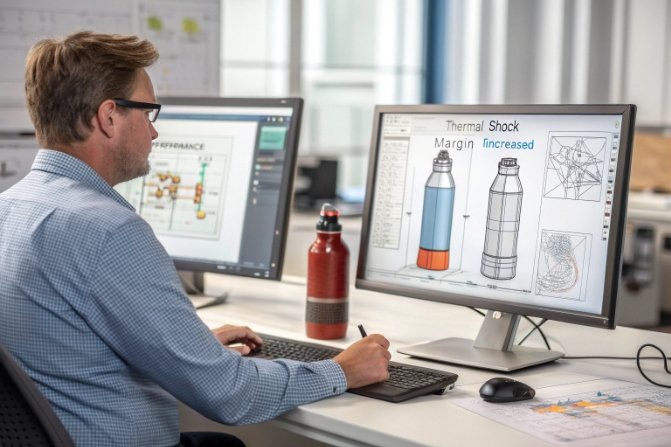
Why boron can support lower energy melting
B₂O₃ can help glass melt and refine more smoothly in some systems. A melt that reaches homogeneity 7 faster can reduce:
– time spent chasing temperature
– defect rework and scrap
– the need for extra heat to “force” fining and mixing
This matters because scrap and re-melt are hidden emissions. A cleaner melt also supports more consistent thermal performance across runs, which reduces claims and returns.
The “boron-efficient” idea is really a balance idea
The best low-energy recipe is not “highest boron.” It is “enough boron to hit thermal targets while keeping the rest of the recipe stable.” Too much boron without proper balance can soften the glass and reduce durability gains. It can also shift viscosity in ways that force higher forehearth temperatures, which can erase energy benefits.
Pairing boron with a slightly higher Al₂O₃ is one of the practical ways to keep the network stable. It helps preserve chemical durability while the thermal expansion is being tuned.
The biggest emissions lever still beats chemistry: cullet quality and consistency
Even a smart boron recipe will struggle if cullet 8 is inconsistent. Mixed cullet can push expansion upward and add redox drift. That forces more correction. That correction often costs energy and creates defects.
A strong “boron-efficient” program usually includes:
– high and stable cullet ratio with strict sorting
– chemistry windows and ratio control (alkali vs stabilizers)
– performance proof by thermal shock and stress checks
| Emissions driver | What improves it | How boron may help | What must be controlled |
|---|---|---|---|
| Furnace energy per ton | lower melting demand | supports smoother melting in some systems | viscosity curve and fining timing |
| Scrap and rework | fewer defects | better homogeneity and stable CTE | cullet quality and redox stability |
| Logistics emissions | lightweighting without failures | reduces thermal shock risk at thinner walls | strength margin and abrasion control |
| Compliance rejects | fewer re-tests and returns | steadier thermal performance | documented QC and change control |
Boron-efficient recipes can support energy and emissions goals, but only when they are treated as part of a full stability plan, not as a single-oxide trick.
Conclusion
B₂O₃ lowers CTE and improves thermal shock margin, especially at thick zones. The best boron level depends on glass family and must be proven with CTE, stress, and glass transition [^10] tests.
…Footnotes
-
Soda-lime glass: The most common glass family used in beverage containers, known for cost-effectiveness but moderate thermal resistance. ↩
-
CTE: A measure of how much a material expands when heated; lower values reduce thermal stress risk. ↩
-
Residual stress: Internal tension remaining in glass after cooling, which can be managed by annealing to prevent failure. ↩
-
Chemical durability: The ability of glass to resist corrosion and leaching when in contact with liquids or harsh environments. ↩
-
Annealing lehr: A long kiln used to cool glass containers slowly and uniformly to relieve internal stresses. ↩
-
Thermal shock: Mechanical load caused by rapid temperature changes, often leading to fracture in materials with high expansion.[^7]: Borosilicate: A glass type with added boron oxide, offering superior resistance to thermal shock and chemical attack. ↩
-
Homogeneity: The uniformity of the glass melt composition, crucial for consistent physical properties and defect-free production. ↩
-
Cullet: Recycled broken glass added to the melt to lower energy consumption and improve melting efficiency.[^10]: Glass transition: The temperature range where glass shifts from a hard, brittle state to a viscous, rubbery state. ↩






