
We often assume that "stronger" glass means better resistance to everything. However, while Boron makes glass thermally invincible, its chemical behavior—specifically against aggressive cleaning agents—is complex and often misunderstood by brand owners.
Boron Oxide (B₂O₃) acts as a powerful glass network former that drastically improves hydrolytic and acid resistance by creating a tighter, more connected atomic structure. However, unlike alumina, high boron content can actually increase solubility in strong alkaline solutions, making the glass susceptible to surface etching during aggressive caustic washing cycles.
Understanding Boron’s Double-Edged Sword
At FuSenglass, we often field inquiries from clients—particularly in the pharmaceutical and premium beverage sectors—who demand "Borosilicate" glass because they believe it is superior in every conceivable metric. While it is true that adding Boron Oxide (B₂O₃) creates Type I glass 1, which is the gold standard for thermal shock resistance and storing neutral injectables, it is not a magic shield against all chemical attacks.
In standard soda-lime glass (Type III), the network is composed primarily of Silica (SiO₂) and modifiers like Soda Ash (Na₂O). These modifiers create "loose" ends in the molecular structure, which allow water to leach out sodium ions. This is why standard glass can sometimes "bloom" or weather if stored improperly.
When we introduce Boron Oxide into the melt, it acts as a network former 2. It doesn’t just sit in the gaps; it actively builds the skeleton of the glass alongside silica. This results in a material with a much lower coefficient of expansion—meaning it won’t crack when you pour boiling water into it.
However, from a chemical corrosion standpoint, Boron introduces a unique dynamic. My production team carefully monitors the boron-to-alkali ratio because it dictates the "Boron Anomaly." This is a phenomenon where the properties of the glass change non-linearly. In the right amounts, Boron tightens the network and prevents leaching. But in high-pH environments, the chemistry flips. As a brand owner, understanding this nuance is critical to preventing product contamination or packaging failure.
Key Roles of Boron in Glass Formulation
| Property | Effect of B₂O₃ Addition | Benefit for Packaging |
|---|---|---|
| Thermal Expansion | Significantly lowers the coefficient of expansion 3 (COE). | Prevents breakage during hot-filling or pasteurization. |
| Hydrolytic Resistance | Increases resistance to water attack (Type I Glass). | Prevents pH shifts in sensitive liquid pharmaceuticals. |
| Melting Point | Acts as a flux, lowering melting viscosity. | Allows for easier forming of complex shapes at lower temps. |
| Refractive Index | Lowers the refractive index. | Creates a clearer, highly transparent glass aesthetic. |
| Chemical Durability | Increases Acid resistance; Varies for Alkali. | Protects against acidic juices/drugs; requires caution with caustics. |
To fully grasp why Boron is excellent for acid but tricky for alkali, we must look at how it physically changes the atomic web of the glass.
How does increasing B₂O₃ change the glass network and affect ion exchange and dissolution in water, acids, and alkaline cleaners?
The durability of glass is determined by how tightly its atomic structure is knit together. Boron acts as a "zipper," closing the gaps that allow ions to escape, but the strength of this zipper depends entirely on the pH of the liquid touching it.
Adding B₂O₃ transforms the glass network by converting loose structural units into stable tetrahedral [BO₄]⁻ groups, which densifies the matrix and blocks the diffusion paths required for ion exchange. This makes the glass nearly impervious to water and acid attack. However, in high-pH alkaline solutions, the B-O bonds are chemically weaker than Si-O bonds, leading to rapid network hydrolysis and surface dissolution.
The Atomic Architecture: Trigonal vs. Tetrahedral
In my experience analyzing glass defects, the root cause is often invisible to the naked eye. It starts at the atomic level. Boron can exist in glass in two main forms:
-
Trigonal [BO₃]: A flat, triangle shape.
-
Tetrahedral [BO₄]: A 3D pyramid shape.
When we add Boron to a soda-lime-silica mix, it initially consumes the alkali (sodium) to form stable [BO₄] tetrahedra. This is the "magic" zone. These tetrahedra integrate seamlessly with the silica network, creating a super-tight mesh.
- In Water and Acids: This tight mesh leaves no room for water molecules to penetrate or for sodium ions to wiggle out. The "ion exchange" (where H+ swaps with Na+) is physically blocked. This is why borosilicate glass 4 is the standard for laboratory beakers—you can boil acid in them all day, and the glass remains virtually untouched.
The Alkali Vulnerability
However, the chemistry changes when the glass meets a strong base (Alkali). The bonds holding Boron into the network (B-O-Si bonds) are chemically different from pure Silica bonds (Si-O-Si).
-
In Alkaline Cleaners: Hydroxyl ions (OH-) in caustic cleaning solutions aggressively attack the glass surface. They find the Boron sites to be the "weak links." The OH- ions break the B-O bonds much faster than they break the Si-O bonds.
-
Once the Boron is dissolved out of the surface, it leaves behind a skeleton of silica that is now porous and weak. This leads to "matrix dissolution," where layers of the glass surface literally peel or dissolve away.
At FuSenglass, when we design bottles for acidic contents (like premium vinegars or acidic serums), we push the boron content. But if the bottle is for a product with a high pH, or one that requires aggressive caustic washing, we have to be very careful.
Chemical Attack Response Matrix
| Environment | Primary Attack Mechanism | Effect of High Boron Content | Resulting Durability |
|---|---|---|---|
| Water (Neutral pH) | Leaching (Ion Exchange) | Blocks Leaching. Tightens network, traps Na+ ions. | Excellent. (Type I Glass standard). |
| Acid (Low pH) | Ion Exchange (H+ <-> Na+) | Blocks Exchange. Prevents protons from entering glass. | Excellent. Superior to standard soda-lime. |
| Alkali (High pH) | Network Hydrolysis 5 (Dissolution) | Weakens Network. B-O bonds break faster than Si-O bonds. | Moderate/Poor. Faster erosion than Aluminosilicate. |
| Salt Solutions | Mixed Mechanism | Stabilizes. Prevents salt weathering. | Very Good. Ideal for saline storage. |
This alkali weakness brings us to a critical operational question: If you use "strong" borosilicate glass, can you wash it?
When can higher B₂O₃ reduce durability in high-pH conditions, and how do borosilicate and soda-lime bottles compare for caustic wash lines?
Operational efficiency relies on aggressive cleaning, but the wrong glass choice can lead to etched, cloudy bottles after just a few cycles. We must match the glass composition to the wash process.
High B₂O₃ becomes a liability when exposed to hot caustic soda (NaOH) above 60°C, where the dissolution rate of the borosilicate network accelerates significantly compared to alumina-stabilized glass. While borosilicate is superior for thermal shock in wash lines, aluminosilicate or treated soda-lime bottles actually offer better surface longevity and resistance to etching in high-pH industrial bottle washers.
The Caustic Wash Dilemma
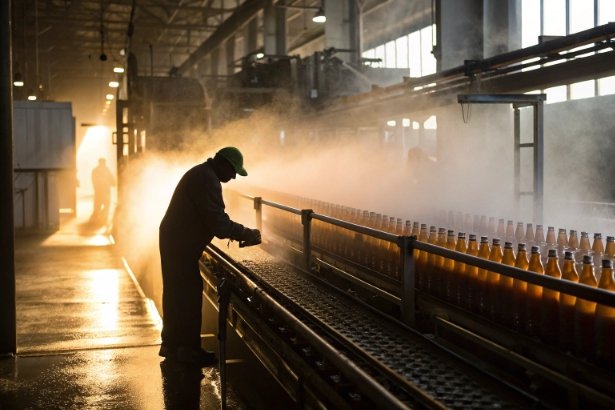
Returnable glass bottles are making a massive comeback due to sustainability goals. A typical returnable bottle might be washed 20 to 50 times in its life. These industrial washers use hot Caustic Soda (NaOH) 6 at 2-4% concentration and temperatures around 80°C to strip labels and sterilize the bottle.
This is the "Kryptonite" for high-boron glass.
I have seen clients switch to borosilicate glass for their returnable fleet, thinking it would last longer because it is "tougher." Within six months, they called me complaining that their expensive bottles looked "hazy" or "scuffed." They assumed it was physical abrasion. It wasn’t. It was chemical etching.
Why Soda-Lime often wins here:
Standard soda-lime glass, especially when reinforced with Alumina (Al₂O₃) rather than Boron, is surprisingly more resistant to this specific type of alkaline attack. Alumina acts as a shield against the OH- ions, whereas Boron acts as a sacrificial entry point.
The "W" Curve:
There is a known phenomenon in glass chemistry regarding corrosion. As you add Boron to silica, acid resistance goes up straight away. But alkali resistance drops, then stabilizes, then drops again. For a bottle washer environment, a high-alumina soda-lime bottle will maintain its glossy appearance for more cycles than a standard borosilicate bottle, even though the borosilicate is technically "Type I" glass.
Comparison: Borosilicate vs. Soda-Lime in Wash Lines
| Feature | Borosilicate (High B₂O₃) | Soda-Lime (Low/No B₂O₃) | Operational Implication |
|---|---|---|---|
| Thermal Shock | Superior. Can withstand rapid temp changes in washer. | Moderate. Needs gradual heating/cooling zones. | Borosilicate allows faster line speeds (less breakage). |
| Caustic Resistance | Lower. Surface etches/clouds faster in NaOH. | Higher. (Esp. with Alumina) Retains gloss longer. | Soda-lime looks "new" for more refill cycles. |
| Scuff Resistance | Harder. Resists physical scratching. | Softer. Physically scratches easier. | Trade-off: Chemically cloudy vs. Physically scratched. |
| Cost | High. expensive raw materials and melting. | Low. Standard mass production. | Soda-lime is much more ROI-friendly for breakage replacement. |
If you are using boron-containing glass, how do you know if it’s failing? You need to track specific indicators beyond just "it broke."
Which corrosion indicators—mass loss, alkali leaching, pH shift, surface haze—should be tracked to qualify boron-containing bottles for food or pharma use?
Corrosion is rarely catastrophic; it is usually insidious. It manifests as invisible contamination or visible degradation that destroys brand value.
For pharma and high-end food applications, you must track "Alkali Leaching" (via titration) to prevent pH spikes that degrade the product, and monitor "Delamination" (via microscopy) to ensure no glass flakes detach. For aesthetic durability, "Surface Haze" and "Mass Loss" are the primary physical indicators that the boron network is breaking down under chemical attack.

The Four Pillars of Corrosion Monitoring
When we qualify a new batch of glass at FuSenglass, we don’t just look at it. We torture it. Depending on your industry, different failure modes matter more.
-
pH Shift (The Pharma Killer):
For liquid pharmaceuticals or unbuffered solutions (like distilled water), the leaching of alkali ions (Sodium/Potassium) from the glass will raise the pH of the liquid inside. Even a small shift can denature a protein drug or spoil a sensitive beverage. Boron helps prevent this if the glass is intact. We measure this by filling the bottle with water, autoclaving it, and measuring the pH change.
-
Delamination (The Boron Flake):
This is unique to borosilicate glass, particularly in tubular vials. During the forming process, Boron can evaporate and re-condense on the inner surface, creating a distinct, unstable layer. Over time, this layer can flake off into the liquid. These flakes (lamellae) 7 are invisible to the naked eye but show up under light inspection as "twinkling" particles. This is a massive recall risk for injectables.
-
Surface Haze (The Brand Killer):
This is relevant for the beverage and cosmetic industry. It is the visual result of uniform etching. The glass loses its shine and looks permanently dirty. We measure this using a Haze Meter 8 or simply by visual comparison against a black background after accelerated aging tests.
-
Mass Loss (The Quantitative Metric):
In extreme testing (like boiling in acid or alkali), we literally weigh the glass piece before and after. The loss in weight corresponds to how much glass dissolved into the solution. This is the most brutal and honest metric for durability.
Indicator Tracking Matrix
| Indicator | measurement Method | Critical For | Warning Sign |
|---|---|---|---|
| Alkali Leaching | Titration (ISO 719/USP 660) 9 | Injectables, IV Fluids, Water. | pH of liquid rises over time. |
| Delamination | SEM Microscopy / Light Scattering | High-value Pharma. | "Glitter" or particles in liquid. |
| Mass Loss | Gravimetric (Weighing) | Aggressive Chemicals/Cleaners. | Glass walls thinning (rare); heavy etching. |
| Surface Haze | Haze Meter / Visual Ref. | Premium Spirits, Cosmetics. | Bottle looks dusty but won’t wipe clean. |
| Si/B Release | ICP-MS Analysis | Sensitive biologicals. | Spike in Silicon or Boron levels in product. |
Finally, let’s translate this technical knowledge into procurement strategy. What do you put on the purchase order?
What composition specs and chemical durability test standards should be required in procurement to ensure consistent corrosion resistance across batches?
Vague contracts lead to inconsistent glass. You must define the glass type by international standards and specify the acceptable limits for hydrolytic resistance to ensure every pallet performs identically.
Require certification to USP <660> / ISO 720 for Hydrolytic Resistance to confirm Type I (Borosilicate) or Type II (Treated) status. For alkali environments, specify ISO 695 compliance. Ensure the chemical composition spec explicitly limits alkali content (<15% combined Na₂O+K₂O) and verifies Boron homogeneity to prevent delamination risks.
Writing the Specification Sheet
As a ghostwriter for your brand’s technical documentation, I advise you to move beyond generic terms like "flint glass" or "amber glass." You need to specify performance.
1. Define the Glass Type (Pharmacopeia Standard):
-
Type I: Borosilicate glass. High B₂O₃ (approx 10-13%). Essential for parenteral (injectable) drugs.
-
Type II: Soda-lime glass with surface treatment (sulfur treatment). It mimics the hydrolytic resistance of Type I but without the bulk boron content. This is a cost-effective alternative for many acidic liquids.
-
Type III: Standard Soda-lime.
2. The Critical Tests:
-
USP <660> / EP 3.2.1: This is the bible for pharma. It includes the "Surface Glass Test" (filling the bottle and autoclaving). You must specify the maximum titration volume (e.g., "Max 0.5 ml of 0.01M HCl").
-
ISO 719: The grains test. Useful for raw material verification.
-
ISO 695 10: If you are washing the bottles, ask for this Alkali Resistance data. Many suppliers won’t have it unless asked.
3. Composition Tolerances:
Glass making is a batch process. The composition can drift.
-
Request a Certificate of Analysis (CoA) for every lot.
-
Look for the B₂O₃ percentage. If you are buying Borosilicate, it should be consistent (e.g., 12.5% ± 0.5%). If it drops, your thermal and chemical properties drop.
-
Look for Alumina (Al₂O₃) levels. As we discussed in previous articles, Alumina stabilizes the Boron.
Procurement Checklist for Chemical Durability
| Specification | Standard / Method | Recommended Limit/Requirement |
|---|---|---|
| Hydrolytic Class | ISO 719 / USP <660> | Type I (for high resist) or Type II (treated). |
| Alkali Resistance | ISO 695 | Class A or B (if caustic washing is required). |
| Arsenic/Lead | USP <232> / ASTM C927 | "Arsenic-free" / Limits below 0.1 ppm. |
| Light Transmission | USP <660> (Amber) | < 10% transmission at 290-450nm (if light sensitive). |
| Annealing | ASTM C148 | Residual stress < Grade 4 (prevents breakage). |
Conclusion
Boron is a powerful tool in the glassmaker’s arsenal, transforming standard sand into high-performance Type I glass. But it is not a universal solution. By understanding the trade-off between acid resistance and alkali vulnerability, and by implementing strict procurement standards, you can ensure your FuSenglass bottles preserve your product’s integrity perfectly.
Footnotes
-
High-quality glass primarily used in pharmaceutical packaging for its superior chemical resistance. ↩
-
Oxides like silica and boron that form the primary structural network of glass. ↩
-
A material property that measures the rate at which a substance expands with heat. ↩
-
A type of glass with silica and boron trioxide as main glass-forming constituents, known for low thermal expansion. ↩
-
A chemical reaction in which water breaks down bonds in a substance, often degrading materials. ↩
-
A strong alkaline chemical used in industrial cleaning and glass bottle washing. ↩
-
Thin layers of glass that flake off from the inner surface of vials, contaminating the contents. ↩
-
An instrument used to measure the transparency and scattering of light through a material. ↩
-
Standard test method for determining the hydrolytic resistance of glass grains. ↩
-
International standard method for testing the alkali resistance of glass surfaces. ↩






