
A bottle can survive shipping and still fail on the line. One fast temperature jump can create stress that the glass cannot release.
Changing the MgO/CaO ratio can shift a bottle’s coefficient of thermal expansion (CTE), but the change is usually small and easy to hide under bigger drivers like alkali level, silica level, and annealing quality.
Mg/Ca is a “fine-tuning knob” that only works when everything else is stable
Why MgO and CaO matter even when the label says “soda-lime”
Most container bottles sit in the soda-lime-silica family 1. The big levers are still SiO2 and alkali. Still, MgO and CaO decide how tight the network is, how the melt flows, and how stable the furnace run stays over weeks. That last part matters for wholesalers because coefficient of thermal expansion (CTE) 2 problems often show up as “random cracks,” but the root cause is drift in composition or forming conditions.
In practice, CaO and MgO both act as alkaline-earth modifiers 3. They do not build the silica network like SiO2 does. They sit in the network and balance charges. But Mg2+ is smaller than Ca2+. It has higher field strength. That usually makes MgO a “tighter” modifier than CaO. So, when some CaO is replaced by MgO, the structure can become slightly more resistant to thermal expansion. The direction is often toward a lower or flatter CTE, but the effect is not dramatic.
The real danger is treating Mg/Ca as a magic switch. If the change also shifts Na2O, Al2O3, redox, or cullet fraction, the CTE result can move in the wrong direction. Also, Mg/Ca affects liquidus and devitrification risk 4. That can create stones, cords, or surface defects. Those defects raise crack risk even if CTE looks “better” on paper.
| What you change | What you hope to gain | What can go wrong | What to lock first |
|---|---|---|---|
| Higher MgO/CaO | Slightly lower or steadier CTE | Liquidus shifts, forming stability drops | Alkali, silica, cullet ratio |
| Lower MgO/CaO | Easier forming in some plants | Higher CTE sensitivity to heat jumps | Annealing and wall uniformity |
| Any ratio change | Better hot-fill margin | Devit defects increase crack starts | Furnace stability and QC cadence |
If this feels “too small to matter,” that is exactly why it matters. Small CTE shifts become big when a hot-fill line runs close to its limit.
The next sections break this down into structural roles, typical CTE direction, thermal shock risk, and the controls that keep mass production consistent.
What roles do MgO and CaO play in glass structure, and why can their ratio shift the CTE?
When buyers hear “modifier,” it sounds like chemistry trivia. On a filling line, modifier balance decides whether thermal stress stays quiet or turns into cracks.
MgO and CaO both modify the silica network, but Mg2+ usually bonds more tightly than Ca2+. That difference changes how easily the structure dilates with heat, so the MgO/CaO ratio can nudge CTE up or down.
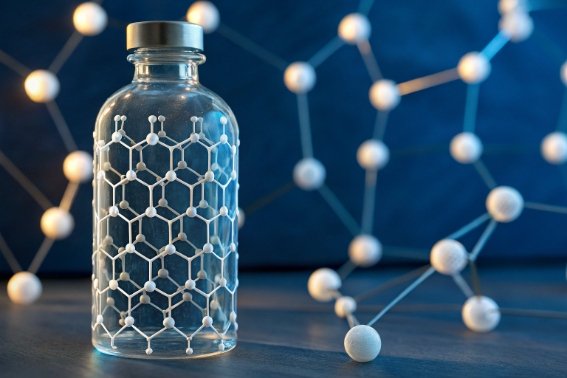
MgO and CaO are not equal modifiers
Both MgO and CaO help improve chemical durability 5 compared with a pure soda-silica glass. That is why “lime” exists in soda-lime glass in the first place. Still, MgO and CaO do not sit in the network the same way.
-
CaO is a classic modifier. It stabilizes the glass and improves durability. It often makes the network more open than MgO does at the same molar replacement.
-
MgO can behave as a tighter modifier. In some silicate systems it can even show “intermediate” behavior, meaning part of the magnesium can sit in a more constrained coordination environment. That often reduces how freely the network can expand.
So the ratio matters. But it matters in a specific way: the ratio changes the type of modifier environment more than the total amount of modifier.
Why ratio effects are easy to hide
A bottle’s measured CTE is the final output of multiple oxide effects plus forming stress. In most commercial models and datasets, alkali (Na2O, K2O) pushes CTE up strongly. SiO2 pushes it down. Al2O3 often pushes it down. MgO and CaO usually have smaller coefficients than alkali. That means Mg/Ca adjustments can be “real” and still look “tiny” in the final number.
Also, factories do not adjust MgO and CaO in a lab vacuum. They adjust limestone vs dolomite sources, cullet streams, and fining agents. Those moves can change several oxides at once.
A useful mental model for purchasing teams
I use a simple buying model: Mg/Ca is a stability lever, not a category lever. It can improve repeatability and add margin, but it will not turn soda-lime into borosilicate.
| Structural question | Higher MgO/CaO tends to do | Why it matters for CTE | Practical implication |
|---|---|---|---|
| How tight is the modifier environment? | Tightens it | Less dilation per °C | CTE can drop slightly |
| How sensitive is CTE to small drift? | Can reduce drift sensitivity | More consistent bottles | Better batch-to-batch uniformity |
| What else changes with the ratio? | Liquidus and forming window shift | Defects can rise | QC must watch devit signs |
When a supplier says “we can tune Mg/Ca,” the best next question is not “will CTE drop?” The best next question is “can you tune it without moving Na2O and without increasing defect risk?”
In soda-lime container glass, does a higher MgO/CaO ratio typically increase or reduce thermal expansion?
Many wholesalers want a simple direction. That is fair. Still, the honest answer needs a small warning label.
In soda-lime container glass, raising MgO/CaO by replacing some CaO with MgO often reduces CTE slightly, or it reduces CTE sensitivity to drift. The effect is usually modest, and it can be canceled by small changes in alkali, silica, or annealing stress.
The “typical” direction: more MgO, slightly lower CTE
In common composition-property relationships used in glass engineering, CaO tends to increase thermal expansion more than MgO does, and MgO can even show a lowering effect in some models when expressed on a molar basis. That is why, when CaO is partially replaced by MgO at roughly constant SiO2 and alkali, the expected direction is a small CTE decrease.
A useful way to say it in procurement terms:
-
If MgO rises and CaO falls while Na2O stays flat, the CTE often trends down a little.
-
If MgO rises but Na2O also rises to keep melting easy, the CTE can trend up, even if Mg/Ca looks “better.”
Why the effect can look reversed in real factory comparisons
Two commercial soda-lime recipes can differ in many oxides at once. A glass with higher MgO might also have lower SiO2 or lower Al2O3. That can push CTE upward even if MgO itself is not the main reason. This is why “compare two spec sheets” is not enough. Measured CTE in a defined temperature window is the only safe answer.
A practical “how much difference” expectation
For wholesalers, it helps to set expectations. Mg/Ca tuning is usually a fine adjustment, not a step change. If a buyer needs a major CTE drop, the project is often moving into borosilicate or special low-expansion families. If the buyer needs a small margin increase and better repeatability, Mg/Ca tuning can help.
| Goal | Is Mg/Ca tuning enough? | What else usually matters more | What to ask the supplier |
|---|---|---|---|
| Reduce CTE by a lot | Usually no | SiO2, alkali, boron systems | “What glass family is this?” |
| Reduce crack rate in hot-fill | Sometimes yes | Annealing, design, cooling ramps | “Show CTE + strain data” |
| Improve batch consistency | Often yes | Cullet control, furnace stability | “Show control charts” |
If the project is close to failure, the best path is not guessing which oxide wins. The best path is measuring CTE and checking strain on bottles pulled from normal production.
How can Mg/Ca balance impact thermal shock resistance and crack risk during hot-fill or temperature cycling?
A low-CTE number looks comforting. Still, cracks happen in the places where heat meets shape, stress, and defects.
Mg/Ca balance can reduce thermal stress by slightly lowering CTE, but it can also change stiffness and defect risk. Thermal shock performance improves only when chemistry, annealing, and surface quality improve together.
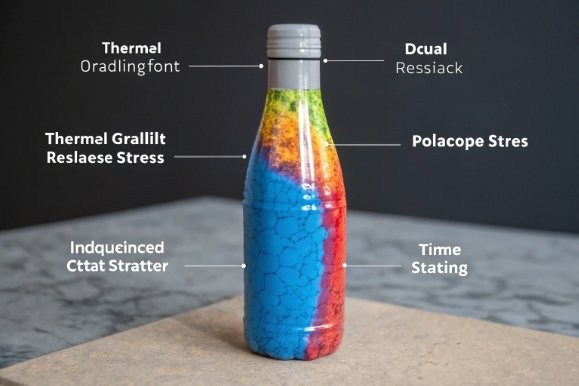
Thermal shock is not only CTE
Thermal shock resistance 6 is linked to thermal expansion, but the real cracking risk depends on a thermal stress parameter that includes elastic modulus 7 and Poisson’s ratio. A bottle can have a slightly lower CTE and still crack if it has high residual stress or surface flaws.
So, the Mg/Ca ratio matters in two ways:
-
CTE effect: a higher MgO/CaO ratio can reduce the expansion strain created by a temperature gradient.
-
Defect effect: changing Mg/Ca can shift liquidus temperature and crystallization tendency. That can change the frequency of stones or micro-defects that act as crack starters.
Both effects must be managed. A “better” CTE is wasted if the bottle has more defect sites.
Hot-fill: the shoulder and heel do not forgive fast cooling
Most hot-fill cracks appear where the wall thickness changes fast. That is usually the shoulder, heel, or base ring. A slightly lower CTE reduces stress during a fast outside cooling step. So Mg/Ca tuning can help, but it rarely fixes a process that uses a cold rinse too soon.
In my own project notes, the most common fix is still simple:
-
slow the first cooling stage,
-
reduce the temperature gap between inside and outside,
-
and improve annealing consistency.
Chemistry changes come after that.
Temperature cycling: repeat stress needs repeat quality
Temperature cycling failures often show up later. The first cycle does not break the bottle. The tenth cycle does. That pattern points to micro-cracks growing from weak surfaces or inclusions. Mg/Ca balance can help by supporting a more stable network, but surface quality and homogeneity decide how fast cracks grow.
| Risk factor | What it does on the line | How Mg/Ca tuning can help | What can cancel the benefit |
|---|---|---|---|
| High ΔT during cooling | Creates steep thermal gradients | Slightly reduces stress via CTE | Cold water shock, thick zones |
| Residual stress from poor anneal | Adds hidden stress | No direct fix | Needs strain control |
| Stones / devit seeds | Start cracks early | Must stay low | Mg/Ca shift can raise liquidus issues |
| Surface damage in handling | Creates crack origins | No direct fix | Needs better conveyors and pack |
The best thermal shock plan is not “chase the lowest CTE.” The best plan is “reduce stress drivers and keep the glass clean and well-annealed.”
What practical controls (recipe windows, furnace stability, CTE testing, batch-to-batch checks) ensure consistent expansion performance in mass production?
Bulk orders fail when controls are vague. A one-time lab result cannot protect a six-month supply agreement.
Consistent expansion performance comes from locked recipe windows, stable furnace operations, and routine verification: CTE by dilatometry in the right temperature range, chemistry by XRF, and batch-to-batch trend limits tied to the same production campaign.

1) Put Mg/Ca in a window, not a target
A single target invites drift. A window manages it. For container glass, a practical approach is:
-
set a window for MgO wt%,
-
set a window for CaO wt%,
-
and set a window for the MgO/CaO ratio or CaO/(MgO+CaO) depending on how the supplier controls raw materials.
The key is to also lock the “big drivers” in compatible windows. Otherwise the ratio means nothing.
2) Demand furnace campaign traceability
CTE and chemistry must match the melt that ships. So the control package should include:
-
furnace or campaign ID,
-
production date range,
-
cullet source notes (at least internal classification),
-
and any known recipe adjustments during the run.
This is not bureaucracy. This is how a buyer avoids a situation where the first 5 pallets behave differently from the last 5 pallets.
3) Verify CTE with a method that matches your use case
CTE must be reported with:
-
the test method,
-
the temperature interval,
-
number of specimens,
-
and repeatability.
For hot-fill, the low-temperature range is often the most useful. For cycling or retort, a wider interval may matter more. The same glass can show a different “average CTE” depending on the interval, so the interval must be written into the purchase requirement.
4) Verify CTE with a method that matches your use case
Dilatometry 8 is the standard. CTE must be reported with:
-
the test method,
-
the temperature interval,
-
number of specimens,
-
and repeatability.
For hot-fill, the low-temperature range is often the most useful. For cycling or retort, a wider interval may matter more. The same glass can show a different “average CTE” depending on the interval, so the interval must be written into the purchase requirement.
5) Verify chemistry with XRF, then trend it
XRF 9 is fast and widely used for glass composition control. A good wholesale control plan uses XRF in two ways:
-
incoming verification on random samples,
-
trend monitoring across batches to detect drift early.
If the first bulk order is large, third-party XRF on a few samples is cheap insurance.
A purchase-order checklist that reduces disputes
These are the controls that have saved the most time in real supply chains:
| Control item | What to request | Typical acceptance style | What it prevents |
|---|---|---|---|
| Recipe windows | MgO, CaO, MgO/CaO + key oxides | “Within range” + max drift | Silent composition drift |
| CTE test | Dilatometry report with interval | Target ± tolerance | Wrong “CTE on paper” |
| Chemistry test | XRF report with totals | Target ± tolerance | Wrong raw material mix |
| Batch consistency | Multi-batch summary | Control charts or min/max | One good batch, then drift |
| Homogeneity | Strain / stress check on rings | Defined strain limit | Residual stress cracking |
One more practical rule: any time the supplier changes limestone, dolomite, or cullet source 10, the Mg/Ca ratio can shift even if nobody “touches the recipe.” That change must trigger a re-check of chemistry and CTE before the next container ships.
Conclusion
Mg/Ca ratio tuning can nudge CTE and improve repeatability, but the real win comes from stable recipes, stable furnaces, and routine CTE plus XRF verification tied to each production campaign.
Footnotes
-
Overview of the most common glass composition used for mass-produced bottles and containers. ↩
-
Technical explanation of how materials expand with heat and why this predicts stress failures. ↩
-
How alkaline earth oxides stabilize the glass network and influence viscosity during forming. ↩
-
Learn about crystallization defects that can weaken glass structure and cause breakage. ↩
-
Understanding glass resistance to weathering and chemical attack for long-term product integrity. ↩
-
Testing methods to determine a container’s ability to withstand rapid temperature changes. ↩
-
Stiffness properties that determine how much stress builds up in the glass during expansion. ↩
-
The standard laboratory method for precisely measuring dimensional changes under controlled heat. ↩
-
A non-destructive analytical technique for verifying elemental composition and glass purity. ↩
-
The role of recycled glass in reducing energy costs and altering melt chemistry. ↩






