
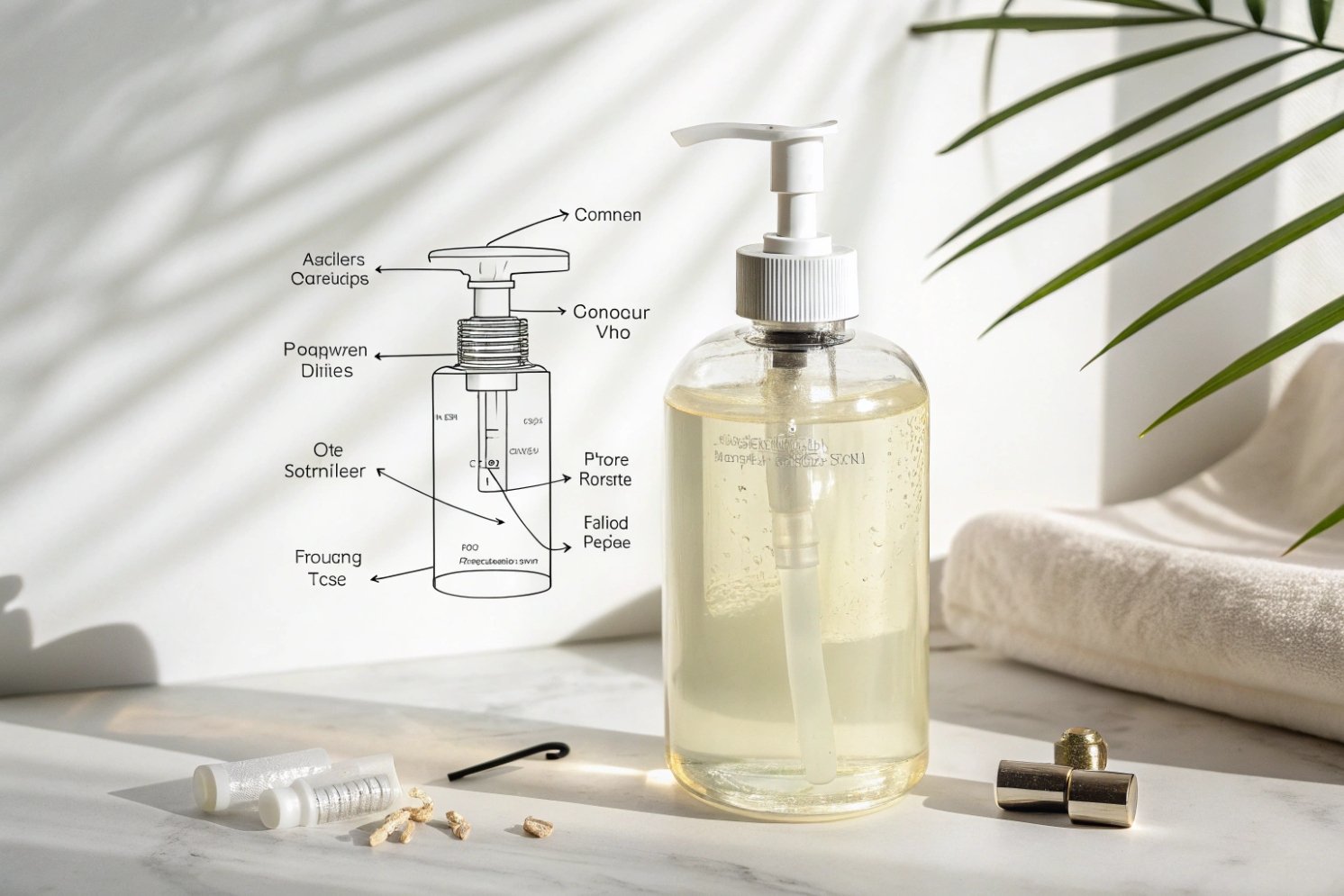
Leaky pumps, half-empty strokes, and jammed heads do not just annoy customers; they waste formula and damage your brand. Most problems start with how the pump actually works.
A soap pump bottle uses a spring-loaded piston, dip tube, and one-way valves to pull liquid up from the bottle and push out a fixed dose each stroke. Output, viscosity, venting, and lock features decide how cleanly and safely it performs.
When you understand the mechanics inside the pump head, it becomes much easier to choose the right spec, avoid leaks in transit, and design a bottle that customers enjoy using every day.
What do the dip tube, piston, spring, and actuator each do inside a pump?
A pump head looks simple from outside, but inside it is a small machine. When you know what each part does, you can talk to suppliers with confidence instead of guessing.
The actuator is the part you press, the piston and spring create suction, the dip tube carries liquid up from the bottom, and check valves control one-way flow so the pump can prime and then repeat a stable dose.
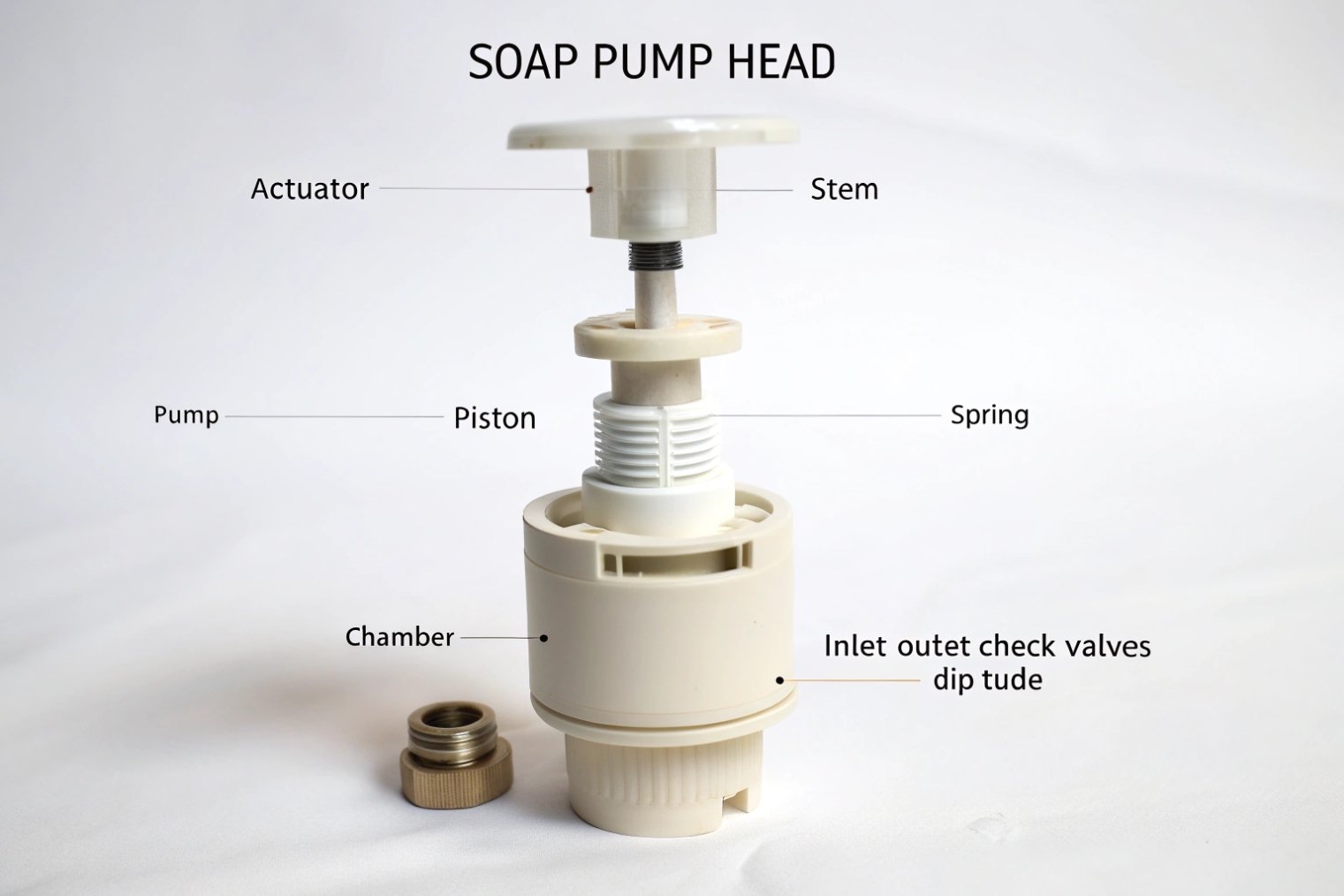
Inside the pump head: who does what?
Here is a simple map of the main components:
| Part | Where it sits | Main job | Typical material |
|---|---|---|---|
| Actuator | The top you press with your hand | Starts the stroke and guides flow to nozzle | PP / ABS |
| Piston | Inside the pump chamber | Moves up and down to change chamber volume | PP / PE |
| Spring | Under the piston | Pushes piston back up after each stroke | Stainless steel or plastic |
| Dip tube | From chamber to bottle bottom | Carries product up into the chamber | PE / PP |
| Check valve | At inlet and/or outlet | Lets liquid move one way, stops backflow | Plastic ball or disc |
When you press the actuator, the mechanism behaves like a small piston pump 1: the piston reduces chamber volume to push liquid out, then the spring returns it to create suction.
When you release the actuator, a one-way inlet check valve 2 opens under vacuum to let product in, while the outlet closes to stop backflow and drips.
The first few presses only move air. This is the priming phase. After several strokes, the dip tube and chamber fill with product. From that point, every stroke dispenses a more repeatable dose, as long as the check valves seal well and the spring still has enough force.
Why dip tube length and shape matter
The dip tube 3 does not just “hang there”. It needs to:
- Reach close to the bottom to reduce leftover product
- Avoid blocking against a flat base
- Stay straight enough not to curl out of the liquid
Many brands use:
- A V-cut or angle cut at the tube end to reduce blockage
- Custom-cut lengths matched to each bottle height
If the tube is too short, customers feel “waste”. If it is too long, it can buckle and suck air. Good suppliers will cut and test dip tubes for each bottle size you use.
Once you see the pump as a small system of piston, spring, valves, and dip tube working together, it becomes clear why material choice, dimensions, and tolerances are so important for long-term performance.
How do output per stroke and viscosity range affect dosing performance?
Two pumps can look identical and feel completely different in use. Sometimes the problem is not the formula. It is a mismatch between output, orifice, and viscosity.
Output per stroke is fixed by the pump chamber volume, so you must match that dose and the orifice size to your soap’s viscosity. Thin liquids need smaller outputs and tighter paths, while thicker soaps need larger outputs and stronger springs.
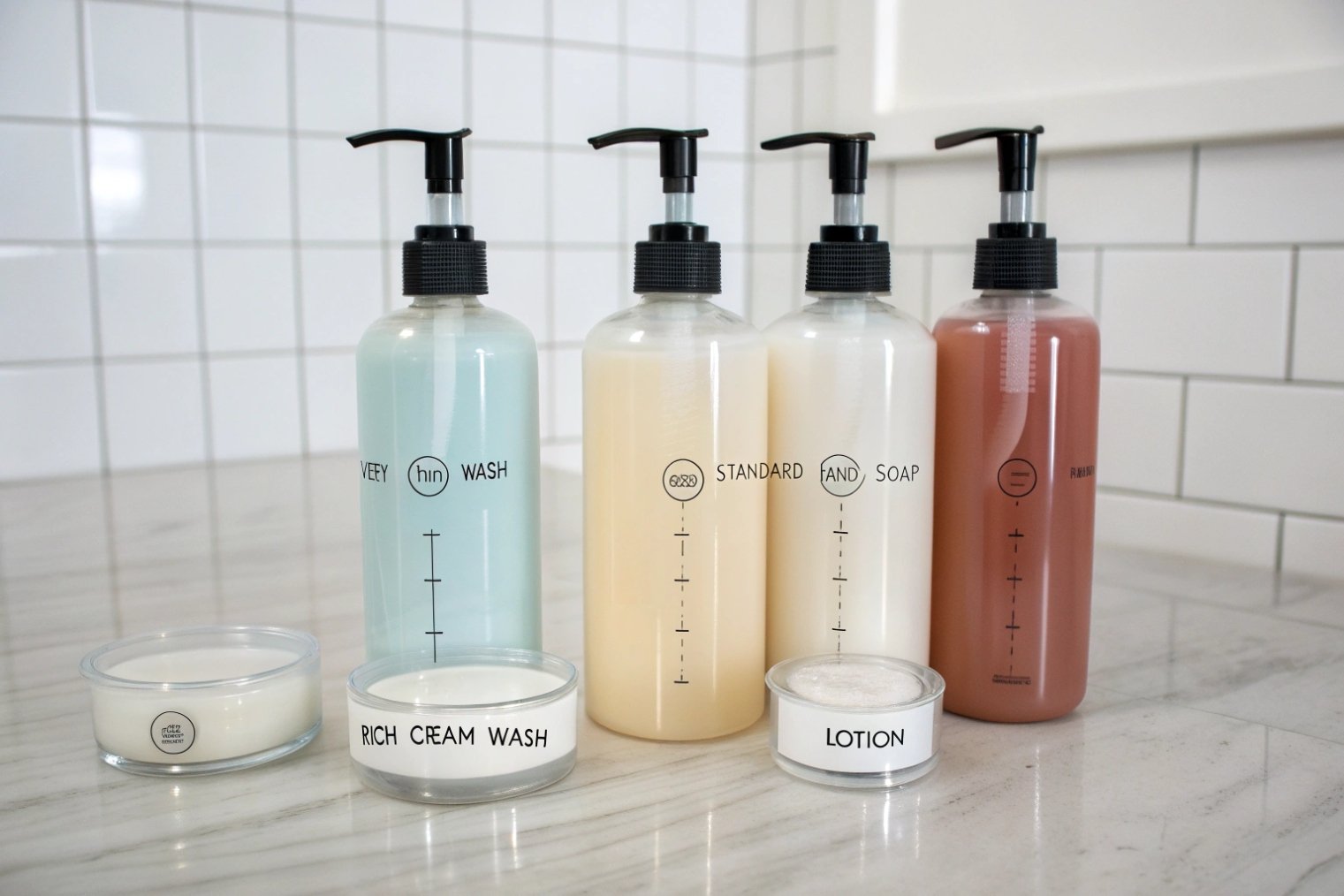
What “output per stroke” really means
Every standard pump has a rated output, often written in ml or cc per full press. Common values for soap and lotion pumps are:
- About 0.7–1.0 ml for hand soap or facial cleansers
- About 1.0–2.0 ml for kitchen soaps and body lotions
- Higher outputs for haircare or cleaning products
This output comes from the chamber volume, plus the way the piston and valves move. If you change the formula but keep the same pump, the output number on paper stays the same, but the feel can change a lot.
For very thin liquids:
- Product may shoot out fast and splash
- The pump can “spit” if there is trapped air
- Small reductions in orifice size help improve control
For very thick liquids:
- The spring and chamber must handle higher resistance
- Too small an orifice can cause high finger force and uneven flow
- A slightly higher rated output often improves user experience
Matching pumps to formulas
A simple way to think about it is by product type:
| Product type | Typical viscosity feel | Suggested pump output | Notes |
|---|---|---|---|
| Micellar / very thin wash | Very runny | 0.5–0.8 ml | Use smaller orifice, anti-drip |
| Standard hand soap | Medium | 0.8–1.2 ml | Most common household pumps |
| Rich cream wash / lotion | Medium–thick | 1.2–2.0 ml | Needs stronger spring |
| Thick hair mask / gel | Very thick | 2.0 ml+ | Consider wide-orifice or jar |
Foaming pumps are a special case. They use a different internal design and require the soap to be diluted. They push air and liquid through a mesh, so the “output” feels big, but the liquid dose per stroke is much smaller. For those, the key is foam quality rather than ml per stroke.
Strokes to prime and user perception
Your formula’s viscosity 4 also changes how quickly the system primes and how “hard” the stroke feels.
Output links to strokes to prime. A high-output pump with a long dip tube often needs more strokes before the first full dose. If a customer stands at a sink pumping ten times before anything comes out, they may think the pump is broken.
During development, you can:
- Measure how many full strokes are needed to get first liquid
- Compare that to what feels acceptable for your market
- Adjust dip tube length, chamber design, or output choice
When the output and viscosity match well, the pump feels “strong but smooth”, the first primes happen fast, and customers use a stable amount of product each time.
Why choose lockable or clip-lock pumps for e-commerce shipping safety?
In a store, bottles stand upright and are handled gently. In e-commerce, they are dropped, squeezed, and shipped sideways for thousands of kilometers. A standard open pump can turn one broken bottle into a full-box disaster.
Lockable and clip-lock pumps keep the actuator from moving during transport, so even under pressure or impact the pump cannot stroke and dispense. This reduces leak risk, protects labels and boxes, and cuts returns in e-commerce and export shipments.
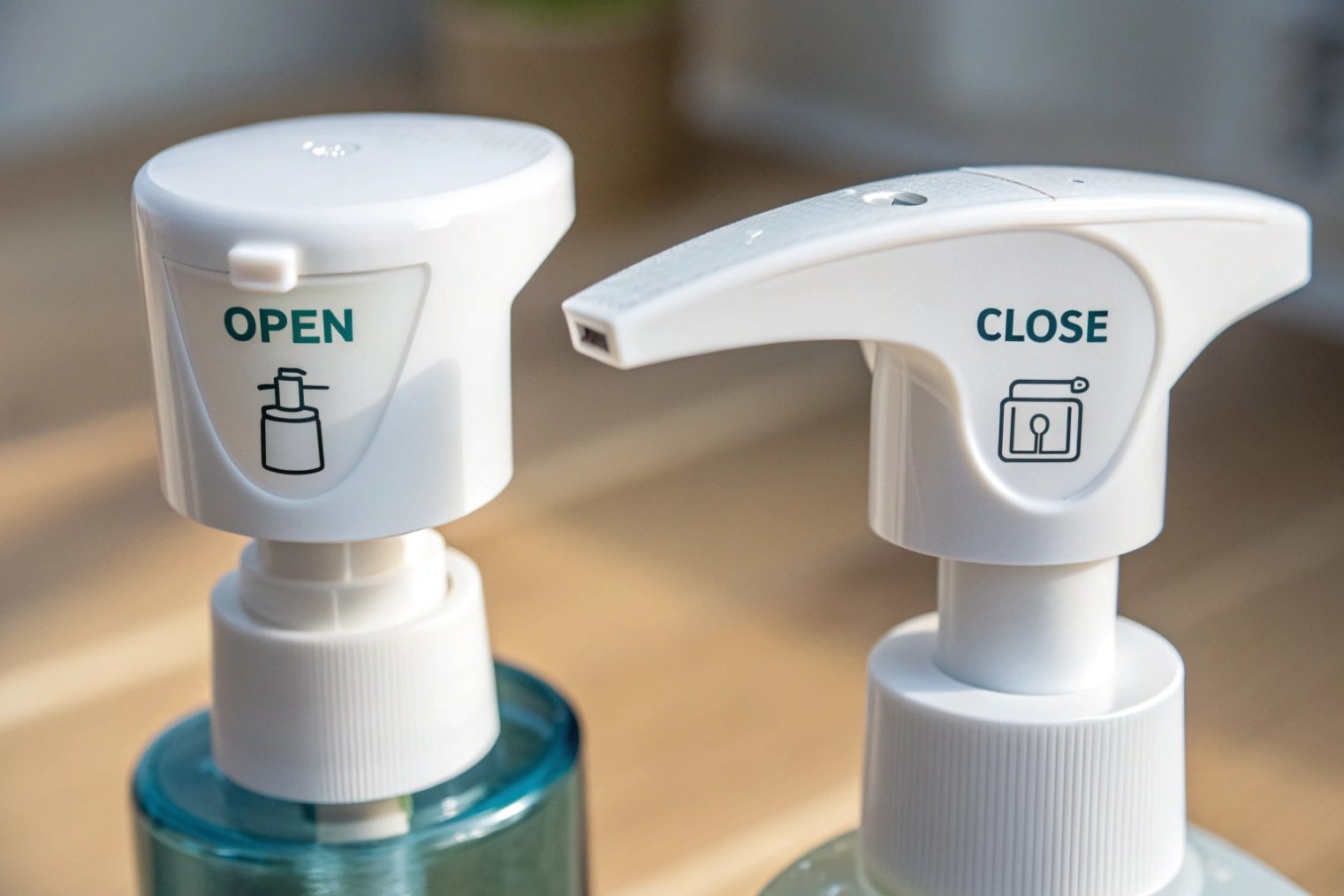
Main lock types you can choose
There are three common ways to “lock” a pump:
-
Twist-to-lock neck
- The actuator turns to a marked OPEN / CLOSE position
- In the locked position, the stem cannot move down
- Good for home and hotel use where users can unlock once
-
Push-down-and-turn child / transit lock
- Actuator is pushed and rotated to compress and lock for shipping
- Comes shipped in “down” position with a shorter profile
- Popular for export cartons and high-output lotion pumps
-
Clip-lock (transport clip)
- A small U-shaped clip sits between the actuator and collar
- Clip physically stops movement until the user removes it
- Very popular for e-commerce and higher-value cosmetics
For online brands, it helps to validate your pack against realistic parcel handling—many teams use lab simulations aligned to ISTA 3-series transport simulation tests 5 rather than relying on “it looked fine in the office”.
If you also want a visible “arrived sealed” cue, a tamper-evident band 6 can reinforce trust and reduce accidental opening during transit.
E-commerce realities you should design for
In real shipping chains, cartons:
- Travel sideways or upside down
- See repeated vibration and many small shocks
- Experience temperature changes that can thin or thicken the formula
If the pump is not locked:
- Each shock can press the actuator a little
- Soap builds up under the cap
- Eventually it leaks, wets the label, and soaks the carton
Lockable features do not replace good sealing, but they add a second layer of defense. Combined with:
- Correct neck finish and torque
- Suitable gasket or liner
- Proper inner bags or shrink bands
…they can sharply reduce the rate of leaking units, especially in international shipments and cross-border e-commerce where parcels are touched by many hands.
From a brand point of view, this means fewer complaints, fewer reships, and fewer damaged first impressions when the box is opened.
How can venting, gasket choice, and anti-clog features extend pump life?
Even a well-matched pump can “die early” if the bottle does not vent, the gasket reacts with the formula, or dried soap blocks the path. These issues usually show up after a few weeks in real life, not on day one.
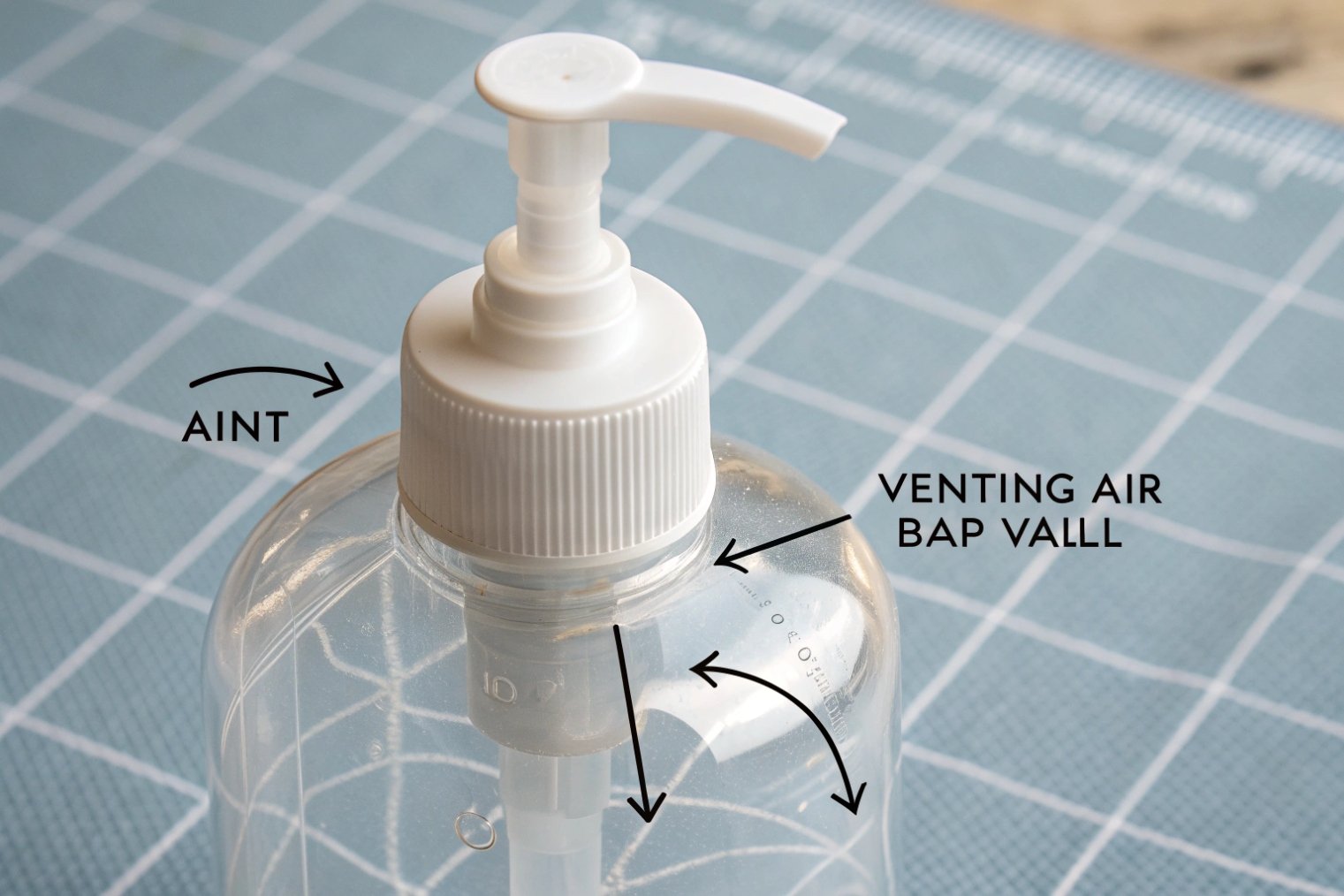
Good vent design lets air back into the bottle, compatible gaskets resist swelling and leaks, and anti-clog features reduce dried residue in the nozzle. Together they keep the pump primed, smooth, and leak-free over the full life of the product.
Why venting matters
Every time the pump dispenses liquid, the bottle volume loses that amount of product. If no air replaces it, a vacuum forms. Then:
- The pump gets harder to press
- Output drops or stops
- A thin plastic bottle may panel or collapse
To prevent this, many pumps and closures use:
- Vented liners that allow controlled air entry
- Tiny vent paths built into the pump housing
- Special designs for very viscous products or soft bottles
If you hear a “whoosh” when you open a cap after pumping several times, venting is not doing its job well. A better vent design will equalize pressure quietly during use, not in one big rush.
Gasket and liner choices for different formulas
The gasket or liner inside the cap is the last defense between formula and outside air. It also sees constant contact with your product, so material choice matters.
Simple guide:
| Formula type | Common gasket / liner choice | Notes |
|---|---|---|
| Standard hand soap, surfactants | PE foam liner | Cost-effective, good general seal |
| Oils and essential oils | F-217 foam liners 7 or PTFE | Better oil resistance, less swelling |
| High solvent or high pH products | PTFE-faced or special elastomer | Needs compatibility testing |
| Natural / fragrance-rich blends | Foam or F217 with trials | Watch for odor pickup or staining |
If the liner swells, shrinks, or hardens, you may see:
- Leaks around the neck in transit
- Hard-to-open caps
- Loss of seal as torque relaxes
So it is important to run compatibility tests with your exact formula at room and elevated temperature over several weeks.
Anti-clog details that make daily life easier
Soap and surfactant products can dry in the nozzle or pump path. Over time this can:
- Partially block the orifice
- Cause jets to shoot sideways
- Make the actuator feel crunchy or stuck
You can reduce this with:
- A slightly larger, smooth orifice with no sharp corners
- Internal wipers that strip liquid from the stem as it returns
- Shorter, cleaner flow paths in the head
- Clear user guidance to flush the pump with warm water if needed
For foaming pumps, the mesh can clog faster. In those cases, formula design (less undissolved solids, stable dilution) plus easy rinsing is key.
When venting works, gaskets stay stable, and clogging is rare, your soap pump feels “new” for much longer. Customers may not know why, but they notice when a bottle works perfectly from the first stroke to the last drop.
Conclusion
A well-designed soap pump is a small fluid system: match its mechanics, materials, and locks to your formula and channel, and it will deliver clean, safe, and satisfying doses every time.
Footnotes
-
How piston pumps meter liquid with a moving piston—useful for understanding pump dose control. ↩︎ ↩
-
Quick reference on one-way valve behavior that prevents backflow in pumps. ↩︎ ↩
-
Packaging glossary showing what a dip tube is and why length matters. ↩︎ ↩
-
Explains viscosity and how “thickness” changes flow and required pump force. ↩︎ ↩
-
ISTA 3-series procedures overview for simulating parcel shipping vibration and drops. ↩︎ ↩
-
Explains tamper-evident band designs and why they signal and resist opening in transit. ↩︎ ↩
-
Shows common F-217 foam liner construction used for sealing caps against leaks. ↩︎ ↩






