
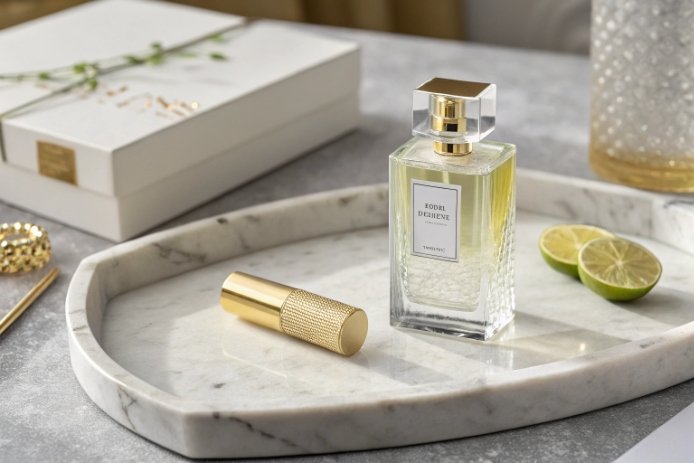
Perfume bottles fail in a different way. A tiny tint, a faint haze, or a weak decoration bond can ruin the whole “luxury” feeling.
Perfume bottles usually use extra-flint, tighter impurity control, and a more stable melt to support water-white display, thick walls, tight neck finishes, and demanding decoration processes.
The real difference is not “a special glass,” but a tighter control system
Perfume bottles are still commonly made from soda-lime-silica 1 families, but the target is different from a standard food bottle. Standard bottles often optimize cost, high cullet, and fast melting. A perfume bottle optimizes display clarity, surface perfection, and decoration reliability. That changes how the oxide window is chosen and how strict the raw material and cullet rules become.
The first big shift is optical. Perfume buyers judge the bottle under strong retail lights, not under warehouse light. Thick glass makes any tint more visible. So extra-flint recipes push total iron down and control iron redox 2 to reduce green tone. If decolorizers are used, they must stay stable for months, not only for one lot.
The second shift is surface. Many perfume bottles are acid-etched 3, metallized, printed, or UV-coated. These processes punish surface salts, micro-roughness, and chemistry drift. So a perfume recipe and furnace practice aim for fewer cords, fewer stones, and less surface “bloom.”
The third shift is forming. Heavy-base bottles need a stable viscosity window, strong homogenization, and careful annealing 4. Tight neck tolerances also need stable gob temperature and stable mold conditions. When the glass chemistry drifts, viscosity drifts. Then neck dimensions drift too.
| Requirement | Standard bottle priority | Perfume bottle priority | What changes in practice |
|---|---|---|---|
| Optical tone | “clear enough” | water-white, neutral | lower Fe, tighter redox, stable decolorizers |
| Defects | low rejects | near-zero visible defects | stronger refining, cleaner cullet, better homogenization |
| Forming | high speed | heavy-base control | stable viscosity curve and thermal management |
| Decoration | simple labels | premium decoration stack | smoother surface, low salts, coating-friendly chemistry |
A perfume bottle recipe is usually not radical. The difference is how narrow the control window becomes, and how much process discipline is added to protect that window.
Now the specific questions.
Do extra-flint recipes need ultra-low Fe₂O₃ and specific decolorizers to stay water-white for fragrance display?
A perfume bottle is often thick and heavy. That thickness magnifies even a small green or yellow cast, especially in clear fragrances.
Yes. Extra-flint perfume glass usually targets ultra-low total iron and a stable redox balance, and it may use very small decolorizer trims (like Se/Co or CeO₂) to keep a neutral, water-white look in thick walls.
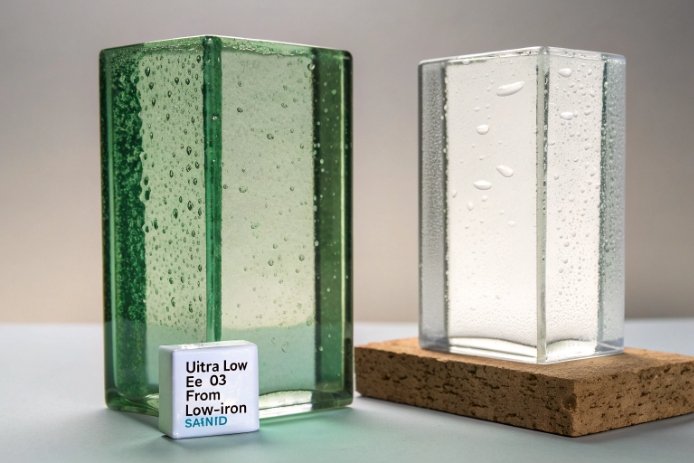
Why “thick wall” makes iron control stricter
Total iron expressed as Fe₂O₃ 5 is the main driver of unwanted tint in flint glass. A standard bottle can tolerate more iron because the wall is thinner and the market is less strict. Perfume bottles often have thick shoulders and a heavy base. That means:
- the same ppm iron looks darker
- the green edge becomes easier to see
- small lot-to-lot changes become visible on shelf
For water-white display, extra-flint programs commonly push total iron into a much lower band than standard flint. The exact target depends on thickness and brand tolerance, but the control habit stays the same: treat iron as a “hard ceiling,” not as a daily knob.
Decolorizers: helpful, but only when the furnace is stable
Decolorizers do not replace good raw materials. They are a fine adjustment tool.
- Se + Co can balance residual green/yellow and pull the glass toward a neutral tone. The risk is drift into pink, blue, or grey if dosing or redox swings.
- CeO₂ can reduce the visual effect of Fe²⁺ and also improves UV absorption in clear glass. The risk is a warmer tone or reduced brilliance if the system is not tuned.
For perfume, the goal is “invisible control.” The customer should see clear fragrance, not a cold blue cast and not a grey veil.
How I specify extra-flint inputs for perfume projects
| Item | What to specify to suppliers | Why it matters for perfume |
|---|---|---|
| Silica sand | low total Fe and low Ti, stable lot-to-lot | controls base tint and haze risk |
| Cullet | dedicated extra-flint stream, low colored pieces | prevents sudden green/yellow drift |
| Redox | stable furnace oxygen potential | keeps Fe²⁺ share from jumping |
| Decolorizers | micro-dose with tight feed control | avoids long-term tone shift |
When all four are controlled, the bottle stays water-white even with thick walls. When one is uncontrolled, the line starts “chasing color” with daily adjustments, and the glass becomes inconsistent.
Which oxide balance and fining agents boost resistance to ethanol and fragrance oils while avoiding haze or odor transfer?
Fragrance is a harsh customer. It sits for months. It contains ethanol, aromatics, and oils, and it is often packaged in clear glass that shows every defect.
Ethanol and fragrance oils rarely attack the glass network directly, but low-alkali release, a tight Al₂O₃ level, and clean refining reduce pH drift, haze risk, and odor problems that come from contamination rather than from glass itself.

What “chemical resistance” means for perfume
Most perfume issues are not “glass dissolving.” The common risks are:
- slight alkali release that shifts fragrance stability in sensitive formulas
- surface defects that trap residues and create haze-looking artifacts
- contamination from cullet organics that creates odor carryover during melting
So the practical target is a durable, clean inner surface.
Oxide balance that supports low extractables behavior
A durable soda-lime base for perfume often sits toward:
- steady SiO₂ for network strength
- controlled Na₂O to reduce ion exchange
- balanced CaO/MgO for stability without devit skins
- modest Al₂O₃ to strengthen the network and improve chemical durability 6
B₂O₃ can be used in small amounts in some designs to help melt behavior, but it must not create new volatility or fining instability. For perfume, “stable and boring” wins.
Fining and refining: avoid seeds, salts, and odor sources
Fining agents 7 in container glass often rely on sulfate systems and controlled redox to remove bubbles. The perfume goal is:
- fewer seeds and cords so the inner surface is uniform
- minimal salt carryover so the surface stays clean for decoration and coatings
- clean cullet so organics do not create odor events in the doghouse
At FuSenglass, the strongest perfume programs treat cullet cleanliness as part of fragrance compatibility. If cullet brings organics, the furnace can create local reducing zones. That can cause cords and sometimes a faint “furnace smell” risk in extreme cases.
| Control area | Best practice for perfume | What it prevents |
|---|---|---|
| Na₂O control | tight band, avoid spikes | pH drift and higher alkali release |
| Al₂O₃ level | modest and stable | better network durability without melting trouble |
| Refining stability | steady fining feed, steady temperature | seeds, cords, and haze-like artifacts |
| Cullet cleanliness | low organics, low CSP | odor events, stones, surface flaws |
Perfume bottles succeed when the glass is optically clean and chemically quiet. That outcome is more about stability than about adding “special” oxides.
How do composition and forming targets enable thick-walled, heavy-base bottles and tight neck tolerances (e.g., FEA 15 crimp)?
Perfume packaging often mixes two hard requirements: heavy glass for luxury feel and tight neck finishes for pumps and crimps. That combination punishes viscosity drift.
A perfume bottle recipe must keep a stable working range and low devit tendency, so the glass flows into thick bases without cords while still holding neck geometry; this needs a controlled SiO₂/Na₂O balance plus disciplined forehearth temperature control.
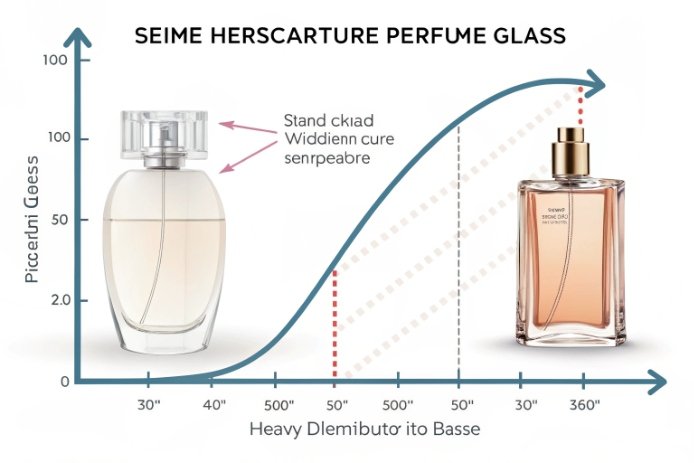
Composition sets the viscosity “shape,” not only one temperature point
Heavy-base bottles need glass that fills the base without creating flow lines, and also forms a precise finish. This depends on:
- viscosity 8 at gob temperature
- viscosity slope across the forehearth range
- stability of that curve when raw materials drift
A recipe with slightly higher network strength (often via stable SiO₂ and modest Al₂O₃) can improve dimensional stability, but it must still melt and refine well. A recipe with high Na₂O melts easily but can become more sensitive to temperature waves. That sensitivity shows up as neck variation.
Heavy base needs better homogenization
Thick sections show cords and stones more easily. So perfume bottles usually need:
- stronger homogenization discipline (flow pattern and temperature uniformity)
- lower tolerance for devit flakes from cold corners
- tighter control of cullet contaminants that create stones
Tight neck finishes are a system of targets
Neck tolerance comes from more than the mold. It comes from:
- stable gob weight
- stable gob temperature
- stable glass viscosity
- stable mold temperature and cooling
If the composition drifts, the same forehearth setpoint produces a different gob behavior. Then the neck moves out of spec.
| Target | What composition must support | What forming must control |
|---|---|---|
| Heavy base fill | stable viscosity and low cords | gob temperature uniformity, press/blow settings |
| Clear thick walls | low devit and low inclusions | forehearth dead-zone control, steady pull |
| Tight neck (FEA 15 style) | stable working range | shear stability, mold thermal balance |
| Low rejects | stable fining response | steady fining and stable redox |
The best result comes when composition and forming targets are written together. A perfume bottle is not only a glass recipe. It is a recipe plus a forming control plan that keeps that recipe inside a narrow window every shift.
Which base-glass choices ensure strong adhesion and durability for acid-etching, metallization, and UV-cured coatings?
Decoration is where perfume bottles separate from standard bottles. A standard bottle can survive with a label. A perfume bottle must survive aggressive surface processing and still look perfect.
Strong decoration performance needs a smooth, chemically stable surface with low salts and low defect density; modest Al₂O₃ support, controlled alkali, and strict impurity control help acid-etch uniformity and improve coating adhesion for metallization and UV systems.
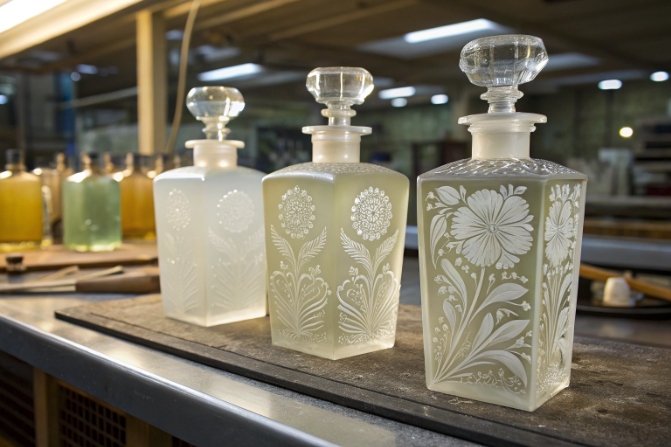
Acid-etching needs uniform surface chemistry
Acid-etch reveals any surface non-uniformity. If the surface has alkali-rich patches, cords, or salt residues, the etch becomes uneven. A stable base glass helps by:
- keeping alkali distribution uniform
- reducing hydrated weak layers that etch too fast
- reducing micro-defects that “print through” as stains
Modest Al₂O₃ often helps by improving network durability and reducing surface attack rate variation. Still, the biggest win is low defect density from good refining and clean cullet.
Metallization needs cleanliness and low ionic movement under the coating
Metallization 9 and vacuum coatings need a very clean, smooth surface. If the glass releases ions or carries micro-salts, adhesion drops and long-term durability suffers. A stable recipe reduces this risk, and a stable process prevents surface bloom.
For perfume lines, it is also common to pair composition control with good surface preparation steps (washing, flame, plasma, primer). Composition sets the “ceiling,” and surface prep delivers the final performance.
UV-cured coatings need the right surface energy and thermal match
UV coatings and lacquers fail when:
- the surface is contaminated
- the glass has micro-roughness and pits
- thermal stress causes micro-cracking at the interface
A recipe that holds a stable thermal expansion 10 and a stable surface condition improves coating durability. Low TiO₂ and low Zr carryover also help because they reduce haze and stones that break coating continuity.
| Decoration process | Composition helps by | Biggest risk if uncontrolled | What to control tightly |
|---|---|---|---|
| Acid-etch | uniform surface chemistry | patchy etch and stains | alkali stability, cords, surface salts |
| Metallization | low ionic residue and smoothness | poor adhesion, peeling | refining, cullet purity, washing quality |
| UV coatings | stable surface and thermal behavior | cracking and delamination | defect control, surface prep, annealing stability |
| Multi-layer stacks | repeatable surface | lot-to-lot variation | recipe drift, fining drift, contamination |
Perfume decoration works best when the base glass is clean and stable. Then coatings can be lighter and still pass durability testing. That reduces cost and reduces rework.
Conclusion
Perfume bottles differ from standard bottles through extra-flint clarity targets, stricter impurity and cullet control, more stable refining, and a surface-ready chemistry that supports heavy bases, tight necks, and premium decoration.
Footnotes
-
Defines the standard chemical composition used for most mass-produced glass containers. ↩
-
Explains the balance of iron states crucial for controlling glass color. ↩
-
Details the decorative process of treating glass with hydrofluoric acid. ↩
-
Describes the cooling process used to remove internal stresses in glass. ↩
-
Provides chemical data on Ferric Oxide, the impurity causing green tints. ↩
-
Standards defining how well glass resists attack from water and chemicals. ↩
-
Substances added to the melt to remove gas bubbles and imperfections. ↩
-
A measure of a fluid’s resistance to flow, critical for glass forming. ↩
-
The process of coating glass with a metallic layer for decoration. ↩
-
How glass volume changes with temperature, affecting coating adhesion. ↩






