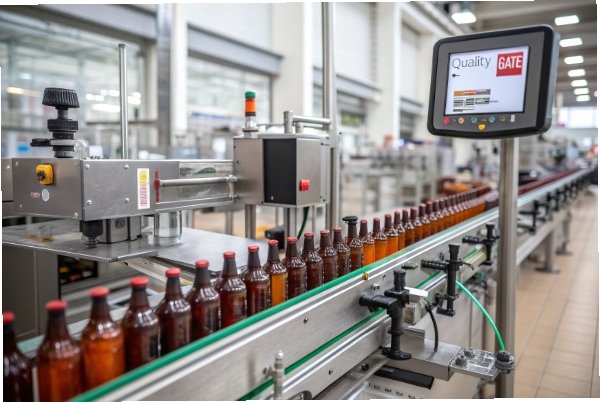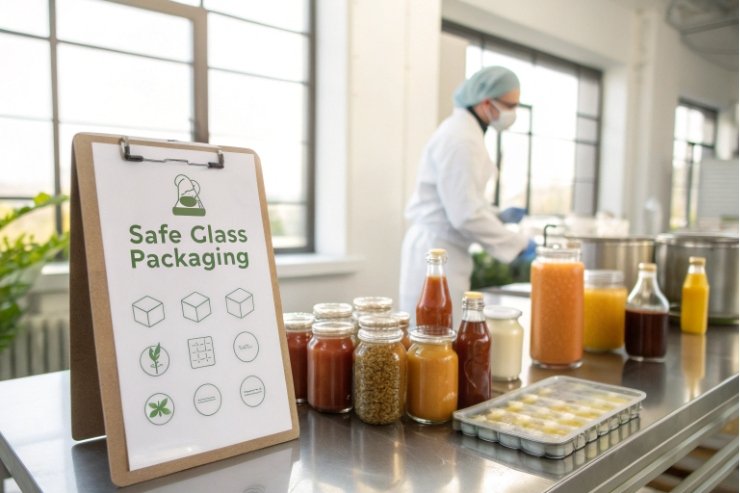
A great product can still fail fast if one small crack, one dirty rim, or one weak seal lets air and microbes in.
Safe glass packaging is a system: use food-grade jars and matched lids, control heat and cleanliness, leave correct headspace, apply the right torque, confirm vacuum, protect from light, and print clear labels plus lot/date codes for traceability.
What Makes Glass “Safe” in the Real World?
Glass feels simple, but the risk is never just “does the jar look nice.” Safety is about what happens at the rim, under the lid, and inside the headspace. Most spoilage starts with one of three problems: contamination on contact surfaces, a seal that never becomes truly airtight, or a process that does not match the food’s acidity and water activity 1. In my day-to-day work with brand owners, the fastest way to lose shelf life is to treat packaging as decoration. Packaging must support the process, and the process must fit the food.
Start with the jar: chips, cracks, and finish fit
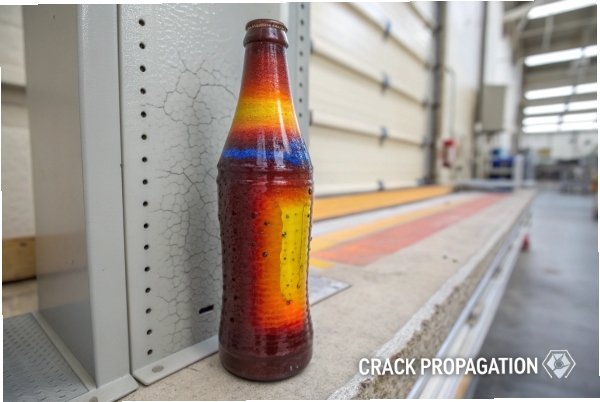
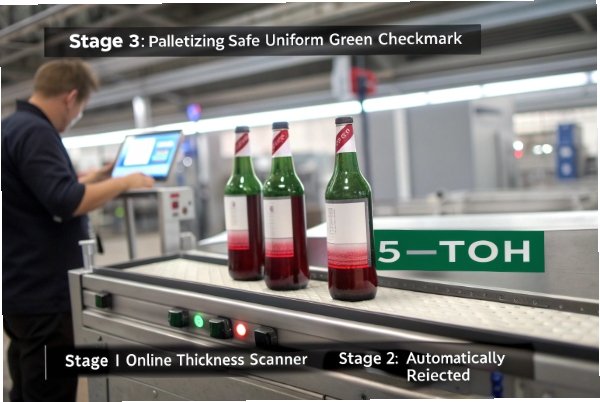
A chip on the sealing surface can stop a gasket from seating. A hairline crack can grow during hot-fill or thermal processing. A poorly formed finish can cause cross-threading or a tilted cap. That is why every incoming jar lot needs a basic inspection plan: visual checks under good light, sampling for finish dimensions, and a simple “rinse and invert” leakage screen for the closure system you use.
The “process + package” rule
A vacuum lid is not a magic shield. For shelf-stable foods, safety depends on using a tested process. High-acid foods can often use boiling-water processing or commercial hot-fill-hold. Low-acid foods need pressure canning at home, or validated retort/aseptic systems in commercial plants. Cold-pack can be safe, but usually only with refrigeration, preservatives, or another validated hurdle. The package must match that reality. In the U.S., many shelf-stable products fall under process expectations tied to acidified foods requirements (21 CFR Part 114) 2 or low-acid canned foods requirements (21 CFR Part 113) 3, depending on the product.
| Risk that causes spoilage or complaints | What it looks like | Packaging control that helps | Process control that helps |
|---|---|---|---|
| Microbial contamination | Mold, gas, off-odors, leaking | Clean rims, correct liner, correct torque, verified vacuum | Validated heat process (or cold-chain plan), sanitation |
| Seal failure | Button pops up, lid spins, syrup weeps | Correct headspace, correct torque, good finish match | Proper hot-fill temp, correct cool-down, no retightening |
| Physical hazards | Glass fragments, sharp chips | Incoming inspection, breakage handling SOP, protected packing | Line controls, glass breakage policy, cleanup verification |
| Light damage | Color fade, rancid notes, vitamin loss | Amber/UV glass, full-body label, carton | Cooler storage, reduced light exposure |
| Traceability gaps | Retail rejection, recall chaos | Lot/date code that stays readable | Batch records, supplier and kettle-to-case links |
A Simple Decision Path Before You Pick a Jar and Lid?
Choosing a jar is easier when the food and the distribution plan are clear. First decide if the product is shelf-stable at room temperature, chilled, or frozen. Then decide if the pack is hot-filled, retorted, or cold-filled. Only then does the jar shape, finish, and closure style make sense.
Step 1: classify the food and the route to market
Acid foods (like many jams, pickles, and tomato-based sauces) often work well with hot-fill-hold or boiling-water processes. Low-acid foods (like meats, beans, many vegetables, and dairy-based sauces) need higher temperatures in pressure/retort systems. Dry goods are different again. They are usually safe without vacuum, but they can go stale or rancid if oxygen and moisture get in.
Step 2: match the finish and closure family
A canning “two-piece” lid is designed for vacuum sealing after thermal processing. A lug (twist-off) closure is built for vacuum-packed foods and fast opening. A continuous-thread (CT) cap is common for cold-fill and dry goods, often with an induction liner for tamper evidence. Swing-top and clamp styles look premium, but they are usually better for refrigerated products or dry goods, not long ambient shelf life.
| Product + distribution goal | Best package pattern | Common jar finish | Closure type |
|---|---|---|---|
| Jam, jelly, pickles (ambient) | Hot-pack + water-bath (home) or hot-fill-hold (commercial) | Canning finish or lug finish | Two-piece canning lid or metal lug |
| Salsa, pasta sauce (ambient) | Hot-fill or validated thermal process | Lug finish | Metal lug with proper compound |
| Low-acid soups/beans (ambient) | Pressure/retort only | Lug finish (retort-rated) | Retort-rated lug or specialized closure |
| Cold-pack dips/ferments (chilled) | Cold-fill + cold chain | CT or lug | CT cap + liner or lug + tamper band |
| Dry spices, tea, powders | Dry-fill | CT, lug, or clamp | CT cap, lug, or clamp (no shelf-stable vacuum claims) |
Now the details that decide success live inside the next four questions.
A good jar choice is only half the work. The rest is headspace, torque, vacuum, light protection, and label discipline.
Which Jar and Lid Types Actually Work for Hot-Fill vs Cold-Pack?
Hot-fill is unforgiving. Cold-pack is often misunderstood. The closure that works for one can fail badly for the other. Hot-fill needs a liner and a cap design that can handle heat, steam, and vacuum. Cold-pack often needs tamper evidence and oxygen control, because vacuum may be low or absent.
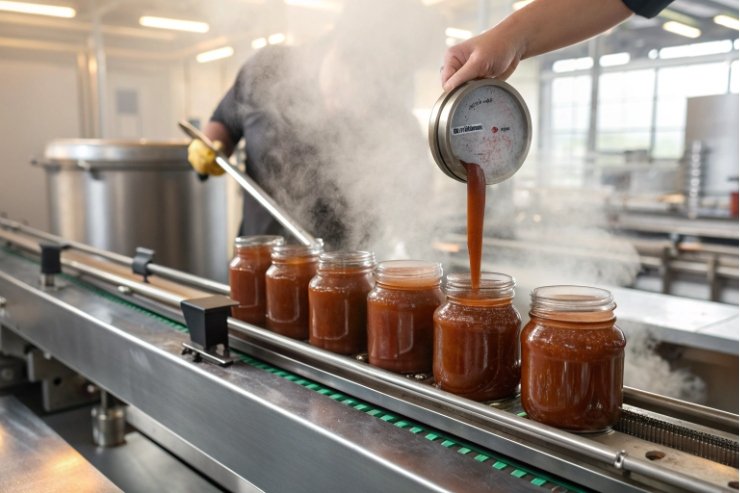
Hot-fill usually favors lug (twist-off) closures or canning lids because they are designed to vent air during capping and then hold a vacuum after cooling. Cold-pack usually favors CT caps with liners or tamper-evident systems, because you often do not create a strong vacuum without vacuum equipment.
Hot-fill winners: lug (twist-off) and vacuum-capable systems
For sauces, jams, and condiments, metal lug caps with a proper plastisol compound are the workhorse. They give a strong hermetic seal when the finish is correct and the cap is applied with controlled torque. Many lug systems also offer a “button” feature that gives a visible vacuum indicator for retail buyers. Two-piece canning lids are also excellent in true canning processes, but they are usually not used in high-speed commercial lines.
Hot-fill also demands jar strength and thermal shock control 4. That means preheating jars, keeping them hot, and avoiding big temperature jumps. A beautiful jar that cracks during filling is not premium. It is scrap, complaints, and risk.
Cold-pack winners: CT + liners, plus honest shelf-life expectations
Cold-pack works well when the product will be refrigerated, or when a validated formulation provides hurdles (pH, salt, preservatives, low water activity). CT caps with induction liners give strong tamper evidence and good leak control. Lug caps can be used on cold-fill lines too, but vacuum may be weak unless you use steam-flow capping or vacuum capping equipment.
Swing-top, clamp, and cork styles can be great for story and gifting. They are not the first choice for long ambient shelf life unless the whole system is validated and tested. For many brands, these closures are best kept for dry goods or chilled items where the “pop” experience matters more than a strong vacuum.
| Closure style | Hot-fill suitability | Cold-pack suitability | Typical use | What to watch |
|---|---|---|---|---|
| Two-piece canning lid | High (with canning process) | Low | Home canning, small-batch | Must be fingertip tight, new flats, tested process |
| Metal lug (twist-off) | High | Medium | Sauces, jams, pickles | Needs correct torque and headspace, finish match |
| CT metal cap + liner | Medium (depends on liner rating) | High | Dry goods, chilled foods | Choose liner for product and heat exposure |
| Plastic CT + induction liner | Low–Medium (depends) | High | Cold-fill, dry-fill | Induction needs control; cap must fit finish tightly |
| Swing-top/clamp | Low | Medium | Refrigerated drinks, dry goods | Not a default hermetic seal for ambient shelf life |
| Weck-style glass lid + clip | Medium (with proper process) | Medium | Specialty canning | Needs correct gasket and clip control |
What Headspace, Torque, and Vacuum Targets Help Prevent Spoilage?
Most “mystery spoilage” is not mysterious. It comes from three measurable settings that drift over time: headspace, torque, and vacuum. If those three are controlled, spoilage and leakage rates drop fast.
Use recipe-specified headspace for canning, and use controlled fill height for hot-fill. Apply only the torque your closure system needs, then confirm a stable vacuum after cooling. These three controls protect seals and reduce oxygen that feeds mold and oxidation.
Headspace: the space that makes the seal possible
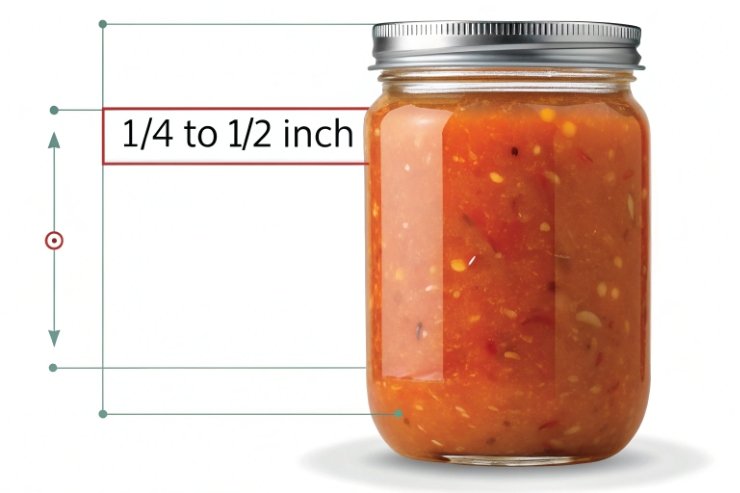
Headspace is not wasted volume. It is the breathing room that lets food expand during heating and lets air vent before the seal locks. Too little headspace can cause siphoning and product on the rim, which kills seals. Too much headspace leaves too much oxygen, which pushes oxidation and weak vacuum.
For home canning, headspace is recipe-specific and should be followed exactly—using trusted headspace guidelines 5. A common pattern is 1/4 inch for jams and jellies, 1/2 inch for fruits, tomatoes, and pickles in boiling water, and about 1 to 1 1/4 inches for many low-acid foods in pressure canning. For commercial twist-off hot-fill, a common control is leaving about 5% headspace, often around 10 mm from the rim, but it must match the jar size and closure design.
Torque: tight enough to seal, not so tight you damage the gasket
Overtightening can stretch lugs, distort liners, and cause vacuum loss after cooling. Undertightening can leak during handling and fail in distribution vibration. In canning, “fingertip tight” matters because air must vent during processing and a vacuum must form during cooling. On lug systems, many lines control application with a torque meter and also confirm “pull-up” position on the thread. In one published lug-closure study, standard lug lids were applied around 23 lb-in in that setup, but every finish and cap compound has its own spec. Treat torque as a controlled parameter, not a feel.
Vacuum: measurable proof the seal is working
Vacuum reduces oxygen, slows oxidation, and supports closure integrity. In the U.S., an FDA inspection guide notes that normal vacuum in some packed foods is often around 10 to 20 inches of mercury (in. Hg), while some packs may be lower or higher depending on product and process. Some closure guidance for vacuum-sensitive products points to final vacuum ranges like 22–26 in. Hg, but that is not universal. The right target is “enough vacuum to hold a hermetic seal without creating opening problems,” and it must be proven with your specific product, headspace, and cooling curve.
| Control | Home canning practical target | Commercial hot-fill practical target | How to verify on the line | What failure looks like |
|---|---|---|---|---|
| Headspace | Follow tested recipe (often 1/4", 1/2", or 1–1 1/4") | Typically 5–10% headspace (often ~10 mm) | Fill height gauge, check weights | Siphoning, dirty rim, weak vacuum |
| Torque | Fingertip tight (do not retighten hot) | Closure supplier spec (often verified by torque meter) | Torque meter + visual pull-up | Leaks, cap tilt, hard opening |
| Vacuum | Confirm concave lid and no leakage after 12–24h | Commonly 10–20 in. Hg (product-dependent) | Vacuum tester (destructive or non) | Button up, mold growth, oxidation |
| Cooling | Undisturbed 12–24h | Controlled cool tunnel or hold | Cooling time logs | Seal failures days later |
Do Amber or UV-Blocking Options Protect Light-Sensitive Foods?
Light is a quiet quality killer. It does not always create obvious spoilage, but it can wreck color, aroma, and nutrition. That is why the “clear jar looks premium” idea can backfire for oils, herbs, and vitamin-rich products.
Amber and UV-blocking options reduce light exposure and help protect oils, herbs, and color-sensitive foods. The best choice depends on the product’s sensitivity and how much shelf lighting it will face, not only on looks.

What light does to real foods
Light can speed up oxidation in oils and create off-notes. It can fade natural colors in sauces and fruit spreads. It can reduce certain vitamins. Even when the seal is perfect, light can make the product taste “older” faster. Many retail shelves also use bright lighting that runs all day, so the exposure is not small.
Amber glass is a strong, simple step. It reduces UV and short-wavelength light exposure, and it is widely used for light-sensitive products. Green can help in some cases, but amber is usually stronger protection. If a brand must keep a clear “flint” look, then other layers matter: a full-body label, a printed sleeve, a carton, or a UV-coating system. In many projects, the best result is a mix: flint glass for brand identity plus a strong label or carton that blocks light where it matters most.
Also remember storage. A perfect amber jar still suffers if pallets sit under sun in a hot warehouse. Light protection works best when it is paired with stable, cool storage and good rotation.
| Food type | Light sensitivity | Good glass choice | Extra protection | Why it matters |
|---|---|---|---|---|
| Olive oil, infused oils | High | Amber (or dark green) | Carton or full label | Slows oxidation and off-flavors |
| Herbs, spices | Medium–High | Amber or coated flint | Opaque label | Protects aroma and color |
| Fruit spreads | Medium | Flint or amber | Keep out of bright light | Helps color and flavor hold |
| Pickles, vinegar sauces | Low–Medium | Flint is often fine | Standard label | Shelf look is usually the driver |
| Vitamin-fortified drinks | High | Amber or UV-coated | Sleeve + carton | Helps vitamin retention |
Which Labels and Date Codes Keep You Retail-Ready and Compliant?
A jar can be sealed perfectly and still get rejected by a retailer if the label is missing one required element or the lot code is unreadable. Compliance is not only law. It is also retailer rulebooks, scanner needs, and recall readiness.
Retail-ready labels usually need a product name, net quantity, ingredients and allergens, nutrition (when required), business info, and storage instructions. Date marks should be clear, and lot codes should support traceability, especially for foods covered by FSMA traceability rules in the U.S.
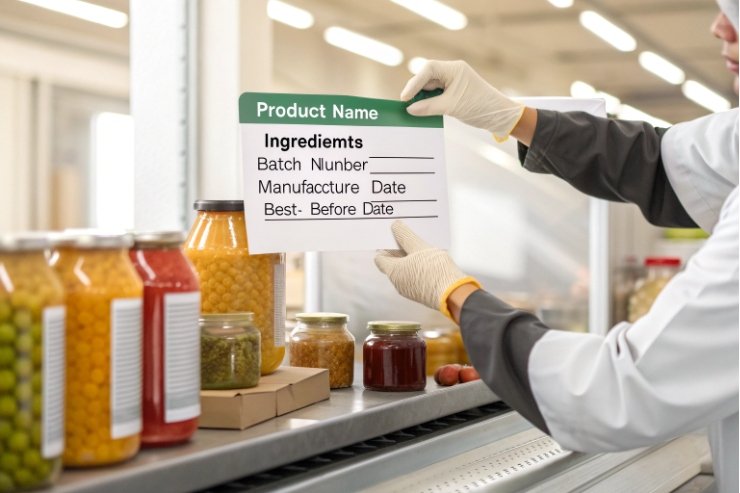
Core label structure that reduces risk in the U.S.
Many U.S. packaged foods must follow FDA labeling rules on identity, net contents, ingredient list, allergen disclosure, and Nutrition Facts when required. Retailers also expect a scannable GS1 barcode 6, and they often want clear storage instructions such as “Refrigerate after opening.” Date labeling is a special case. In many situations it is voluntary at the federal level (infant formula is a key exception), but it is still common in retail. FDA and USDA have encouraged “Best if Used By” as a clearer quality-focused phrase, and many buyers prefer it.
EU basics: food information rules and clear date meaning
In the EU, food information rules focus on consumer clarity. Labels often need the name of the food, ingredient list with allergens emphasized, net quantity, date marking (“best before” or “use by” depending on risk), storage conditions, and the responsible food business operator address. Many categories also require nutrition declarations. The exact layout and language rules depend on the market and the distribution plan.
Coding: lot codes, date codes, and “survives distribution”
The best code is the one that stays readable after steam, water spray, and friction in case packing. For glass, common methods include inkjet on the lid, laser on coated surfaces, or label-printed codes. For traceability, a lot code should link to batch records, raw materials, and filling time windows. In the U.S., the FDA Food Traceability Rule 7 introduces “traceability lot code” concepts for certain foods, and the compliance date is close. Even when a product is not on the traceability list, strong lot coding makes recalls smaller and faster.
| Market goal | Must-have label elements | Date marking best practice | Lot/traceability best practice | Common retail rejection reason |
|---|---|---|---|---|
| U.S. grocery | Identity, net qty, ingredients, allergens, Nutrition Facts (if required), business address | Prefer “Best if Used By” for quality; add “Use By” only when safety-based | Lot code that links to batch + line + time | Missing allergen, wrong type size, no net qty |
| EU retail | Name, ingredients + allergens emphasized, net qty, date, storage, FBO address, nutrition (often) | “Best before” vs “Use by” used correctly | Lot code + records aligned with FIC and traceability needs | Missing allergen emphasis, wrong language, unclear date |
| DTC / premium gift | Same legal basics + brand story | Clear, readable, easy to find | Lot code still required for control | Date unreadable or placed on seam |
| Foodservice bulk | Clear identity + handling | Date clear for rotation | Case-level lot coding helpful | No case code, hard to scan |
Conclusion
Safe glass packaging is controlled detail: match jar and lid to the process, hold headspace and torque steady, verify vacuum, block light when needed, and label like a retailer and regulator will inspect it.
Footnotes
-
Defines water activity and why it predicts microbial risk better than “moisture” alone. ↩ ↩
-
Official regulation for acidified foods—useful for knowing when scheduled processes and controls apply. ↩ ↩
-
Official regulation for low-acid canned foods—key for understanding when retort validation is mandatory. ↩ ↩
-
Explains thermal resistance and why sudden temperature changes crack glass during hot-fill. ↩ ↩
-
Practical headspace targets and why they matter for venting, vacuum formation, and seal success. ↩ ↩
-
Shows how to get GS1 barcodes so retail scanners work and product identifiers stay consistent. ↩ ↩
-
Summary of traceability recordkeeping and traceability lot code expectations for certain higher-risk foods. ↩ ↩