
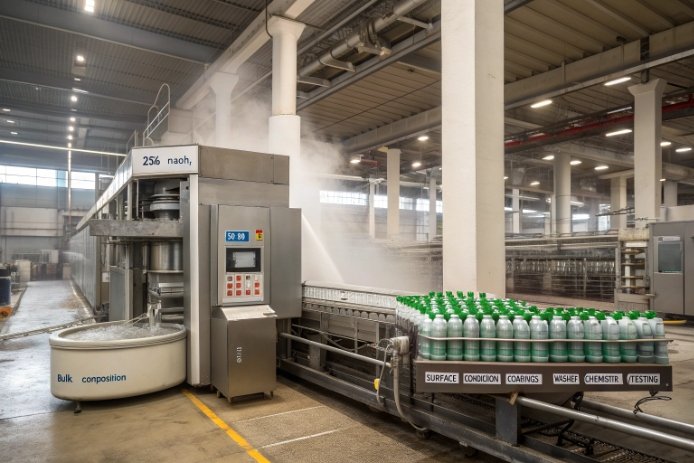
Returnable bottles can look perfect at filling. Then, after a few washer cycles, the surface turns dull, labels stick, and pitting appears.
Caustic-wash resistance comes from a more durable soda-lime network (less exchangeable alkali, more network strength), plus clean cullet and stable fining so the inner surface stays smooth through many 2–3% NaOH cycles.
What does “caustic-wash resistance” really mean for returnable bottles?
Caustic-wash resistance is not a single number. It is the bottle’s ability to keep a smooth, cleanable surface after many washes in alkaline solution, often 2–3% NaOH, with heat, spray impact, and mechanical rubbing. In real returnable systems, the bottle sees a harsh mix: hot caustic, surfactants, water hardness, label glue, and abrasion from bottle-to-bottle contact. If the glass surface becomes micro-rough, the washer removes labels slower, “label-scum” builds up, and the bottle loses clarity and gloss. Even worse, micro-pits become crack starters, so breakage rises.
The chemistry behind it is simple: soda-lime glass 1 contains alkali that can exchange with water and can be attacked by strong base. Caustic attack increases when the surface has more non-bridging oxygen, higher alkali mobility, or weak, inhomogeneous zones. That is why the best formulation work focuses on tightening the network and reducing surface vulnerability, not only changing one oxide.
Still, composition alone does not win. A durable recipe can fail if the melt is not homogeneous. Cords near the surface, devit skins from a cold forehearth corner, or sulfate salt carryover can become the first pitting sites. Cullet contamination can also make pitting worse by adding ceramics, stones, or organics that disturb redox and fining. So the target is a “quiet melt” that forms a smooth inner surface.
What the washer is really “measuring”
- Gloss loss / haze increase: early sign of micro-etching
- Pit density: direct sign of localized attack
- Label removal time and scum: shows if the surface got rough and sticky
- Weight loss / thickness loss: useful, but it misses localized pits
- Breakage in reuse: the final cost driver, often from pits and scratches working together
| Washer failure symptom | Root cause family | Fastest formulation lever | Fastest process lever |
|---|---|---|---|
| Dulling (loss of brilliance) | uniform surface etching | higher SiO₂/Al₂O₃, lower Na₂O drift | better fining and homogeneity |
| Pitting | local weak zones + inclusions | reduce alkali mobility, avoid nucleators | cullet cleaning, remove devit triggers |
| Label-scum | micro-roughness + glue residue | improve surface durability 2 | washer chemistry + surface cleanliness |
| Early breakage in reuse | pits + scratches + stress | devit control and durability | hot-end/cold-end handling discipline |
If the goal is long returnable life, the recipe should be tuned with the washer profile in mind, not only with furnace cost in mind.
Next, the quickest win is usually a base-glass shift, because it reduces the attack rate before any coating is considered.
Which base-glass shifts—higher SiO₂/Al₂O₃, lower Na₂O, and balanced CaO/MgO—best resist 2–3% NaOH washing?
A returnable bottle often fails because the base recipe is optimized for melting speed, not for alkaline durability.
The strongest base-glass moves for 2–3% NaOH are a modest increase in SiO₂ and Al₂O₃, tight control or slight reduction of Na₂O, and a CaO/MgO balance that avoids devit skins and keeps the inner surface smooth.

Increase network strength without breaking meltability
For soda-lime beverage glass, pushing SiO₂ too high can raise melting cost and viscosity. So the best approach is a modest shift inside a stable container window. In practice, a small SiO₂ increase paired with tighter Na₂O control often reduces caustic etching speed. Al₂O₃ is even more useful because it strengthens the network at relatively small additions and often improves chemical durability and hardness. Many bottle bases already have Al₂O₃ around 1–2%. For returnables, the goal is to keep Al₂O₃ stable and, when the furnace allows, move toward the upper part of a safe range.
Control Na₂O as a “drift killer,” not a single target
Na₂O helps melting and lowers viscosity, but it also increases exchangeable alkali at the surface. In caustic wash, the attack is strong, so higher alkali mobility tends to increase surface roughening and dulling. Many plants do not need a dramatic Na₂O reduction. They need a tighter band. A recipe that swings ±0.5% Na₂O week to week (often due to cullet variability) will show more wash variability than a recipe that is held stable at a slightly higher average.
Balance CaO/MgO to prevent devit and surface skins
CaO and MgO stabilize soda-lime glass and support durability, but the washer outcome depends heavily on surface quality. If the MgO/CaO balance increases liquidus risk in colder zones, devit skins 3 can flake into the melt and create surface defects. Those defects are perfect pitting starters. So the best CaO/MgO strategy is the one that lowers devit tendency in your forehearth and feeder, because devit is an indirect but powerful caustic durability killer.
| Base-glass shift | Typical benefit in NaOH wash | Common trade-off | What to watch in trials |
|---|---|---|---|
| +SiO₂ (modest) | slower uniform etching, better gloss retention | higher melting energy | furnace pull stability, seeds |
| +Al₂O₃ (modest) | improved chemical durability, often better scratch + wash | slower melting if excessive | stones, cord risk, working range |
| tighter / slightly lower Na₂O | less alkali availability, steadier wash results | higher viscosity | gob temperature control, forming |
| balanced MgO/CaO | fewer devit skins, smoother surface | phase shift risk if extreme | liquidus behavior, forehearth cold spots |
A good returnable recipe rarely looks “exotic.” It looks like a disciplined soda-lime window that favors durability and smoothness, while still melting clean at high throughput.
The next question is about small additions. These can help, but they can also create cords and stones if chosen carelessly.
Do small ZrO₂, ZnO, or B₂O₃ additions improve alkali durability without hurting meltability or causing cords?
Small additions can be powerful, but only if they are easy to dissolve and easy to control in continuous production.
Small ZrO₂ and ZnO additions can improve alkali durability and slow surface attack when fully dissolved, while B₂O₃ is usually not the first choice for caustic resistance because boron-rich structures can be more vulnerable to strong alkali unless the whole glass family is designed for it.

ZrO₂: durability booster with a “dissolution risk”
ZrO₂ can increase chemical durability by strengthening the network and reducing ion mobility. In returnable bottles, it can reduce dulling rate and sometimes reduce pit growth speed. The risk is practical: zircon-bearing raw materials can be hard to dissolve, and undissolved particles become stones. Stones do not only hurt appearance. They also create local roughness and can become pitting seeds. So ZrO₂ works only when:
- the addition is small and well dispersed
- the melting and fining system can dissolve it fully
- refractory wear is controlled so zircon-rich particles do not enter as contaminants
For many plants, ZrO₂ 4 is a “careful trim,” not a big lever.
ZnO: a helpful modifier that must stay stable
ZnO can improve chemical durability and can reduce certain surface corrosion behaviors by changing local structure and slowing alkali attack. It can also help some devit behaviors in certain compositions. The main risk is not usually stones, but dosing stability and cost. If ZnO is added as a “magic fix” without controlling Na₂O drift and surface defects, the benefit is often small.
B₂O₃: good in some glass families, risky in strong caustic
B₂O₃ is excellent in borosilicate families where the whole composition is designed for high chemical resistance and thermal performance. In soda-lime returnable bottles, small B₂O₃ additions can help melt behavior, but in strong NaOH environments, boron-containing networks can be attacked and can contribute to haze or faster surface change if the system is not balanced. For that reason, B₂O₃ is usually not my first choice for caustic durability in standard returnable soda-lime lines. If B₂O₃ is used, it should be validated with real washer cycles, not only with short lab dips.
| Small addition | When it helps most | Main risk | Practical guideline |
|---|---|---|---|
| ZrO₂ (small) | long-life returnables with tight melt control | stones if not dissolved | only if furnace can dissolve and QC can detect stones early |
| ZnO (small) | reducing dulling and stabilizing surface | cost and dosing drift | keep dosing stable, validate with multi-cycle trials |
| B₂O₃ (small) | improving meltability in specific designs | can worsen caustic attack if not balanced | use only with strong validation and tight process control |
The safest sequence is always: fix base window and homogeneity first, then trial small additions. Otherwise, additives become a costly way to hide instability.
Next, caustic wash problems are often blamed on chemistry, but the real driver is the surface quality created by cullet, redox, and fining.
How do cullet quality, furnace redox, and fining chemistry impact surface pitting and label-scum during returnable cycles?
Returnable systems punish small defects. The washer finds the weakest spots first.
Dirty cullet increases inclusions and local chemistry spikes, redox instability creates cords and uneven surfaces, and fining swings raise seeds and salt residues, so all three can increase pitting and make label-scum worse during reuse cycles.
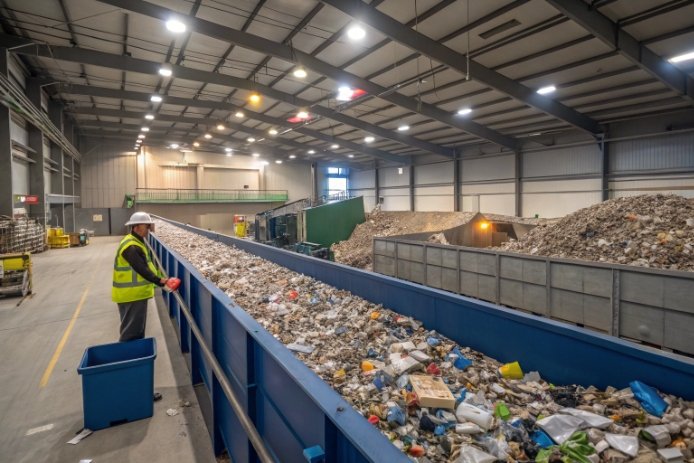
High cullet is good for energy and CO₂, but returnable bottles demand food-grade cleanliness and low contamination. Cullet problems that show up as caustic failures include:
- CSP (ceramics/stone/porcelain): hard inclusions that become pit starters
- metals: can create stones and roughness
- organics (labels, glues, residual contents): cause local reducing zones near the doghouse, which can disturb fining and create cords
- mixed chemistry cullet: causes week-to-week Na₂O and CaO drift, changing wash performance
Label-scum is often a surface roughness problem plus glue chemistry. When the glass becomes micro-etched, glue residue anchors more easily. So a clean, smooth inner surface is a label-cleaning advantage, not only a glass durability advantage.
Redox control: the simplest way to reduce cords that become weak zones
Redox does not directly “add pits,” but it changes melt homogeneity. Unstable oxygen potential can cause:
- cords and striae 5 reaching the surface
- uneven sulfate decomposition and foam behavior
- local chemistry bands that wash differently
In returnable cycles, those bands can turn into visible dulling lines and “patchy” scum zones. A stable redox state supports a uniform surface and more repeatable wash behavior.
Fining chemistry: seeds and salts often become surface problems
If fining is unstable, seed rate rises. Seeds that reach the surface can become tiny pits after forming or can act as stress concentrators. Also, fining swings can increase salt carryover, creating microscopic residues that change how labels and coatings behave. In a returnable washer, those residues can trap soil and glue.
| Process variable | What it changes at the surface | How it shows up after washing | Fast corrective action |
|---|---|---|---|
| Dirty cullet (CSP, organics) | inclusions + redox noise | pitting + scum patches + dulling | cullet QC, washing, blending, supplier control |
| Redox swings | cords + chemistry bands | streak-like dulling, uneven gloss loss | stabilize combustion, reduce organics spikes |
| Fining feed swings | seeds + salt residues | higher pit density, more scuffing and haze | stabilize fining feed and fining temperature |
| Forehearth cold spots | devit skins + roughness | rapid pitting and dulling lines | eliminate dead zones, stabilize profile |
A strong returnable program treats cullet 6, redox, and fining as part of “formulation,” because they decide the real surface the washer attacks.
Now the final step is verification. A recipe change without the right tests often creates false confidence.
Which verification methods—alkali resistance tests and multi-cycle washer trials—plus coatings pair with the recipe to ensure long-term performance?
Short tests can be misleading. Caustic wash damage grows with cycles, and the failure mode changes from “gloss loss” to “pits + breakage.”
The best verification plan combines a quick lab alkali attack screen with real multi-cycle washer trials that measure gloss, haze, pit density, label removal, and breakage, while using coatings as a support layer, not as the main solution.
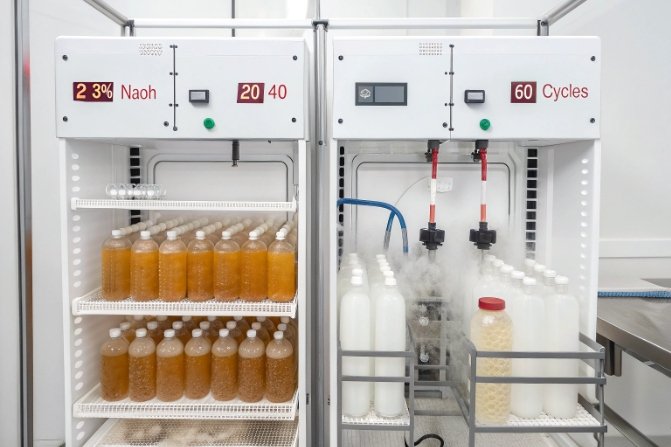
Lab screening: fast comparisons, not final proof
A lab alkali resistance screen is useful for ranking candidate recipes and for catching “bad” drift fast. Good lab metrics include:
- weight loss or thickness loss after controlled NaOH exposure
- gloss loss and haze increase (more sensitive than weight loss)
- surface roughness (Ra) and pit density by microscopy
- ion release (Na, Ca) in the solution for trend tracking
Still, lab tests usually lack spray impact and abrasion. So they must be treated as a filter, not as a guarantee.
Multi-cycle washer trials: the real approval gate
A realistic washer trial should mimic:
- NaOH concentration (2–3%) and temperature profile
- time in zones (prewash, caustic, rinse, sanitizer)
- spray pressure and mechanical contact
- label type and glue type used in the market
The best KPIs are:
- label removal time and scum rating after each cycle block
- gloss and haze trend curve (not only end value)
- pit density growth rate, not only pit count
- breakage rate under handling simulation after cycles
Coatings: reduce dependence, but keep expectations realistic
Returnable bottles typically use hot-end and cold-end coatings mainly to reduce scratching and scuffing. These coatings help because scratches and pits work together. If the bottle scratches less, pits have fewer stress partners, and reuse life improves. For pure caustic chemical resistance, surface treatments or barrier coatings can help, but they must survive repeated caustic cycles and must not create adhesion problems for labels.
The safest approach is:
- use composition to slow chemical attack
- use coatings to reduce abrasion 7 and defect growth
- keep coatings consistent and compatible with labels and washers
| Verification step | What it proves | Pass/fail signal that matters |
|---|---|---|
| Lab NaOH attack screen | relative durability ranking | low gloss loss and low pit initiation |
| Multi-cycle washer trial | real reuse performance | stable label removal, low scum, slow haze growth |
| Post-cycle strength check | mechanical risk in reuse | low breakage at heel/shoulder/finish |
| Surface inspection | defect mechanism | pits linked to inclusions or devit lines |
| Coating compatibility trial | real system stability | no coating loss, no label adhesion problems |
When the recipe, process controls, and verification plan are aligned, returnable bottles stop being a “wash complaint” product and become a predictable, long-life packaging system.
Conclusion
For caustic-wash resistance, prioritize a tighter soda-lime network, clean cullet and stable fining/redox 8, then prove performance with real multi-cycle washer trials supported by abrasion-control coatings 9.
Footnotes
-
The standard glass family used for mass-produced bottles, containing silica, soda, and lime. ↩
-
How well a material resists chemical breakdown, crucial for returnable bottles. ↩
-
Crystalline defects on the glass surface that can cause weakness and pitting. ↩
-
Zirconium Dioxide, an oxide sometimes added to improve chemical resistance. ↩
-
Visible lines or cords in glass caused by uneven composition, leading to weak spots. ↩
-
Recycled glass added to the melt; must be clean to avoid defects in returnables. ↩
-
Mechanical wear from rubbing, which coatings help to minimize during bottle handling. ↩
-
The balance of oxidation states in the melt, critical for color and fining stability. ↩
-
Protective layers applied to glass to reduce scratching and improve durability. ↩






