
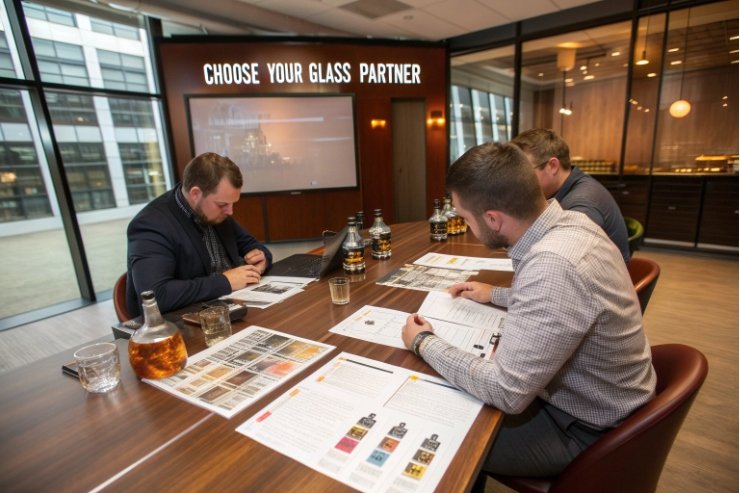
You only get one chance to launch a bottle. If the glass is wrong, everything from price point to bartender love starts on the back foot.
The right glass bottle supplier proves quality, certifications, and service up front, offers custom molds and pilots, protects your schedule with realistic MOQs and terms, and keeps your lines running through strong mold care and cap-fit control.
When glass partners act like true production teammates, you worry less about breakage, delays, and complaints, and more about building a premium spirits brand that grows across markets and SKUs.
Which certifications (ISO, food-contact, CSR) and AQL data should you require up front?
Many teams start with price lists and shape catalogs, then discover later that basic compliance and quality systems were never clear. That is a painful way to learn.
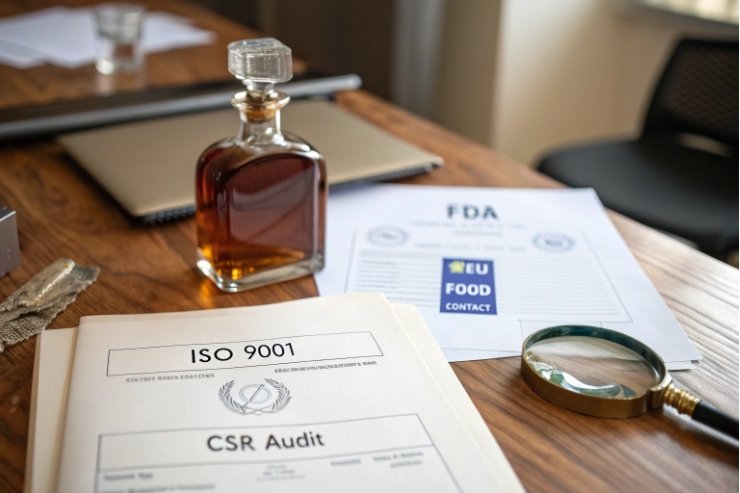
Ask for proof of food-contact safety, ISO-based quality systems, CSR audits, and detailed AQL inspection data before you talk design. If a supplier cannot share these, they are not ready for premium spirits.
Core certifications that protect your brand
For spirits, you want glass that is safe, legal, and consistent across all your markets. So the supplier should be able to show at least:
- ISO 9001 quality-management certification 1
- Food-contact compliance aligned to the EU food contact materials framework 2 (FDA, EU regulations, or local standards)
- Heavy-metal and migration test reports for glass and decoration
- CSR or social audits such as Sedex SMETA audits 3 if your brand talks about ethics or ESG
You do not need a wall full of framed certificates, but you do need clear, current documents and test reports that line up with the claims in their sales deck.
Making AQL and QC data part of the brief
Premium spirits packaging cannot live with “we check everything by eye”. You need to know what they check and how often.
Ask for:
- Their standard AQL levels for critical, major, and minor defects
- Sample QC reports from past spirits runs
- Definitions of each defect class (stones, blisters, checks, mold seams, color issues, etc.)
If they use a standard approach, ask whether their plan follows ISO 2859-1 AQL sampling procedures 4 (or an equivalent, documented system).
You want to see that they measure:
| Dimension / test | Why it matters for spirits |
|---|---|
| Neck inner / outer diam. | Cork / T-stopper fit and leak control |
| Total height | Line compatibility, case-packing, carton fit |
| Weight and base thickness | Premium feel, breakage risk |
| Vertical load and impact | Pallet stability and transport resistance |
| Visual defects (bubbles…) | Premium appearance and consumer confidence |
If they already have a formal AQL plan with clear numbers, it is much easier to set acceptance rules in your supply agreement.
CSR, sustainability, and transparency
If your brand speaks about sustainability or social responsibility, your glass supplier must not undermine that message.
So ask up front:
- Do they track recycled glass content and energy use?
- Are there any CSR or social compliance audits (Sedex, BSCI, SMETA, etc.)?
- How do they handle waste, water, and emission control?
When a supplier answers these questions with real data instead of slogans, it tells you a lot about how they run the rest of their plant.
Can the supplier deliver custom molds, small pilots, and complex decorations reliably?
Most spirits brands want more than a stock bottle. But some suppliers push hard into custom promises without the tools, mold shop, or decorators to back them up in real production.
Check that the supplier can handle the full chain: design support, custom molds, pilot runs, and advanced decoration, with clear timing and repeatability. If they cannot, your “dream bottle” may stay on slides.
Custom molds and pilot-ready mindset
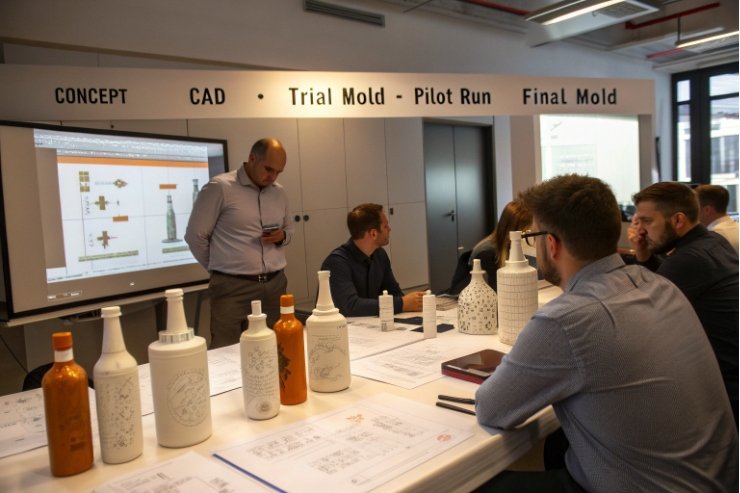
A good spirits supplier will talk about molds and pilots in the same breath, because they know how important first runs are for your launch.
Key points to confirm:
- In-house or closely partnered mold shop with spirits experience
- Ability to supply trial molds or single-cavity tools for first testing
- Clear process: drawings → 3D files → sample bottles → final approval
You want a partner who can explain, in simple terms, how they handle heavy bases, complex shoulders, and proprietary neck finishes without compromising run speed or cavity life.
Decoration depth and process control
Premium spirits packaging often uses more than one decoration process. You may need combinations like:
- Direct screen printing in one or more colors
- Hot-stamped metallic logos or borders
- Partial frosting or coating, including gradients
- Spot varnish or texture zones under the hand
Ask for physical samples that show:
- Fine line quality in print and embossing
- Alignment between decoration and glass features
- Durability after handling, washing, and bar use
You want to see that the same quality shows up on several samples, not just on one “hero” bottle.
A simple capability grid:
| Area | What to ask for | What you want to see |
|---|---|---|
| Mold making | Spirits case studies, heavy-base examples | Clean seams, crisp embossing |
| Prototyping / pilots | Trial mold option, small-batch support | Realistic lead times and clear pricing |
| Decoration | Full list of processes, in-house vs outsourced | Range of samples with consistent quality |
| Design support | CAD team, DFM feedback for your agency or designer | Fast, practical responses to design ideas |
Reliability and communication under pressure
Custom work always brings changes. Shapes get refined, embossing gets sharper, closure specs move. The key questions are:
- How quickly do they update drawings when changes come in?
- Do they warn you early if a certain design will cause production risk?
- Have they supported limited editions or fast-turn campaigns before?
If a supplier is open, honest, and specific about what is easy and what is hard, you can trust them much more when the launch date is close.
What lead times, MOQs, and logistics terms (FOB/CIF/DDP) safeguard your launch?
The nicest bottle design will not help if your launch date slips because the glass arrives late, broken, or stuck in customs. Spirits brands need clear timing rules and logistics structures, not guesswork.
Protect your launch by matching supplier lead times and MOQs to your real forecast, and by choosing Incoterms and logistics setups that give you enough control, visibility, and buffer.
Understanding lead-time blocks
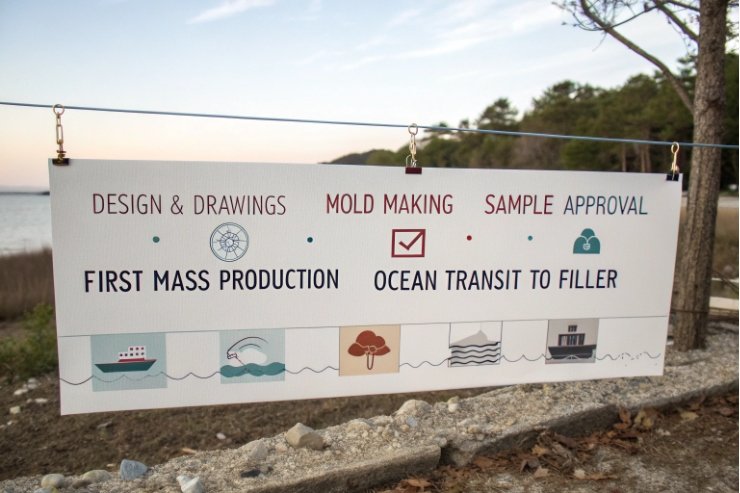
Glass projects have several time blocks, not just “production”.
You should map:
- Design and drawing approval time
- Mold making and sample production
- First mass-production slot and packing
- Transit time to your filler under FOB, CIF, or DDP
Typical production lead times for repeat orders might be 4–8 weeks, but the first custom run plus molds and samples can easily take 10–14 weeks. Your supplier should help you draw a calendar that includes holidays, maintenance shutdowns, and your own line availability.
Matching MOQs to your brand stage
Minimum order quantity (MOQ) 5 can make or break young spirit brands.
Key questions:
- What is the MOQ per SKU and per color / decoration?
- Can they offer smaller first runs at slightly higher unit cost?
- Are there shared or combined production slots for related SKUs?
You want MOQs that:
- Do not over-stress your cash flow or storage
- Still give a realistic amortization path for your molds
- Allow growth into more markets or sizes without constant re-negotiation
Simple view:
| Brand stage | Typical glass need | Supplier fit |
|---|---|---|
| Launch / craft | Smaller batches, high mix of SKUs | Flexible MOQs, pilot support |
| Growing regional | Larger batches, more stable forecast | Clear MOQs, better unit cost, stock options |
| Global premium | High volume, multiple markets and SKUs | Strong capacity, multi-plant, stock programs |
Choosing the right logistics terms
FOB, CIF, and DDP are not only trade jargon. They define who controls what. If you need a neutral reference, use the Incoterms® 2020 rules for FOB, CIF, and DDP 6.
Very simply:
- FOB: Supplier delivers to port. You handle sea freight and customs. Good if you have strong logistics partners.
- CIF: Supplier covers freight and insurance up to your port. You handle customs and local transport.
- DDP: Supplier delivers to your door, duty paid. Easy for you, but less control and sometimes higher hidden cost.
For premium spirits, many brands prefer FOB or CIF so they can:
- Pick reliable carriers and routes
- Control transit times and consolidation
- Manage insurance and customs with trusted agents
Whatever you choose, check:
- How the supplier packs pallets (shrink, corner posts, top boards)
- Historical transit breakage and claim handling
- Ability to share tracking data and shipment documents early
Good logistics planning should feel boring and predictable. If every shipment is a drama, it is time to review the setup.
How do mold maintenance, dimensional control, and cap-fit tests reduce line downtime?
Line downtime is one of the most expensive problems in bottling, yet many teams look only at per-bottle glass price. Unstable necks, worn molds, or poor cap fit can stop a filler faster than any marketing issue.
Strong mold maintenance, tight dimensional control, and real-world cap-fit testing keep your filler running, protect your closures, and prevent ugly issues like leaks, breaks, or stuck corks.
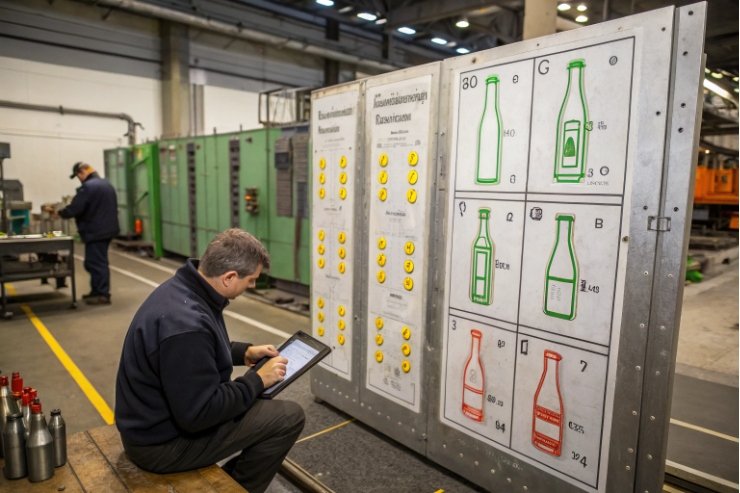
Mold care as an insurance policy
Molds do not stay perfect forever. As they wear, dimensions drift, seams grow, and the risk of stress in the glass rises.
Ask your supplier:
- How often do they inspect and refurbish molds?
- Do they track cavity-level performance (for example, bad-actor cavities)?
- How do they decide when to repair vs. replace?
A supplier who can share their mold maintenance plan shows they care about your long-term quality, not only the first glamorous run.
Dimensional control that matches your line
Your bottling line lives inside a window of allowed variation. If the neck or height drifts outside that window, you see:
- More mis-screws or broken corks
- Label wrinkles or misplacement
- Case-packer jams and pallet lean
You want the supplier’s tolerances to sit inside your line’s safe window, not sitting right on the edge.
Set up clear dimensional specs for:
- Total height and body diameter
- Neck outer and inner diameters
- Neck ring and finish profile
- Weight and center of gravity
Then ask for regular reports and capability data, not just “we check”.
A simple link between control and downtime:
| Control area | If weak | What happens on your line |
|---|---|---|
| Neck dimensions | Variable insertion force, leak risk | Stop-start, rejected bottles, rework |
| Height and diameter | Poor handling through rinsers, fillers, caps | Jams, lower top speed |
| Weight distribution | Tipping on conveyors and in cases | Breakage, safety risk, slower operation |
Real cap-fit tests, not only drawings
Neck-finish drawings are important, but they are not enough by themselves. You also need to see your actual corks, T-stoppers, or capsules on real glass from the mold.
Good suppliers will:
- Run cap-fit tests with your closures and send full samples
- Measure insertion force, pull-out force, and leak performance
- Adjust neck and finish based on what they see in the test
For screw closures, many teams standardize acceptance using ASTM D2063 torque retention testing for continuous thread closures 7 (or an equivalent, documented method).
You can also run short line trials with pilot batches to check:
- How fast your line can run without extra rejects
- How bartenders and staff feel about opening and pouring
- Whether capsules, labels, and seals sit correctly every time
When mold care, dimensional control, and cap-fit testing all work together, your filler becomes more stable and your operations team stops blaming “the glass” for every bad day.
Conclusion
The right spirits glass supplier does more than sell bottles. They bring strong quality systems, real custom capabilities, honest timing, and smart engineering so your bottle, your line, and your brand can grow together with confidence.
Footnotes
-
Verify the supplier’s ISO 9001 scope, certificate dates, and audit body—signals real quality management. ↩︎ ↩
-
Confirms EU requirements for materials touching food and drink, useful for exports and compliance files. ↩︎ ↩
-
Explains SMETA’s audit approach so you can validate ethical sourcing claims with recognizable reporting. ↩︎ ↩
-
Defines the standard AQL sampling framework many factories reference—helps you compare inspection rigor. ↩︎ ↩
-
Clarifies how MOQs are set and why they affect cash flow, storage, and launch risk. ↩︎ ↩
-
Official definitions of Incoterms responsibilities—prevents costly misunderstandings on freight, risk, and customs. ↩︎ ↩
-
A recognized torque retention method to align cap-fit acceptance criteria between your closures, glass, and line. ↩︎ ↩






