
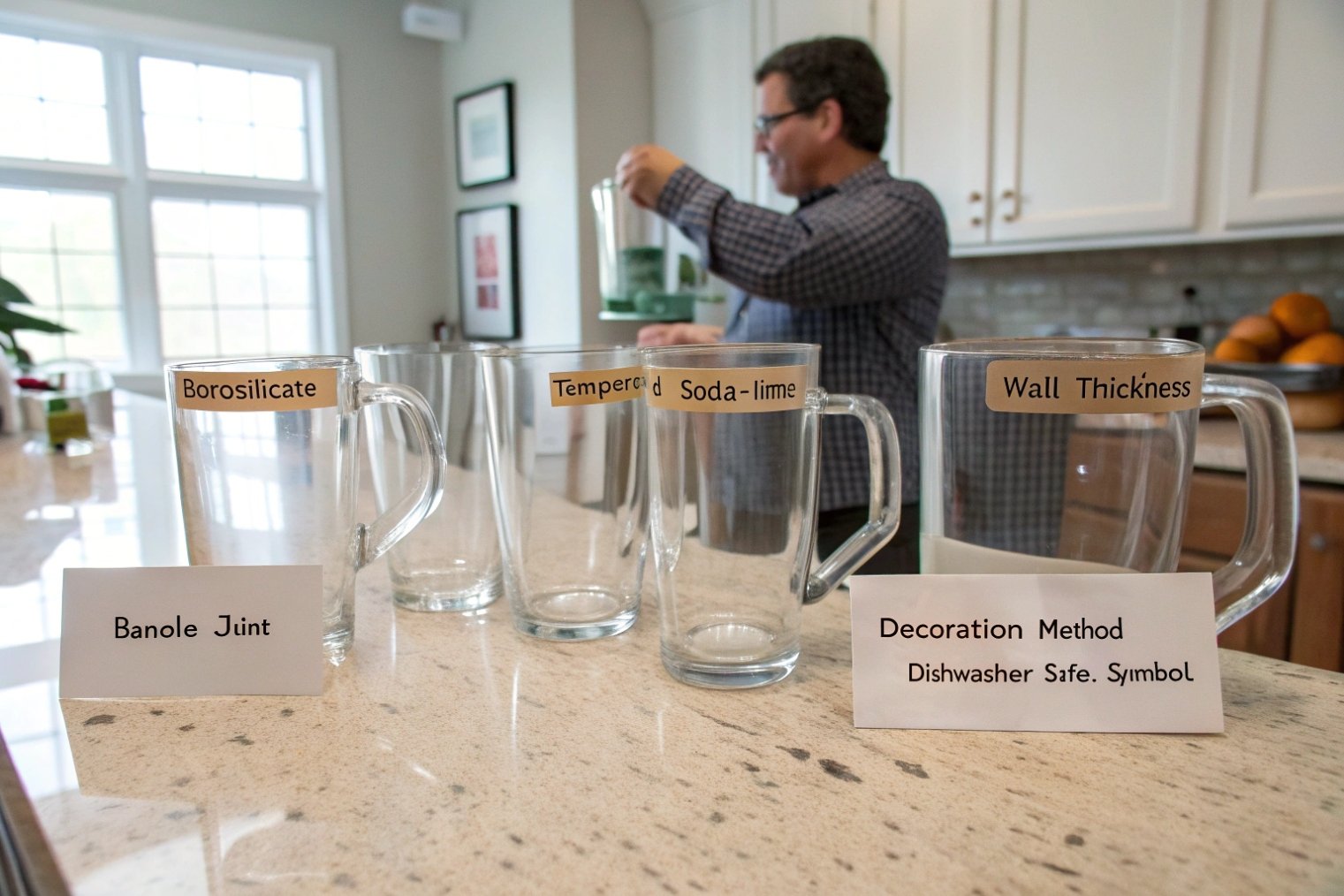
A glass mug that looks great on day one but chips or clouds after ten washes is a waste of money, and sometimes a safety risk.
To choose a durable, dishwasher-safe glass mug, focus on glass type (borosilicate vs tempered), handle design, wall thickness, decoration method, and clear dishwasher-safe symbols rather than just brand or style.
Once you look at your mug like a small piece of engineered glassware, the decision becomes much easier. Let’s walk through material, shape, decoration, and certifications step by step.
Should you choose borosilicate or tempered soda-lime for daily dishwasher use?
Most people only see “glass is glass”. In reality, borosilicate and tempered soda-lime behave differently in the dishwasher and on the table.
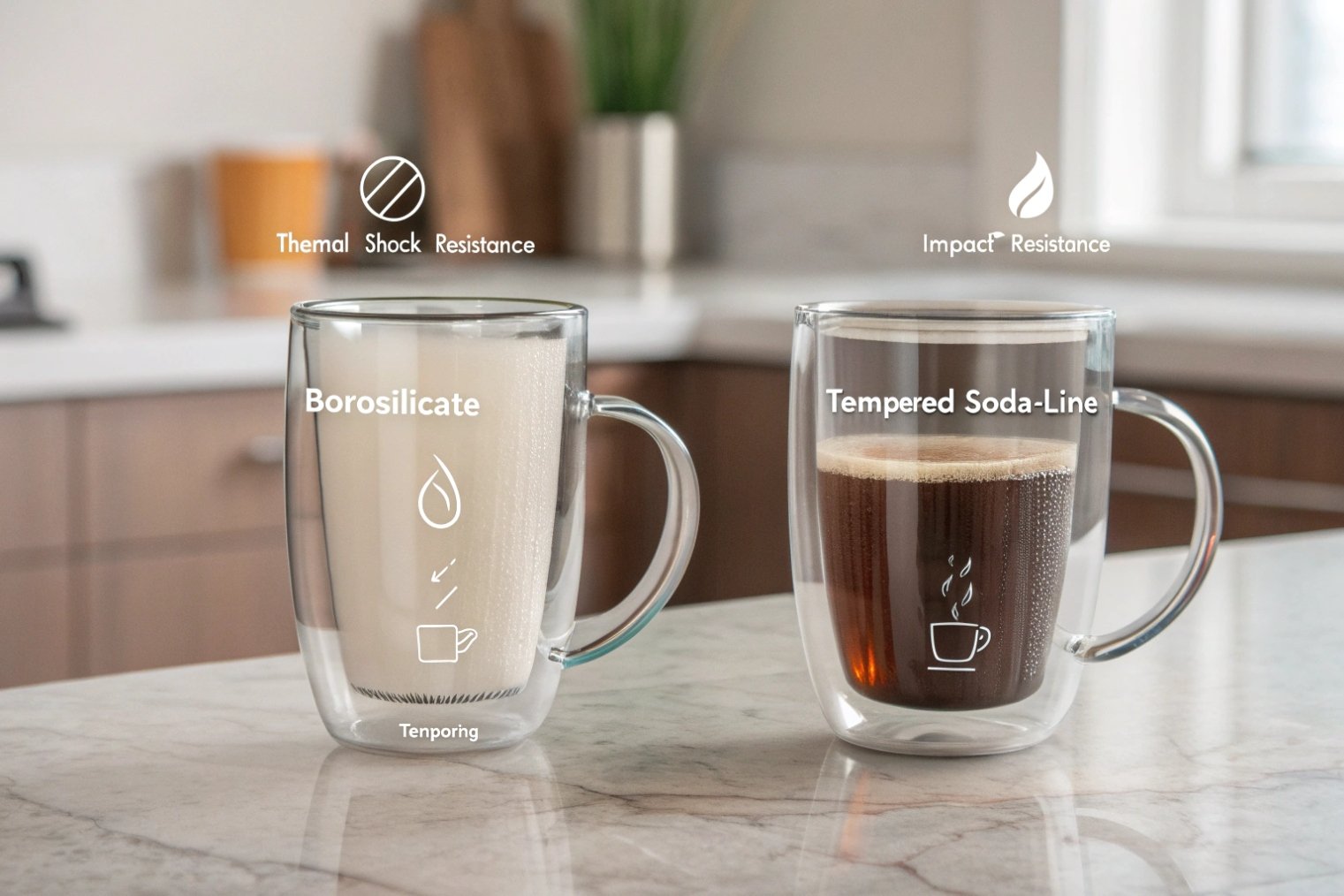
For daily dishwasher use, both borosilicate and tempered soda-lime work well if clearly marked dishwasher-safe; borosilicate wins on thermal shock, while tempered soda-lime often wins on impact strength.
Understanding the two main glass options
At mug level, you usually meet two families:
| Property | Borosilicate glass | Tempered soda-lime glass |
|---|---|---|
| Thermal shock resistance | Excellent (low expansion) | Good, better than plain soda-lime |
| Impact / drop resistance | Good, but still brittle | Very good (2.5–5× stronger than annealed) |
| Typical use | “Double-wall” or clear specialty mugs | Everyday café tumblers, stackable mugs |
| Dishwasher compatibility | Good if labeled safe | Very good if labeled safe |
| Price and availability | Higher, more “specialty” | More common and usually cheaper |
Borosilicate has a very low coefficient of thermal expansion 1. That means it tolerates fast temperature changes better. If you pour boiling water into a room-temperature mug, borosilicate gives you a wider safety margin. For a real datasheet example, see the Corning® 7740 borosilicate material properties 2.
Tempered soda-lime starts from regular soda-lime glass and then gets a heat treatment that builds compressive stress at the surface. The result is much better resistance to mechanical shocks, like clinking against other mugs, racks, or cutlery. This is why cafés and canteens love toughened (tempered) glass in general-purpose service ware. (Britannica overview 3)
How to choose between them for daily use
For most people:
- If the mug will see rough handling, crowded dishwashers, kids, or office kitchens, tempered soda-lime is usually the more forgiving choice.
- If you want high thermal-shock safety (for example, moving from cold room to very hot liquids often), borosilicate is attractive, especially for single-wall mugs.
Double-wall borosilicate mugs sit in a special category. They insulate very well and stay cool to the touch. But the inner and outer walls are joined by a sealed edge. If that seal is not designed and tested for dishwashers, heat and water pressure can slowly weaken it. Unless the maker clearly says “dishwasher safe” (and ideally “top rack only”), double-wall pieces are better hand-washed.
In all cases, the most important line is still the manufacturer’s care note. Material alone is not enough. If the mug does not explicitly say dishwasher-safe, assume the designer never validated it for that abuse.
Which handle shapes and wall thicknesses resist chipping best?
Most broken mugs do not fail in the middle of the wall. They fail at the rim or the handle. Design there matters more than people think.
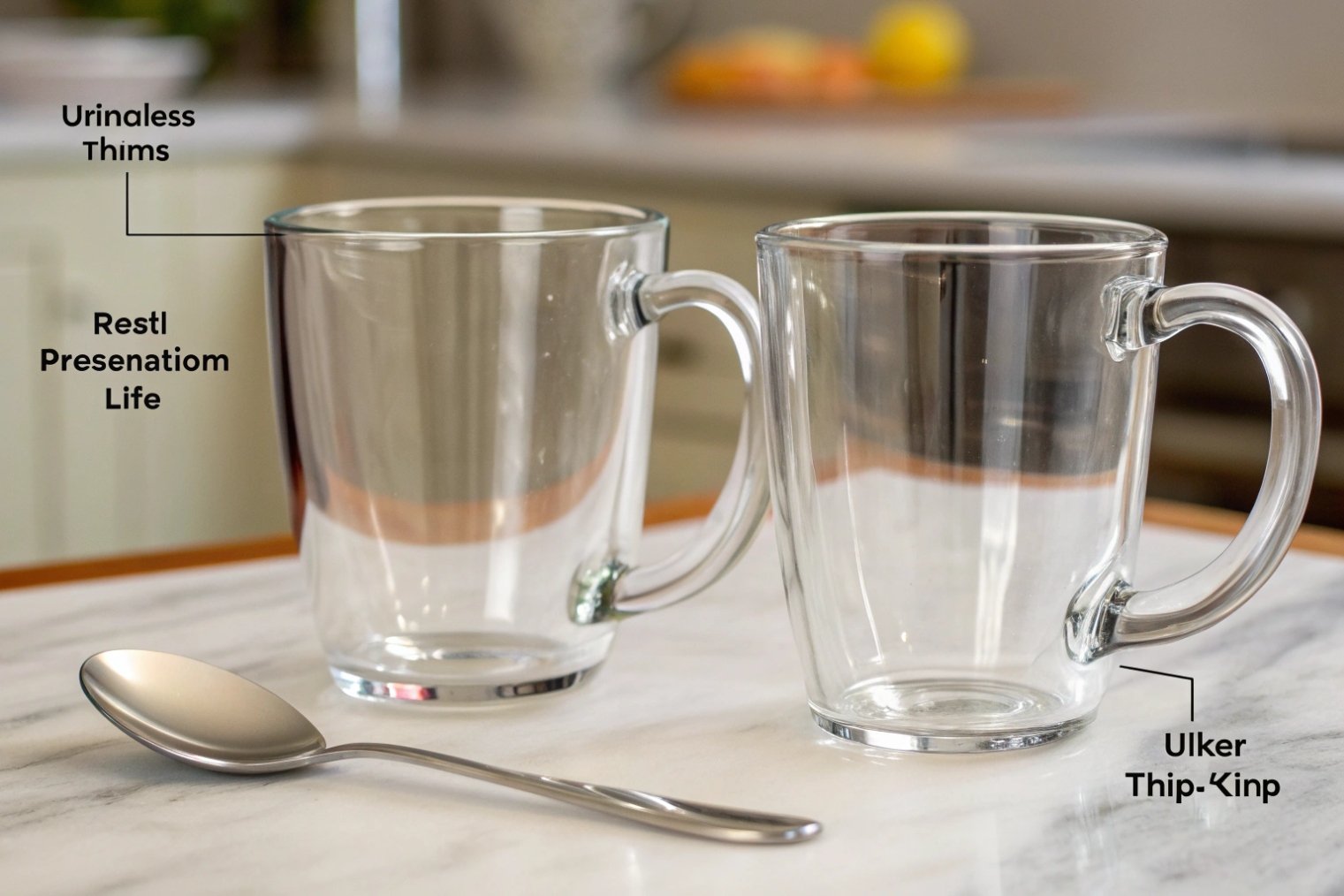
Look for thick, smooth rims, medium-to-thick walls, and solid, generously attached handles; these details resist chipping in racks, clinks against cutlery, and daily knocks much better than thin, delicate designs.
Wall thickness and rim design
Thin glass feels elegant, but it has a small safety margin. Everyday dishwashers combine hot water, high-pressure sprays, and banging against other items. That environment favors robust geometry.
Key points I watch:
- Thicker walls: more material means more energy absorption before a crack starts. For daily mugs, medium-thick walls are a good compromise between weight and strength.
- Rounded, slightly thick rims: sharp, thin rims chip easily when the mug meets a spoon or another mug. A rounded lip distributes stress better.
- No sudden thickness jumps: very thin walls that meet a very thick base can trap stress at the transition. Smooth changes are safer.
You do not need lab calipers. If the mug feels feather-light and the rim looks razor-thin, it is probably not the best candidate for heavy dishwasher use.
Handles that survive real life
Handles are classic failure points. In a dishwasher, hot water and weight from the rack combine with constant impacts. Good handle design matters.
What I favor:
- Integral or thickly welded handles: the base of the handle should have a wide footprint where it joins the body, not two tiny “dots” of glass.
- Simple loops: C-shaped handles with enough space for fingers, no fancy spikes or very thin curves.
- Balanced size: big enough to hold comfortably, but not so big that it sticks out and hits everything in the rack.
Here is a simple handle checklist:
| Feature | Better for durability | Higher risk for chipping |
|---|---|---|
| Handle thickness | Medium to thick | Very thin or “string-like” |
| Attachment area | Wide, smooth joins | Small contact points |
| Shape | Simple C or D | Complex, decorative cut-outs |
| Mug balance when full | Stays stable when lifted by handle | Feels twisted or unbalanced |
For dishwasher use, I also think about rack fit. Mugs that nest nicely between prongs and do not wobble will hit fewer neighbors during the wash cycle. A stable base and a handle that does not snag on the rack are small details that add up to much longer life.
Do decals, inks, and coatings survive commercial wash tests?
Many people fall in love with a printed mug and then watch the design fade, crack, or peel after a few months in the dishwasher.
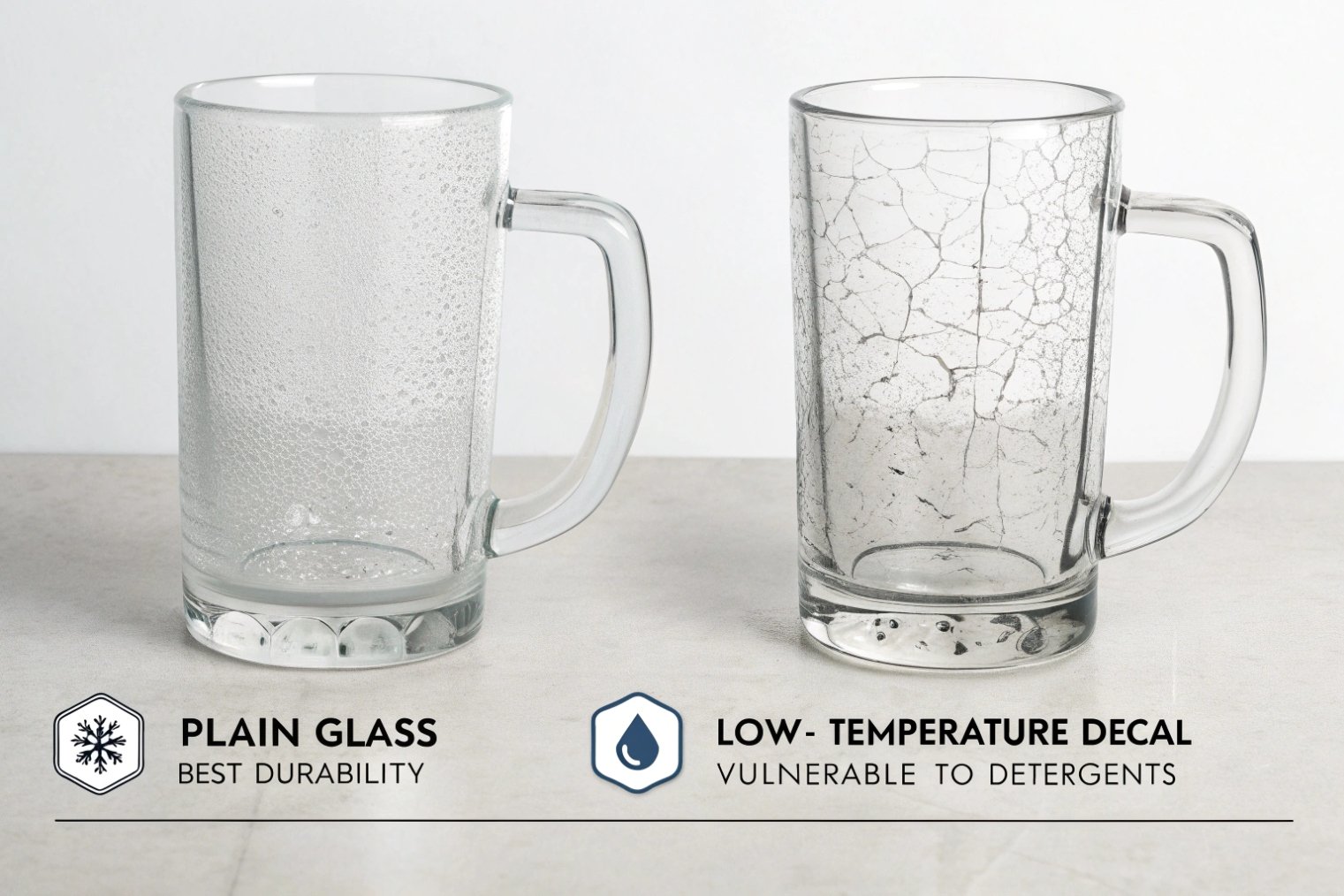
Plain, undecorated glass survives dishwashers best; if you want graphics or logos, look for high-fired, dishwasher-tested inks and avoid metallic trims on mugs that will see frequent or commercial washing.
How decoration methods behave in dishwashers
Dishwasher detergents are quite aggressive. They are designed to break down grease and food quickly, and they can contribute to alkaline detergent glass corrosion (one cause of “clouding”). (Manufacturer guidance 4) Combine that with hot water and strong jets, and you get a tough environment for inks and coatings.
Common decoration methods:
- High-fired ceramic inks / screen prints: fused into the glass at high temperature. These withstand home dishwashers quite well when formulated and cured correctly—especially when you see high-fired ceramic ink screen printing described for industrial washing resistance. (Example process note 5)
- Low-temperature decals: applied with an adhesive layer and cured at lower temperature. They look sharp but can lift, fade, or crack under strong detergents.
- Metallic trims (gold, platinum, lusters): thin metallic layers at the rim or decorations. Beautiful, but often the first to dull, pit, or flake in dishwashers.
- External color coatings: sprayed or dipped coatings. Some are baked on and quite durable, others scratch and cloud quickly.
If you need the mug to survive commercial dishwashers (hotter water, harsher detergents, many cycles per day), I treat decoration claims very seriously. I look for terms like:
- “Dishwasher-safe decoration, tested to X cycles”
- “Commercial dishwasher safe”
- Any mention of standards or in-house test methods
If that information is missing, I assume the decoration is more about look than long-term endurance.
When to go plain and when to trust decoration
For pure durability:
- Plain, clear glass is king. No inks, no decals, no metallic lines. Everything you see is just glass, so there is nothing to peel or fade.
For branded mugs, cafés, or gifts:
- Choose suppliers who can show wash-test results or at least specify “dishwasher-safe print”.
- Avoid metallic trims on daily-use mugs. Save gold rims for hand-wash-only special pieces.
- If the design is important but you accept some aging, it can still be a good trade, as long as expectations are honest.
As a rule of thumb, if the mug is a daily workhorse, treat decoration as optional. If the mug is a showcase or a gift and will not see dozens of cycles per week, high-quality decoration is less of a risk.
What certifications or symbols actually verify dishwasher safety?
“Dishwasher safe” on a product page is one thing. A clear symbol or tested claim on the base is more convincing, especially when you are buying for cafés, offices, or resale.
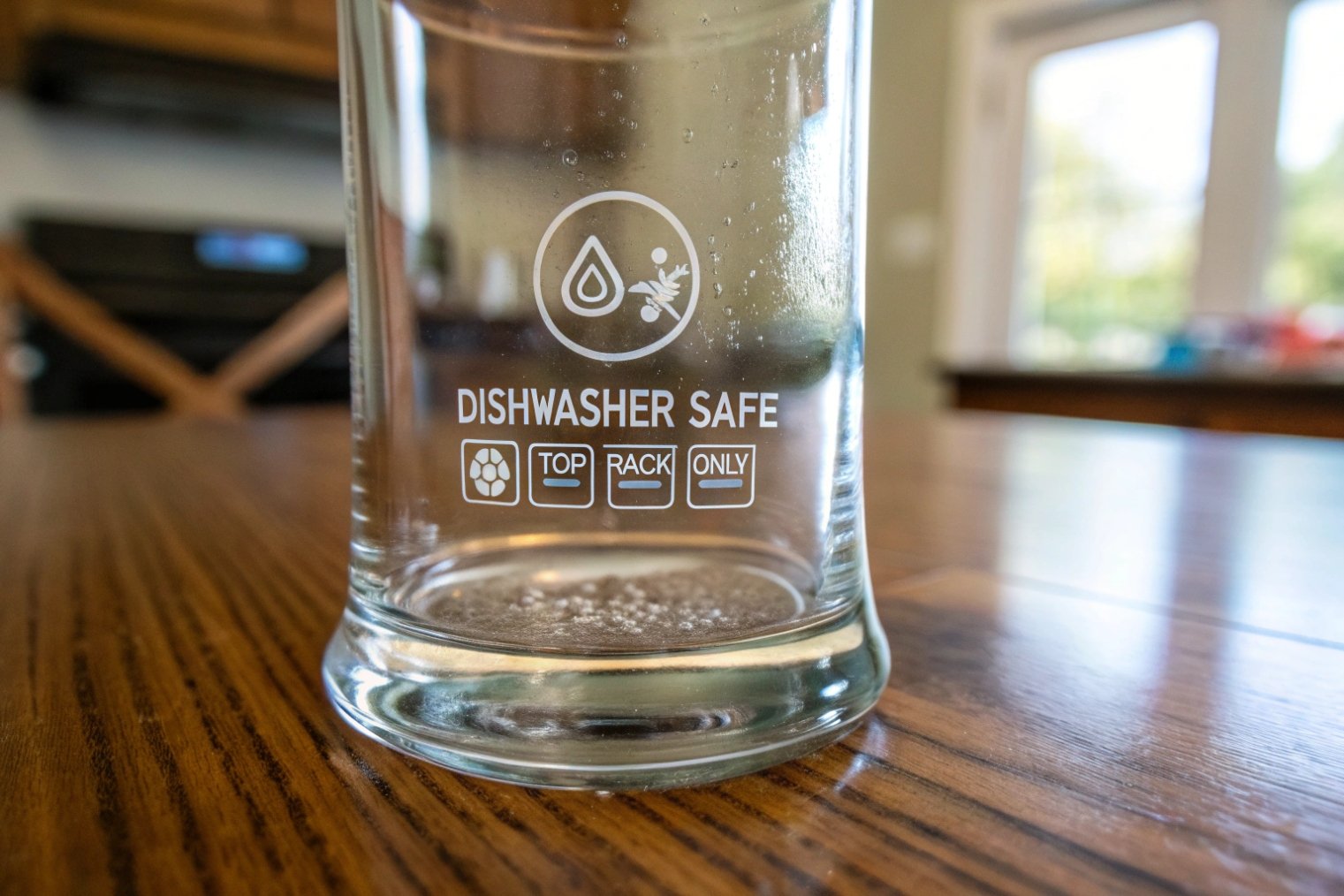
Check for dishwasher-safe symbols, care notes (like “top-rack only”), and, for heavy use, references to tested dishwasher cycles or standards; when in doubt, trust explicit markings over assumptions.
Common symbols and care notes
There is no single global dishwasher icon, and some consumer advocates note there’s no universally approved dishwasher-safe symbol 6. Still, some patterns are common:
- A plate or glass with water droplets or spray lines often means “dishwasher safe”.
- Extra text like “top rack only” tells you the mug should stay away from the hotter lower rack.
- Some manufacturers print simple words: “Dishwasher safe”, “Hand wash only”, or temperature icons.
Top-rack-only matters because:
- The heating element is usually closer to the bottom of the machine.
- The top rack tends to run cooler and gentler.
If a mug says “top rack only”, I always respect that. It is often about both glass stress and decoration life.
What about formal tests and standards?
Behind the scenes, some manufacturers use test standards that expose mugs to a set number of wash cycles at controlled conditions. One commonly referenced framework is the EN 12875-1 mechanical dishwashing resistance test method 7. You might see references to:
- “Tested to X domestic dishwasher cycles”
- “Commercial dishwasher tested”
These claims show that someone actually ran the mug through a controlled abuse program, not just a guess from marketing. For heavy-duty environments (cafés, hotels, offices), I would always favor mugs from brands that publish at least some durability or test data.
There is no single global consumer symbol like an official “certified dishwasher-safe” stamp that covers all products. So your best safety net is a mix of:
- Clear symbols or text on the mug or packaging.
- Brand reputation and experience with their glassware line.
- Simple logic: if the maker refuses to say it is dishwasher-safe, it is safest to assume it is not.
Conclusion
A durable, dishwasher-safe glass mug is not just about pretty design. It is a small engineering choice: the right glass, the right handle, the right wall thickness, and honest dishwasher claims that match how you actually live.
Footnotes
-
Explains thermal expansion and why low expansion reduces thermal-shock stress in glass. ↩ ↩
-
Datasheet showing 7740 borosilicate expansion, density, and viscosity points used in real glass design. ↩ ↩
-
Clear overview of how tempering raises strength and changes break behavior in safety glass. ↩ ↩
-
Manufacturer explanation of dishwasher cloudiness from alkaline detergents and how to reduce it. ↩ ↩
-
Practical note on fired ceramic ink decoration designed to resist industrial washing and abrasion. ↩ ↩
-
Explains common dishwasher icons and why “dishwasher safe” markings vary by brand and region. ↩ ↩
-
Summary of a standard reference method used to compare dishwashing resistance under defined conditions. ↩ ↩






