
Hot-fill cracks feel random. One day the line is fine. Next day, bottles split at the heel and customers blame the glass, not the process.
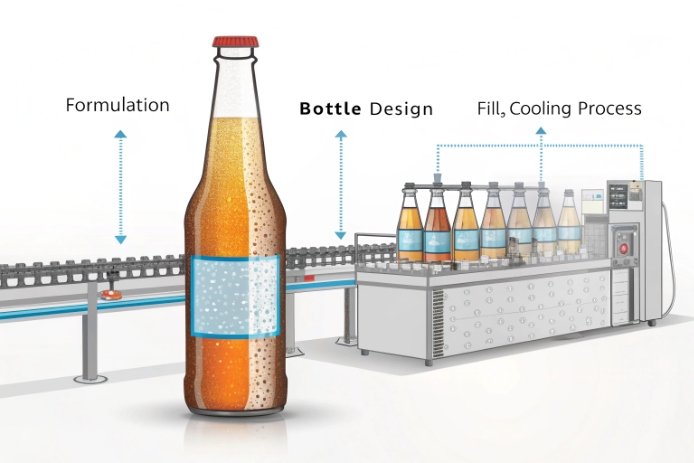
Hot-fill performance is a balance of composition, melt quality, and bottle design. The best formula raises temperature margin, stays easy to melt, and keeps surfaces smooth for acidic beverages.
Hot-fill success comes from one word: margin
Hot-fill at 85–95 °C creates fast temperature gradients. Those gradients create stress. Stress finds weak points. In glass, weak points are usually surface flaws, cords near the wall, devit skins, or sharp design corners. So the first priority is margin. Margin means the bottle stays far from stress failure during filling, capping, cooling, and handling.
What the formulation is really doing
A hot-fill recipe should support four things at the same time:
- A slightly higher strain/annealing point so the glass stays stiff during hot-fill handling.
- A stable thermal expansion 1 behavior so thermal shock is less severe.
- A strong, smooth inner surface so acid beverages do not create micro-attack that grows cracks.
- A clean melt with low defects, because defects kill strength faster than any oxide change can save.
Why “stronger glass” is not one oxide
Raising SiO₂ and Al₂O₃ often helps durability and stiffness, but it can also raise viscosity and make melting harder. Lowering Na₂O can reduce alkali mobility and improve durability, but it can narrow the forming window. Balancing CaO and MgO can reduce devit risk, but it can shift liquidus behavior. This is why the best solution is a controlled window, not a dramatic redesign.
| Target | What to move in composition | What can break if overdone |
|---|---|---|
| Higher temperature margin | +SiO₂, +Al₂O₃, tighter Na₂O | melting rate, fining stability |
| Lower thermal-shock sensitivity | stable expansion, low defects | working range, forming stability |
| Higher durability in acidic drinks | stable network, low alkali release | cost, batch sensitivity |
| Better real strength | fewer cords, seeds, stones | needs process discipline |
A short story that still sticks in my mind: one juice customer blamed “weak glass” after hot-fill cracks. The recipe was not the main issue. A forehearth cold spot caused a devit skin. That skin turned into pits after washing. After we fixed the temperature profile and held sulfate feed steady, the same composition passed.
The next sections break down the main levers so a recipe and a process plan can move together.
Now, the first big lever is how the base oxides shape strain and annealing behavior.
Which oxide ratios raise strain/annealing points for 85–95 °C hot-fill?
Hot-fill failures often happen even when drop tests pass. The missing piece is how the glass behaves close to its annealing range during filling and early cooling.
To support 85–95 °C hot-fill, use a soda-lime window with modestly higher SiO₂ and Al₂O₃, controlled Na₂O, and a CaO/MgO balance that avoids devit and keeps viscosity stable.
Start from a “hot-fill friendly” soda-lime window
Most beverage bottles use soda-lime-silica glass 2. For hot-fill, the practical move is to bias the window toward stiffness and durability without turning the melt into a slow, defect-prone system.
A workable starting window often looks like this:
- SiO₂: 72.5–74.0 wt%
- Na₂O: 12.5–14.0 wt% (tight band, avoid spikes)
- CaO: 9.0–10.5 wt%
- MgO: 2.5–4.0 wt%
- Al₂O₃: 1.5–2.5 wt%
This kind of window can raise the “hot stiffness” feeling and reduce chemical sensitivity in acidic beverages, while keeping melting realistic.
How each oxide influences strain/annealing behavior
- SiO₂: strengthens the network and tends to raise characteristic temperatures. It also raises viscosity, so it must be increased carefully.
- Al₂O₃: improves network rigidity and durability. Modest increases often help hot-fill performance because the glass becomes less sensitive to small process drift.
- Na₂O: lowers melting temperature and viscosity. Too high, or too unstable, makes the glass more mobile and can increase alkali release. For hot-fill, tight control matters more than a dramatic reduction.
- CaO/MgO: stabilize the network. Still, poor balance can raise liquidus temperature 3 and cause devit skins in cold zones. Devit skins create weak surfaces that crack during thermal cycling.
What to prioritize in the plant spec
| Item | Hot-fill goal | Why it matters |
|---|---|---|
| Na₂O drift | very low | drift changes viscosity and stress response |
| Al₂O₃ stability | tight window | supports durability and stiffness |
| MgO/CaO balance | avoid liquidus spikes | prevents devit lines and surface skins |
| Melt homogeneity | fewer cords | cords near surface reduce real strength |
For hot-fill, composition is a support tool. The main win still comes from stability. A stable “good” window beats an unstable “perfect” window every time.
Next, many teams ask about micro-additions, because they want extra margin without large base shifts.
How do B₂O₃/ZnO/ZrO₂ micro-additions trade off meltability, thermal-shock resistance, and devitrification risk?
Micro-additions sound easy. Add a little oxide, fix the issue, move on. In real furnaces, small changes can trigger new defects if the melt cannot dissolve or homogenize them.
ZnO and small ZrO₂ can improve durability and slow surface attack, but they can raise cost and defect risk if not fully dissolved. B₂O₃ can help meltability, but it must be validated for hot-fill stress and durability.
B₂O₃: melt helper, but validate the full system
Small B₂O₃ additions can lower viscosity and support melting. That can improve fining 4 and reduce unmelted grains, which helps real strength. Still, B₂O₃ changes the network and can change chemical behavior in strong alkali environments. Hot-fill beverages are often acidic, so boron is usually not the biggest durability risk. The bigger risk is instability: volatility, fining response changes, and color/redox interactions in some plants.
A useful way to treat B₂O₃ is as a process stabilizer, not as a “thermal shock magic oxide.”
ZnO: durability and surface behavior tool
ZnO can improve chemical durability in some soda-lime systems and can reduce certain corrosion patterns. It can also change devit behavior in a helpful way at small levels. The main trade-off is cost and dosing control. If dosing drifts, viscosity and fining response can drift.
ZrO₂: strong durability, but stone risk is real
ZrO₂ can strengthen the network and improve chemical durability. For hot-fill, the appeal is better surface stability over time. The risk is practical: zircon-bearing additions can be hard to dissolve. Undissolved particles become stones. Stones are not only appearance defects. They also create crack starters under thermal cycling.
Decision guide for micro-additions
| Addition | Potential benefit | Main risk | When it makes sense |
|---|---|---|---|
| B₂O₃ (small) | easier melting, better homogeneity | volatility, working-range shift | when meltability limits quality |
| ZnO (small) | better durability, smoother long-term surface | cost, dosing drift | when pitting/haze appears after cycling |
| ZrO₂ (very small) | strong durability boost | stones if not dissolved | only with strong melt control and QC |
The key is sequence. Fix base window and melt homogeneity first. Then trial micro-additions with real hot-fill and cooling profiles. Otherwise, additives become a new source of cords and defects.
Now, even the best recipe will fail if the bottle design concentrates stress.
What design choices reduce stress cracks with the recipe?
Many hot-fill cracks are not “glass chemistry” failures. They are stress concentration failures. A small design change can give more safety margin than a big oxide change.
Use consistent wall thickness, generous heel radius, smooth transitions, and controlled headspace and vacuum behavior. Design should reduce thermal gradients and stress peaks during filling and cooling.
Wall thickness: uniform beats thick
Thicker walls reduce some stress in certain cases, but they also increase temperature gradients and cooling time. Hot-fill works best when the wall is consistent and the design avoids thick-to-thin jumps. If the base is heavy, the shoulder and body should not be too thin. When thickness changes sharply, stress concentrates and cracks start.
Heel radius and base geometry: remove stress notches
The heel is a classic crack site. A sharp heel radius acts like a notch. Hot-fill adds thermal stress right where handling also adds impact and abrasion. A larger heel radius reduces peak stress. It also improves coating coverage and reduces scuffing.
Internal pressure and vacuum management
Hot-fill often creates a pressure or vacuum story:
- During filling and capping, pressure can rise.
- During cooling, vacuum can form.
- If vacuum is too high, paneling and stress can appear.
The design tools include:
- correct headspace
- suitable closure and liner design
- controlled capping temperature
- pressure relief features if the product needs them
Design + formulation checklist
| Design element | What it should do | How it supports the recipe |
|---|---|---|
| Wall thickness profile | reduce thermal gradients | avoids local stress spikes |
| Heel radius | remove notch stress | improves crack resistance |
| Base shape | avoid sharp corners | reduces stress concentration |
| Finish design | hold tolerances | reduces closure-induced stress |
| Headspace control | manage pressure/vacuum | prevents paneling and cracking |
The best programs treat hot-fill as a “system design.” Composition sets the material behavior. Design sets stress distribution. Process sets the real surface quality.
Next, clarity and UV protection must be maintained for acidic beverages, and that depends heavily on colorants, fining, and redox.
How can colorants and fining/redox control maintain clarity and UV protection while meeting hydrolytic resistance for acidic beverages?
Brands want protection and clarity at the same time. Many plants can hit one and miss the other if redox and fining are not stable.
Choose colorants that match the light risk, then hold redox and sulfate fining stable to avoid cords and haze. Keep alkali release controlled with a durable base window for acidic beverages.
Color choice: protect the drink without breaking the brand
- Amber: strong protection for near-UV and blue light. Great for beer and sensitive juices. Needs stable redox and sulfur chemistry to avoid shade drift.
- Green/emerald: moderate protection with strong branding. Needs tight Cr/Fe control and clean cullet streams.
- Flint with label/sleeve: keeps “clear look” while the label blocks light. Works well for functional drinks when the brand needs clarity.
For hot-fill, thick glass areas can make color look darker. So the color system must be tuned at real wall thickness, not only on lab samples.
Fining and redox: the real clarity levers
Clarity problems in hot-fill bottles often come from:
- cords and striae 5 that become visible in thick walls
- seeds that create sparkle defects
- devit skins from cold zones
- salt carryover that affects surface cleanliness
Stable sulfate fining and stable furnace redox 6 reduce these problems. Redox swings can change iron valence and color response, especially in amber systems. They can also change foam and heat transfer, which changes refining and can increase defects.
Hydrolytic resistance for acidic beverages
Acidic beverages do not usually attack glass as aggressively as strong alkali, but they can still expose:
- high alkali release (taste risk in water-based drinks)
- weak inner surfaces that haze over time in some conditions
- variability caused by cullet contamination 7
A durable soda-lime window with modest Al₂O₃ and controlled Na₂O supports low ionic release trends. The biggest improvement often comes from reducing surface defects and keeping the inner surface smooth.
Control table for clarity + UV + durability
| Control item | What to hold steady | What it protects |
|---|---|---|
| Colorant feed | low drift, clean sources | brand color consistency |
| Redox state | stable oxygen potential | shade stability, fewer cords |
| SO₃ and fining feed | steady trend, no pulses | low seeds and low haze |
| Cullet stream | color-pure, low CSP, low organics | clarity, durability, recyclability |
| Hydrolytic screen | regular trend test | early warning for alkali release drift |
When clarity, UV protection, and hydrolytic resistance 8 are treated as one system, hot-fill success becomes predictable. When they are treated as separate problems, the line keeps switching between “clear,” “strong,” and “protected,” but never holds all three.
Conclusion
Hot-fill performance improves when a stable soda-lime window, careful micro-additions 9, smart stress-reducing design, and steady color/fining/redox control work together, not when one lever is pushed too hard.
Footnotes
-
The rate at which glass expands as it heats; crucial for thermal shock resistance. ↩
-
The standard glass type for bottles; balancing oxides here is key for hot-fill. ↩
-
The temperature above which the glass is completely liquid; affects devitrification. ↩
-
Removing gas bubbles from the melt; critical for glass strength and clarity. ↩
-
Visible cords or lines in glass caused by composition differences, weakening the bottle. ↩
-
The balance of oxidation states in the melt, controlling color and fining stability. ↩
-
Contaminants in recycled glass that can cause defects and weaken the bottle. ↩
-
The glass’s ability to resist chemical attack, important for maintaining beverage quality. ↩
-
Small amounts of specific oxides added to fine-tune glass properties. ↩






