
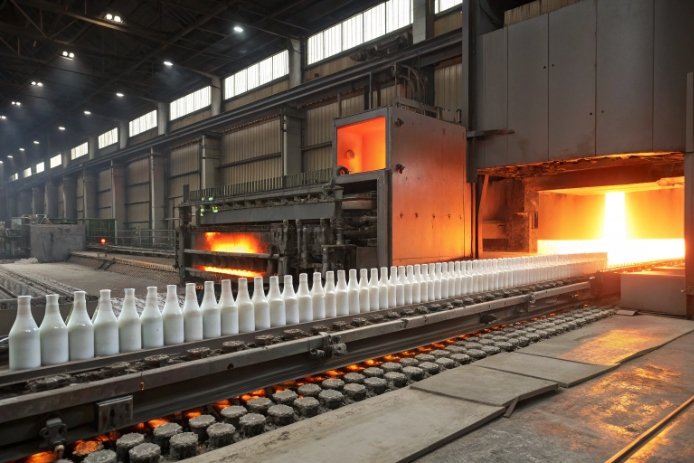
A furnace can look stable, but one dirty cullet load can flip the melt. Then seeds jump, flint turns green, and operators chase the line with heat.
Redox is the melt’s oxygen activity, and it sets the balance of multivalent species like iron and sulfur. When redox stays in a tight band, fining stays efficient, foam stays low, and color stays repeatable across shifts.
Redox control is a system, not a single additive
Redox is a “timing control” for bubble removal
In bottle glass, most bubble pain comes from timing. Gas must be produced when the melt is hot and fluid. The same gas becomes a defect when it forms early under the batch blanket or late in the forehearth. Redox sits in the middle of this timing. A reduced melt carries more Fe²⁺ and S²⁻, and an oxidized melt carries more Fe³⁺ and SO₄²⁻. Those species decide when sulfur gases form, how foam behaves, and how fast seeds grow into bubbles that can rise out. (See fining mechanisms 1)
Redox affects heat transfer, so it can change your temperature field
Redox is also tied to radiant heat transfer through iron species. A shift toward Fe²⁺ can change how the melt absorbs near-IR radiation, and that can change how heat moves into the glass bath. When heat transfer changes, the “same setpoints” can produce a different real temperature map. This is one reason operators sometimes feel the furnace “pull” differently even when the control screens look unchanged.
Redox control works best when it is framed as inputs + atmosphere + feedback
A stable redox plan has three layers:
- Input stability: cullet cleanliness, consistent batch reducers, and predictable sulfate.
- Atmosphere stability: air/fuel ratio, oxygen staging, and leak control.
- Feedback: fast redox signals and slow chemistry confirmation.
| What shifts redox | What it changes first | What the plant feels | Best response style |
|---|---|---|---|
| Dirty cullet (labels, organics) | melt becomes more reducing | foam, color drift, more seeds | remove organics, raise oxygen capacity |
| Excess carbon/reducer in batch | more S²⁻ and Fe²⁻ | ambering risk, cords | reduce reducer, slow corrections |
| Too oxidizing firing | more Fe³⁺ and SO₄²⁻ | weak amber, different fining timing | adjust air/fuel and oxygen staging |
| Rapid recipe corrections | redox gradients | cords, reboil waves | smaller steps, model-based pacing |
Redox control becomes much easier when everyone agrees on one point: redox is not a lab number that changes once per day. It is a live process state that can shift within hours.
Now it helps to define redox in industrial glassmaking in a way that matches what a bottle furnace actually does.
What is redox in industrial glassmaking?
A team can debate redox for weeks and still miss the point. The melt does not care about opinions. The melt cares about oxygen activity.
Redox in industrial glassmaking is the balance of oxidized and reduced species in the melt, usually described through oxygen activity or pO₂. It controls the equilibrium of multivalent elements like Fe, S, Sb, Ce, and Cr, so it shapes fining, foaming, heat transfer, and color.

The simplest usable definition
Redox is the melt’s chemical “mood,” and oxygen activity is its best language. When oxygen activity is low, the melt is more reducing. When oxygen activity is high, the melt is more oxidizing. This shifts the Fe²⁺/Fe³⁺ balance and the sulfur form balance (S²⁻ vs SO₄²⁻). Those balances are not just chemistry notes. They are defect drivers.
Why multivalent elements are the center of the story
Bottle glass contains iron almost always, and it often contains sulfur in some form for fining. Many plants also use small amounts of tin, cerium, selenium, cobalt, or other color and fining helpers. All of these can change oxidation state. Redox decides which state dominates, and that state decides how the melt behaves.
Redox is never “one value everywhere”
A furnace is not perfectly mixed. The batch area can be more reducing under the blanket. The refining zone can be more oxidizing. The feeder can drift again based on temperature and residence. This is why in-line measurement locations matter. (Read about oxygen sensors 2)
| Place in the furnace | Why redox differs there | Typical risk | What to watch |
|---|---|---|---|
| Under batch blanket | organics and carbon react first | early foam and trapped seeds | foam events and gas release |
| Refining zone | high temperature and strong convection | fining timing shifts | seed count trend |
| Forehearth/feeder | conditioning and reheating | reboil and color drift | blisters at mould, ΔE drift |
A good working definition also includes the idea of control lag. Even if a correction is perfect, the furnace will show the result later because glass needs time to travel. That lag is why redox control must be calm and consistent.
With the definition clear, the next question becomes obvious: why does redox control directly improve clarity and color stability?
Why does redox control yield clarity and color stability?
A plant can buy better molds and better inspection, but unstable redox will still leak defects. Redox makes defects, and redox also decides whether defects can be removed.
Redox control improves clarity because it stabilizes fining and foam, so bubbles grow and escape instead of staying as seeds. It improves color stability because it holds the Fe²⁺/Fe³⁺ balance steady, which controls the green tint in flint and supports consistent amber chemistry in reduced glasses.
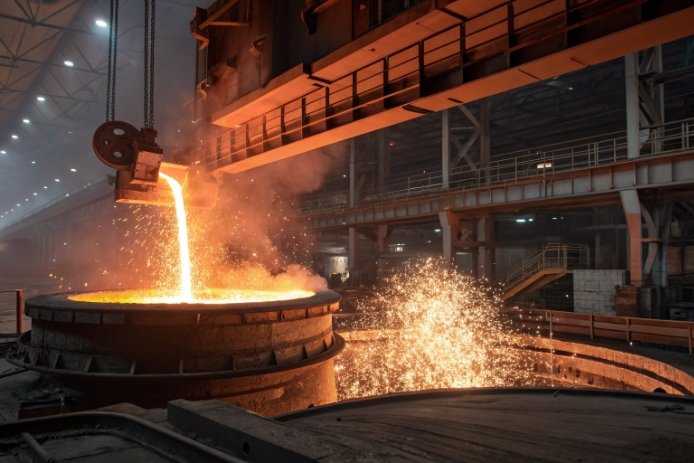
Clarity: redox decides whether sulfur helps fining or traps bubbles
Sulfate fining is common in industrial glass because it removes small bubbles. Sulfur chemistry is also redox sensitive. If the melt becomes too reducing, sulfate can shift toward sulfide and create strong SO₂ generation in the wrong temperature band. That can build foam. Foam blocks heat transfer. It also traps bubbles under a stable film. This is why a reducing spike can show up as a seed spike hours later. (See sulfate foam issues 3)
In a stable redox band, gas-producing fining reactions support bubble growth when viscosity is low enough for bubble rise. In an unstable band, the same chemistry becomes a foam generator.
Color: iron redox is the daily lever for flint and green
In container glass, iron drives a large part of the baseline color. More Fe²⁺ often makes the green cast stronger and shifts it toward a bluish tone. More Fe³⁺ shifts the cast toward yellowish and can look “cleaner” in flint. When redox drifts, the same raw iron level produces different visible color. (See iron redox control 4)
Some plants use decolorizers to mask iron’s green. That can help, but it does not replace redox control. When redox drifts, the decolorizer package is no longer tuned, and color becomes noisy.
Amber: sulfur redox becomes part of the color chemistry
Reduced container glasses can form the Fe³⁺–S²⁻ chromophore that gives amber tone. This is why amber requires a controlled reduction window. If reduction rises too much, amber can turn too dark and can create cords. If oxidation rises too much, amber can weaken or shift.
| Quality output | Redox-driven mechanism | What “stable” looks like | What “unstable” looks like |
|---|---|---|---|
| Seed count | fining gas timing + foam behavior | smooth low seed trend | step changes after cullet swings |
| Flint tint | Fe²⁺ fraction | tight ΔE across shifts | green drift and Monday/Friday variation |
| Amber tone | Fe³⁺–S²⁻ balance | repeatable transmission | dark cords or weak amber |
| Blisters at mould | reboil from sulfur/redox shifts | flat blister rate | waves after forehearth reheating |
When the plant holds redox steady, the process stops reacting like a pendulum. Operators stop chasing color with emergency firing changes. QA also sees fewer “mystery lots.”
Now the useful question: which agents and atmosphere settings can tune redox in a reliable, repeatable way?
Which agents and atmosphere settings tune redox reliably?
Many plants know the “tools,” but they use them like emergency levers. That approach creates oscillation and cords.
Reliable redox tuning uses small, planned changes in reducers and oxidizers, paired with stable combustion control. The strongest levers are cullet cleanliness, carbon balance, sulfate and nitrate strategy, and air/fuel plus oxygen staging that keeps oxygen activity steady from batch to feeder.
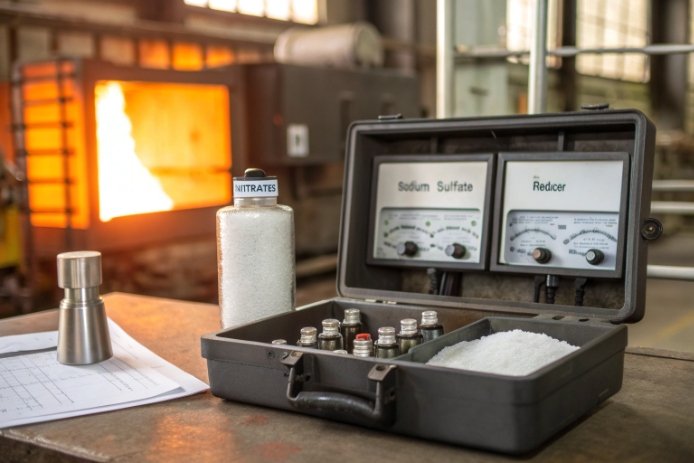
Reducing agents: use them, but respect the lag
Common reducers include:
- carbon sources (coke, anthracite, carbon in batch additives)
- organics in cullet (labels, inks, plastics) (See cullet contamination 5)
- some color systems that are sensitive to reduction
The most dangerous reducer is the one you did not plan for. Dirty cullet can spike reduction fast. That is why clean cullet is a redox control tool, not only a recycling tool.
If the melt is too oxidizing for a target color (often amber), a controlled reducer addition can help. The safest style is a small change held long enough to see the steady response, not quick “up and down” corrections.
Oxidizing agents: keep sulfur useful and keep color stable
Common oxidizers include:
- sulfates (often sodium sulfate) as part of fining packages
- nitrates as oxidizing helpers in some recipes (See nitrate behavior 6)
- oxygen enrichment through firing control
Sulfate is both a fining chemical and a redox participant. Nitrates can help shift the early melt more oxidizing, but they can also change emissions profiles, so they need a clear plan.
Atmosphere settings: combustion control is a redox tool
Atmosphere control is not only “more air.” It is about consistent oxygen potential:
- hold a stable air/fuel ratio
- use oxygen staging when available
- reduce air leaks that create local cold oxidizing zones
- avoid strong local reduction pockets under the blanket
A small furnace leak can create gradients. Gradients create cords. So sealing and burner maintenance are redox controls in disguise.
A practical tuning table for daily operations
| Goal | Chemistry lever | Atmosphere lever | What to avoid |
|---|---|---|---|
| Reduce foam and seeds | reduce unplanned reducers, stabilize sulfate | slightly more oxidizing firing | big swings in sulfate dose |
| Protect flint color | limit Fe²⁺ rise, keep cullet clean | stable oxygen activity in feeder | “chasing” color with heat alone |
| Hold amber tone | controlled reduction window | steady, repeatable firing | short bursts of reducer or oxygen |
| Lower reboil risk | stabilize sulfur speciation | avoid forehearth reheating spikes | mixing oxidized and reduced streams |
The most reliable “agent” is still discipline. A plant that controls cullet and uses slow recipe trims will beat a plant that uses aggressive additives without feedback.
That feedback leads directly to the final question: will closed-loop redox control become standard?
Will closed-loop redox control become standard?
Manual control can work, but it often reacts too late. High cullet and tight flint specs do not forgive slow feedback.
Closed-loop redox control is moving toward standard use in many bottle operations because in-line oxygen activity sensors can measure melt redox in feeders and canals. When the sensor signal feeds a model, plants can predict feeder redox hours ahead and correct batch inputs earlier, which reduces seeds and color drift.
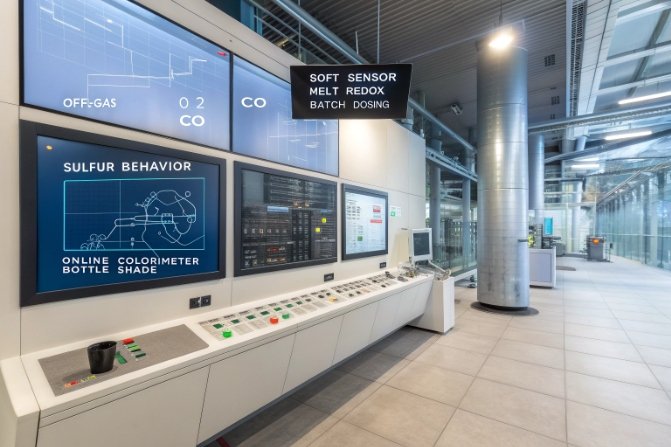
What “closed-loop” really means in glass
A true closed loop in a glass furnace is rarely “instant.” Glass has a long residence time. So the best architecture is predictive:
1) measure oxygen activity in the melt (and sometimes under the batch blanket)
2) translate the signal into fining and color risk through a model
3) apply small batch and combustion corrections
4) confirm with slow lab chemistry and product inspection
This style matches how modern model predictive control is used in other parts of the glass process. The controller predicts future behavior and avoids big oscillations. (See MPC in glass 7)
Why adoption grows faster with recycled cullet
High cullet share makes redox drift more likely because cullet contamination changes reducer load. In-line redox measurement is especially helpful in high-cullet furnaces and during color conversions. That is where operators need fast signals to prevent a bad shift from becoming a bad week.
What sensors can do today
In-line oxygen activity sensors are designed for feeder, forehearth, and canal measurement locations. Some approaches also measure under the batch blanket. When batch and feeder signals are combined, a furnace model can predict feeder redox in advance, which supports earlier, smaller corrections. (Read in-line sensor study 8)
The biggest barrier is not technology
The main barriers are:
- sensor maintenance culture and calibration habits
- agreement on one redox setpoint and one action plan
- clear rules that prevent over-correction
- integration with cullet passport and lot tracking
When those barriers are handled, closed-loop redox control becomes a cost and quality win. It reduces rejects and improves stability. It also makes high recycled content easier because the furnace does not panic when cullet changes.
| “Closed-loop” maturity step | What changes | What improves first |
|---|---|---|
| Redox monitoring only | operators see drift early | fewer surprise foam events |
| Monitoring + action rules | slower, safer corrections | tighter flint ΔE and seed count |
| Monitoring + predictive model | corrections happen earlier | fewer cords and reboil waves |
| Full MPC integration | redox + temperature + pull tied together | higher yield and smoother transitions |
Closed-loop redox control will not replace experienced operators. It will reduce the number of situations where experience is forced to fight bad information. (See digitalization benefits 9)
Conclusion
Redox control is oxygen activity control. Stable redox keeps fining efficient and color repeatable. Clean cullet, calm additives, stable firing, and in-line sensors are the clearest path to long-term stability. (See sulfur redox overview 10)
Footnotes
-
Study on sulfate fining efficiency and gas release mechanisms in glass melts. ↩
-
Overview of in-line redox sensors for glass melting applications. ↩
-
Technical article on sulfate foam formation and control strategies. ↩
-
Detailed guide on controlling iron redox for consistent glass color. ↩
-
WRAP quality protocol for cullet contamination limits. ↩
-
Research on the role of nitrates in glass batch reactions and oxidation. ↩
-
British Glass article on Model Predictive Control (MPC) for furnace optimization. ↩
-
Academic paper on the use of oxygen sensors in glass melts. ↩
-
Siemens discussion on digitalization and process control in the glass industry. ↩
-
Research publication on redox and sulfur reactions in glass melting processes. ↩






