
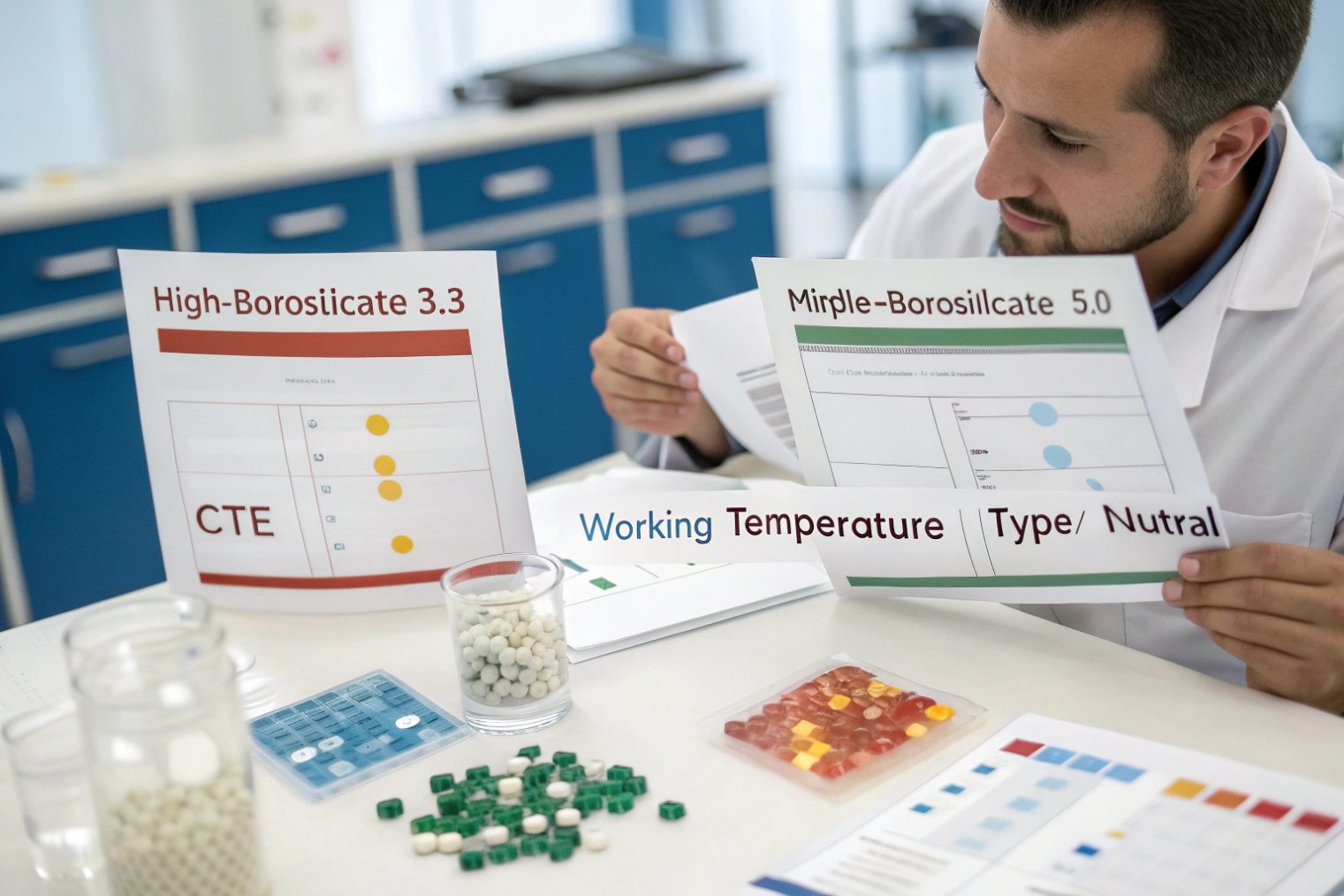
Many buyers see “3.3” and “5.0” on glass datasheets and feel lost. Without this distinction, it is easy to overpay or under-protect critical products.
High-borosilicate 3.3 glass has lower thermal expansion and higher working temperature than middle-borosilicate 4.9–5.0 glass, so it offers stronger thermal-shock margins, while middle-borosilicate optimizes melt cost and line speed for high-volume, chemically inert pharma packaging.
In practice, both glass families sit inside the broader “Type I neutral borosilicate 1” world. The real decisions happen around expansion class, tubing specs, and where each composition hits the best cost–performance point for labware, pharma vials, and technical packaging.
What composition and CTE ranges actually define middle-borosilicate glass?
Datasheets often list only “Type I neutral glass” and hide expansion class details in small notes. This can mask important differences in temperature behavior and glass-to-metal sealing options.
Middle-borosilicate usually means 4.9–5.1×10⁻⁶ K⁻¹ thermal expansion with roughly 73–76% SiO₂ and around 9–11% B₂O₃, while high-borosilicate 3.3 sits near 80% SiO₂, ~13% B₂O₃, and much lower alkali content.
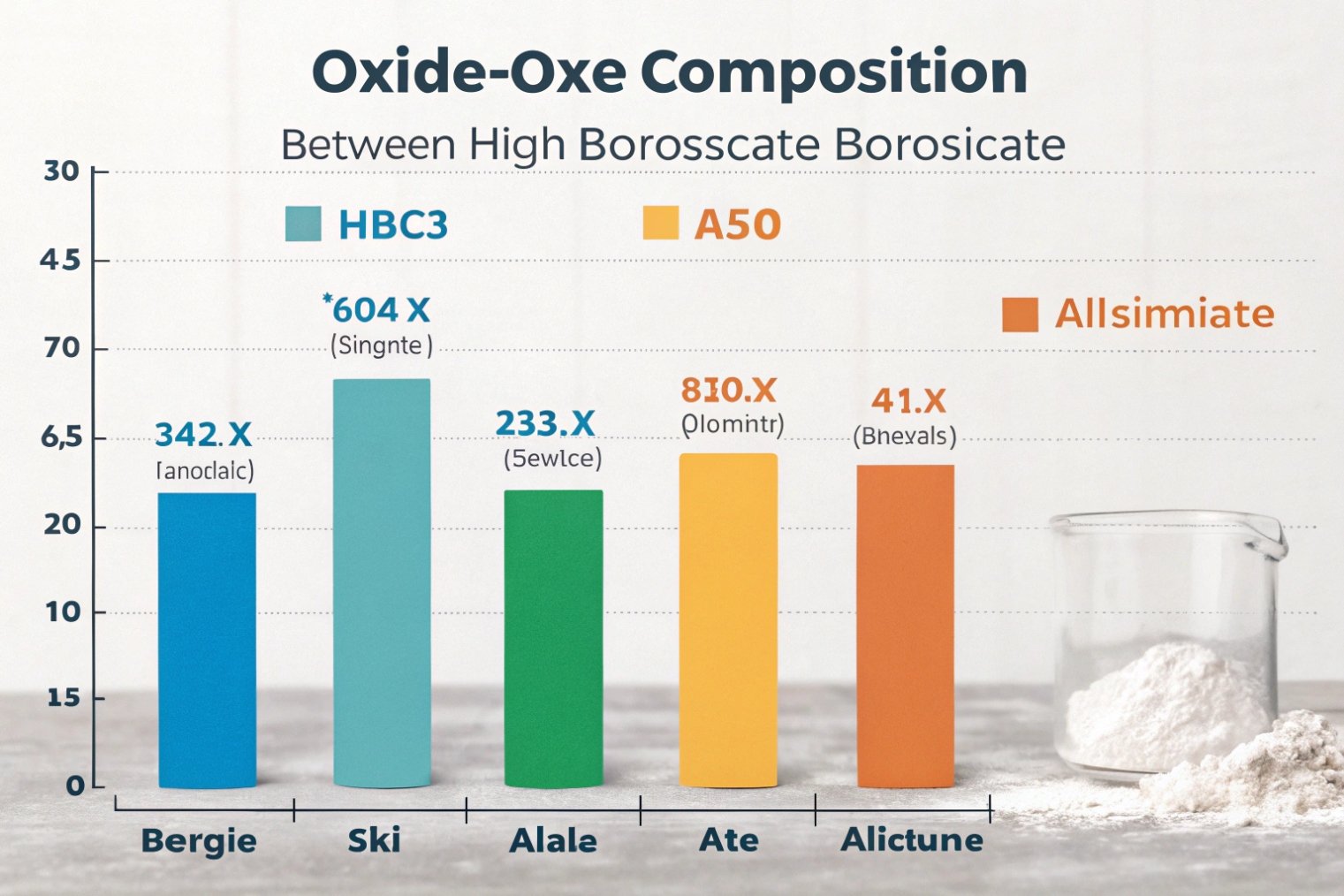
How the chemistry shifts between 3.3 and 4.9–5.0 expansion
Within borosilicate, the “3.3” and “4.9/5.0/5.1” labels point mainly to thermal expansion, but the composition under the hood is different. The low-expansion side is formally defined in ISO 3585 borosilicate glass 3.3 2.
A simplified comparison looks like this:
| Feature | High-borosilicate 3.3 (≈33-expansion) | Middle-borosilicate 4.9–5.1 (≈51-expansion) |
|---|---|---|
| Typical CTE (20–300 °C) | ~3.3×10⁻⁶ K⁻¹ | ~4.9–5.1×10⁻⁶ K⁻¹ |
| SiO₂ | ~80–81 wt% | ~73–76 wt% |
| B₂O₃ | ~12–13 wt% | ~9–11 wt% |
| Alkali (Na₂O + K₂O) | Very low | Higher, tuned for forming |
| Al₂O₃ and alkaline-earth oxides | Modest, for strength and viscosity control | Higher, for viscosity and expansion adjustment |
| Colour usage | Mostly clear (lab, tech) | Clear or amber (pharma tubing, vials) |
For a concrete 51-expansion tubing reference (composition + expansion class), see the Corning® 51-V Tubing Data Sheet 3.
High-borosilicate pushes silica and boron content up, while holding alkali low. That creates a tight, low-expansion network. Middle-borosilicate eases the composition toward higher expansion by adding more alkali and alumina, and by trimming B₂O₃ and SiO₂.
From a classification angle, both can still sit inside Type I neutral, hydrolytic class HGB 1, acid resistance S1 in major pharmacopeias. In labware terms, the ASTM E438 laboratory glass specification 4 is often where buyers see “low-expansion borosilicate” vs “higher-expansion alumino-borosilicate” framed most directly. So on paper they are both “top-tier” for water and acid resistance. The CTE difference is what drives thermal and sealing behavior.
For engineering, this leads to one extra nuance. In glass-to-metal seals 5:
- High-borosilicate 3.3 matches low-expansion metals like tungsten and molybdenum.
- Middle-borosilicate 4.9–5.1 aligns better with alloys such as the Kovar alloy 6.
So even before we talk about heat or chemicals, expansion class already steers which glass family belongs in a given system.
Where do temperature and chemical-resistance gaps appear between the two?
Many people assume high-borosilicate is “chemically better” in every way. The reality is more balanced: both are very durable; high-borosilicate stretches the extreme temperature envelope a bit further, while middle-borosilicate meets most pharma and packaging needs comfortably.
High-borosilicate 3.3 offers lower expansion and slightly higher softening and working temperatures, so it survives harsher thermal cycling, while middle-borosilicate 4.9–5.0 keeps almost the same chemical resistance but with a modest drop in thermal-shock margin.
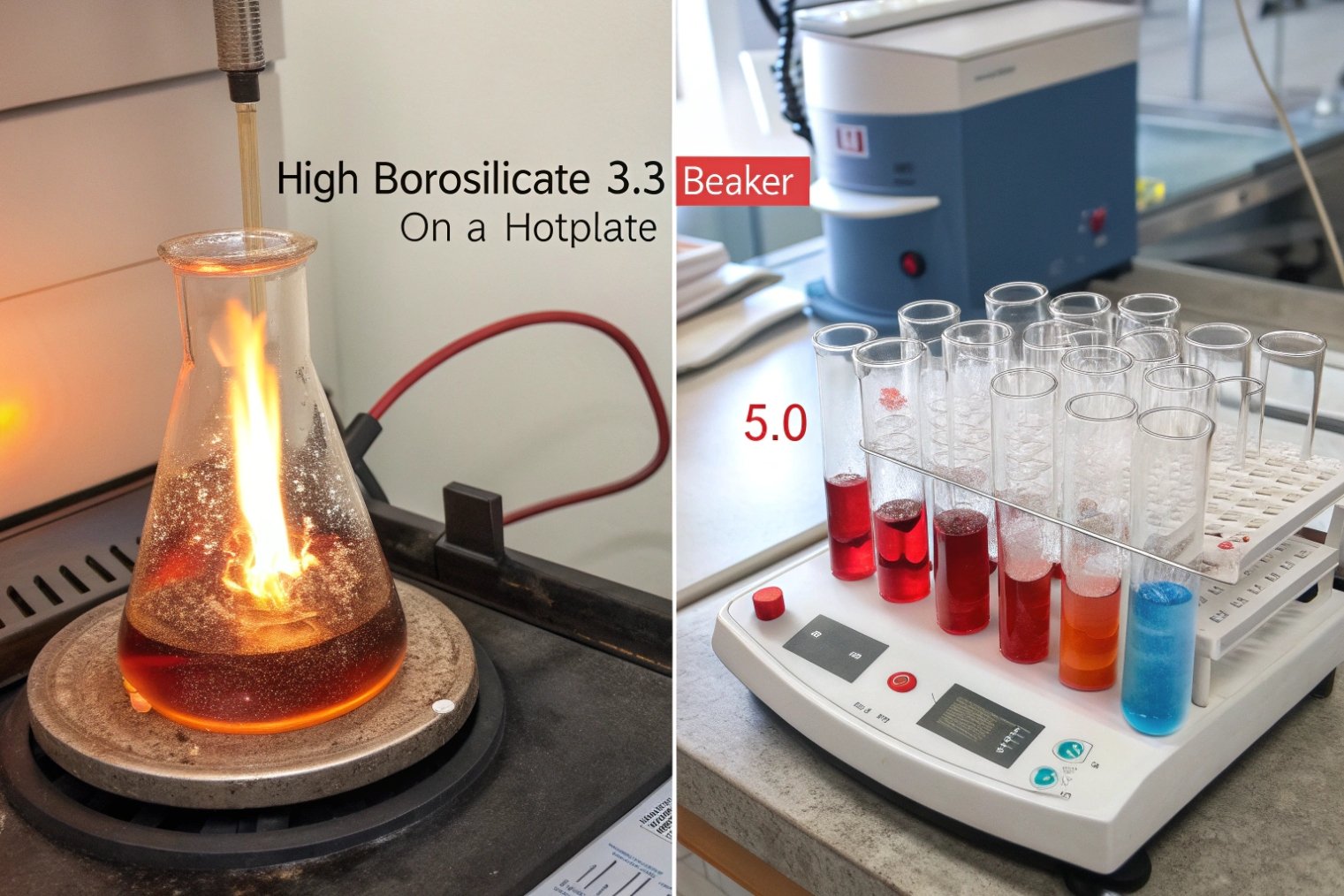
Temperature window and thermal-shock behavior
High-borosilicate is designed for serious temperature gradients. Middle-borosilicate is tuned more for reliable tubing and pharma use.
Typical numbers:
| Property | High-borosilicate 3.3 | Middle-borosilicate 4.9–5.0 |
|---|---|---|
| CTE (20–300 °C) | ~3.3×10⁻⁶ K⁻¹ | ~4.9–5.1×10⁻⁶ K⁻¹ |
| Softening point | ~820–825 °C | ~780–790 °C |
| Working point (viscosity 10⁴) | ~1250–1260 °C | ~1150–1180 °C |
| Typical thermal-shock limit | Higher, more severe gradients | Slightly lower, still very strong |
This translates roughly as:
- High-borosilicate 3.3 is better for direct flame, harsh hot–cold cycles, and heavy cycling in lab and industrial setups.
- Middle-borosilicate 4.9–5.0 is more than enough for autoclave, steam sterilization, hot-filling, and pharma lyophilization conditions.
From the user side, you mostly feel this in labware and technical glass:
- A 3.3 beaker can sit on a hotplate, then cool safely.
- A 5.0 vial can move through freeze–dry–stopper–steam cycles without issue, yet it would not be sold as a “flame beaker”.
Chemical resistance: similar on paper, subtle gaps in practice
Under pharmacopoeial tests, both classes reach:
- Type I neutral glass
- Highest hydrolytic resistance
- Top acid resistance class
So water and acid attack are extremely low in both families.
Where the difference shows up is in ultra-sensitive extractables studies:
- High-borosilicate 3.3, with its lower alkali content and tighter network, tends to show slightly lower levels of leached alkali ions.
- Middle-borosilicate 5.0 / 5.1, especially in amber form, can show marginally higher ionic extractables when tested with advanced LC/MS methods.
For most food, beverage, and standard pharma products, this difference does not move the needle. For very sensitive biologics or ultra-trace analytical work, people sometimes still prefer clear 3.3 glass as a safety margin.
So the real gap is:
- Thermal: clearly better for 3.3.
- Chemical: close in formal classes, with a small practical edge for 3.3 in extreme cases.
Where are the cost/performance sweet spots for each glass type?
If every project had unlimited budget, high-borosilicate 3.3 would look like the “safe” choice. In real life, middle-borosilicate 4.9–5.0 often gives a better mix of cost, performance, and regulatory comfort for pharma and high-volume packaging.
High-borosilicate 3.3 is the best choice when extreme thermal cycling or ultra-low extractables matter most, while middle-borosilicate 4.9–5.0 is optimized for large-scale tubing, vials, and cartridges where strong but not extreme conditions and tight cost control dominate.
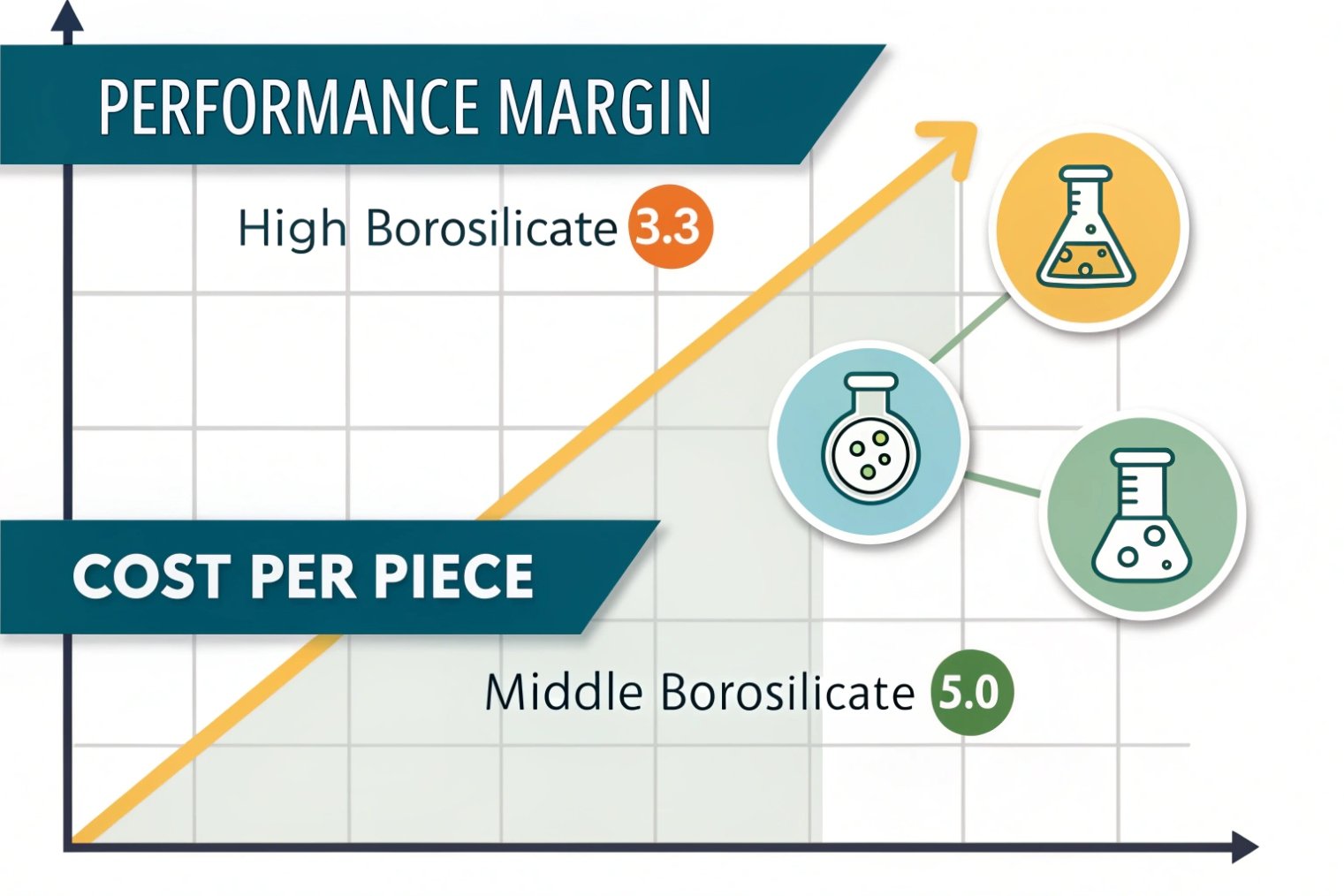
Matching each expansion class to its ideal applications
One useful way to see the sweet spots is to lay them side by side:
| Application area | High-borosilicate 3.3 best when… | Middle-borosilicate 4.9–5.0 best when… |
|---|---|---|
| Lab apparatus (beakers, flasks, columns) | Thermal gradients, flame, repeated heating cycles | Moderate heat, non-flame, cost-sensitive labware |
| Pharmaceutical primary packaging | Very aggressive drug + very demanding extractables | Standard injectables, vials, ampoules, cartridges |
| Biologics and high-value injectables | Extreme sensitivity, long shelf life, small lots | High-volume, cost-controlled, still Type I neutral |
| Technical sight glasses | High ΔT, steam, hot caustic or solvents | Moderate thermal stress, strong chemical resistance |
| Ovenware and cookware | Direct flame, extreme shock | Less common; usually 3.3 or soda-lime is chosen |
| Glass-to-metal seals | Sealing to tungsten, molybdenum | Sealing to Kovar and similar alloys |
In pharma, many national and industry standards now explicitly recognize both high- and middle-borosilicate tubing types as Type I neutral glass. Some Chinese YBB standards, for example, define different tubing classes and specs for injection vials made from 3.3 vs 5.0 expansion glass, even though both pass Type I requirements.
This opens a practical strategy:
- Use high-borosilicate 3.3 for the most demanding injectable or diagnostic products, where any risk of extractables or thermal stress carries a large cost.
- Use middle-borosilicate 4.9–5.0 for mainstream vials, ampoules, syringes, and cartridges, where line efficiency, forming yield, and cost per piece set the rules.
Cost, SKU strategy, and light protection
Three extra points tend to matter once we reach purchasing and marketing:
-
Melting and energy cost
Middle-borosilicate works at lower temperatures and often delivers higher draw speeds per furnace, which lowers cost per meter of tubing compared with 3.3. -
Amber and light protection
Middle-borosilicate 5.0 / 5.1 is widely supplied in amber Type I tubing. This combines neutral glass chemistry with strong UV and blue-light shielding for photosensitive drugs. High-borosilicate 3.3 tends to appear more often as clear glass for lab and technical work. -
Portfolio simplification
Many pharma packers choose a “mainstream” middle-borosilicate vial family plus a smaller high-borosilicate range for specific critical products. That keeps complexity and cost under control, while still offering a premium option where needed.
So high-borosilicate is the specialist athlete. Middle-borosilicate is the dependable workhorse for pharma and high-performance packaging.
Do forming methods or annealing curves differ in a meaningful way?
On a drawing, both glasses can look similar: tubing, vials, cartridges. But the forming windows and annealing curves differ enough to affect line design, defect risk, and even surface chemistry.
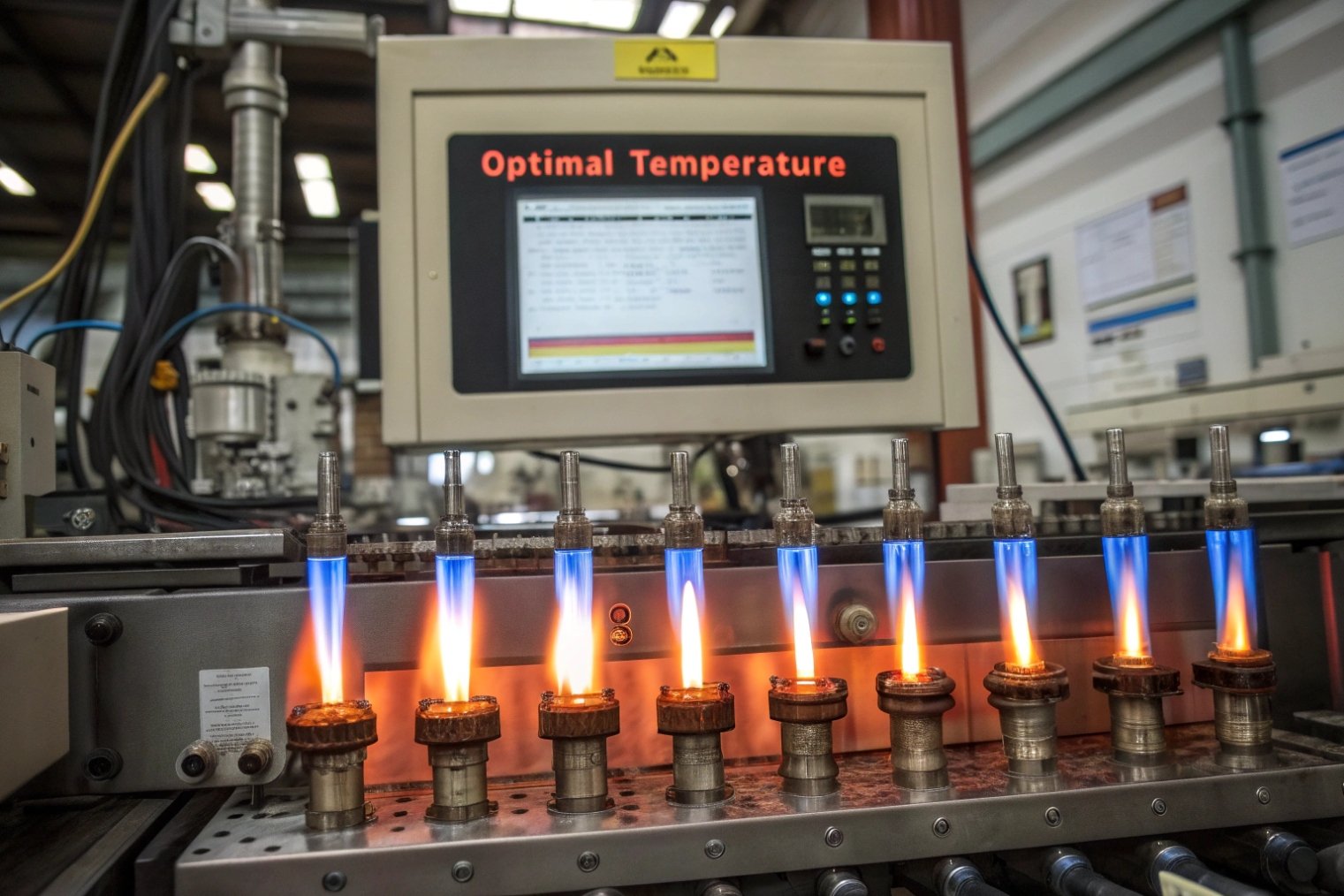
Both middle- and high-borosilicate use similar tubing and vial-forming methods, but high-borosilicate needs higher forming temperatures and slightly higher annealing points, which narrows the process window and can raise energy cost and surface-volatilization risk.
Forming temperature ranges and line design
Both families are commonly produced as tubing using Danner, Vello or down-draw methods, then converted into vials, cartridges, syringes, or labware. The main practical differences are:
| Aspect | High-borosilicate 3.3 | Middle-borosilicate 4.9–5.0 |
|---|---|---|
| Melt temperature | Higher | Lower |
| Working temperature window | Narrow and high | Slightly wider and lower |
| Typical forming temperature | Around 1200–1250 °C | Around 1000–1150 °C |
| Line speed potential | Often lower at same furnace size | Higher, better throughput |
| Surface volatilization risk | Higher (more risk of local composition change) | Lower, gentler on surface chemistry |
On the vial-forming line, this shows up as:
- More sensitive burner adjustment for 3.3 tubing.
- Slightly higher risk of local surface changes on high-borosilicate if flame conditions are not stable.
- Different wear profiles for tools and forming parts due to temperature differences.
In practice, experienced converters know how to run both glasses well. But when a factory handles both 3.3 and 5.0 tubing, they usually separate them by line or by campaigns to respect different heat profiles.
Annealing curves and residual stress
Annealing and strain points 7 matter because they set how residual stress is removed after forming and how the glass responds to later thermal loads.
- High-borosilicate 3.3 has higher annealing and strain points than middle-borosilicate, in line with its higher softening temperature.
- Middle-borosilicate 4.9–5.0 anneals at slightly lower temperatures and can cool a bit faster for the same stress target.
Practically, this means:
- A 3.3 vial needs a carefully tuned lehr profile to avoid frozen-in stress that might reduce its thermal-shock margin.
- A 5.0 vial has a slightly wider safe window, which helps high-speed, high-volume production with fewer stress-related rejects.
From a buyer’s viewpoint, you rarely see the full annealing curve, but you feel it in:
- How well vials survive hot sterilization and cold storage.
- The level of breakage when the line or lab pushes temperature cycles close to the limit.
Both glass families can reach excellent residual-stress levels when the process is tuned. The key point is: high-borosilicate offers the largest thermal envelope, but it demands the tightest forming and annealing discipline to unlock that advantage.
Conclusion
High-borosilicate 3.3 pushes thermal and extractables performance to the limit, while middle-borosilicate 4.9–5.0 balances Type I chemical durability with easier forming, faster lines, and better economics for large-scale pharma and packaging.
Footnotes
-
USP <660> overview clarifies Type I glass and performance-based classification used in pharma packaging. ↩ ↩
-
ISO 3585 defines borosilicate 3.3 properties, including CTE and key physical limits. ↩ ↩
-
Corning 51-V datasheet lists oxide composition and 51-expansion CTE values for middle-borosilicate tubing. ↩ ↩
-
ASTM E438 explains Class A vs Class B borosilicate categories and their measured properties. ↩ ↩
-
Practical guide to matched glass-to-metal sealing with Kovar, tungsten, and molybdenum in technical packages. ↩ ↩
-
Background on the Kovar alloy and why its expansion matches many glass-to-metal seal designs. ↩ ↩
-
Defines annealing and strain points so you can interpret lehr curves and stress-risk differences. ↩ ↩






