

Metal finishes can win shelf attention fast, but they can also break your light and fill-level specs. That surprise shows up late, right before shipment.
Metallic plating usually lowers transmittance and raises reflectance. It can also add wavelength-selective blocking and strong angle effects, so the same bottle can test “OK” in one setup and fail in another.
How metallic layers reshape bottle optics and acceptance criteria
Transmittance is no longer the only number that matters
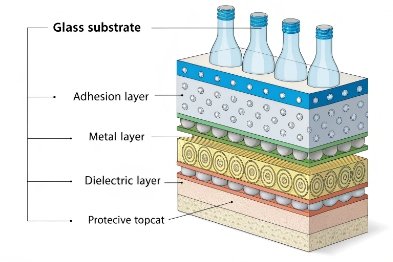
Once a metallic layer is on the bottle, the optics stop being “glass-only.” A plated bottle is a layered system: air → metal film → (sometimes a clear topcoat) → glass → product. Light does not just pass through. A lot of it gets reflected, and some gets absorbed as heat inside the film.
In plain terms, three metrics become linked:
-
spectral transmittance 1: how much light gets through to the product.
-
Spectral reflectance: how much light bounces back to the viewer or sensors.
-
Haze / scattering: how much light spreads and blurs instead of staying clean.
This is why a plated bottle can look premium and still cause line issues. A high-gloss metal film often gives a mirror look, but it can also confuse photo-eyes, make fill lines hard to read, and hide defects like underfill or bubbles.
“Metallic plating” can mean several different stacks
In packaging talk, people say “electroplated,” but on glass the practical route is often:
-
a seed or primer (to help adhesion and conductivity),
-
then a metal deposition layer (vacuum metallization 2, sputtering, or plated-on-metalized layer),
-
then a topcoat (clear lacquer, tinted lacquer, UV-blocking lacquer, or scratch coat).
Each layer changes the final spectrum. A clear topcoat can shift gloss and reduce oxidation. A tinted topcoat can cut UV and blue without changing the metal itself.
A quick mapping from finish type to expected light behavior
The table below is the simplest way to align buyer expectations with physics.
| Finish stack (typical) | What happens to transmittance | What happens to reflectance | Main procurement risk |
|---|---|---|---|
| Thin semi-transparent metal film | Drops, but may still pass some light | Rises strongly, angle-sensitive | Lot-to-lot film thickness drift |
| Opaque metallic layer | Near-zero transmittance | Very high, mirror-like | Fill-level inspection failure |
| Metal film + tinted clear topcoat | Cuts more UV/blue | Can stay high | Color drift and ΔE disputes |
| Metal film + matte topcoat | Can recover camera readability | Lower gloss reflectance | “Premium look” mismatch |
| Patterned or windowed metal | Local transmittance only in windows | Mixed | Pinhole vs design-window confusion |
What optical behavior do electroplated films introduce?
A metallic layer can look stable in the sample room, then behave wildly under store lights and on high-speed lines. That gap creates rework and claims.
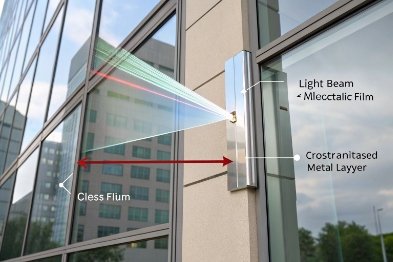
Metal films introduce reflection, absorption, and thin-film interference. They also create strong angle dependence, so the spectral curve can change with viewing angle and measurement geometry.
Reflection dominates, and it changes how “light” is perceived
Bare glass reflects a little. Metal reflects a lot. When a metal film sits on glass, the reflectance can jump from “a small glare” to “mirror-like.” This changes two things at once:
-
The bottle looks brighter and more premium in a spotlight.
-
The bottle transmits less light to the inside, even if the base glass is clear.
For product protection, high reflectance can help because less light enters the pack. But for inspection, that same reflectance can blind sensors, cause false rejects, and hide fill level.
Absorption adds heat and can cut specific bands
Metals absorb light too. Absorption depends on metal type and film thickness. Some metals absorb more in the UV or blue edge. Some absorb more evenly. If the film is thick enough, the bottle becomes effectively opaque. If the film is thinner, it can act like a “neutral density” filter with a color tint.
Interference makes the spectrum tunable, but also sensitive
Very thin films can create thin-film interference 3 effects. That means the reflectance and transmittance can show peaks and dips across wavelengths. It looks like a smooth curve in some cases, but it can also look wavy. Small thickness changes can shift these features.
| Film feature | Optical effect | What changes it most | What to control in specs |
|---|---|---|---|
| Film thickness | Shifts reflectance/transmittance levels | Deposition time and power | Thickness window + process SPC |
| Film roughness | Adds haze and lowers gloss | Surface prep and topcoat | Haze limit + visual standard |
| Metal choice | Changes absorption and tint | Material selection | Metal type + color master |
Premium shelves reward shine, contrast, and a “jewelry” feel. Metallic finishes deliver that fast. But production lines and QA systems often hate that same finish.
Plating boosts premiumization because reflectance and metallic highlights signal value. It risks under-fill detection because opaque or reflective layers block transmitted light and confuse vision systems that rely on seeing the liquid level through the wall.

Why metallic finishes sell
A metal-coated bottle can look heavier, cleaner, and more “engineered.” The finish often improves shelf pop under spot lighting and perceived quality in hand. This is one reason many spirits, cosmetics, and gifting SKUs adopt partial plating or full metallic coats.
Why the same finish can break fill-level controls
Many filling lines use fill-level inspection 4 sensors that assume light can pass through the container wall. A high-reflectance film can create glare and “hot spots.” An opaque film can block the view completely. Even a patterned film can create false edges that look like a fill line.
| Goal | Plating design choice | Why it works | Tradeoff |
|---|---|---|---|
| Keep premium shine | Full gloss metal + clear topcoat | High reflectance, luxury look | Harder to inspect fill level |
| Protect product from light | Opaque metal or strong UV cut | Low internal light dose | Can force new QC method |
| Maintain fill inspection | Clear window or matte sensor band | Restores contrast for sensors | Slight design constraint |
How to test reflectance, pinholes, and wavelength blocking?
Plated bottles fail in two ways: the spectrum is wrong, or the film is not continuous. Pinholes, thin spots, and scratches can ruin protection and create ugly variability.
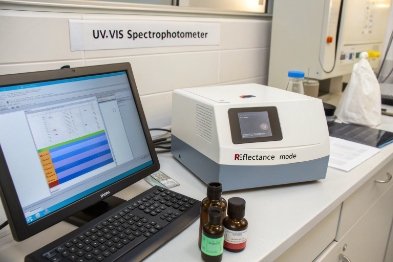
Testing should combine UV-Vis spectral scans, reflectance measurement with controlled geometry, and pinhole detection using high-contrast backlighting or imaging. A good plan also maps coating uniformity by zones on the bottle.
Spectral testing: measure both transmittance and reflectance
For plated bottles, transmittance alone can mislead. A bottle can have low transmittance because the film reflects, not because it absorbs. A solid lab method includes UV-Vis spectral scans 5 across the target band (often UV + visible).
Pinhole testing: protection fails locally
A plated film is only as good as its weakest point. pinhole detection 6 using backlight imaging can identify bright points where light leaks in. This can be automated with vision systems to ensure consistent quality across production lots.
| Test target | Recommended instrument/setup | What to report | Common mistake |
|---|---|---|---|
| UV/visible blocking | UV-Vis spectrophotometer | Spectrum + max %T in band | Testing flat coupons only |
| Reflectance control | Sphere reflectance | Band-average %R + gloss note | No geometry definition |
| Pinholes | Backlight + camera | Count/area threshold | Spot-checking one side only |
Are sputtered nano-films delivering tunable spectral control?
Brands want a precise look and precise protection. They also want thinner layers, less tint shift, and better repeatability. Nano-films promise that, but the details matter.
Yes, sputtered nano-films and multilayer stacks can deliver tunable spectral control through thickness and material selection. They can target UV blocking while keeping higher visible transmission, but they demand tight process control and strong adhesion systems.
Why sputtering is attractive for optical tuning
The process of sputtering 7 can deposit thin, dense films with controlled thickness. In optics, thickness is power. Changing thickness changes how much light reflects and how steep the UV cut-off can be. With multilayers, the tuning can get more precise, reflecting UV strongly while leaving more visible light for a clear look.
The real-world limits: curvature, cost, and robustness
Bottles are not flat wafers. Curvature and deep shoulders make uniform deposition harder. A film that is uniform on a panel can vary near the heel. Also, nano-films can be brittle without the right underlayer and topcoat system. Packaging still needs handling strength and abrasion resistance.
| Nano-film feature | What it can deliver | What to control | What to test |
|---|---|---|---|
| Single thin metal | Simple reflect/absorb tuning | Thickness window | Spectrum by zone |
| Multilayer stack | Sharper cut-offs, better tuning | Layer order + thickness | Transmittance + reflectance |
| Anti-oxidation coat | Stable appearance over time | Coating chemistry | Aging + ΔE drift |
Conclusion
Metallic layers reduce transmittance and add strong reflectance and angle effects. The best outcomes come from clear specs, zone-based testing, and early line trials for fill-level and light protection.
Footnotes
-
Learn how spectral transmittance measures light passing through materials at specific wavelengths. ↩ ↩
-
A guide to vacuum metallization processes for applying metallic coatings to glass surfaces. ↩ ↩
-
Understanding how thin-film interference creates color shifts and reflections in metallic layers. ↩ ↩
-
Insights into automated fill-level inspection technologies for quality control in bottling lines. ↩ ↩
-
Technical details on using UV-Vis spectroscopy to measure light absorption and transmission. ↩ ↩
-
Overview of pinhole detection methods used to ensure the continuity of protective coatings. ↩ ↩
-
Explaining the sputtering process used for precision deposition of thin films on substrates. ↩ ↩






