
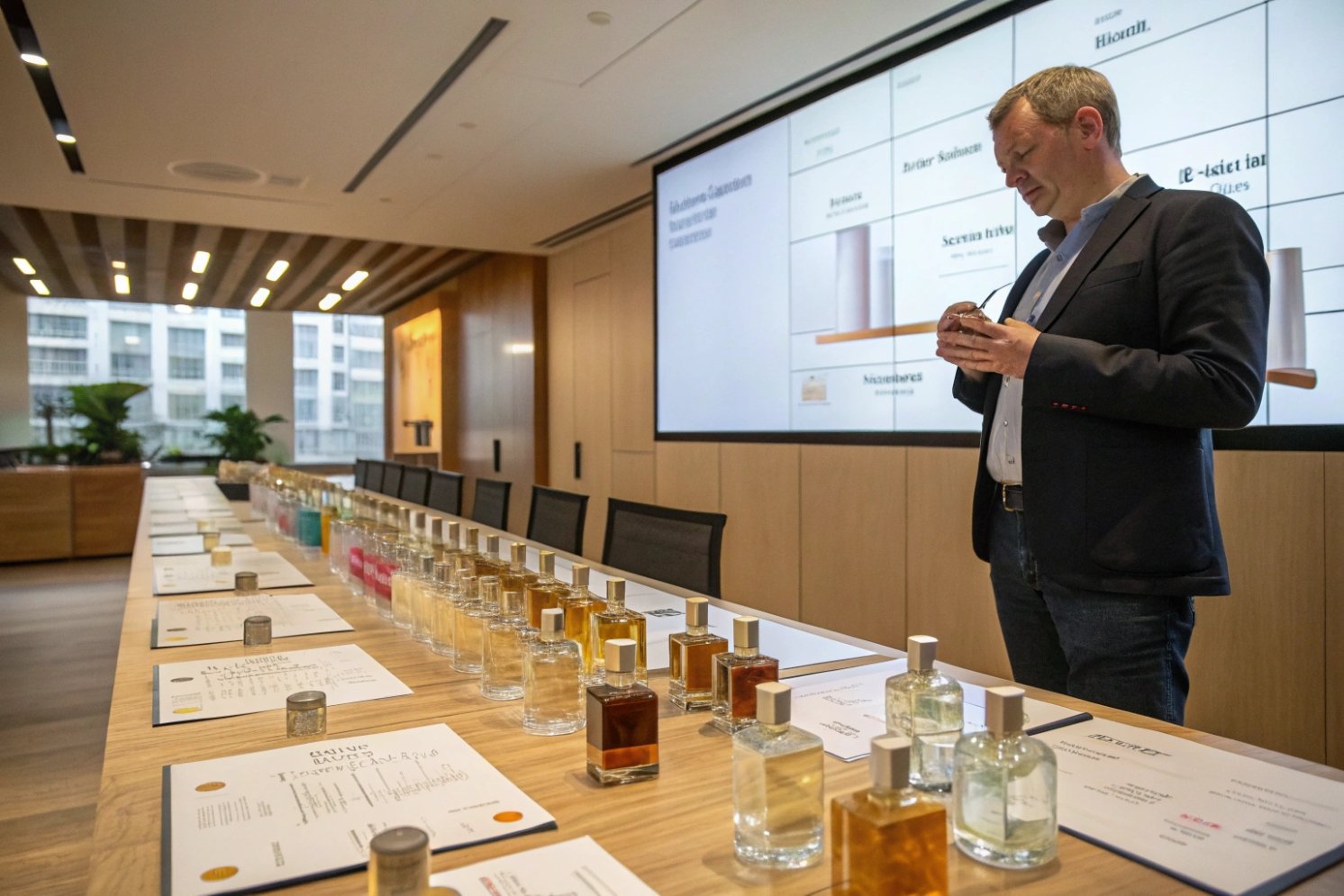
A beautiful fragrance in the wrong bottle supplier’s hands turns into leaks, colour shifts, endless delays, and margin loss. The risk hides in details you cannot see on a glossy catalog page.
To choose the right glass perfume bottle supplier, look for strong certifications, real in-house capabilities, clear MOQs and AQL rules, and a partner willing to run compatibility, leak, and drop tests with your actual formula.
A good supplier is not just “who has the nicest shape”. It is a long-term partner that can protect your juice, keep your launches on time, and grow with your brand from the first 5,000 bottles to your first million.
Which certifications should I require from a glass perfume bottle supplier?
When a supplier has no certified quality system, every bottle you fill becomes a small gamble with your brand name written on it.
You should require at least ISO 9001, chemical compliance (REACH) and third-party testing such as SGS; for premium projects, ISO 15378 or GMP-style controls for primary packaging are a strong plus.
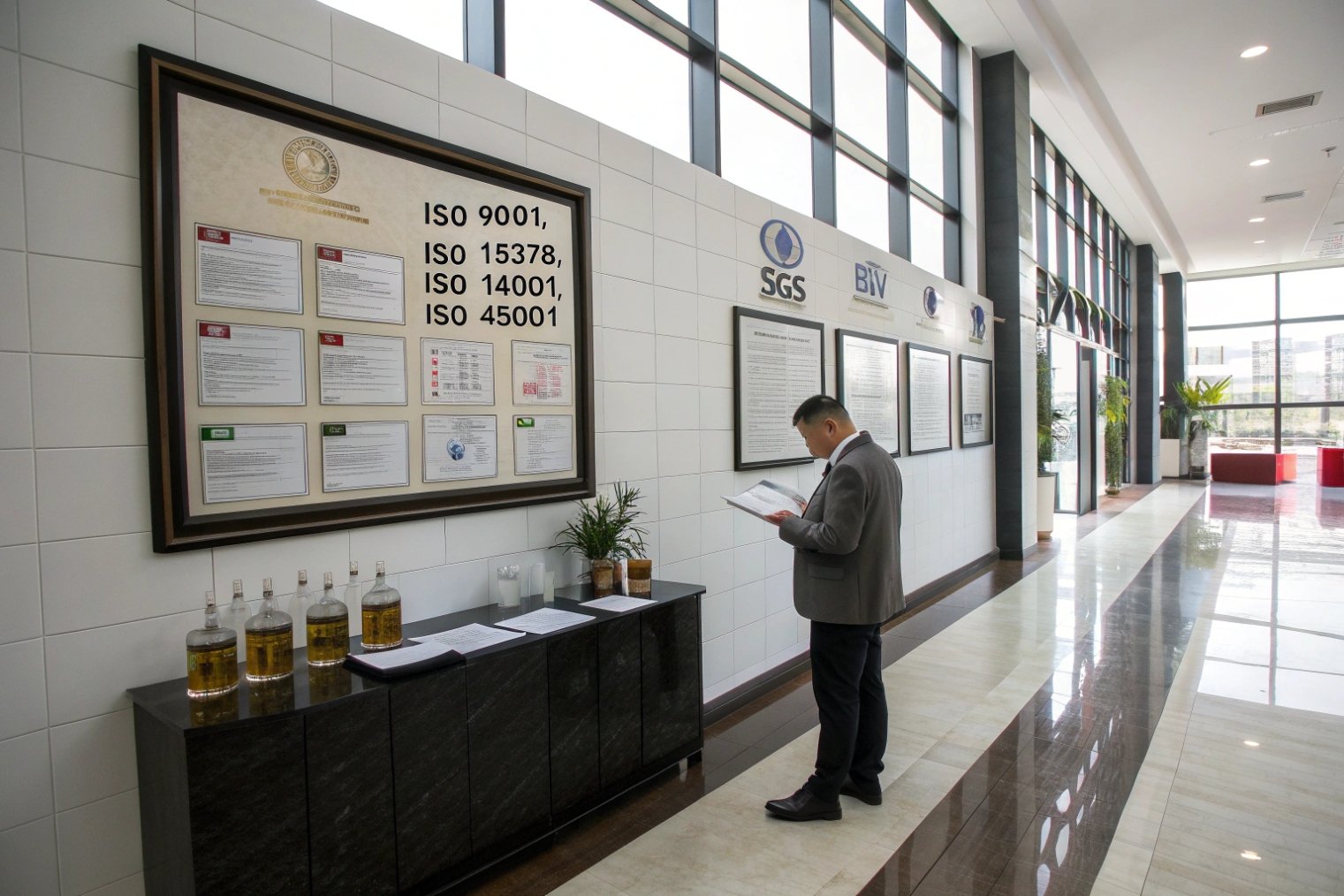
Core quality certifications that really matter
For perfume bottles, you are buying primary packaging. It touches a flammable, skin-contact product and must stay stable for years. That is why a basic “factory tour video” is not enough.
Key certificates to ask for:
| Certification | What it proves | Why it matters for perfume |
|---|---|---|
| ISO 9001 quality management system 1 | Formal quality management system is in place | Consistency, traceability, controlled change |
| ISO 15378 primary packaging GMP 2 | GMP principles for primary packaging (originated in pharma) | Tighter controls on defects and cleanliness |
| ISO 14001 | Environmental management | Supports your sustainability story |
| ISO 45001 / SA8000 | Occupational health, safety, and social responsibility | Auditable ethical sourcing |
| SGS third-party testing and inspection 3 / BV reports | Independent lab or audit reports | Confirms performance and compliance claims |
For many high-end glass groups, ISO 9001 across all plants is standard, and several sites also hold ISO 15378 and food or pharma certifications. That is a good benchmark for perfume as well.
Chemical, regulatory, and market access
Beyond pure “quality system”, you also need:
- EU REACH regulation compliance 4 for the EU (no restricted heavy metals, safe coatings, controlled chemicals).
- Declarations for lead-free crystal or flint used with ethanol.
- If you decorate heavily: confirmation that inks, coatings, and glues meet cosmetic packaging rules in your target markets.
Ask for technical data sheets and safety declarations for:
- Spray coatings and lacquers
- Hot-stamping foils
- Adhesives and UV inks
This helps your own regulatory team prepare PIF / dossier work without surprises later.
How to verify all this in practice
Paper is one thing, real practice is another. So:
- Request current certificates with scope and validity dates.
- Check if the scope includes your plant and product type.
- During an audit (virtual or on-site), ask how they handle non-conforming glass, re-annealing, and mixing cullet.
A supplier who knows their certifications and can explain how they use them day-to-day is usually far safer than one who just forwards an old PDF.
What in-house mold, decoration, and assembly capabilities matter most?
A supplier might show a beautiful reference sample, but outsource every critical step. When something goes wrong, nobody owns the problem and timelines explode.
The best perfume bottle suppliers combine in-house mold making, decoration, and final assembly so they can control tolerance, colour, and fit from the furnace to the finished set.
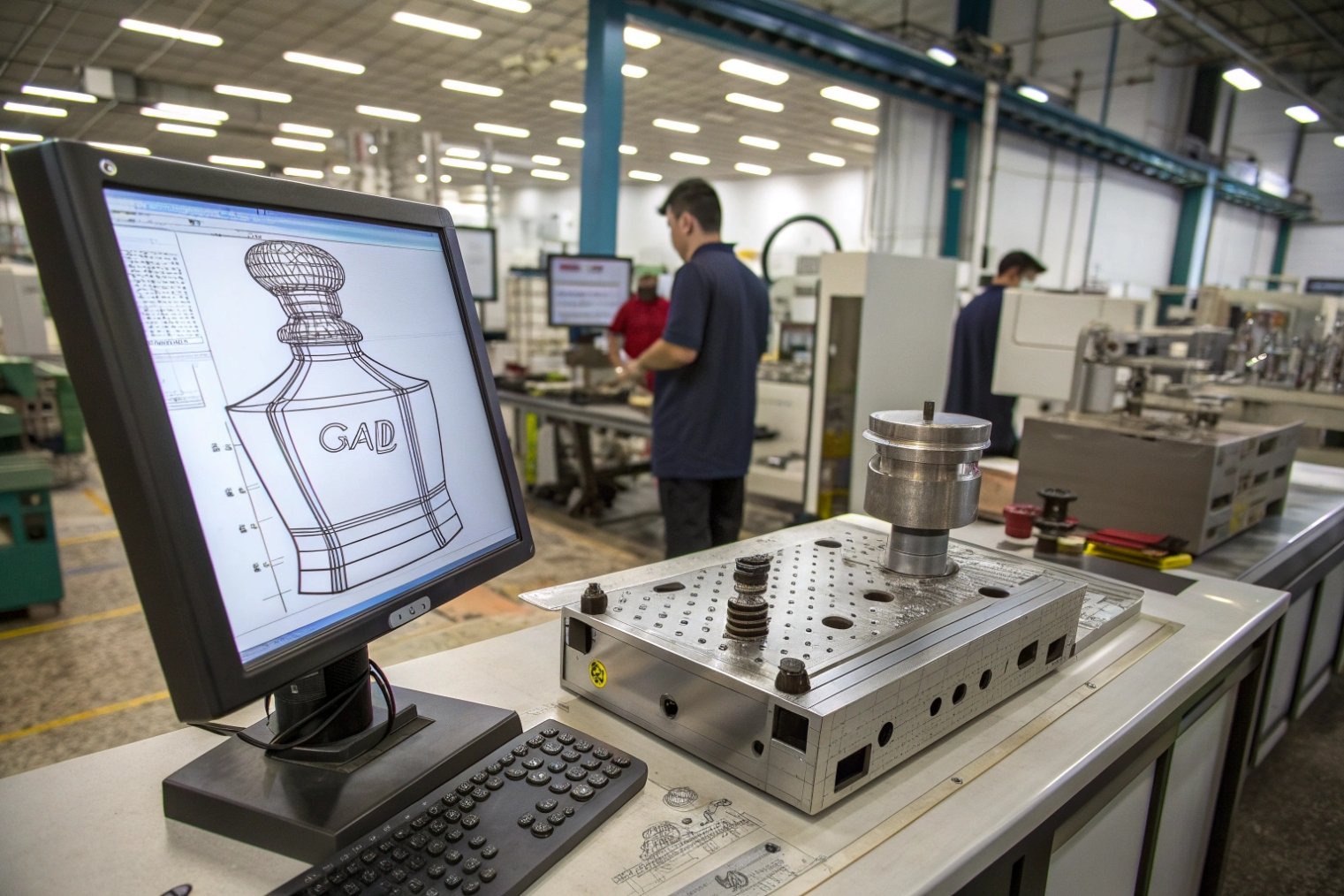
Mold and engineering capabilities
Mold control is the foundation. Without it, you fight crooked necks and random wall thickness forever.
Important points:
- In-house mold workshop or a stable mold partner with quick response.
- Ability to adjust neck finishes (crimp vs screw, FEA/GINA standards).
- Experience with heavy bases, asymmetrical shapes, and thick-walled luxury bottles.
A good supplier will show:
- Past custom perfume projects with similar complexity.
- Technical drawings with tolerances, not just 3D renderings.
- Clear guidance on minimum wall thickness and weight for your design.
Decoration and special effects
Decoration is where the pack becomes “your brand” instead of just “a bottle”.
Common in-house decoration services you should value:
| Capability | Examples | Why it matters |
|---|---|---|
| Spray coating | Solid colours, gradients, metallic tones | Core for brand colour and coverage |
| Acid etch / frosting | Full or partial matte effects | Premium feel, hides fingerprints |
| Screen / pad printing | Logos, text, regulatory details | Sharp, repeatable branding |
| Hot stamping / foil | Gold, silver, holographic details | Luxury accents |
| UV / digital printing | Small runs, personalization, complex graphics | Flexible marketing and trials |
Suppliers with integrated decoration lines reduce both lead time and damage risk because bottles do not travel between multiple factories. You also have a single partner responsible for defects like ink adhesion or colour mismatch.
Assembly and component integration
Perfume is never just the bottle. You also need exact fit between:
- Glass neck and pump (crimp or screw)
- Pump and collar
- Collar and cap (often with magnet or metal shell)
Ask if the supplier can:
- Source and assemble pumps, collars, and caps as a turnkey set.
- Control crimp torque and crimp height for leak-free seals.
- Run line trials with your chosen pumps and gaskets.
When mold, decoration, and assembly live under one roof, you get fewer “grey zones” where each supplier blames another for a leak, scratch, or off-centre fit.
What MOQs, lead times, and AQL/inspection standards are typical?
A beautiful design does not help if MOQs are too high, lead times slip, or defect levels eat your margin and your reputation.
For perfume bottles, expect MOQs from a few thousand for stock items to 30,000+ for new custom molds, lead times of 30–60 days after approval, and AQL plans around 0.4–1.0 for critical and 1.0–2.5 for major defects.
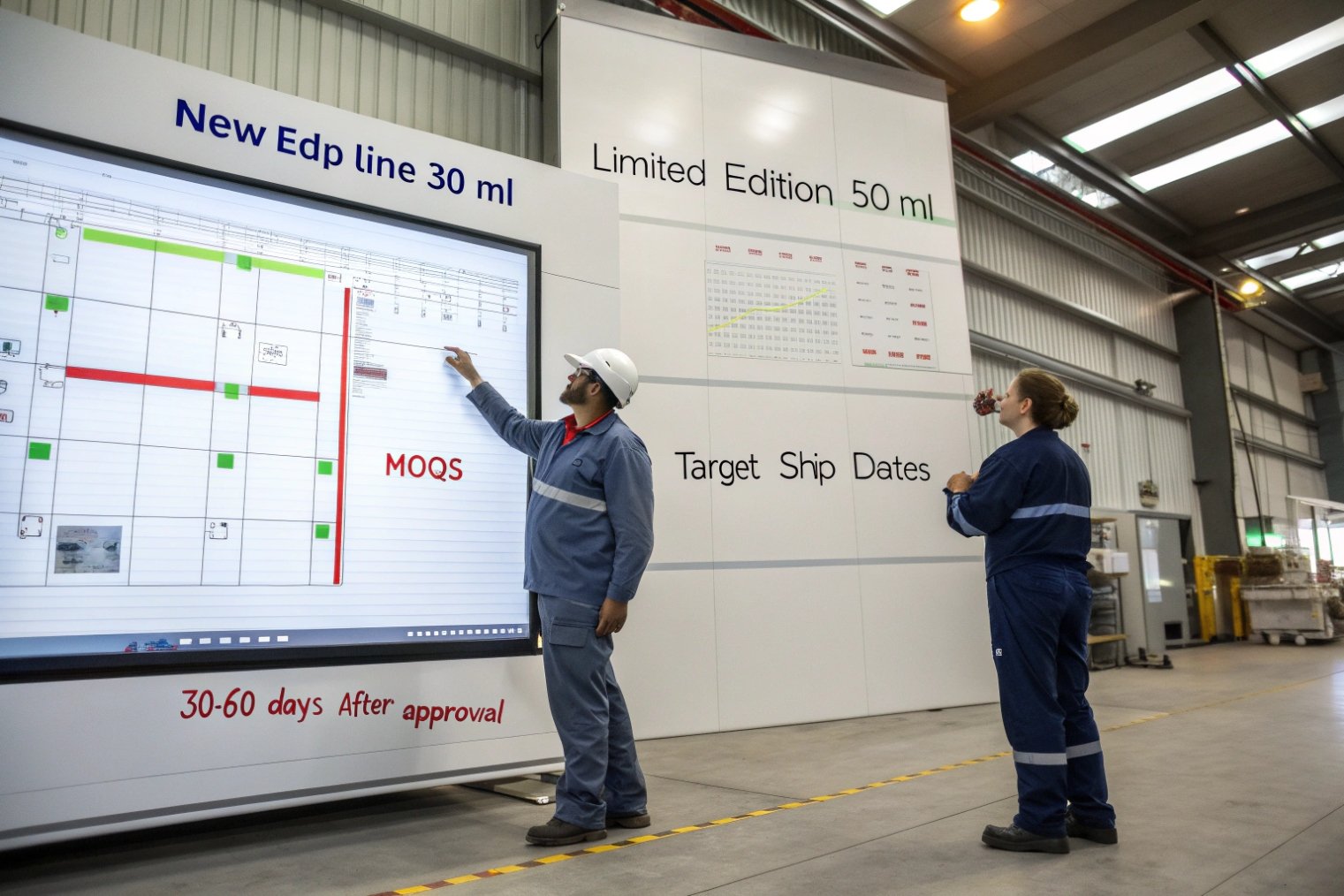
Typical MOQs and how they scale
Every factory has its own thresholds, but these ranges are common:
| Project type | Typical MOQ range |
|---|---|
| Stock bottle, no decoration | 1,000–5,000 pcs per item |
| Stock + simple coating/print | 3,000–10,000 pcs per design |
| Custom mould, undecorated | 20,000–30,000 pcs per run |
| Custom + heavy decoration | 30,000+ pcs, sometimes by step |
Some suppliers will “flex” MOQs for first launches by:
- Grouping several colours on the same mold run.
- Sharing a standard glass shape across different caps and sprays.
- Offering warehouse stock programs where they hold undecorated glass and decorate on demand.
Lead times from concept to warehouse
Lead time has several layers:
- Mold design and sampling
- 3–6 weeks for drawings, soft molds, and first glass samples.
- Decoration and assembly sampling
- 2–4 weeks for colour, print, and full set approvals.
- Mass production
- 4–8 weeks for standard runs, depending on volume and decoration steps.
- Freight
- Sea freight can add 3–6 weeks, air freight 5–10 days.
Locking these into a critical path timeline avoids last-minute panic before a launch.
AQL and inspection you should insist on
Ask the supplier to share their standard Acceptance Quality Limit (AQL) 5 plan for perfume glass. A typical structure looks like:
| Defect type | Examples | Typical AQL |
|---|---|---|
| Critical | Sharp edges, deep cracks, wrong neck fit | 0.4–1.0 |
| Major | Bubbles in view area, bad coating, crooked | 1.0–2.5 |
| Minor | Small seeds, tiny specks outside label zone | 2.5–4.0 |
Also clarify:
- Do they run 100% visual checks on critical areas (neck, sealing surface)?
- Will they accept third-party inspections (SGS, BV) on your behalf?
- Can they share process capability (Cpk) 6 or defect trend data over time for big programs?
Clear MOQs, realistic lead times, and transparent AQL rules give you a stable planning base and make internal approvals with finance and operations much easier.
Can suppliers run compatibility, leak, and drop tests with my formula?
The real test is not “does this empty bottle look nice”. It is “does this full bottle survive six months in a warehouse, a truck ride, and a flight without leaking or changing the scent”.
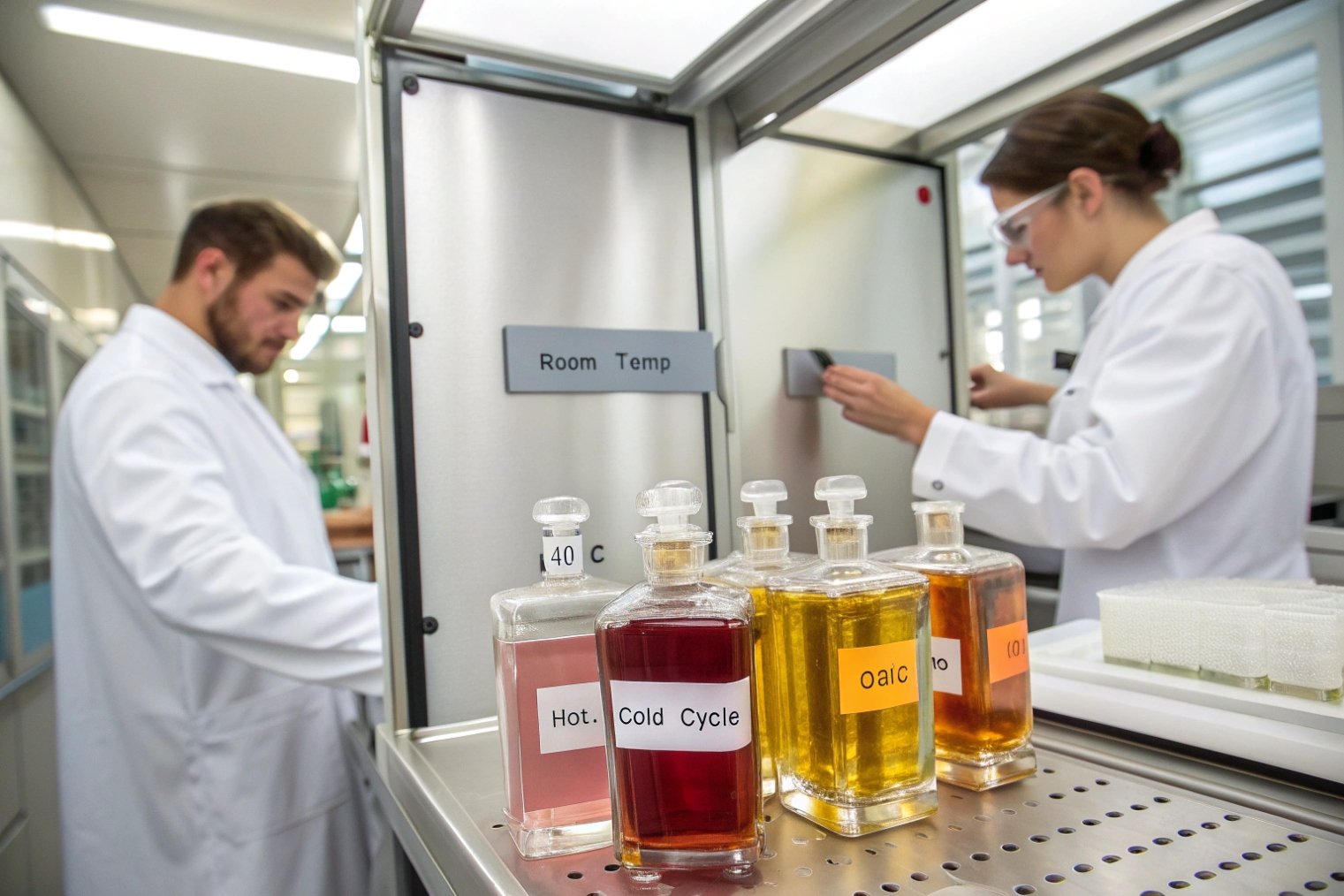
A strong supplier can fill test runs with your actual perfume, then run compatibility, leak, and drop tests to prove glass, coatings, pumps, and gaskets all work together.
Compatibility testing with your juice
Even when glass is inert, decoration layers, pumps, and gaskets are not always neutral. High-proof alcohol, citrus, and resin notes can attack weak materials.
Good compatibility testing includes:
- Filling bottles with your real formula or a close ethanol test base.
- Storing samples at elevated temperature (e.g. 40°C) and room temperature for several weeks.
- Checking for:
- Colour change in the juice
- Coating softening or blistering
- Ink bleeding or label curl
- Off-odours from plastics or elastomers
The goal is simple: the packaging should “disappear” and let the fragrance stay itself.
Leak, drop, and transport tests
Next, you want proof that the set behaves like a finished product, not a lab sample.
Typical tests to ask for:
| Test type | What it checks | Simple approach |
|---|---|---|
| Leak test | Pump and collar seal integrity | Invert bottles, apply pressure, warm/cool |
| Drop test | Resistance to shocks in logistics | Drops from defined heights onto hard base |
| Vibration / transit | Carton strength, bottle-to-bottle contact | Simulated transport on a shaker table |
| Thermal shock | Hot–cold swings during shipping or display | E.g. 5–45°C cycles with visual checks |
Some suppliers follow ISTA transit testing standards 7 or in-house packaging standards for these, but even simple, well-documented protocols are better than none.
Building a joint qualification plan
The safest approach is to treat packaging like a small technical project:
- Agree a test matrix: which bottle, which pump, which cap, which formula.
- Define pass/fail criteria for leaks, cracks, visual damage, and scent change.
- Share responsibilities: what the supplier tests in their lab, and what you repeat in your own stability or third-party lab.
If the supplier can show previous test reports (even with data anonymised) for other perfume brands, that is a strong sign they understand the requirements of alcohol-based, flammable, and scent-critical products.
In the end, a well-tested bottle set saves far more money and reputation than it costs. One avoided leakage recall pays for a full round of testing many times over.
Conclusion
The “right” glass perfume bottle supplier is the one whose certifications, capabilities, quality rules, and test support quietly protect your fragrance and your brand for the long term.
Footnotes
-
Official ISO overview of ISO 9001 and what certification typically covers. ↩ ↩
-
Official ISO page for ISO 15378 and its GMP expectations for primary packaging. ↩ ↩
-
See what third-party testing services like SGS can verify before shipment. ↩ ↩
-
EU REACH basics and how chemical compliance is defined for materials and coatings. ↩ ↩
-
Practical definition of AQL and how acceptance sampling is commonly interpreted. ↩ ↩
-
Explains Cpk and how capability metrics reveal stable vs drifting production quality. ↩ ↩
-
ISTA standards reference for packaging transit tests used to simulate shipping abuse. ↩ ↩






