
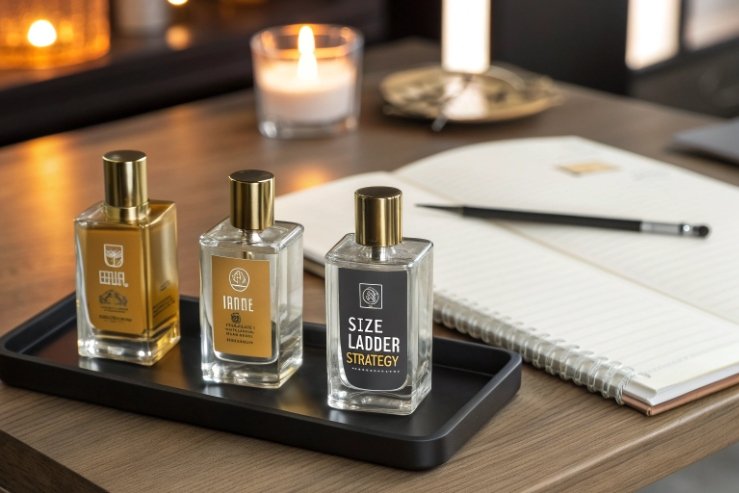
A perfume can smell perfect and still lose sales if the bottle feels too small, too heavy, or overpriced. Size mistakes show up as slow sell-through and returns.
The best perfume bottle size matches how people use the scent, fits travel and shelf rules, ships efficiently, and sprays consistently with the right headspace and pump output.
Most brands do not fail on fragrance. They fail on the packaging system. Bottle size sets your price ladder, your carton yield, your freight cost, and the way the customer holds the product every day. The good news is that this decision can be made with a simple framework and a few tests.
30 ml vs 50 ml vs 100 ml: how do sales mix and price tiers differ?
Picking a size only because “everyone sells it” is risky. A size can look right on a shelf and still break your margin or slow your repeat purchases.
30 mL drives discovery and gifting, 50 mL is the everyday standard and often the best margin balance, and 100 mL pushes value and loyalty when your brand already has trust.

Build a size ladder that feels fair and still protects luxury
What each size is really “for”
30 mL works best when the goal is low friction. It fits travel habits, impulse buys, and first-time buyers. It also fits gifting because it feels thoughtful but not “too much.” This size is also a strong option for higher concentration formats where fewer sprays are used per wear.
50 mL is the practical center. It feels like a full product, and it does not feel wasteful. In many projects, this is where unit economics start to behave. Tooling, decoration, and packing labor spread out better than 30 mL, but the bottle still stays compact.
100 mL sells when the customer already knows the scent. It signals value and commitment. It can also reduce packaging per milliliter, which supports a sustainability story—especially when paired with widely understood glass recycling 1.
A simple price ladder that does not “cheapify” the brand
The ladder should lower price-per-milliliter at each step, but the drop should not be so big that 50 mL looks like a bad deal. A clean structure is to keep the 30 mL “entry,” make 50 mL the hero, and let 100 mL be the best value for loyal users.
| Size | Buyer mindset | Typical role in the line | Price-per-mL direction | Common mistake |
|---|---|---|---|---|
| 30 mL | “Try it / travel / gift” | Entry SKU, sets, online conversion | Highest | Pricing too close to 50 mL |
| 50 mL | “Daily use” | Main retail SKU, best balance | Mid | Under-decorating so it looks basic |
| 100 mL | “This is my signature” | Value SKU, loyalty, boutiques | Lowest | Making it too tall/heavy to handle |
A practical way to plan your sales mix without pretending you know exact numbers
No single mix fits every brand. Still, a safe planning pattern is to treat 50 mL as the anchor SKU, then use 30 mL to widen the top of the funnel, and use 100 mL to lift AOV after trust is built. For new launches, smaller sizes often convert better online and at pop-ups because the customer can say “yes” faster. In department stores and brand boutiques, larger sizes can perform because staff support and brand story reduce risk.
Gifting matters too. 30–50 mL formats bundle well with minis, candles, or accessories. This makes it easier to build sets without making the box oversized. When a brand wants both margin and reach, the most stable lineup is often: 30 mL + 50 mL at launch, then add 100 mL after repeat purchase shows up.
How do size and shape affect freight class and carton yield?
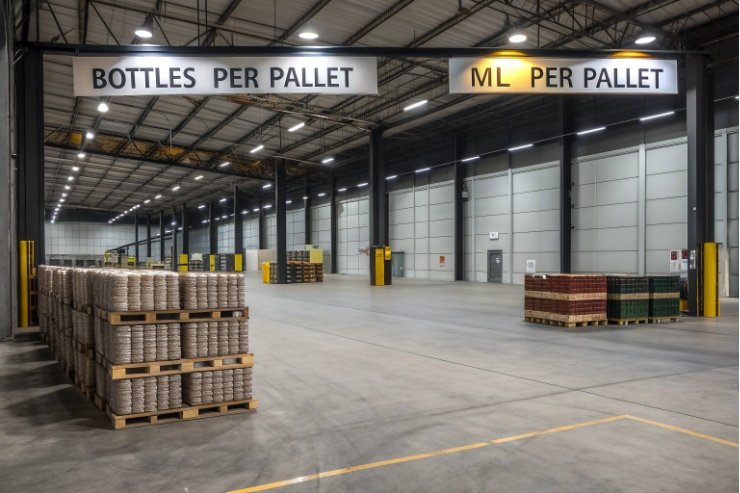
A bottle can be beautiful and still be expensive to ship. Freight is not just about weight. It is also about space, breakage, and how many units fit per carton and per pallet.
Shorter, squarer bottles usually ship cheaper and pack tighter, while tall or wide luxury shapes reduce carton yield, increase dimensional cost, and raise breakage risk, especially above 100 mL.
Treat shipping as part of product design, not an afterthought
The three cost levers: cube, weight, and damage rate
Perfume bottles ship as “air.” That means the empty space in your carton can cost as much as the glass, especially when carriers charge using dimensional weight 2. Taller bottles increase carton height, and height often forces fewer layers per pallet. Wide shoulders and thick bases can also cut yield because inserts must grow.
Weight still matters. Heavy glass raises freight cost and makes manual handling harder. It also increases drop energy during transit, so breakage can rise unless the pack is upgraded. Breakage is a hidden tax that shows up later as claims and replacements.
Carton yield is where small shape changes pay back fast
Carton yield means units per master carton and cartons per pallet. When the footprint is efficient, the brand can ship more saleable units per container. When it is inefficient, every order gets more expensive.
A fast way to evaluate a bottle is to look at its “packing rectangle.” Square-ish bottles nest better than round bottles with wide caps. Very sculpted bottles often need custom inserts, and inserts can dominate the carton size.
| Design choice | What happens in shipping | What it does to cost | Low-risk fix |
|---|---|---|---|
| Very tall bottle | Fewer layers per pallet | Higher cost per unit | Reduce height or use wider, shorter profile |
| Wide cap or crown | Bigger carton footprint | Lower units per carton | Use a tighter cap diameter or shorter overcap |
| Heavy thick-base glass | Higher weight and breakage energy | More freight + more claims | Optimize glass weight and add smarter inserts |
| Complex shape | Custom inserts and more void | More material and labor | Simplify key contact points, keep flat panels |
Shape choices that keep luxury while improving logistics
A “stable luxury” form is often 50–75 mL with a wider base and moderate height. It feels premium in hand, but it also reduces tipping and packs well. Very tall >100 mL bottles can look impressive, but they often create a fragile center of gravity. That can drive dented cartons and broken pumps.
There is also a tooling and MOQ angle. Custom shapes can be worth it, but only when volume supports it. When volume is still uncertain, it can be smarter to use a proven standard finish and focus on decoration. That keeps components available and reduces delays.
A simple rule helps: if the bottle shape forces a bigger carton, it must earn that space on shelf. If it does not improve conversion, it is just a shipping penalty.
Which sizes meet travel and retail planogram requirements?
Customers love “portable luxury,” but they hate friction. If a bottle cannot travel, or it does not fit standard shelf spacing, it can lose sales even when the scent is great.
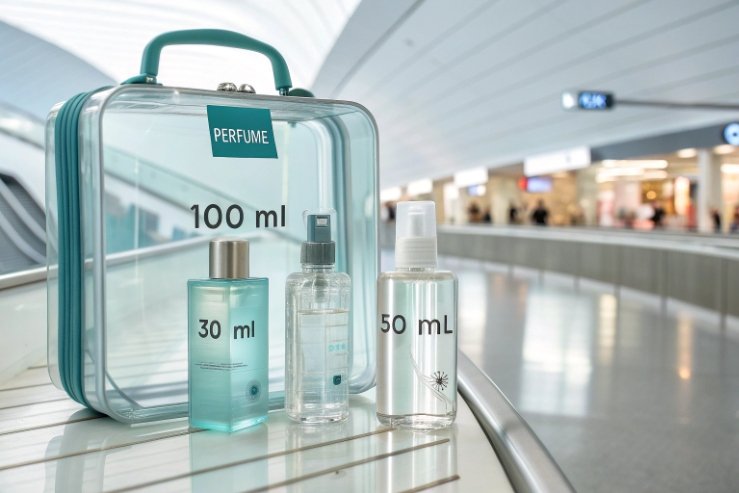
For travel, bottles at or under 100 mL reduce airline carry-on friction, and for retail planograms, 30–50 mL formats fit more facings while 50–100 mL often match standard fragrance shelving and promo displays.
Design around real-world rules and shelf behavior
Travel compliance is not just a regulation, it is a buying trigger
Many shoppers look for the ≤100 mL hand-luggage liquids limit 3 because it feels safe for carry-on habits. Even when the buyer does not travel every week, the idea of easy travel lowers purchase anxiety. This is one reason 30 mL converts well online. It feels like a low-risk choice.
Travel also changes how the bottle is used. A bag needs leak resistance, cap security, and a pump that does not actuate by accident. If travel is part of the brand story, it is smart to consider an overcap with real retention and a pump that can be locked or protected.
Planograms reward consistency and footprint control
Retail shelves have fixed heights, and testers often sit in front. If a bottle is too tall, it can block signage or look unstable. If it is too wide, it can reduce facings. More facings often means more sales because the product looks “available” and easier to pick up. If you have not worked from a retail planogram 4 before, this is where “a few millimeters” turns into real lost shelf capacity.
This is where 50 mL shines. It balances shelf presence and packing density. 30 mL lets stores carry more SKUs in the same bay, which helps discovery sets and seasonal launches. 100 mL often sells best when the brand already has a hero scent and wants a value signal.
| Channel | Size that usually converts well | Why it works | What to watch |
|---|---|---|---|
| DTC / online | 30 mL, 50 mL | Lower risk, easier shipping | Returns if sprayer feels weak or leaks |
| Pop-ups / events | 30 mL, 50 mL | Fast decision, gifting | Need strong visual impact in small footprint |
| Department stores | 50 mL, 100 mL | Staff support and trust | Tester and shelf height limits |
| Boutiques | 50 mL, 75–100 mL | Brand story supports commitment | Heavy bottles tipping and fingerprints |
A practical lineup that covers travel and retail without too many SKUs
A clean plan is a “wearable size” plus a “home size.” That often means 30–50 mL for daily carry, and 100–200 mL as a refill or home bottle if the brand supports sustainability. Pairing full sizes with 2–10 mL minis also helps trial-to-full conversion without adding too many glass SKUs.
When the brand is new, fewer SKUs usually win. A tight set like 30 mL + 50 mL or 30 mL + 100 mL can work, but 50 mL tends to be the safest anchor because it fits most shelves and most hands.
What headspace and pump output ensure consistent performance?
A bottle can be the perfect size and still disappoint if the spray feels weak, the plume is inconsistent, or the pump spits. Performance is part of luxury.
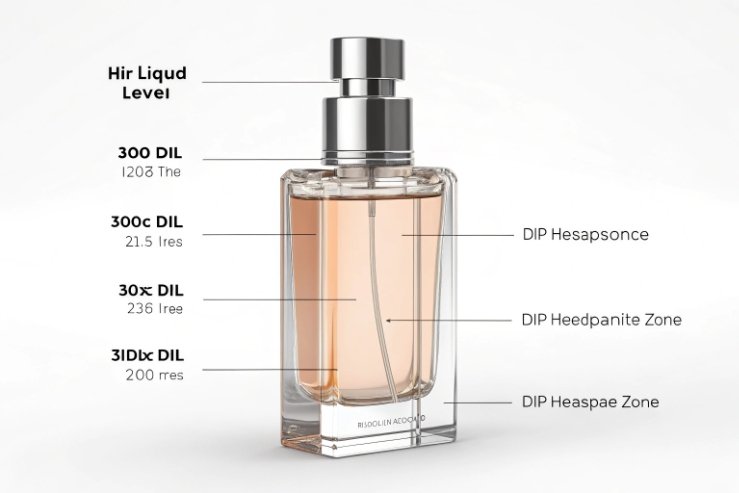
Stable performance comes from matching headspace, dip tube length, and pump output to each size, then validating spray angle, priming, and leakage across temperature cycles and shipping conditions.
Make the spray feel the same across 30, 50, and 100 mL
Headspace is not wasted space, it is a control zone
Headspace (also called ullage 5) supports pumping, expansion, and safe crimping or screw closure sealing. Too little headspace can raise leakage risk when the liquid expands in heat. Too much headspace can increase oxidation risk over long storage and can make the bottle look underfilled.
A practical approach is to plan headspace as a controlled amount, then confirm it with actual fill tests. Many brands aim for a small but consistent headspace so the fill line looks intentional across SKUs.
| Size | Practical headspace goal | Why it helps | What goes wrong if ignored |
|---|---|---|---|
| 30 mL | Small and consistent | Keeps premium look, supports pump | Underfill perception or leaking on heat |
| 50 mL | Moderate control | Stable spray and shipping buffer | Visible variation between lots |
| 100 mL | More buffer needed | Expansion and handling safety | Big air gap looks cheap if not designed |
Pump output and spray feel must match the size story
Pump output is often discussed like a small number, but the customer feels it. A fine mist can feel “luxury.” A wet spray can feel cheap. Output also changes how long a bottle lasts, which changes repurchase timing and customer satisfaction.
The key is consistency across sizes. If 30 mL sprays too much per actuation, it empties fast and feels like bad value. If 100 mL sprays too little, it feels weak and the user over-sprays. When you compare components, look for published pump dosage per actuation 6 so your “wear experience” stays consistent between sizes.
A simple development method works well:
- Choose a target “wear experience” first (mist density, plume width, dry-down feel).
- Select a pump output that supports that experience.
- Match dip tube length and filter to avoid sputter near the end of life.
- Validate priming (how many pumps to first spray) and re-priming after travel.
Tests that prevent expensive surprises
Component performance should be checked with filled product, not only with water. Alcohol content, fragrance oils, and temperature change behavior. If you ship through parcel networks or marketplaces, a good baseline is to include ISTA transit testing 7 in your qualification plan.
A basic test set can save a launch:
- Prime test: number of actuations to first consistent spray.
- Spray pattern test: angle and plume symmetry.
- Leak test: inverted storage and vibration.
- Heat/cold cycle: expansion and seal stability.
- End-of-life test: last 10% of fill should not sputter.
There is also an ergonomics link. Very tall or heavy bottles can change how the user presses the pump, which changes perceived spray quality. This is why 50–75 mL often feels “right” in hand. It supports a stable grip and an easy press without tipping.
When size decisions and component decisions are made together, the brand gets a bottle that looks premium, ships well, and sprays like it should.
Conclusion
Choose size like a system: usage occasion, price ladder, shipping cube, shelf fit, and sprayer performance must match, so the bottle sells well and feels premium every day.
Footnotes
-
Overview of how glass recycling works and why it supports sustainability claims. ↩ ↩
-
Explains how dimensional weight impacts shipping cost when cartons are light but bulky. ↩ ↩
-
Official hand-luggage rules that influence why shoppers prefer bottles marked 100 mL or less. ↩ ↩
-
Defines planograms and why footprint consistency affects facings and shelf performance. ↩ ↩
-
Clarifies “ullage” and why controlled headspace matters for expansion, sealing, and premium fill perception. ↩ ↩
-
Shows real-world pump dose specifications, useful when matching spray feel across sizes. ↩ ↩
-
Introduces ISTA packaging test standards used to simulate transit stresses and reduce shipping damage risk. ↩ ↩






