
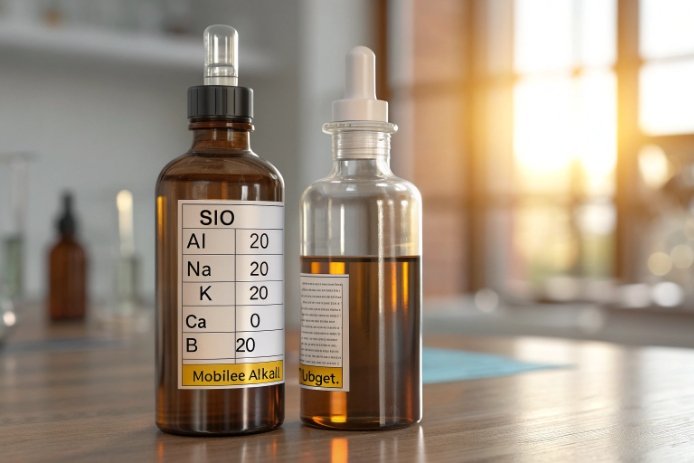
Solvent complaints can look like a filling problem, but the root cause is often the container surface. A small chemistry shift can raise extractables 1 and destroy confidence.
Solvent resistance in packaging glass is mainly chemical durability: how little the glass surface dissolves, leaches ions, hazes, or forms particles when exposed to a solvent under set time and temperature. Glass is usually strong against most organic solvents, but water content, pH, and alkali mobility can change the outcome fast.
The chemistry map behind “solvent resistance” in bottle glass
Solvent resistance sounds like a polymer topic, but glass has its own version. For bottle glass, the practical question is not “does it melt?” It is “does the surface stay stable and quiet?” A stable surface means low ion release, low haze, and low particle risk. It also means labels and decorations behave more consistently because the surface chemistry stays steady.
…The two main attack paths
1) Ion exchange (early stage).
Alkali ions 2 like Na⁺ and K⁺ can exchange with H⁺ from water or water carried inside a solvent blend. This can happen even when the solvent is “mostly organic.” This stage raises extractables and can shift the local pH at the surface.
2) Network dissolution (later stage).
If OH⁻ concentration is high enough, the silica network can be attacked. This is why strong alkaline solutions are the classic enemy of many silicate glasses. When the network starts to dissolve, haze and surface roughness rise. The risk of particles and flakes also rises in sensitive systems.
Why the same solvent behaves differently in real packaging
The solvent itself is only one input. In packaging, the real system includes:
-
water content (even “anhydrous” solvents pick up water over time),
-
…temperature and time,
-
dissolved salts and surfactants,
-
pH modifiers and amines,
-
headspace and oxygen,
-
…closure and liner materials that can add or remove species.
So the bottle formulation sets a baseline, but the product formulation can push it into a bad region.
| What a customer calls it | What it usually is in glass terms | What to measure |
|---|---|---|
| “Cloudy bottle wall” | Surface etch / roughness | Haze, microscopy, weight loss |
| “Strange taste or odor” | Extractables or interaction with closure | Ion release, E&L study |
| “White film” | Salt deposition after leaching | Ion profile, pH, residue |
| “Black or shiny flakes” | Delamination-like particles or surface corrosion | Particle count, SEM/EDS |
| “Random breakage later” | Stress + surface damage combo | Stress scan, surface strength trend |
In my view, the fastest way to control solvent resistance is to define it as a measurable package-performance goal. That makes the chemistry discussion much easier, because the team can link oxides to a real test result.
Now the definition needs to be precise.
What defines solvent resistance in packaging glass?
Solvent resistance is often described with vague words like “inert” or “non-reactive.” That language is not enough for QC and validation.
Solvent resistance in packaging glass is defined by how little the container changes and how little it contaminates the product during contact. It is validated through extractables, hydrolytic resistance, and corrosion screening tests that match the product, time, and temperature.
What “passes” looks like for glass packaging
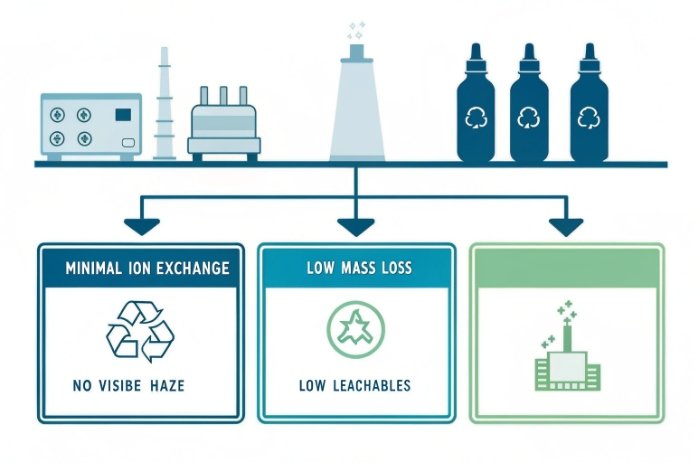
A solvent-resistant bottle should meet three outcomes:
1) The bottle surface stays smooth and clear (no haze, no etching).
2) The product stays within purity targets (low ion release, low particles).
3) The performance stays stable across lots (low variation).
For many industries, water-based durability methods are still the backbone because water is the main driver of corrosion chemistry. ISO 719 and ISO 720 are common methods that measure alkali extracted from glass grains by hot water, then classify hydrolytic resistance 3. ISO 719 4 uses 98°C water extraction, while ISO 720 uses 121°C and is intended for more resistant glass types. :contentReference[oaicite:0]{index=0}
For container-focused testing, ASTM C225 5 covers resistance of glass containers to chemical attack, including autoclave testing at 121°C with water or dilute acid conditions. :contentReference[oaicite:1]{index=1}
In pharma, performance is tied to compendial expectations, not only internal QC. USP <1660> 6 describes factors affecting inner surface durability and recommends approaches to evaluate risk of particles and delamination 7 in glass containers. :contentReference[oaicite:2]{index=2}
A practical definition that works for beverage, cosmetics, and pharma
Solvent resistance should be written as a test plan, not as a promise:
-
solvent or product simulant,
-
…water content and pH,
-
…contact temperature and time,
-
acceptance limits for ions and particles,
-
visual and haze limits.
| Category | Primary concern | Typical acceptance style | Best “first screen” |
|---|---|---|---|
| Beverage / food | Clarity + taste stability | Visual + sensory + ion trend | Hydrolytic resistance + targeted soak |
| Cosmetics | Appearance + fragrance stability | Haze + ions + closure interaction | Product soak + extractables |
| Pharma | Patient safety + particulate risk | Compendial + E&L + particle limits | USP-based durability + product-specific stress |
Once solvent resistance is defined this way, the role of alkali becomes very clear, especially in aggressive solvent systems.
Why does alkali content matter for aggressive solvents?
Many aggressive “solvents” are not aggressive because they dissolve silica directly. They are aggressive because they create the right chemistry for alkali mobility and surface attack.
Alkali content matters because Na₂O and K₂O increase the pool of mobile ions that can leach or exchange when water and polar solvents are present. In alkaline conditions, leached alkali can also raise local pH and speed network dissolution, so high alkali can turn a mild system into a corrosion system.
The key idea: “aggressive solvent” often means “water + high pH”
Glass corrosion 8 is strongly driven by OH⁻ in many silicate systems. When pH is high enough, the silica network becomes more vulnerable. One simple way to say it: strong alkaline materials can attack glass more than many acids do, and this effect grows with temperature. :contentReference[oaicite:3]{index=3}
A lot of packaging “solvents” are blends:
-
alcohol + water,
-
glycol ethers + water,
-
solvents + amines,
-
…solvents + surfactants,
-
cleaning solutions used on reused bottles.
These blends can carry water into contact with the glass surface. They can also shift pH upward. When that happens, alkali mobility becomes the first visible signal in extractables, and then surface damage can follow.
Why Na₂O/K₂O is a lever and a risk
Alkali oxides help melt workability. They drop melting temperature and lower viscosity. That is why soda-lime glass exists at scale. Still, higher alkali also tends to increase the amount of ions that can be exchanged and extracted under attack conditions. ISO 719 and ISO 720 are built around measuring extracted alkali as the indicator of hydrolytic attack. :contentReference[oaicite:4]{index=4}
So alkali is not “bad.” It is “powerful.” It must be balanced with stabilizers and network formers so the surface stays quiet.
A quick way to predict risk without waiting months
When a product contains aggressive ingredients, these questions help:
-
Does the product contain water or will it absorb water?
-
Does it contain amines, soaps, or alkaline buffers?
-
Will it be heated, sterilized, or stored warm?
-
Is the contact time long (cosmetics, pharma) or short (many beverages)?
| Product feature | Why it raises glass risk | What alkali does in that system | What to do next |
|---|---|---|---|
| Water present | Enables ion exchange | Raises Na/K release | Run soak + ion release trend |
| High pH / amines | Drives OH⁻ attack | Can raise local pH faster | Use higher durability glass or surface treatment |
| Sterilization heat | Speeds reactions | Increases leaching rate | Use compendial tests + worst-case cycle |
| Long shelf life | More time for corrosion | Cumulative extractables | Stability study with container lots |
This is why low-alkali and better-stabilized glasses are preferred in pharma and high-end cosmetics when the product is chemically “active.”
Now the hard part is balancing that durability goal with melt and forming reality.
How should formulators balance durability with melt workability?
A bottle plant can make an extremely durable glass that is too hard to melt and too stiff to form at speed. That glass will fail the business, even if it passes chemistry tests.
Formulators balance durability and melt workability by using alkali to keep viscosity and energy in a workable range, then using stabilizers and network formers to control ion mobility and surface corrosion. The best balance is reached with small, controlled oxide moves and strong control of raw material drift, not with big recipe swings.
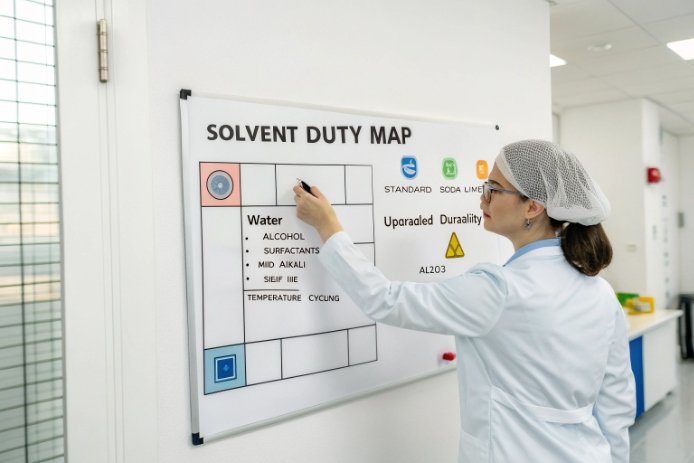
The trade-off triangle that shows up on every line
In container glass, these three goals fight each other:
-
Durability: low ion release, low corrosion, stable surface.
-
Meltability: reasonable furnace temperature, good fining, good pull rate.
-
Formability: stable gob temperature, working range, low defect rate.
Alkali helps meltability and formability. SiO₂ and Al₂O₃ help durability but raise viscosity and energy demand. CaO and MgO improve durability and can tune viscosity behavior, but they also change liquidus and working range.
So the best practice is to adjust one lever at a time in small steps, then validate with both furnace KPIs and package KPIs.
The “small moves” that usually work
-
Slightly reduce total alkali when durability is weak and melt margin exists.
-
Slightly raise Al₂O₃ when surface durability needs stability and color allows it.
-
Tune CaO/MgO when the line needs viscosity curve shaping without large alkali change.
-
Keep cullet chemistry stable because cullet drift can erase any careful optimization.
ASTM C225 can support acceptance screening for container corrosion resistance under autoclave conditions. ISO 719/720 can support hydrolytic resistance classification trends when comparing lots or recipe steps. :contentReference[oaicite:5]{index=5}
A decision table that matches real production conversations
| Symptom | Likely chemistry driver | Typical tweak direction | Melt / forming risk to watch |
|---|---|---|---|
| High Na/K extractables | Alkali mobility too high | Reduce alkali slightly, raise stabilizers | Higher melt temp, higher viscosity |
| Haze or etching in alkaline blends | Surface network attack | Increase network formers and stabilizers | Pull rate loss, devit risk |
| Furnace energy too high | Over-stabilized glass | Add small alkali or boron (if allowed) | Durability drop, volatility issues |
| Forming too tight | Viscosity too high | Small alkali increase or adjust Mg/Ca | CTE shift, durability shift |
This is also why “durability” should be written as a range, not a single number. A plant needs a safe zone that holds both chemistry and production KPIs.
Now the question becomes what is changing in the market, especially in pharma and cosmetics, where products can be more chemically active and regulators care about extractables.
Are solvent-resistant chemistries advancing for pharma and cosmetics?
Pharma and cosmetics push glass in different ways. …Pharma pushes patient safety and particulate control. Cosmetics pushes appearance, fragrance stability, and long shelf life. Both push extractables and surface stability.
Yes, solvent-resistant glass solutions are advancing, mainly through higher chemical durability compositions, tighter control of inner surface uniformity, and more performance-based standards. Aluminosilicate and boron-free approaches are gaining attention for delamination resistance, while testing frameworks are being modernized to support new glass materials and better predict inner surface durability.
The pharma driver: durability, extractables, and delamination risk
Pharma cares about the drug-contacting surface. …USP <1660> focuses on factors affecting inner surface durability and approaches to evaluate potential for particles and delamination, including lot-to-lot comparisons. :contentReference[oaicite:6]{index=6}
USP has also been modernizing how glass is evaluated. USP’s notice of intent to revise <660> reflects a move toward performance-based evaluation, and it supports the reality that multiple glass chemistries can meet Type I performance 9 when tested properly. :contentReference[oaicite:7]{index=7}
Europe is also refining clarity in this area. EDQM has published a revision notice for Ph. Eur. chapter 3.2.1 to clarify the purpose of tests used to define glass type and hydrolytic resistance. :contentReference[oaicite:8]{index=8}
On the material side, suppliers are promoting more durable, more uniform inner surfaces. Corning describes Valor® Glass as an aluminosilicate 10 composition with a uniform interior surface designed to eliminate delamination and provide low extractables, while meeting USP Type I hydrolytic criteria. :contentReference[oaicite:9]{index=9}
Recent industry reporting also links boron volatility during converting to interior heterogeneities and delamination risk, which supports interest in boron-free compositions for some pharma use cases. :contentReference[oaicite:10]{index=10}
The cosmetics driver: alcohols, oils, actives, and brand appearance
Cosmetics often use alcohol-water blends, essential oils, surfactants, and actives. These formulas are not always extreme, but they are diverse. The right response is often:
-
choose a glass with strong hydrolytic resistance when water is present,
-
avoid high-alkali drift that raises ion release,
-
validate with product-specific soak and extractables tests,
-
control decoration and coating compatibility, because many failures blamed on “glass attack” are actually coating or print failures.
What is likely to change next
In the next phase, more projects will connect:
-
chemistry (composition and surface uniformity),
-
process history (forming and converting),
-
performance testing (hydrolytic resistance, extractables, particles),
-
and risk models (predictive screening and lot trending).
That reshapes what “solvent-resistant glass” means. It becomes less about a label like “Type I” and more about proven performance in the real product and process window.
| Sector | What is improving | What it changes for buyers | What to ask your supplier |
|---|---|---|---|
| Pharma | Performance-based standards and predictive durability screening | More options beyond classic borosilicate | Inner surface durability data, <1660> approach |
| Pharma | Aluminosilicate / boron-free approaches | Lower delamination risk for some products | Extractables profile, converting controls |
| Cosmetics | Better product-specific compatibility testing | Fewer surprises in shelf life | Soak protocol, ion limits, haze limits |
| Both | More focus on lot uniformity | Better consistency in QA yields | Lot-to-lot trend reports |
In my experience, the biggest wins come from pairing a stable glass chemistry with a clear validation plan. That turns “glass is inert” from a belief into a controlled quality outcome.
Conclusion
Glass solvent resistance is really surface durability under a defined exposure. Alkali content is the main risk knob in aggressive, water-containing systems, so smart balancing and modern testing drive safer packaging.
Footnotes
-
[Overview of chemical compounds that can migrate from packaging into pharmaceutical products.] ↩
-
[Scientific review of ion exchange mechanisms and their effect on glass properties.] ↩
-
[Explanation of testing methods to determine water resistance of glass containers.] ↩
-
[Standard method for testing hydrolytic resistance of glass grains at 98°C.] ↩
-
[Standard test methods for evaluating the resistance of glass containers to chemical attack.] ↩
-
[Guidelines for screening and predicting glass delamination and inner surface durability.] ↩
-
[Detailed look at the causes and testing of glass flaking in pharmaceutical packaging.] ↩
-
[Analysis of how acids and alkalis attack and dissolve glass surfaces.] ↩
-
[Classification and properties of high-quality pharmaceutical glass types.] ↩
-
[Comparison of performance and properties between aluminosilicate and borosilicate glasses.] ↩






