
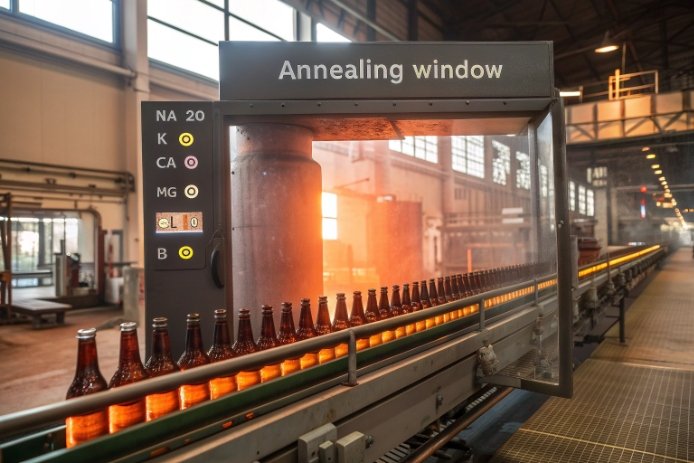
A bottle can look perfect at the inspection camera and still crack in a warehouse. That is the cost of a tight annealing window.
The annealing window is the temperature range where stress can relax fast enough before the glass “freezes” below the strain point. Glass chemistry shifts the anneal point, the strain point, and the slope between them, so it also shifts lehr speed, breakage risk, and yield.
Formulation is not only melt and forming, it is stress relaxation
Bottle plants often treat the lehr 1 like a downstream “cooling tunnel.” In real life, it is a stress management machine. The lehr can only do its job inside the annealing range, and that range is set by the glass formulation. If the formulation changes, the best lehr profile changes too. If the profile stays the same, the stress level at room temperature changes. That is when delayed breakage shows up as a surprise.
What formulation changes inside the lehr
The lehr problem has two layers.
The first layer is thermal. Heat must leave the bottle in a controlled way. Thick zones cool slower than thin zones. The finish and heel behave differently from the body. Radiant heat transfer also changes as coatings, colors, and soot levels change.
The second layer is viscoelastic. Above the strain point 2, glass can still relax stress. Below it, stress becomes “locked in.” The temperature where stress can relax in minutes is near the annealing point 3. The temperature where stress needs hours is near the strain point. The gap between those points is a big part of what operators call the annealing window.
Formulation drives both layers because it drives:
– viscosity 4 vs temperature behavior,
– structural relaxation speed,
– elastic modulus changes with temperature.
Why the same lehr can behave “different” on two similar bottles
Two bottles can have the same weight and shape and still need different lehr tuning. The reason is that chemistry can shift the viscosity curve. If the curve is steep, a small temperature drift in a zone can move stress relaxation from “fast” to “almost none.” That makes the process sensitive. It also makes breakage look random.
| Lever | What changes in the lehr | What the line feels | What the customer sees |
|---|---|---|---|
| Viscosity curve near Tg | Stress relaxation rate | More or less residual stress | Warehouse breakage, impact failures |
| Anneal/strain temperatures | Target zone setpoints | More tuning, more alarms | Inconsistent strength |
| Thermal expansion (CTE) | Stress created during cooling | More checks if mismatch | Cracks after filling or transport |
| Thickness distribution | Time to equalize temperature | Need longer soak or slower belt | More rejects if rushed |
This is why formulation control belongs in the same conversation as lehr control. The next step is to define the annealing window in a way that is useful for bottle operations.
A simple rule helps: a wide window forgives small mistakes. A narrow window makes every small drift expensive.
What defines the annealing window for bottle glass?
When a lehr team says “the window is tight,” they usually mean the process only works in a narrow band of belt speed and zone temperature.
For bottle glass, the annealing window is defined by the annealing range (between annealing point and strain point) plus the practical limits of bottle shape, thickness, and lehr heat transfer. A usable window exists when the bottle reaches a near-uniform temperature in the range, then cools through it without rebuilding stress.
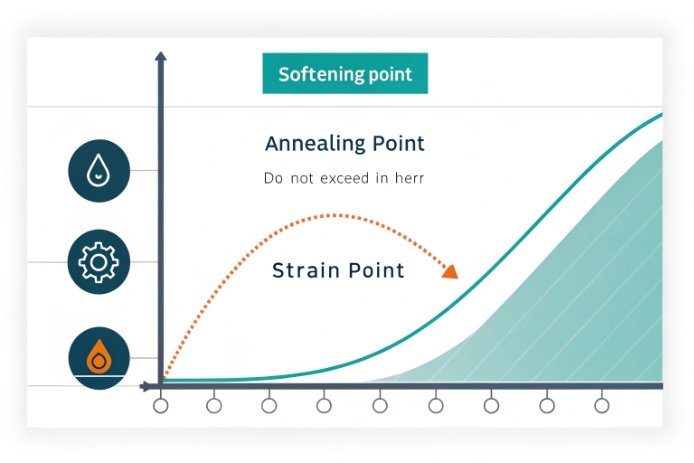
The core definition: annealing range
Most engineers anchor the range with two viscosity points:
– Annealing point: stress relaxes in minutes.
– Strain point: stress relaxes in hours, so stress below it becomes permanent in production time.
The temperature distance between these two points is the backbone of the window. But the plant window is not only that distance.
The plant definition: a usable process window
In a bottle lehr, “window” means the set of conditions where all of these are true at the same time:
– The whole bottle reaches a temperature close enough to the annealing point to let stress relax.
– The temperature difference between thick and thin zones is small enough, so new stress is not added faster than it can relax.
– The bottle cools through the strain point slowly enough, so stress does not lock in above the allowed limit.
– The belt speed meets throughput needs without pushing stress above the spec.
So the window is a mix of glass properties and equipment realities.
Why geometry and chemistry must be read together
A thick base needs more time. A tall bottle has more gradient risk. A heavy finish can store heat and then create stress later in cooling. If the formulation has a higher strain point, the critical “slow cooling” zone shifts up in temperature. If the formulation has a steeper viscosity curve, the control band gets smaller.
A practical way to express the window on a shop floor
Instead of only listing “anneal point = X°C,” it helps to list a control band like this:
– Soak zone: target temperature range (± °C)
– Cooling slope: max °C/min through the annealing range
– Belt speed band: min–max speed for stress compliance
| Window element | How it is set | What shifts it | How it is checked |
|---|---|---|---|
| Soak temperature band | Near annealing point | Chemistry and thickness | IR profile + stress checks |
| Cooling rate through range | Based on stress limit | Chemistry, geometry | Belt speed and zone setpoints |
| Exit stress limit | Internal spec or customer spec | Market and use case | Polariscope / stress measurement |
| Safety margin | Extra buffer vs drift | Process capability | Trend charts and alarms |
When this definition is clear, the business impact becomes obvious. A wider window is not only “nice.” It is money.
Why window width impacts throughput and breakage rates?
A fast line can still be a weak line if annealing is not stable. That weakness shows up late, when it is hardest to trace.
Window width impacts throughput because belt speed and zone setpoints must stay inside the safe band. If the band is narrow, small drift forces slower speed and more rejects. If stress is locked in above the limit, breakage rises during filling, capping, case packing, and storage.
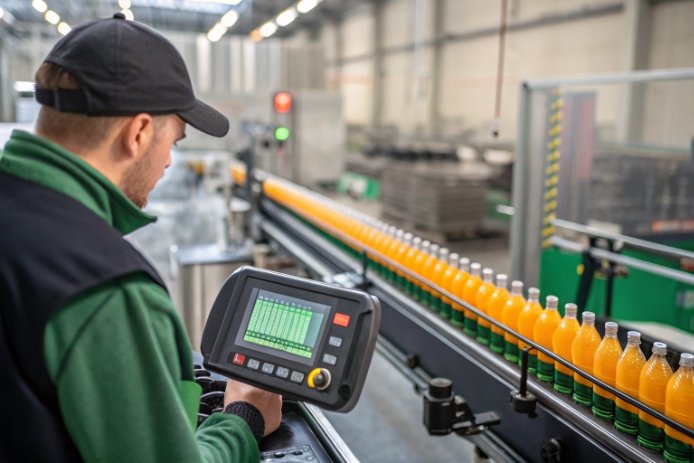
Throughput: why a narrow window slows a plant
A lehr has only a few knobs: zone temperatures, airflow, and belt speed. If chemistry makes the annealing range narrow, the lehr becomes sensitive. The belt speed must drop to give more time for soak and controlled cooling. The line then loses bottles per hour.
A narrow window also increases “micro-stops.” Operators see more alarms, more tweaks, and more time spent chasing stability. Even when the average speed looks fine, the effective output drops because downtime and scrap rise.
Breakage: why stress turns into real cracks later
Residual stress is like a hidden load stored in the glass. When the bottle sees a small impact, or when it sees a temperature change during filling, the stored stress adds to the new stress. The crack then starts at a weak spot and runs fast.
In many plants, the first sign is not an obvious “annealing fail.” It is:
– more checks at the heel,
– more finish chips that spread,
– more random sidewall cracks after capping,
– more warehouse breakage in the same SKU.
This is why window width is a risk control tool.
The control-band logic
A wide window allows:
– faster belt speed at the same stress level,
– less sensitivity to raw material drift,
– less sensitivity to lehr airflow changes,
– more stable quality across shifts.
A narrow window forces the opposite.
A simple cause-and-effect map that helps management
| Wider window gives… | So the plant can… | And the market sees… |
|---|---|---|
| More stress-relaxation margin | Run faster without raising stress | Fewer cracks in distribution |
| Larger temperature tolerance | Reduce scrap from small drifts | More stable complaints rate |
| More robust cooling slope | Simplify setpoint control | Fewer “mystery” failures |
| More stable exit stress | Cut rework and sorting | Better brand trust |
In my view, the best lehr KPI is not only belt speed. It is belt speed plus exit stress stability. That pair predicts both cost and customer pain.
Once the impact is clear, the next question is the one plants care about most: how chemistry can be adjusted to widen the window without breaking other targets.
How to adjust oxides to widen the annealing window?
A common mistake is to chase one knob, like “raise CaO” or “lower Na2O,” without asking what the lehr needs and what the furnace can still melt.
Oxide changes can widen the annealing window by flattening the viscosity-temperature slope near the anneal/strain range, or by shifting anneal and strain points to match the lehr capability. Typical moves include lowering total alkali, increasing network formers like SiO₂ and Al₂O₃, and tuning alkaline earth balance, but each move has melting and forming trade-offs.
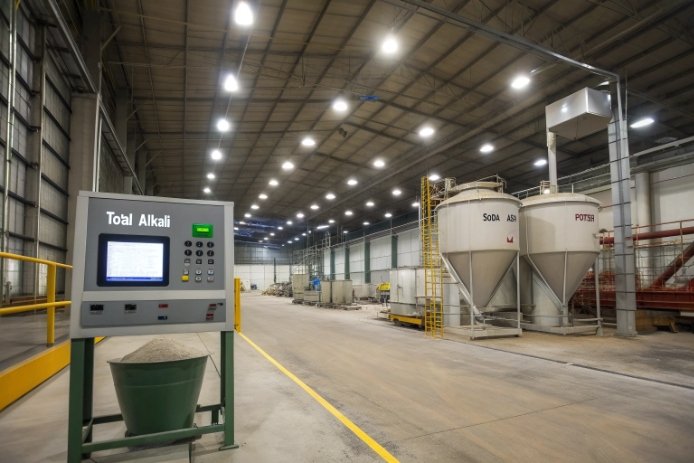
Start from the viscosity curve, not from a single oxide number
The window is controlled by how fast viscosity changes with temperature near Tg 6. If viscosity changes very fast with temperature, the gap between the annealing point and strain point becomes small in °C. That makes control hard.
So the goal is often one of these:
– increase the °C gap between anneal and strain points,
– reduce sensitivity so small zone drift does not change stress a lot,
– move the range to temperatures the lehr can hit evenly.
Common oxide levers and what they usually do
Alkali (Na₂O, K₂O): lowers viscosity and lowers Tg. It can help melting and forming. But it can also make the viscosity curve steeper near Tg in many soda-lime systems. That can tighten the annealing window. It also raises thermal expansion, which can raise stress risk during cooling and during thermal shock events.
Silica (SiO₂): increases network connectivity. It often raises viscosity and Tg. It can improve chemical durability and can reduce thermal expansion. But it makes melting harder and can raise energy use.
Alumina (Al₂O₃): strengthens the network and can improve durability. It often raises viscosity and can improve resistance to devitrification in some ranges. But too much can tighten forming and increase furnace load.
Alkaline earths (CaO, MgO): act as stabilizers and modify viscosity and expansion. The CaO/MgO balance can shift the working range and expansion. It can also change how sensitive viscosity is to temperature in the annealing range.
B₂O₃ (when used): can reduce thermal expansion and change relaxation behavior. It is not common in standard container glass, but it can appear in specialty bottles where thermal shock or stress control is critical. It also has cost and volatility considerations.
A practical “widening” playbook with trade-offs
| Chemistry move | Likely effect on window | What can break | What to monitor |
|---|---|---|---|
| Reduce total alkali slightly | Often less sensitivity near Tg | Harder melt, higher forming temp | furnace pull, gob temp, CTE |
| Add a small Al₂O₃ increase | Often stronger network, better durability | Higher viscosity, tighter forming | mold filling, defects, energy |
| Shift CaO/MgO balance | Can tune viscosity and CTE | Liquidus and devit risk can shift | stones, cords, viscosity proxy |
| Raise SiO₂ modestly | Often lowers CTE, can stabilize stress | Higher melting demand | fuel, fining, throughput |
| Keep total stabilizers stable | Keeps durability stable | Batch cost shifts | leaching, strength trend |
How to run oxide changes without losing weeks
A safe method is stepwise:
1) Lock cullet percentage and color package during trials.
2) Adjust only one lever at a time in a small band.
3) Measure anneal and strain behavior from lab property data, then verify with lehr stress data.
4) Update lehr profile with each chemistry step, not after the trial.
5) Track breakage not only on the line, but also after 24–72 hours.
A wider window is possible, but it is never free. It is a balance between melt cost, forming stability, and lehr robustness.
Can digital twins predict optimal annealing profiles?
Lehr tuning often depends on the best technician on the best day. That is not a stable system when demand changes fast.
Digital twins can predict better annealing profiles when they combine heat-transfer simulation, viscoelastic stress relaxation models, and real plant data. They work best when glass properties (viscosity and relaxation behavior) are accurate, and when the model is linked to sensors and zone controls for continuous correction.

What “digital twin” means in a bottle lehr
A useful lehr twin is not only a 3D drawing. It is a live model that:
– predicts bottle temperature history in each zone,
– predicts stress build and stress relaxation,
– updates predictions using real measurements,
– recommends setpoints and belt speed to hit a stress target.
This can be built in layers. The first layer can be a fast simplified model that runs in real time. The second layer can be a deeper finite element model used for offline optimization and new bottle design.
The physics that matters most
A lehr twin needs:
– heat transfer (radiation, convection, conduction),
– temperature-dependent properties (Cp, conductivity, density),
– viscoelastic stress relaxation,
– structural relaxation (often described with fictive temperature ideas).
Many stress simulation approaches in glass annealing use models in the Narayanaswamy 7 family and related structural relaxation frameworks. These models help predict how stress relaxes as the glass cools through the annealing range.
Where the twin gets its accuracy
The twin is only as good as the inputs:
– correct bottle geometry and thickness map,
– correct emissivity assumptions (clear vs amber vs coated),
– correct viscosity and relaxation parameters for the exact glass composition,
– correct airflow and zone boundary conditions.
In practice, a plant does not need perfect physics to gain value. It needs the model to be consistent and to learn from data.
What the best twins do for throughput
A good twin can:
– estimate exit stress before the bottles exit,
– suggest speed changes when a zone drifts,
– recommend new setpoints when a bottle weight or thickness changes,
– reduce trial-and-error for new molds and new recipes.
This helps plants run closer to the edge without falling off the edge.
A realistic adoption path that works for many plants
| Stage | Tool style | What it solves | Data needed |
|---|---|---|---|
| 1 | “Soft sensor” model | Predict exit stress trend | zone temps, belt speed, bottle ID |
| 2 | Hybrid physics + ML | Optimize setpoints and speed | stress checks, IR profiles, rejects |
| 3 | Full FEM offline twin | New bottle and recipe design | geometry, properties, lab data |
| 4 | Closed-loop optimization | Automatic control within limits | stable sensors, governance rules |
A digital twin will not remove the need for good annealing practice. It will reduce the guesswork. It will also make formulation shifts easier to handle, because the model can update the best profile faster than manual tuning.
Conclusion
Bottle chemistry sets the annealing and strain behavior, which sets the true lehr window. A wider window supports higher speed and lower breakage, and digital twins can help keep it stable.
Footnotes
-
Lehr: A long oven used for annealing glass, designed to heat glass to the annealing point and then cool it slowly to relieve internal stresses. ↩
-
Strain point: The temperature below which viscous flow virtually stops, preventing further stress relief; typically corresponds to a viscosity of 10^14.5 Poise. ↩
-
Annealing point: The temperature at which internal stresses are relieved within minutes; typically corresponds to a viscosity of 10^13 Poise. ↩
-
Viscosity: A measure of a fluid’s resistance to flow; in glass, it dictates processing temperatures and the rate of stress relaxation. ↩
-
Thermal expansion: The tendency of matter to change in volume in response to a change in temperature, crucial for determining thermal stress during cooling. ↩
-
Tg: Glass Transition Temperature, the range where the glass transitions from a hard, brittle state to a viscous, rubbery state, critical for annealing. ↩
-
Narayanaswamy: Refers to the Narayanaswamy model of structural relaxation, widely used to predict stress evolution in glass during complex thermal histories. ↩






