
When glass wine bottles break, you do not just lose product. You lose label, cork, carton, freight, and brand trust in one hit.
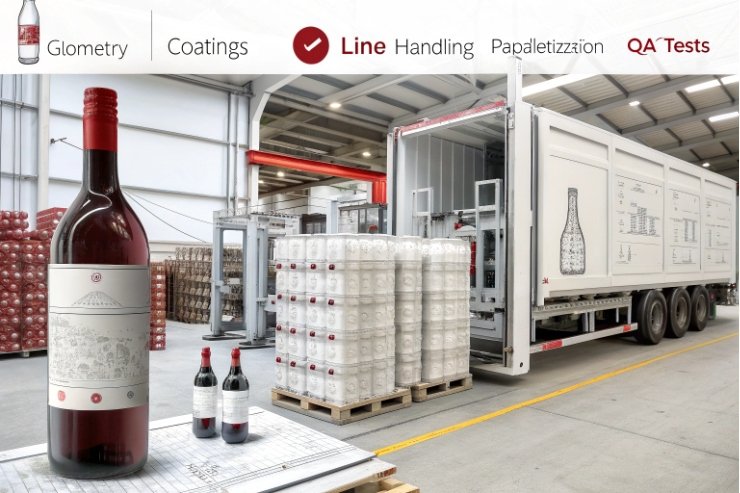
You reduce breakage by combining stronger bottle geometry, correct coatings and line handling, protective palletization and shippers, and targeted QA tests like drop, burst, and thermal shock that match real line and transport abuse.
When design, filling line, and logistics teams work in silos, each one does “okay” work, but bottles still fail at the weakest link. When they work together, small tweaks at every step add up to a big drop in breakage. Below I walk through the key levers: the bottle itself, the way it moves on the line, how it travels on pallets, and which tests give early warning before you ship thousands of cases.
Which bottle design tweaks most improve impact strength and breakage resistance?
Breakage often gets blamed on transport or operators, but many failures start in the bottle drawing board stage with sharp corners, thin heels, or weak punts.
Gentle shoulder and heel radii, adequate base and wall thickness, a well-designed punt, and good weight distribution all raise impact strength, while keeping a classic wine look and reasonable glass weight.
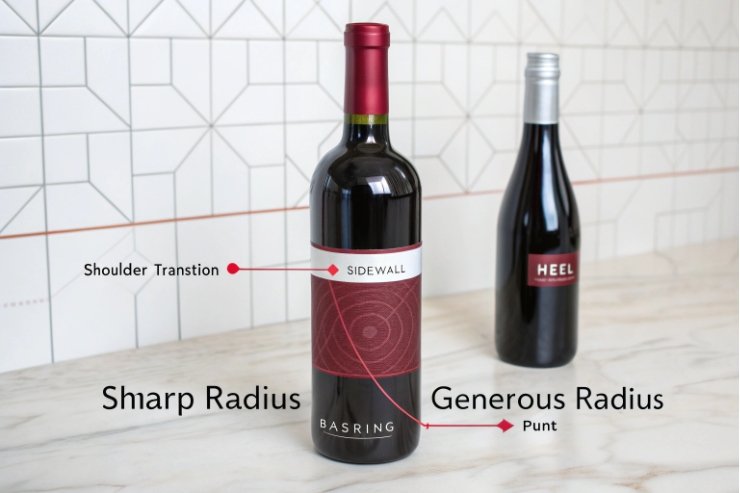
Where wine bottles usually break
In real returns and lab work, most glass failures cluster in a few zones:
- Heel and base ring
- Shoulder transition
- Sidewall scuffs turning into cracks
- Thin spots from poor gob distribution
These areas see the highest impact when bottles hit each other, rails, or case walls. They also carry most of the vertical load in stacked pallets. If geometry is harsh or glass too thin, microcracks from small hits can grow into full breaks later.
How design details change strength
Some design changes give a big boost without changing the style much:
| Design feature | Effect on strength | Practical guideline |
|---|---|---|
| Shoulder radius | Reduces stress at transition | Use generous radius, avoid sharp “cliffs” |
| Heel radius | Lowers impact stress at base edge | Smooth heel curve, no “knife” corners |
| Base thickness | Improves impact and top-load capacity | Keep a solid base ring, avoid weak spots |
| Punt depth and shape | Spreads load and stiffens base | Use consistent, centered punts |
| Wall thickness | Raises impact margin | Target consistent, not just “thicker” walls |
| Embossing / debossing | Can create stress risers | Keep relief away from high-stress zones |
A deeper, well-formed punt can stiffen the base and help distribute vertical load. But an off-center or very uneven punt can do the opposite and introduce stress. So drawing and mold quality matter as much as the nominal depth.
Balancing weight, strength, and sustainability
Many wineries now push for lighter bottles to cut CO₂. This is possible, but only when geometry and process control improve at the same time. A smart lightweight design:
- Uses more radius and fewer sharp transitions
- Keeps glass where it works hardest (heel, shoulder, finish)
- Avoids “cosmetic” mass like very thick punts that add weight but not real strength
In practice, stepping down weight in stages works well. You move from a heavy “icon” bottle to a slightly lighter one, monitor breakage and QA data, then decide if the next small reduction is safe. At each step, the drawing and mold set must support stable glass distribution, or you simply trade solid heavy bottles for thin, fragile ones.
How do coatings and low-friction conveyors cut scuffing and line breakage?
Many bottles leave the glass plant strong enough, then lose strength on the filling line because of abrasion and hard contacts that nobody notices day to day.
Hot-end and cold-end coatings, plus smooth, low-COF conveyors and well-set guides, cut scuffing and microcracks, so bottles keep their original strength instead of slowly weakening as they move through the line.
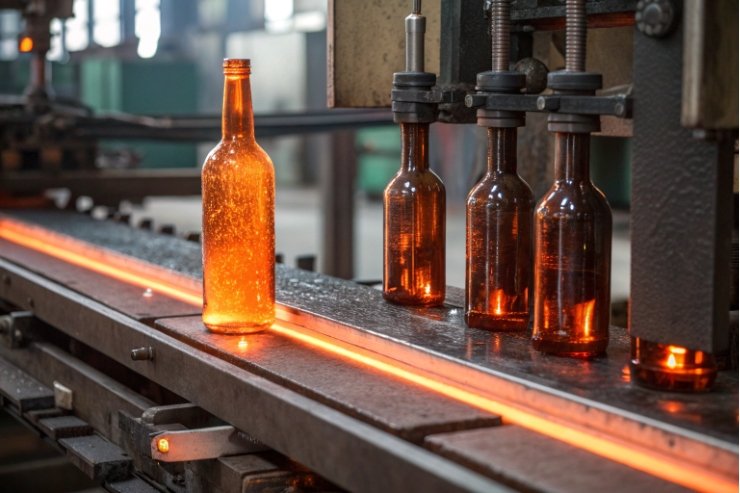
What hot-end and cold-end coatings really do
Fresh glass is strong, but only while the surface stays smooth. Tiny scratches act like crack starters. Coatings protect this surface:
- Hot-end coating (often tin oxide) goes on near the forming stage. It bonds to hot glass and makes a hard, thin base layer.
- Cold-end coating (often polyethylene or similar) is sprayed on later. It adds a slippery top layer that reduces glass-to-glass friction.
Together, these hot-end and cold-end coatings 1:
- Cut scuffing when bottles rub in bulk, on conveyors, or in cases
- Improve resistance to impact, because fewer microcracks form
- Let bottles survive more line cycles for returnable systems
If coating levels drop or coverage is uneven, you may see more “mysterious” breaks where bottles seem fine at the plant but fail after filling and transport.
Conveyor design, COF, and handling
Even with good coatings, harsh line hardware can damage glass fast. Key points:
| Area | Risk | Improvement ideas |
|---|---|---|
| Side rails / guides | Glass-to-metal rubbing, heel hits | Use plastic covers, correct height and angle |
| Dead plates / gaps | Base chipping, tipping | Minimize gaps, keep transfers smooth |
| Accumulation zones | Bottle-to-bottle scuffing | Control back pressure, use low-COF belts |
| Dividers / combiners | Sudden impacts and jams | Gentle spacing screws, speed matching |
Low-friction (low-COF) conveyor belts and rail materials, plus controlled lubrication, let bottles slide instead of grab and jerk. This reduces both tip-over events and scraping.
Operating discipline on the line
Design is one side. Daily practice is the other. Small things matter:
- Keep speed differences between conveyors small
- Avoid running bottles hard into closed gates
- Remove or cover any protruding bolts or sharp edges
- Set side guides just close enough to control, not squeeze
When we audit lines, we often find that a few tight guides, one bad transfer, or a rough metal edge cause most of the visible scuff bands and heel chips. Fixing these does not need big capital. It needs attention and clear line standards.
What palletization, dividers, and wrapping schemes best protect wine in transit?
A strong, well-handled bottle can still fail inside a weak carton or unstable pallet. Shipping conditions add vibration, drops, compression, and changing humidity.
Good case design, dividers or molded pulp, stable pallet patterns, strong wrap, and basic rules like zero pallet overhang and dunnage bags cut transit damage far more than extra glass weight alone.
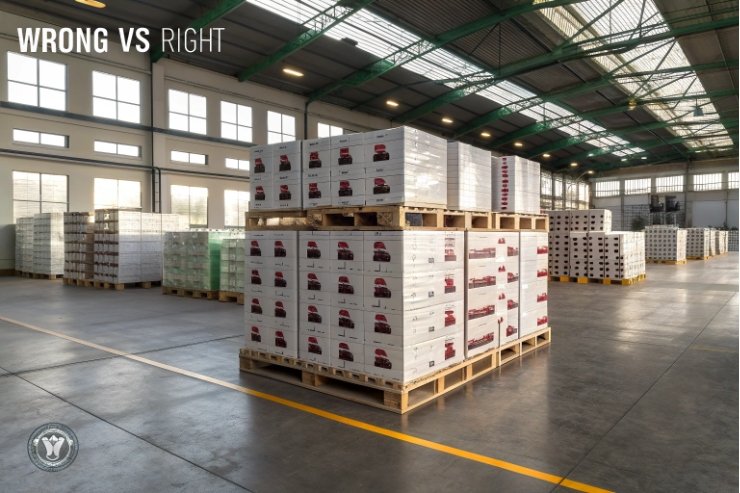
Case and divider systems
Inside the shipping case, the main goal is to prevent glass-on-glass contact and limit how far each bottle can move when the truck hits a bump or the pallet tilts slightly. Common solutions:
- Corrugated dividers (simple, flexible, low cost)
- Molded pulp trays (good shock absorption, good for wine)
- Foam inserts (high protection, higher cost, less green image)
A quick way to compare:
| Solution | Protection level | Cost | Sustainability / image |
|---|---|---|---|
| Corrugated grid | Medium | Low | Good, widely recycled |
| Molded pulp | High | Medium | Very good, “eco” look |
| Foam inserts | Very high | Higher | Weak, often not recyclable |
For long export routes or fragile extra-light bottles, molded pulp often gives the best balance between protection and brand image. It wraps the bottle in a softer, energy-absorbing nest, so drops and side hits cause less peak stress on the glass.
Building stable pallets
On the pallet, the unit load must act like one block, not a stack of loose boxes. Good practice includes:
- No overhang: boxes must sit fully inside the pallet footprint
- Strong, stiff pallet top decks to reduce carton crushing
- Interlayer sheets between layers to spread load and add friction
- Corner posts and edge protectors to support stretch film and prevent crushing
Humidity also matters. Wet or very humid storage can cut corrugated compression strength a lot, so the same stack height that worked in dry conditions may fail in a damp warehouse. For long sea shipments, moisture-resistant board grades or better ventilation can pay off.
Stretch wrapping or shrink hooding needs correct pattern and tension. Too loose, and the load shifts. Too tight, and cases crush, pushing bottles into each other.
Protecting loads inside the trailer or container
Even a good pallet can fail if it slides or tips inside a trailer. Simple tools help, and they are explicitly recognized in the FMCSA cargo securement rules 2:
- Inflatable dunnage bags fill voids between loads and walls
- Load bars or straps prevent pallets from walking forward under braking
- Choosing vehicles with better suspension reduces vibration peaks
When breakage shows up at random corners of the truck, not just at the bottom of stacks, it often points to load shift or hard impacts during transport rather than weak bottles.
As a rule, if you change pallet pattern, case board grade, divider design, or wrap scheme, it is smart to re-check performance with a combined vibration and drop test protocol, not just a simple static stack test.
Which QA tests predict real-world line and logistics durability?
You can keep guessing and reacting to breakage, or you can build a test suite that finds weak points before full-scale rollout.
Drop, vertical load, internal pressure (burst), and thermal shock tests on empty bottles, plus ISTA-style vibration and drop tests on full shippers, give a realistic picture of how bottles and packs will behave on lines and in transit.
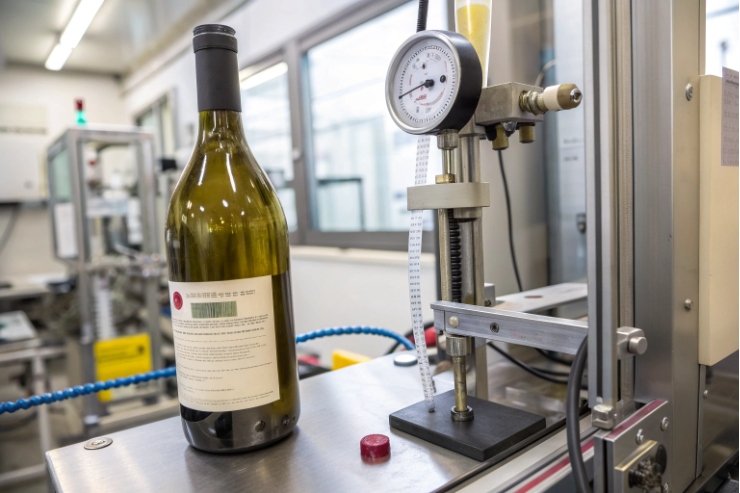
Bottle-level strength tests
At the glass plant or incoming inspection, several tests are common:
- Internal pressure / burst test: checks how much pressure an empty bottle can take before it fails (see ISO 7458:2004 internal pressure resistance test methods 3).
- Vertical load (top load): checks how much axial force the bottle can carry (see ISO 8113:2004 resistance to vertical load 4).
- Impact test: pendulum or similar test to see how the sidewall reacts to a controlled hit.
- Thermal shock (ΔT): measures how big a temperature jump the bottle can survive (see ASTM C149 thermal shock resistance of glass containers 5).
These tests help confirm that the design and forming process give a strong, consistent bottle. If you track results over time, shifts in any value may warn of mold wear, gob issues, or coating problems.
Shipper and pallet-level tests
Bottles do not travel alone, they travel in boxes on pallets. So packaging QA should include:
- Drop tests on full cases (flat, edge, and corner drops)
- Random vibration tests that simulate truck or sea freight
- Compression tests on stacked cases or full pallets
Widely used standards like ISTA 3A test procedure 6 give structured test sequences that combine drops and vibration. They help you see not just “does it break”, but “where and how does it break”. For distribution-focused sequences, many teams also benchmark against ASTM D4169 performance testing of shipping containers and systems 7, especially when routes, handling, or pallet patterns change.
A simple mapping:
| Test type | Focus area | Helps answer |
|---|---|---|
| Burst / pressure | Bottle wall and finish strength | Safe for line pressure and handling? |
| Top load | Base, heel, and finish under stack | Safe under planned pallet heights? |
| ΔT thermal shock | Glass surface and annealing | Safe for hot/cold process and storage? |
| Case drop | Dividers, carton, bottle geometry | Safe under manual handling and bumps? |
| Vibration (ISTA-type) | Pallet stability, carton, dividers | Safe on real transport routes? |
When lab results and field breakage do not match, that is a signal to update the test profile. For example, you may need to add more side-impact drops or a different vibration spectrum that matches a new route or vehicle type.
In practice, the best setup is simple. Use bottle tests to qualify designs and production. Use shipper and pallet tests to qualify any change in packaging, pallet pattern, or route. Use breakage data from the field to keep both sets of tests honest.
Conclusion
Stronger wine bottles come from many small gains: smarter geometry, gentler lines, better pallets, and QA tests that copy real abuse before your customers ever touch the case.
Footnotes
-
Explains how coatings reduce scuffing and help bottles survive high-speed filling lines. ↩ ↩
-
Defines dunnage and dunnage bags and sets basic requirements for preventing load shift in transit. ↩ ↩
-
Standard overview of internal pressure resistance testing methods for glass containers. ↩ ↩
-
Standard overview for measuring glass container resistance to vertical (top) load. ↩ ↩
-
Standard description for evaluating thermal shock resistance of commercial glass bottles and jars. ↩ ↩
-
Overview of ISTA 3A sequence combining drops and vibration for packaged-product performance. ↩ ↩
-
Describes a structured distribution hazard test sequence for shipping units and packaging systems. ↩ ↩






