
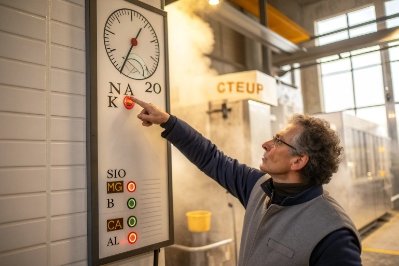
Scratches and scuffs look minor at first. Then pallets rub, conveyors bite, and premium bottles start looking cheap before they reach the customer.
Glass bottle hardness can be increased by tightening the network with SiO₂ and Al₂O₃, stabilizing with CaO/MgO, and controlling alkalis. The key is to raise hardness while keeping viscosity and devitrification risk inside your forming window.
A practical roadmap to harder bottles without factory pain
Hardness is not a single “magic oxide”
Hardness in glass comes from how the network resists local indentation and scratch initiation. A tighter, more connected network usually gives higher hardness. A more “open” network usually gives lower hardness. This is why network formers and intermediates matter more than decorative colorants when the goal is real wear resistance.
In soda-lime container glass 1, the most practical formulation levers are:
-
Increase network connectivity: modest shifts in SiO₂ and Al₂O₃ usually increase hardness and also improve chemical durability.
-
Improve stabilization: adequate CaO and MgO reduce ion mobility and support a more durable surface over time.
-
Control modifiers: excess Na₂O/K₂O makes melting easier but can reduce hardness and raise surface weathering risk.
Hardness gains from formulation are often incremental, not dramatic. A “big jump” in hardness usually comes from surface strengthening processes, coatings, or both. Still, formulation is the foundation. When the base glass is chemically stable and less prone to weathering, the surface stays smoother longer. That gives a real improvement in abrasion performance in service.
Use hardness goals that match what buyers see
Buyers rarely ask for Vickers hardness 2. They complain about scuffs, frosting, dull panels, and label damage after transport. So the best hardness program ties formulation to real wear tests and real logistics conditions.
| What you want to improve | Best formulation direction | What can go wrong | What to measure each shift |
|---|---|---|---|
| Scratch and scuff resistance | +SiO₂, +Al₂O₃, stable CaO/MgO | Viscosity rises, forming slows | Forehearth stability, gob weight trend |
| Pallet wear and rub marks | Stable chemistry + lower weathering tendency | Haze growth, dulling | Abrasion test trend, haze checks |
| Surface durability after washing | +Al₂O₃, +MgO (balanced) | Devitrification risk | Stones/cords rate, devit monitoring |
| Consistent appearance | Stable cullet chemistry | Color drift, inclusions | ΔE trend, defect mapping |
A hardness upgrade only matters if it survives production. The next sections break down what hardness really means, why it matters for abrasion, how to raise it without harming formability, and how ion-exchange hybrids can add margin.
If hardness is treated as a system goal, not a single recipe tweak, the results stay stable at scale.
What determines surface and bulk hardness in glass bottle?
Surface damage happens fast. Bulk properties change slowly. When people mix them up, they choose the wrong fix and waste weeks.
Surface hardness depends on the glass network near the surface, surface hydration/weathering, and micro-flaws. Bulk hardness depends on overall composition and structure. Both are shaped by SiO₂/Al₂O₃ connectivity and by alkali and alkaline-earth balance.
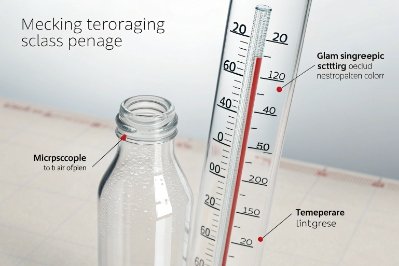
Surface hardness is where real life happens
Most bottle “hardness problems” start at the surface. Conveyors, guides, and case packing all create micro-scratches. Those scratches grow faster when the surface is chemically weak or already hydrated. A glass that weathers easily can develop a softer, more reactive surface layer. This layer can scratch sooner, even if the bulk glass is fine.
Composition helps surface hardness by reducing ion mobility 3 and reducing surface attack:
-
Higher Al₂O₃ reduces hydrolytic attack and keeps the surface more stable.
-
Adequate CaO/MgO stabilizes the network and reduces alkali leaching.
-
Lower Na₂O/K₂O reduces the supply of mobile ions that feed surface exchange.
Bulk hardness is the material baseline
Bulk hardness is the resistance to indentation inside the glass. It is mainly controlled by the network structure across the whole melt. Bulk hardness matters when a bottle sees point contact loads, impact events, and long-term wear in returnable systems. Still, bulk hardness alone does not guarantee scratch resistance. The surface condition often dominates.
Hardness is not the same as toughness
Harder glass does not always mean safer glass. Hardness can increase while fracture toughness 4 stays similar or even drops. This is why a hardness program should always track breakage and stress behavior. In my experience, the best programs improve surface stability and handling conditions first, then adjust composition in small steps.
| Property | What it describes | What composition improves it | What else controls it |
|---|---|---|---|
| Surface hardness | Scratch initiation resistance | +Al₂O₃, balanced CaO/MgO, controlled alkali | Weathering, coatings, handling damage |
| Bulk hardness | Indentation resistance | +SiO₂, +Al₂O₃ (within window) | Melt homogeneity, defects |
| Scratch resistance | Real-world scuff performance | Stable surface chemistry | Conveyor design, packaging friction |
| Breakage risk | Crack growth and flaw sensitivity | Indirect only | Annealing, surface flaws, design |
Once the team separates surface and bulk, the next question becomes easy: why hardness matters so much in abrasion and pallet wear.
Why higher hardness resists abrasion and pallet wear?
A bottle can pass strength tests and still look destroyed after shipping. That is a hardness and abrasion story, not a burst-pressure story.
Higher hardness helps bottles resist abrasion because the surface is less likely to form deep scratches under the same rub force. Fewer deep scratches means fewer visible scuffs and fewer crack starters during pallet vibration and case movement.
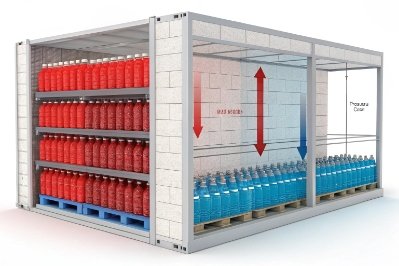
Abrasion is a repeated micro-damage process
Pallet wear is not one big impact. It is thousands of small contacts:
-
bottle-to-bottle rubbing in cases
-
vibration during transport
-
guide rail contact on the line
-
carton friction and slip-sheet movement
Each contact can create a micro-scratch. If the surface is softer or chemically weaker, scratches form easier and grow deeper. Deep scratches matter because they do two bad things:
1) They look ugly fast.
2) They reduce strength by acting like crack starters.
Higher hardness reduces scratch depth at the same load
Harder surfaces tend to form shallower grooves for the same contact event. Shallow grooves are less visible and less dangerous. This is why premium spirits and cosmetics often demand better abrasion performance even when fill conditions are mild.
Still, hardness is not the only factor. Friction matters too. That is why “hardness” projects often succeed when formulation, hot-end/cold-end treatments, and packaging friction controls are improved together.
Why pallet wear is also an optical problem
Scuffing changes surface roughness. Roughness scatters light. Scattering makes bottles look hazy or dull, even when color is correct. This is why buyers sometimes report “color change” when the real issue is surface scatter from wear.
| Wear driver | What it does | Why hardness helps | Extra control that matters |
|---|---|---|---|
| Bottle-to-bottle rub | Creates scratches and scuffs | Lowers scratch depth | Partition design, pack tightness |
| Vibration in transit | Repeats micro-contacts | Reduces cumulative damage | Pallet wrap and cushioning |
| Guide rail friction | Adds line scuffs | Resists gouging | Rail material and lubrication |
| Case friction | Causes dulling | Reduces surface roughness growth | Carton spec and slip sheets |
Hardness is a visible quality driver. But raising hardness by composition alone can raise viscosity and slow forming. The next section explains how to raise hardness without harming formability.
How to raise hardness without harming formability?
A recipe that is harder but cannot form at speed is not a win. The right solution keeps the viscosity curve inside the working window and avoids devitrification.
Raise hardness by increasing network strength (SiO₂, Al₂O₃) in small steps, while using CaO/MgO to stabilize and keeping Na₂O/K₂O controlled. Validate each step against viscosity, forming defects, and devitrification risk.

Step 1: Use Al₂O₃ as the “hardness + durability” lever, but respect viscosity
Al₂O₃ is one of the most effective practical levers in container glass because it improves network connectivity and hydrolytic resistance 5. It also helps lightweighting because the glass keeps durability while wall thickness drops. The risk is viscosity. If Al₂O₃ goes up too fast, forehearth temperatures must rise to hold gob weight, and forming defects can spike.
A safe approach is a tight Al₂O₃ window plus a reactive, well-melting alumina source. Poor dissolution can create stones and cords, which hurt both appearance and strength.
Step 2: Stabilize with CaO/MgO instead of pushing alkali for meltability
Hardness programs fail when a plant tries to compensate viscosity by adding more Na₂O. That can undo durability gains and increase CTE and stress sensitivity. A better approach is to keep alkalis controlled and use balanced CaO/MgO to stabilize performance. MgO-rich dolomitic balance often supports long-term weathering and alkaline wash performance, which keeps the surface harder in real service.
Step 3: Lock cullet chemistry so the hardness window stays real
Cullet drift can quietly raise alkalis or dilute stabilizers. Then hardness and durability drift too. A hardness-focused SKU needs cullet rules that prevent mixed-family glass and heavy contamination. Closed-loop or tightly verified cullet streams reduce variability and keep viscosity and hardness stable.
| Formulation move | Hardness impact | Formability impact | How to manage the risk |
|---|---|---|---|
| +SiO₂ (small step) | Increases | Viscosity rises | Confirm furnace energy and fining stability |
| +Al₂O₃ (small step) | Increases strongly | Viscosity rises faster | Use reactive sources, monitor stones |
| +MgO (balanced) | Supports long-term surface hardness | Working range can shift | Keep devit checks and defect mapping |
| -Na₂O/K₂O (avoid excess) | Improves durability and surface stability | Meltability drops | Improve heat balance, do not chase alkali |
| Better cullet control | Stabilizes hardness and viscosity | Supply constraint | Cullet COA, sorting, XRF tracking |
This is the core rule: hardness improvement must be linked to viscosity control. The recipe should be tuned with one lever at a time, and the plant should validate with forming KPIs, not only lab hardness numbers.
When the recipe is near the limit, a surface strengthening method can add margin. That brings the final question: do ion-exchange hybrids complement recipe tweaks?
Are ion-exchange hybrids complementing recipe tweaks?
Some programs need a bigger jump in scratch and crack resistance than formulation can deliver alone. This is where ion-exchange ideas enter the conversation.
Yes. Ion-exchange hybrids can complement recipe tweaks by strengthening the surface through alkali ion exchange, while the base formulation is tuned for stable durability and workable viscosity. The best results come when both parts are designed together.
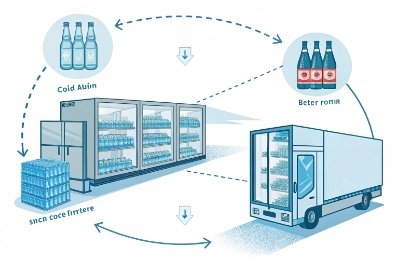
What ion exchange adds that formulation alone cannot
Formulation changes often deliver incremental hardness gains. Ion exchange can deliver a surface compression layer that improves resistance to crack growth and can improve scratch performance in some cases. The basic idea is that smaller ions in the surface are exchanged for larger ions, creating compressive stress 6 near the surface. Compressive stress makes it harder for cracks to open.
This is not a free upgrade. Ion exchange depends on:
-
the alkali content at the surface
-
temperature and time controls
-
surface condition and cleanliness
So the base glass recipe still matters. If the surface weathers fast or leaches alkali, the process becomes less repeatable.
Why “hybrid” is the right word for bottle programs
Most high-volume bottle plants will not use ion exchange on every SKU. Still, hybrid strategies are realistic:
-
Use a more durable base composition (higher Al₂O₃, balanced CaO/MgO).
-
Apply ion exchange or localized strengthening only on high-value SKUs or thermal shock 7 critical designs.
-
Combine with abrasion-control steps (handling and packaging friction control).
This hybrid approach keeps cost realistic while improving performance where it matters most.
How to judge if ion exchange is worth it for a bottle
The decision should be based on where losses occur:
-
If the problem is mainly scuff appearance, coatings and friction control may be more cost-effective.
-
If the problem is crack-driven breakage under thermal shock or impact, ion exchange can add real margin.
| Requirement | What recipe tweaks do well | What ion exchange adds | Main limitation |
|---|---|---|---|
| Better long-term surface stability | Strong improvement | Indirect benefit | Needs stable cullet and chemistry |
| Higher scratch resistance | Moderate improvement | Can improve via stronger surface state | Process cost and uniformity |
| Lower breakage from cracks | Indirect improvement | Strong improvement via compression | Needs tight process control |
| Maintain formability | Must be managed carefully | No help on melting | Still limited by viscosity curve |
Ion exchange works best when it sits on top of a stable, durable glass composition. When both parts are aligned, a bottle can be lighter, cleaner in appearance, and more resistant to wear in the supply chain.
Conclusion
Harder bottles come from a tighter network and a stable surface: more SiO₂/Al₂O₃, balanced CaO/MgO, and controlled alkalis. Ion-exchange hybrids can add extra surface margin for premium SKUs.
Footnotes
-
A guide to the most common type of glass used for beverages and food containers globally. ↩ ↩
-
Learn how the Vickers test measures the resistance of a material to plastic deformation from a point. ↩ ↩
-
Understanding how ions move within the glass structure, affecting chemical durability and surface stability. ↩ ↩
-
Detailed explanation of a material’s ability to resist the propagation of cracks under stress. ↩ ↩
-
An international standard for testing how glass surfaces resist chemical attack by water. ↩ ↩
-
Stress applied to a material that results in its compaction, often used to strengthen glass surfaces. ↩ ↩
-
How glass reacts to rapid temperature changes, which can lead to structural failure or cracking. ↩ ↩






