
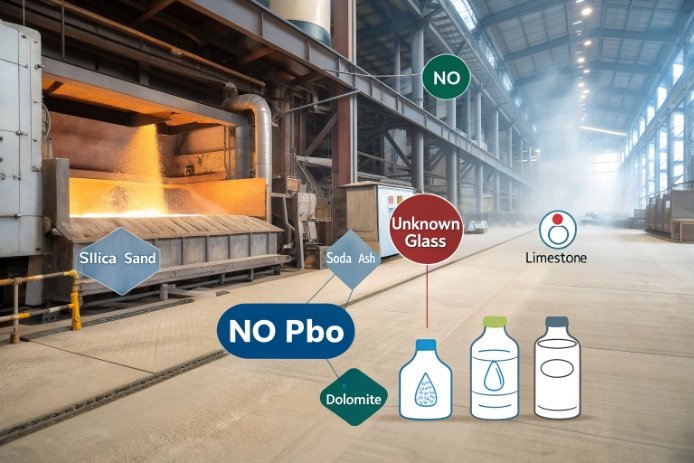
A bottle can look perfect and still fail a buyer’s heavy-metal screen. One surprise trace element can stop a shipment, delay a launch, and damage trust.
Lead-free bottle glass starts with a standard soda-lime or borosilicate recipe that uses zero PbO, plus strict control of cullet and decorations. The real work is preventing trace lead from recycled streams, batch additives, and printing/enamels while keeping clarity, strength, and chemical resistance stable.
Lead-free design is a recipe plus a contamination firewall
Most container glass 1 is already “lead-free by design” because modern bottle formulas are based on silica, alkali, and alkaline earth oxides, not lead. The hard part is proving lead stays out across real production conditions. That means the formulation strategy must include two layers:
1) A PbO-free base composition that meets performance targets (clarity, strength, chemical durability, processability).
2) A contamination firewall that blocks trace lead from raw materials, cullet, furnace dust, and especially decorative systems.
In practice, a buyer’s “lead-free” requirement can mean two different checks:
-
Total lead content in the glass (a composition check).
-
Lead release / migration under a food-contact style extraction test (a performance check).
A plant that only controls the base recipe can still fail because lead enters through a cullet lot, a recycled stream, or even a label ink used on decorated glass. This is why the best lead-free programs are written like a control plan, not like a single recipe sheet.
Lead-free program blueprint
| Control area | What can go wrong | What “good” looks like | Simple control tool |
|---|---|---|---|
| Base composition | PbO accidentally used in special frit/additive | PbO not used at all | Approved material list (AML) + supplier declarations |
| Cullet | Leaded glass mixed into cullet stream | Cullet is container-only and color-sorted | Cullet contracts + lot audits |
| Decorations | Lead in enamels, inks, metallic pigments | Low-heavy-metal decoration system | Vendor DoC + migration tests on decorated area |
| Furnace/handling | Cross-contamination from dust or carryover | Stable, clean handling and traceability | Housekeeping + sampling plan |
| Proof for buyers | Missing documents or weak test scope | Clear COA + compliant test reports | Document pack tied to destination market |
If the goal is export-ready lead-free bottles, the next sections show how to build this in a way that stays affordable and repeatable.
A lead-free bottle is not “one-time clean.” It is “always clean,” even when recycled content and production pressure rise.
Why was lead ever used in glass, and why is it avoided in today’s food, beverage, cosmetic, and pharma packaging?
Lead has a long history in glass, but modern packaging has different priorities: safety perception, regulation, and brand risk.
Lead oxide was used because it boosts refractive index, improves brilliance, and lowers working temperature in some specialty glasses. It is avoided in packaging today because lead is toxic, regulated in many packaging frameworks, and even trace contamination can trigger compliance failures and consumer backlash.
Why lead was attractive in glassmaking
Lead oxide (PbO) can make glass easier to work with and more visually striking. It can raise refractive index 2 and improve “sparkle,” and it can lower viscosity and working temperature in certain glass systems. These benefits fit decorative crystal, optical components, and specialty shielding applications much more than mass bottle production.
Bottles do not need sparkle. Bottles need:
-
stable clarity or stable color,
-
mechanical strength for filling lines and logistics,
-
chemical resistance to beverages, acids, alcohol, and cosmetics,
-
predictable recycling behavior.
PbO does not belong in that list.
Why packaging avoids lead now
Packaging is a high-volume consumer product. Even a small risk can scale fast. Lead is also treated as a priority heavy metal across multiple compliance systems. Many buyers want both:
-
No intentional addition of lead, and
-
Very low incidental lead, even when recycled content is high.
Pharma adds an extra layer. Drug packaging is not only about food contact. It is about extractables and leachables 3, hydrolytic resistance 4, and long shelf life. That pushes procurement teams to prefer established packaging glass families (soda-lime 5 for non-parenteral, and Type I performance glass for many injectable uses) rather than exotic compositions.
Hidden “lead” risk that surprises buyers
Even when the bottle glass itself is clean, lead can appear in:
-
decorated enamels or inks,
-
external coatings,
-
closures and accessories if the request is “full set.”
So the safest path is to treat lead-free as a system claim, not only a glass claim.
Quick comparison for buyers
| Glass type / use | Why it exists | Lead relevance today | Buyer risk level |
|---|---|---|---|
| Lead crystal / decorative | Brilliance and workability | Often contains PbO by design | High (not for packaging) |
| Standard soda-lime bottles | Low cost, strong, recyclable | Designed without PbO | Low (if cullet is controlled) |
| Pharma performance glass | High hydrolytic resistance | Lead is not a normal ingredient | Low (with pharma-grade controls) |
Lead was used for beauty and process benefits in specialty glass. Modern packaging avoids it because safety and compliance are the product now.
What raw materials and cullet controls are critical to prevent trace lead contamination in bottle glass?
Trace lead rarely comes from “pure chemistry mistakes.” It usually comes from supply chain mixing and recycled streams.
Preventing trace lead requires strict cullet sourcing (container-only, audited, color-sorted), raw material supplier qualification, and a zero-tolerance approach to leaded glass streams like CRT or crystal entering the furnace. Decorations and printing systems must also be controlled because they can add lead even when the glass melt is clean.
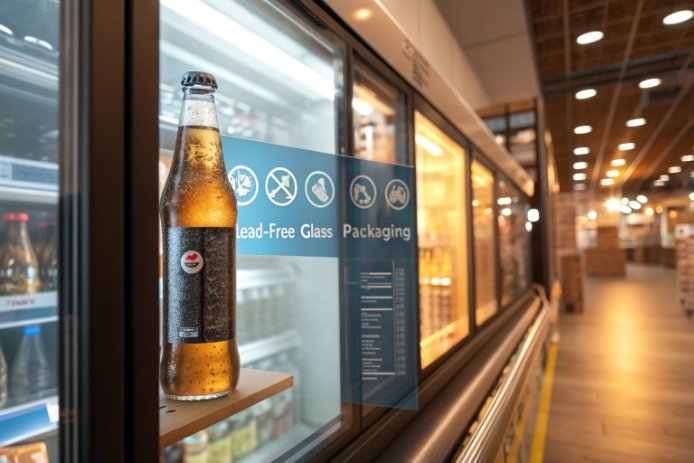
The biggest real-world lead entry points
1) Cullet streams (the #1 risk for trace lead)
Cullet 6 is good for energy and CO₂ goals, but it is also the fastest way to import contamination. The most common lead risk is not normal container cullet. It is “wrong glass” cullet:
-
lead crystal fragments,
-
leaded electronic glass,
-
mixed demolition glass with unknown history.
If a plant uses post-consumer cullet, the program must include:
-
supplier audits,
-
incoming lot screening,
-
contamination limits in contracts,
-
clear rejection rules.
2) Batch raw materials (low probability, high impact)
Sand, limestone, dolomite, feldspar, and soda ash are usually low in lead, but “usually” is not a control plan. A lead-free program sets:
-
supplier qualification,
-
periodic heavy-metal screens on incoming materials,
-
traceability by lot.
This is more important when sourcing changes, when a plant blends lots, or when the product is sold into strict markets.
3) Additives and color systems
Some additives are fine in normal glass control, but they become risky if the supply chain is not clean. Also, specialty colors and decoration systems can bring heavy metals if the wrong pigments or frits are used.
Decorated glass deserves special attention. A bottle can pass a “bulk glass” lead test and still fail a migration test on a decorated lip area if the decoration system is not qualified.
Cullet and raw material control checklist
| Step | What to control | Practical rule | What to record |
|---|---|---|---|
| Cullet sourcing | Only container-grade streams | No mixed demolition glass | Supplier, origin, sorting method |
| Cullet receiving | Lot screening for heavy metals | Test by risk-based frequency | COA + incoming test log |
| Raw materials | Supplier qualification | No unapproved substitutions | Lot traceability + supplier declarations |
| Decorations | Ink/enamel pigment system | Lead-free decoration spec | Decoration vendor DoC + migration tests |
| Furnace | Cross-contamination | Clean handling and return cullet rules | Nonconformance and corrective actions |
When the target is “lead-free with high recycled content,” cullet is the control point that decides success or failure.
Which glass composition adjustments help maintain clarity, strength, and chemical resistance without using lead?
Lead is not needed for bottle performance. The performance levers in packaging glass come from silica network strength, alkali balance, alkaline earth stabilizers, and small durability boosters.
To maintain clarity, strength, and chemical resistance without lead, manufacturers tune a PbO-free soda-lime-silica base using higher silica and controlled alkali, plus durability boosters like Al₂O₃ and balanced CaO/MgO. Process control (redox, fining, annealing) then protects optical and mechanical stability at scale.
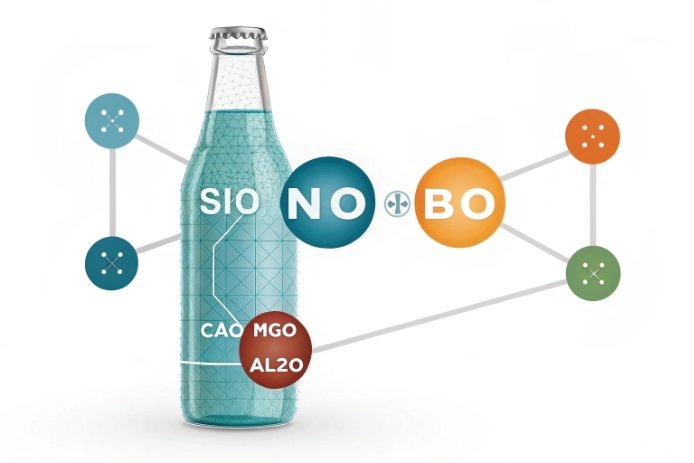
Clarity: win the impurity battle, not the Pb battle
Clarity problems in bottles mostly come from iron and other trace ions, not from missing lead. So the clarity plan is:
-
low-iron sand,
-
controlled cullet color mix,
-
stable furnace redox to avoid green shift,
-
clean batch handling to reduce cords and stones.
Lead-free does not reduce clarity. Poor impurity control reduces clarity.
Strength: composition helps, but process and design finish the job
Bottle strength depends on:
-
surface quality (scratches reduce strength fast),
-
lightweighting design choices,
-
optional surface treatments.
Composition adjustments that support strength and process stability:
-
slightly higher Al₂O₃ to improve network rigidity and durability,
-
balanced CaO/MgO for stability and workable viscosity,
-
avoid excessive Na₂O that can reduce chemical resistance.
The target is not “hard glass.” The target is “stable glass that forms consistently.”
Chemical resistance: focus on alkali and the network
For food, beverage, cosmetics, and many pharma uses, chemical durability matters in water, acids, alcohol, and sometimes oils. A stronger network resists leaching and surface attack. Common levers:
-
increase SiO₂ within process limits,
-
add Al₂O₃ in a controlled range,
-
balance alkali and alkaline earth oxides to keep melt and forming stable.
For pharma containers, buyers often ask for performance-based classifications and hydrolytic resistance. That is a testing and quality system issue as much as a formula issue.
A practical “lead-free composition mindset”
| Performance target | Composition lever (PbO-free) | Process lever | Common buyer symptom if missed |
|---|---|---|---|
| High clarity (flint) | lower impurities, stable network | redox + refining control | green cast, haze, cords |
| Strong in logistics | balanced CaO/MgO/Al₂O₃ | annealing + handling | higher breakage, scuffs |
| Chemical resistance | higher SiO₂ / Al₂O₃, controlled Na₂O | clean melt + stable cooling | taste issues, surface etching |
| High recycled content | tolerant base recipe + controls | cullet sorting + QC | color drift, heavy metal spikes |
Lead-free bottle glass is not a special chemistry trick. It is a standard, proven glass family run under tighter impurity and supplier control.
What testing and compliance documents should buyers request to verify lead-free glass bottles for export markets?
Buyers often ask “lead-free?” but forget to define the proof. The right document pack prevents delays at customs and prevents disputes after delivery.
Buyers should request a market-matched compliance pack: heavy-metals content limits for packaging, food-contact declarations and GMP statements, lead/cadmium release testing for glass articles (especially if decorated), and pharma performance tests when relevant. A COA tied to lot traceability is the backbone.
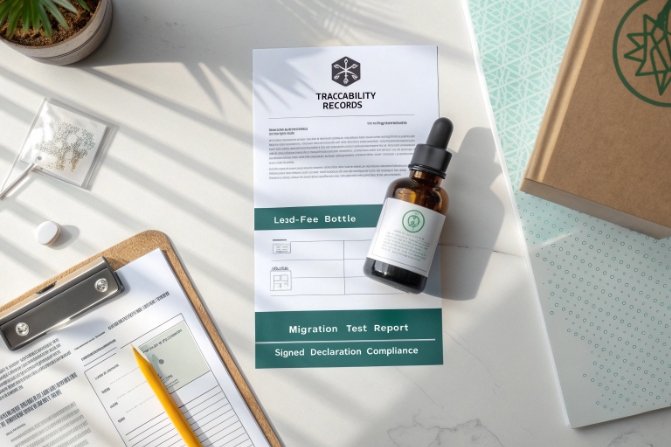
The minimum document pack that works in most export cases
1) Certificate of Analysis (COA) by lot
Ask for a COA that includes:
-
key oxides for the glass family,
-
heavy metal screening for Pb (and often Cd, Hg, Cr(VI) as packaging frameworks require),
-
traceability: production date, furnace/line, lot number.
A COA without traceability is not a control document. It is only marketing.
2) Heavy metals in packaging statement
Many packaging systems limit heavy metals in packaging components. Buyers should request a declaration that the bottle and its packaging components meet the relevant heavy metals limits for the destination market. If the shipment includes caps, pumps, droppers, or printed boxes, the statement must cover the full packaging set, not only the bottle.
3) Food-contact compliance declaration
For food and beverage, request a declaration aligned to the destination region’s food-contact 9 framework and the manufacturer’s GMP 10 system. In Europe, buyers typically expect a Declaration of Compliance under the EU food-contact framework rules and evidence of GMP controls for food-contact materials.
4) Lead/cadmium release testing when risk is higher
For plain, undecorated bottles, bulk composition and supplier control may be enough. For decorated bottles, printed logos, or enamel-coated areas, request lead/cadmium release testing on the finished decorated product, not only the base glass.
5) Pharma-specific compliance, when relevant
If the glass is used for pharmaceutical packaging (especially injectable or sensitive products), request:
-
hydrolytic resistance and relevant performance classifications,
-
documentation aligned with pharmacopoeia expectations used by the buyer’s market.
A buyer-friendly request table
| Buyer request | What to ask for | When it matters most | Common mistake |
|---|---|---|---|
| “Lead-free glass” | Pb total content test + lot COA | all markets | only a generic statement, no lot data |
| “Packaging heavy metals compliant” | declaration for Pb/Cd/Hg/Cr(VI) sum limits | EU and many US states | covering bottle only, not full packaging set |
| “Food-contact compliant” | EU framework DoC + GMP statement, or US food-contact approach docs | food, beverage | mixing up FDA-only with EU needs |
| “Safe decorated bottles” | migration/release test on decorated area | printed/enamel bottles | testing base glass only |
| “Pharma grade” | hydrolytic resistance and performance tests | pharma | using food-contact tests as a proxy |
A strong supplier will not resist these requests. A strong supplier already has them ready because the control plan demands it.
Conclusion
Lead-free bottle glass is simple chemistry and strict discipline: use proven PbO-free compositions, block lead entry through cullet and decorations, and prove compliance with lot-based testing and documents.
Footnotes
-
Industry data on the recyclability and production of glass containers. ↩
-
Optical property measuring how light propagates through the glass medium. ↩
-
Testing for chemical compounds that might migrate from packaging into drugs. ↩
-
Measure of how well glass resists chemical durability attacks from water. ↩
-
The most common type of glass used for bottles and windows. ↩
-
Recycled broken or waste glass used to facilitate melting. ↩
-
Ceramic composition used for fusing or enameling on glass surfaces. ↩
-
Heat treatment process to remove internal stresses from formed glass. ↩
-
Regulations ensuring materials are safe to come into contact with food. ↩
-
System for ensuring that products are consistently produced and controlled. ↩






