
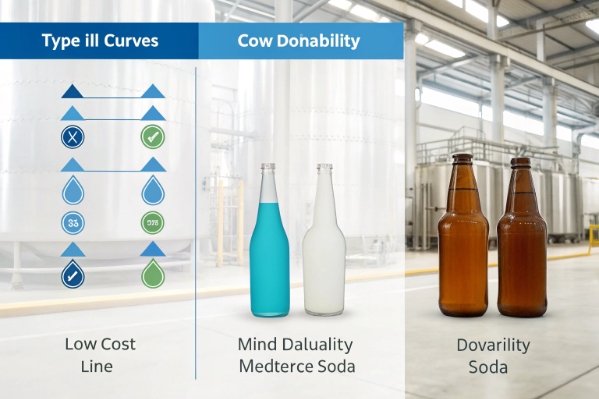
Every penny counts in packaging procurement, but cutting corners on glass quality for chemically aggressive products can lead to expensive recalls.
To balance cost and resistance, manufacturers must match the glass "Type" to the product’s pH aggression. For most applications, treated Soda-Lime glass (Type II) offers the chemical durability of Borosilicate (Type I) at a fraction of the cost, bridging the gap between performance and budget.
The Economics of Durability
In my 20 years at FuSenglass, the most common mistake I see buyers make is "over-specifying" or "under-specifying." Some demand pharmaceutical-grade Borosilicate 1 for a simple lotion (wasting money), while others put a high-pH hair relaxer in standard untreated flint glass (inviting disaster).
The goal is to find the "Sweet Spot"—the lowest cost material that guarantees safety for the shelf life of your product. Glass is not a single material; it is a category. The chemical formulation determines its resistance to the "etching" of alkalis or the "leaching" of acids.
When acids attack, they extract alkali ions (sodium/calcium), which can alter the pH of your liquid. When alkalis attack, they dissolve the silica network itself. Resistance to this is called "Hydrolytic Resistance 2."
For 90% of cosmetic and food products, you do not need the most expensive glass. You need smart engineering. By tweaking the raw material mix or applying surface treatments, we can make standard glass behave like premium glass.
Glass Grade Hierarchy & Cost Structure
| Glass Type | Common Name | Relative Cost | Chemical Resistance | Best Use Case |
|---|---|---|---|---|
| Type I | Borosilicate (Neutral) | $$$$ (High) | Excellent (High Acid/Alkali) | Injectable drugs, Strong Acids. |
| Type II | Treated Soda-Lime | $$ (Medium) | High (Surface De-alkalized) | IV Fluids, Aggressive Serums. |
| Type III | Standard Soda-Lime | $ (Low) | Moderate (Standard) | Beverages, Food, Lotions. |
| Type NP | General Purpose | $ (Lowest) | Low (Non-Parenteral) | Dry goods, Powders. |
Which glass types and durability grades offer the best cost-to-performance for acidic or alkaline products?
Choosing between standard soda-lime 3 and borosilicate is the single biggest cost driver in your packaging bill of materials.
Type II "Sulfur-Treated" Soda-Lime glass offers the best cost-to-performance ratio. It undergoes a surface de-alkalization process that boosts its chemical resistance to near-Borosilicate levels for a fraction of the price, making it ideal for most acidic or alkaline formulations.
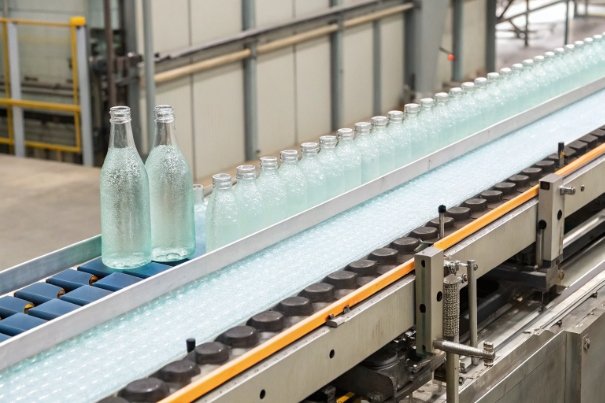
At FuSenglass, we guide clients away from the expensive "Type I" trap unless absolutely necessary. Here is the breakdown of value:
1. Type I Borosilicate (The "Overkill"):
This glass contains Boron Oxide, which locks the silica network together. It is virtually immune to chemical attack. However, it requires extremely high melting temperatures, making it 3-4 times more expensive than standard glass. Unless you are packaging injectable drugs or extremely strong acids (pH < 2), this is usually wasted money.
2. Type III Standard Soda-Lime (The "Standard"):
This is your everyday "High-White" or flint glass. It is cheap and beautiful. For neutral products (pH 5-8), it is perfect. However, if you put a strong alkali in it, the glass will "bloom" or flake. If you put a sensitive water-based acid in it, the glass will leach sodium, raising the product’s pH and potentially destabilizing the formula.
3. Type II Treated Soda-Lime (The "Smart Choice"):
This is the champion of value. We take standard Type III glass and expose it to Sulfur Dioxide 4 ($SO_2$) gas right before it enters the annealing lehr 5. This gas pulls the sodium ions out of the inner surface of the bottle (de-alkalization). The result is a bottle made of cheap materials but with a "skin" of pure, highly resistant silica. It passes most pharmaceutical tests for hydrolytic resistance but costs only marginally more than standard glass.
Cost-Benefit Analysis
| Feature | Type I (Borosilicate) | Type II (Treated) | Type III (Standard) |
|---|---|---|---|
| Acid Resistance | Extreme | High (Surface only) | Moderate |
| Alkali Resistance | High | High (Surface only) | Low |
| Melting Point | High (High Energy Cost) | Standard | Standard |
| Aesthetics | Clear, slightly blue/yellow tint | Clear, slight bloom (washable) | Crystal Clear (High White) |
| Recommendation | Pharma Vials / Ampoules | Aggressive Cosmetics / Toners | Perfume / Food / Standard |
Which formula and raw-material upgrades improve chemical resistance with the lowest cost impact?
Minor adjustments to the batch recipe can significantly toughen the glass network without requiring a complete overhaul of the production line.
Increasing Aluminum Oxide ($Al_2O_3$) and optimizing the "Cullet" (recycled glass) ratio are the most cost-effective formula upgrades. Alumina strengthens the silica network against alkali attack, while controlled cullet usage lowers melting energy costs without sacrificing chemical purity.
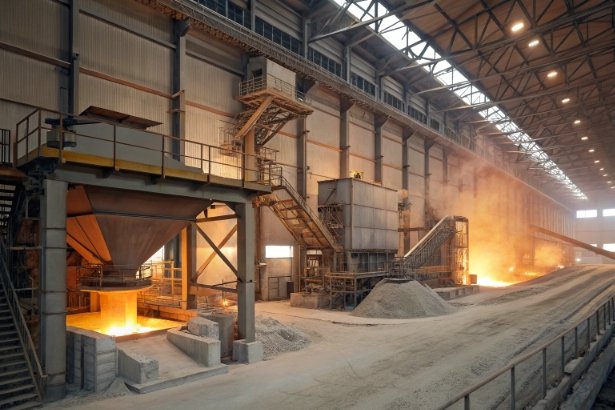
The Science of the Batch
Glass manufacturing is cooking. If you want a tougher cookie, you change the ingredients slightly.
The Alumina Boost ($Al_2O_3$):
Aluminum Oxide 6 is the magic ingredient for chemical durability. It acts as a network stabilizer. In standard bottle glass, we might use 1.5% to 2% Alumina. By bumping this up slightly (usually via Feldspar 7 or Nepheline Syenite 8), we can significantly improve the glass’s resistance to "weathering" and alkali attack. The cost impact is minimal because these minerals are abundant. This is often called "Super-Flint" or modified soda-lime.
The Magnesium Factor ($MgO$):
Replacing some Calcium Oxide ($CaO$) with Magnesium Oxide ($MgO$) (using Dolomite 9 instead of Limestone) lowers the liquidus temperature and improves resistance to devitrification. More importantly, mixed-alkali effects can tighten the glass structure, slowing down ion leaching.
Strategic Cullet Strategy:
Cullet is broken, recycled glass. It melts at a lower temperature than raw sand, saving huge amounts of energy (gas).
-
The Risk: High cullet levels can introduce contaminants or unknown chemical variances.
-
The Fix: Using "Internal Cullet" (waste from our own factory) ensures we know the exact chemistry. We can maintain high chemical resistance at a lower cost by maximizing internal cullet usage, rather than buying unpredictable external post-consumer cullet.
Additive Impact Table
| Ingredient Upgrade | Function | Effect on Durability | Cost Impact |
|---|---|---|---|
| Increase Alumina ($Al_2O_3$) | Network Intermediate | Major Increase. Resists weathering/leaching. | Low (Raw material is cheap). |
| Add Magnesia ($MgO$) | Stabilizer | Moderate Increase. Slows reaction rates. | Low (Switch Limestone to Dolomite). |
| Reduce Sodium ($Na_2O$) | Flux | Increase. Less alkali to leach out. | High (Requires higher melting temp). |
| Low-Iron Sand | Color Purity | Neutral (Mainly aesthetic). | High (Premium raw material). |
When is it more cost-effective to change coatings/closures instead of upgrading the glass formula for acid/alkali resistance?
Sometimes the bottle isn’t the problem—the interaction between the liquid and the headspace is, and fixing the accessory components is far cheaper than melting specialized glass.
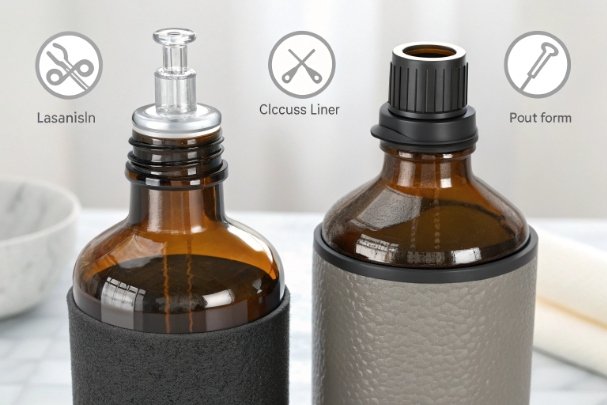
It is more cost-effective to upgrade closures or internal coatings when the chemical attack is localized to the headspace or seal. Applying a silicone internal coating or upgrading to a PTFE-lined cap is significantly cheaper ($0.01-$0.05/unit) than switching the entire production to Borosilicate glass.
The System Approach to Cost
At FuSenglass, we often save clients money by telling them not to change the glass.
Scenario: A client has a Vitamin C serum (Acidic, pH 3). They are worried about leaching and want Type I glass.
The Reality: The acid might leach a tiny amount of sodium from Type III glass, but usually not enough to degrade the product. The real risk is the liquid evaporating or oxidizing the cap.
The Solution: Instead of doubling the bottle price for Type I, we perform Internal Siliconization. We spray a microscopic layer of silicone oil or emulsion inside the bottle. This hydrophobic layer prevents the liquid from ever touching the glass. It stops leaching dead in its tracks. Cost? Fractions of a penny.
The Closure Upgrade:
If your product is alkaline, it might creep up the neck and dissolve the glass finish (rim). Upgrading the glass is hard. Upgrading the liner to a PTFE (Teflon) Faced Liner or a Polypropylene cap (which is alkali resistant) is easy. By ensuring the seal is chemically inert, you mitigate the risk of the glass rim deteriorating, as the exposure is limited.
Intervention Cost Comparison
| Problem | "Nuclear" Option (High Cost) | "Smart" Option (Low Cost) | Savings |
|---|---|---|---|
| pH Shift (Leaching) | Switch to Type I Glass | Internal Siliconization | ~40-60% |
| Finish Corrosion | Switch to Ceramic Glass | PTFE/Teflon Liner | ~80-90% |
| Product Haze | Acid Etching (Frosted) | Internal De-alkalization ($SO_2$) | ~30-50% |
| UV Degradation | Expensive Spray Coating | Amber/Green Mass Color | ~20-30% |
What test plan and purchasing specs (pH range, temperature, shelf life, migration limits) help buyers avoid over-specifying while still preventing field failures?
Precision in your specification sheet prevents you from paying for performance you don’t need, while testing ensures you get the performance you paid for.
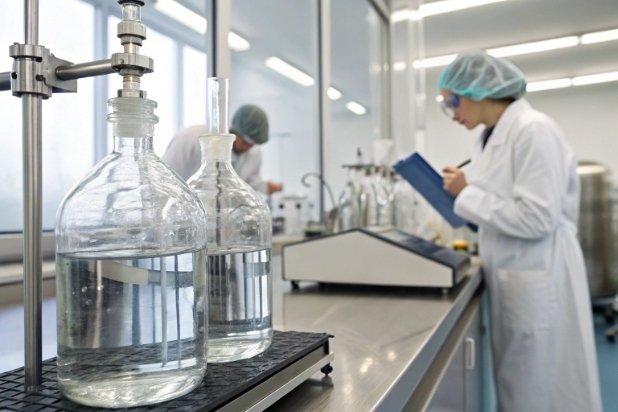
Buyers should specify "Hydrolytic Resistance per USP <660>" limits rather than dictating glass composition. A test plan involving pH stability checks and accelerated aging (40°C for 3 months) will validate if cheaper Type II or III glass is sufficient, avoiding unnecessary Type I costs.
Writing the Right Specs
Don’t copy-paste specifications from a pharmaceutical manual if you are selling face toner.
1. Define Performance, Not Material:
Instead of writing "Must be Borosilicate," write "Must pass USP Type II Hydrolytic Resistance." This allows us (the manufacturer) to use Sulfur-Treated Soda-Lime glass to meet your requirement at a lower cost.
2. The Hydrolytic Resistance Test (The Bible):
This measures how much alkali releases from the glass when boiled in water.
-
Type I Limit: Extremely low release.
-
Type II Limit: Very low release (often sufficient for pH 3-10).
-
Type III Limit: Moderate release (sufficient for pH 5-8).
3. The Real-World pH Challenge:
Test your product in our samples. We recommend a 3-Month Stability Test at 40°C. Measure the pH of your product at the start and end.
-
Pass: pH shift < 0.2.
-
Fail: pH shift > 0.5 (indicates significant leaching).
If Type III glass passes this test with your product, you do not need to upgrade.
4. Migration Limits:
For heavy metals (Lead/Cadmium), simply specify "Compliance with FDA CPG 7117.06 and Prop 65 10." Standard glass passes this easily. Do not set arbitrary "Zero" limits that require expensive pure-silica sands unless legally required.
Smart Specification Tiering
| Spec Parameter | Standard Requirement (Lowest Cost) | Enhanced Requirement (Mid Cost) | Premium Requirement (High Cost) |
|---|---|---|---|
| Glass Material | Type III Soda-Lime | Type II (Surface Treated) | Type I Borosilicate |
| Hydrolytic Class | USP/ISO Class 3 | USP/ISO Class 2 | USP/ISO Class 1 |
| Alkali Release | < 8.5 ml (0.02N $H_2SO_4$) | < 0.7 ml (0.02N $H_2SO_4$) | < 1.0 ml (0.02N $H_2SO_4$) |
| Testing Protocol | Visual Inspection | + pH Shift Test | + Full Migration Study |
Conclusion
Balancing cost and quality is about understanding "Good Enough." By utilizing Type II surface treatments and smart testing protocols, you can achieve premium chemical resistance without the premium price tag of pharmaceutical glass.
Footnotes
-
Detailed information on the superior thermal and chemical resistance of borosilicate glass. ↩
-
A technical guide explaining the measurement of glass resistance to water attack. ↩
-
The most common commercial glass type, composed primarily of silica, soda, and lime. ↩
-
A chemical compound used in surface treatment to enhance the durability of glass containers. ↩
-
A specialized oven used in glass manufacturing to anneal and remove internal stresses. ↩
-
A critical compound used to increase the mechanical strength and chemical resistance of glass. ↩
-
A group of rock-forming tectosilicate minerals used as flux in glassmaking. ↩
-
An igneous rock rich in alumina and alkalis, used to lower the melting temperature of glass. ↩
-
A mineral that provides magnesia and calcium oxide to improve glass melting properties. ↩
-
California legislation requiring warnings about significant exposures to chemicals that cause harm. ↩






