
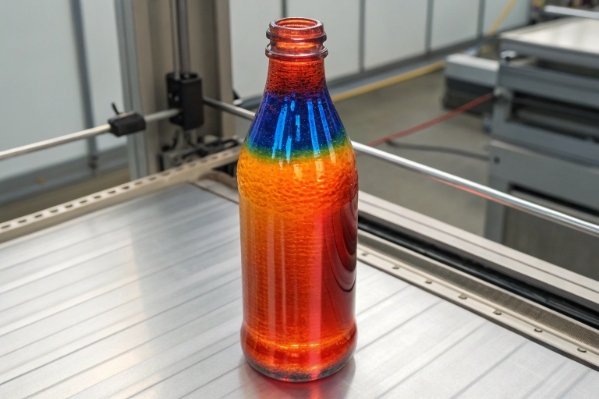
The bottle "finish" (the mouth and threads) is the most geometrically complex part of the container. Because it combines intricate shapes with mechanical stress from the cap, it is a prime candidate for thermal failure.
Thermal resistance at the bottle mouth is ensured by reducing stress concentrations through "generous radii" design, maintaining strict temperature control during the "invert" forming stage to prevent thermal checks, and ensuring the annealing lehr specifically targets the neck to remove residual tension.
The Critical Interface
At FuSenglass, we remind clients that the finish has a harder life than the rest of the bottle. It isn’t just a container; it’s a mechanical anchor. It has to withstand the "vertical load" of the capper, the "hoop stress" of the torque, and the "thermal shock" 1 of the filling lance—often all at the same time.
While the body of the bottle expands and contracts relatively freely, the finish is constrained by the closure. If the glass expands (hot fill) but the cap is rigid (or expands differently), or if the finish cools too fast relative to the shoulder, the result is a "Split Finish"—a vertical crack that destroys the seal and ruins the product.
The "Thermal-Mechanical" Trap
| Factor | Thermal Effect | Mechanical Effect | Resulting Failure |
|---|---|---|---|
| Geometry | Thin threads heat fast; thick neck cools slow. | Threads take torque load. | Crazing / Thread Chipping |
| Cooling | Finish cools fastest in the mold (contact with ring). | Finish is handled by grippers. | Thermal Checks (Hairline cracks) |
| Capping | Glass expands into the cap. | Cap compresses the glass. | Vertical Split (Burst) |
Which finish design details (lip radius, bead, land, threads) most improve thermal shock resistance?
A thermal-resistant finish is one that avoids sharp corners and sudden changes in thickness, allowing heat to flow smoothly without creating stress risers.
To maximize thermal resistance, the finish should feature a large "Lip Radius" (avoiding flat tops), a robust "Transfer Bead" to act as a heat sink and stiffener, and "Round Profile" threads (R-threads) rather than sharp-edged threads to distribute expansion forces evenly.
Engineering the Geometry
You cannot change the physics of glass, but you can change the geometry to hide stress.
1. The Lip Radius (Sealing Surface):
A flat sealing surface (sharp edges) is bad for heat. We prefer a radiused (rounded) lip.
- Why? When hot liquid touches the rim, heat enters the glass. A sharp corner concentrates this thermal energy, creating a stress concentration 2. A rounded lip allows the heat to dissipate into the neck wall more uniformly.
2. The Transfer Bead (The Neck Ring):
That bump at the bottom of the neck isn’t just for handling; it’s a structural stiffener.
- Why? It acts as a "thermal break" between the finish and the shoulder. It absorbs some of the mechanical and thermal stress, preventing cracks from traveling down into the shoulder.
3. Thread Profile:
Sharp, V-shaped threads are stress concentrators.
- Why? As the cap tightens and the glass expands, the force focuses on the tip of the V. We use Rounded (Knuckle) Threads. They are harder to chip and distribute the thermal expansion load over a wider surface area.
Design "Do’s and Don’ts"
| Feature | Poor Thermal Design | Optimized Thermal Design |
|---|---|---|
| Sealing Surface | Flat / Square Edged | Fully Radiused (Round) |
| Thread Shape | Sharp / Triangular | Round / Trapezoidal |
| Wall Thickness | Variable (Thin threads, thick bore) | Uniform Distribution |
| Neck Ring | Absent / Small | Prominent Transfer Bead |
How can forming consistency and annealing control reduce residual stress around the bottle mouth?
The finish is formed by the "Neck Ring" mold, which sucks heat out of the glass rapidly. If this cooling isn’t managed, the finish is born with fatal flaws.
Forming consistency relies on maintaining the optimal "Neck Ring Temperature"; if the ring is too cold, it causes "Thermal Checks" (micro-cracks) upon contact. In the annealing lehr, the finish often cools too fast because it sticks up into the airflow; special "heat retention" zones are required to keep the neck hot enough to relieve stress.
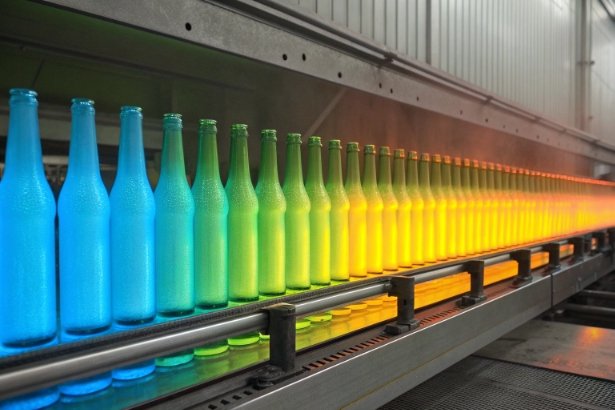
The Manufacturing Challenge
1. The "Check" Hazard (Forming):
In the IS machine 3, the glass gob hits the neck ring first. This metal ring forms the threads.
-
The Risk: If the ring is cold and the glass is 1000°C, the thermal shock creates microscopic cracks called "Checks." These are invisible to the eye but will grow into splits during pasteurization.
-
The Fix: We strictly control the mold cooling air to keep the neck rings hot, reducing the $\Delta T$ at contact.
2. The "Chimney" Effect (Annealing):
In the lehr, heat rises. But cooling air also flows over the top. The tall neck of a bottle is exposed to this cooling airflow more than the base (which is shielded by neighbors).
-
The Risk: The neck cools below the "Strain Point" 4 before the stress is relieved, locking in tension.
-
The Fix: We adjust the lehr’s "top drift" dampers to restrict airflow over the finishes in the annealing zone, forcing the necks to stay hot (550°C) for the full soak time.
How should closure type, liner material, and capping torque be matched to prevent finish cracking during hot-fill or pasteurization?
The cap and the bottle are a thermal couple; if they fight each other during heating, the glass always loses.
For hot-fill applications, "Lug Caps" (Twist-off) are superior to continuous thread (CT) caps because they allow internal pressure venting. Liner materials must be soft enough (e.g., Plastisol) to absorb the differential expansion between the glass finish and the metal/plastic closure without transferring that stress to the glass.
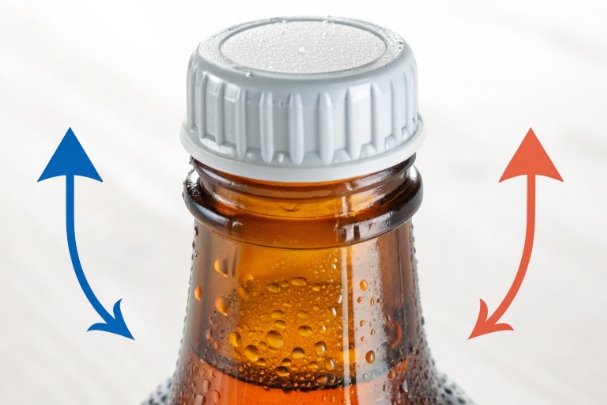
The Capping Equation
1. Venting vs. Pressure:
When you pasteurize a sealed bottle, the air inside expands.
-
CT Caps (Screw): Hold the pressure tight. The pressure pushes up on the cap, which pulls up on the glass threads. This "Hoop Stress" 5 + Thermal Shock = Thread Separation.
-
Lug Caps (Metal): Designed to "flex." The lugs lift slightly to let excess pressure escape (venting), then vacuum down as it cools. This relieves the stress on the glass finish.
2. Thermal Expansion Mismatch:
-
Plastic Caps (PP): Expand 10x more than glass. If applied tight when cold, and then heated, the cap expands and might loosen (back-off). If applied hot and then cooled, the cap shrinks and crushes the glass neck.
-
The Fix: Torque specifications must be set at the filling temperature. Do not over-torque.
3. Liner Compression:
A hard liner transmits force directly to the glass. A soft liner (foam or plastisol 6) acts as a shock absorber. For thermal processes, a softer, thicker liner helps accommodate the glass movement.
Closure Compatibility Matrix
| Process | Best Closure | Why? | Liner Choice |
|---|---|---|---|
| Hot Fill / Pasteurization | Metal Lug (Twist-Off) | Vents pressure; manages vacuum. | Plastisol (PVC) |
| Carbonated (Cold) | Crown / ROPP | Holds pressure; mechanical lock. | PE / PVC |
| Hot Fill (Aggressive) | Plastic (Heat Stabilized) | Resists heat deformation. | HS Liner (Induction) |
| Retort (121°C) | Special Retort Lug | Controlled venting profile. | High-Temp Plastisol |
What supplier specs and QC tests best verify mouth heat resistance before mass production and shipment?
Inspecting the finish is harder than inspecting the body, but specific optical and mechanical tests can catch defects before they leak on the line.
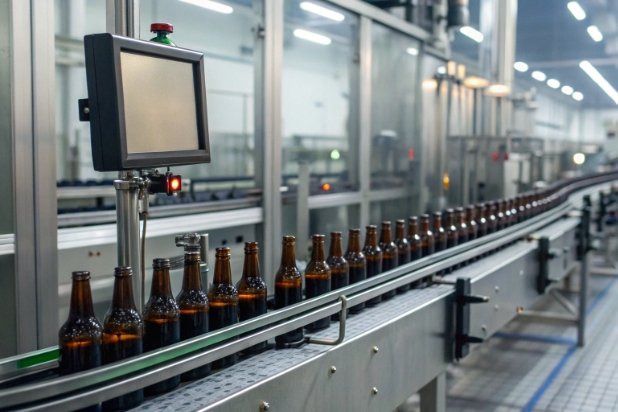
Suppliers must use "Automatic Check Detection" (Camera/Laser) on 100% of production to reject finish cracks. Wholesale buyers should perform "Thermal Shock with Cap" testing to simulate the actual expansion stress, and use a Polariscope to ensure the finish temper is Grade 2 or better.
The Validation Gauntlet
1. Automatic Check Detection (On-Line):
We use high-speed cameras that spin the bottle and flash light at the finish.
- Function: Cracks reflect light differently. The machine kicks out any bottle with a "reflective" flaw in the threads or rim. This is mandatory for heat-resistant ware.
2. The "Capped" Thermal Shock Test:
Standard thermal shock tests use open bottles. This is cheating.
-
Real Test: Cap the bottle (apply torque). Heat it. Cool it.
-
Why: The cap adds mechanical stress. A bottle might pass thermal shock when open, but split when the cap is squeezing the threads during the temperature spike.
3. Vertical Load Test:
Since the finish is the thinnest part, we crush it vertically.
- Spec: Must withstand > 150 kg (for carbonated) or > 80 kg (standard) without crumbling. This ensures the glass distribution in the neck is sufficient.
QC Protocol Summary
| Test | Objective | Pass Criteria |
|---|---|---|
| Check Detection | 100% Inspection | 0 checks (cracks) allowed. |
| Finish Polariscope | Stress in Threads | Grade $\le 2$ Temper. |
| Capped Shock Test | Simulation | No thread splitting or crazing. |
| Thread Dimensions | Cap Fit | "T" and "E" within GPI tolerance 7 ($\pm 0.15$mm). |
Conclusion
The finish is the gateway to your product. By demanding radiused threads, hot-neck forming controls, and venting closures, you ensure that this complex piece of glass engineering can take the heat without cracking under pressure.
Footnotes
-
Stress caused by rapid temperature changes, potentially causing glass fracture. ↩
-
A location in an object where the stress is significantly greater than the surrounding area. ↩
-
An automated machine used in glass container manufacturing for forming bottles. ↩
-
The temperature below which glass behaves as a rigid solid and stress cannot be relieved. ↩
-
Mechanical stress defined for rotationally symmetric objects, acting circumferentially. ↩
-
A suspension of PVC particles in a liquid plasticizer, used as a closure liner. ↩
-
Industry standards for glass container dimensions and finish specifications. ↩






