
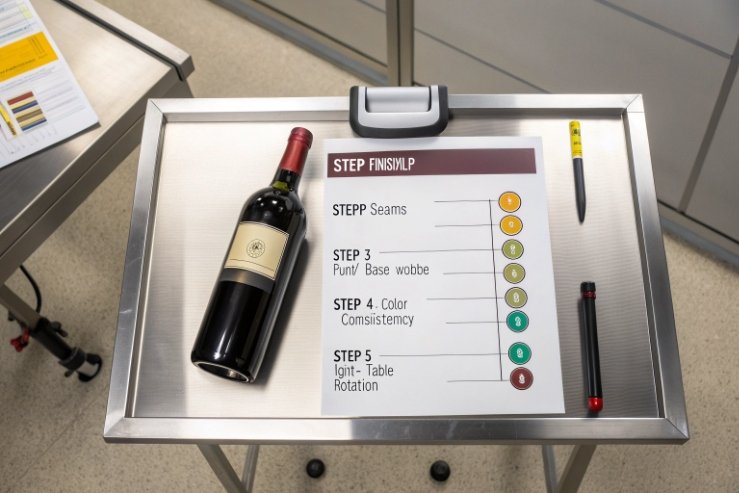
A bottle can pass “looks fine” at first glance and still leak, wobble, or crack later. A 60-second visual routine can catch most risk before the bottle ever reaches your line.
Yes—seam alignment, punt symmetry, and wobble are strong visual signals. The finish/lip area predicts sealing problems, color consistency hints at process control, and a simple light-table rotation quickly reveals bubbles, cords, stones, and thin zones.
This is the same basic routine I use when screening incoming bottles or pre-production samples. It is fast, repeatable, and it focuses on defects that actually become leaks, breaks, or brand damage.
Do seam alignment, punt symmetry, and wobble reveal defects?
A premium bottle should look “quiet.” When seams, base geometry, or symmetry look noisy, it usually means forming drift or worn tooling.
Yes. Straight seams, a centered punt, and a stable base usually indicate good forming control. Crooked seams, off-center punts, and rocking are common signs of mold mismatch, base distortion, or ovality.

Quick seam check (10 seconds)
Hold the bottle at arm’s length and visually track each vertical seam from shoulder to heel:
- Seams should be straight and consistent.
- Seams should not look “torn,” jagged, or sharply raised.
- The two seams should look similar. One “angry” seam is a red flag.
What it tells you:
- Raised or sharp seams increase scuff and carton rub.
- Seam mismatch can signal mold wear or poor parting line fit.
- If you see a fin-like ridge near the finish/neck transition, it may be a seam on the neck ring parting line 1.
Punt symmetry check (10 seconds)
Flip the bottle and look at the punt:
- The punt should look centered.
- The heel ring should look even and round.
- The base should not look twisted or “pulled” to one side.
Off-center punts often correlate with distribution issues and base stress. They can also cause wobble and increase breakage risk during handling.
Wobble test (10 seconds)
Place the bottle on a known flat surface:
- Spin it gently.
- Tap the shoulder lightly.
- Watch for rocking or a visible lean.
A good bottle sits flat and does not “walk.” Rocking usually means base distortion or uneven heel ring. Lean can signal ovality or uneven thickness.
If you’re sorting a mixed pallet, keep a one-page reference like a container defect causes and remedies guide 2 so teams use the same defect language.
| Visual cue | What you see | What it often means | Why it matters |
|---|---|---|---|
| Crooked seam | seam drifts or waves | parting line drift, mismatch | scuff, cheap look |
| Sharp seam | seam feels like a ridge | finning/flash | carton rub, cut risk |
| Off-center punt | punt not centered | distribution/timing | wobble, base stress |
| Rocking base | bottle rocks on flat table | base ring distortion | breakage risk, bad shelf feel |
| Leaning bottle | bottle stands tilted | ovality or deformation | filling line issues |
Which finish flaws predict sealing problems later?
If there is one zone that deserves the most attention, it is the finish. Many leaks start here, even when the closure looks perfect.
Finish chips, hairline cracks, rough sealing lands, oval mouths, and uneven lip thickness are the most predictive visual signs of later sealing failures—especially for cork and T-top systems.
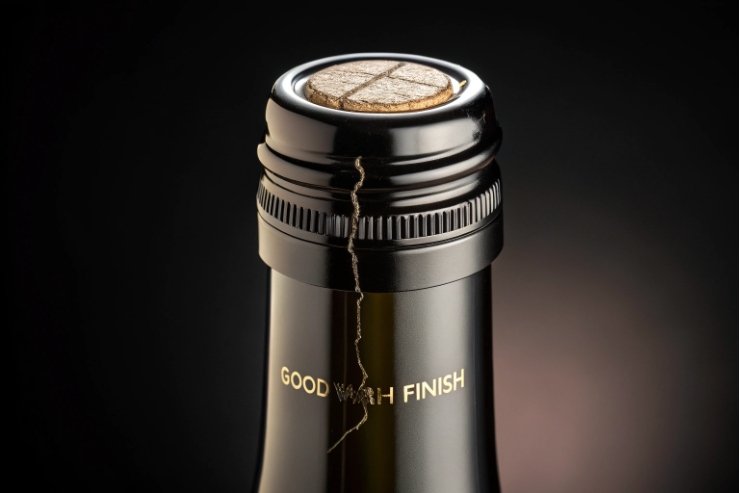
What to inspect on the finish (20 seconds)
Hold the bottle so light grazes the lip. Rotate slowly.
Look for:
- chips or nicks on the top lip (even tiny ones)
- hairline cracks radiating from the lip
- a “wavy” sealing land (not flat, not even)
- out-of-round mouth (oval look when rotated)
- overpress or sharp edges that can cut corks or liners
Then do the fingertip test:
- A good lip feels smooth and uniform.
- A bad lip catches your nail or feels sharp on one side.
For a deeper visual checklist, this industry article on neck finish inspection and leak-related defects 3 is a useful reference for what to treat as “must reject.”
Why small finish defects become big problems
Closures seal by compression. Chips and cracks create leak paths. Rough lips damage corks or liners. Ovality causes uneven compression and leads to slow weeping that shows up after shipping, not in the factory.
A simple rule is harsh but effective: if you can feel it with your fingernail, the customer will eventually find it with a leak.
| Finish defect | Naked-eye sign | Seal risk | Typical outcome |
|---|---|---|---|
| Lip chip | tiny missing edge | High | seepage, cork failure |
| Hairline crack | faint line at rim | Very high | delayed break or leak |
| Oval mouth | shape looks “egg” | High | uneven seal compression |
| Sharp overpress | ridge at sealing land | Medium to high | liner damage, torque scatter |
| Dirty sealing land | dust/oil ring | Medium | poor adhesion, micro-leaks |
Does glass color consistency indicate process control?
Color is not only a marketing choice. It is also a process control signal. When color drifts, other things may be drifting too.
Yes. Consistent glass color across bottles suggests stable batch and furnace control. Color streaks, two-tone zones, or random shade drift can signal cullet variation, poor mixing, or temperature/chemistry instability that may also increase defects like cords or haze.
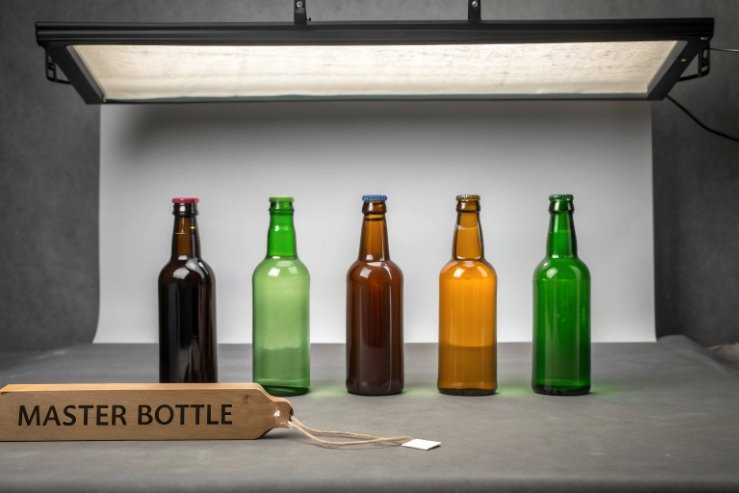
What to look for without instruments
Line up 3–5 bottles from the same lot:
- Compare hue under the same light.
- Look for one bottle that looks more green, more brown, or more gray.
- Check for streaks or vertical “bands” of slightly different shade.
If you do use numbers later, aligning to the CIE Lab* color space 4 helps teams compare lots without arguing about lighting.
Color consistency matters more in these cases
- Flint / super-flint: customers see everything
- Premium spirits-style wine bottles: appearance is part of the brand promise
- Frosted or coated bottles: color perception changes, so control must be tighter
Use a “master bottle” reference
For quick incoming checks, keep a known-good master bottle. Compare each new lot against it in consistent lighting. This prevents arguing based on memory.
If your program has tight shade limits, define an acceptance window using CIE ΔE* color difference equations 5 so “match” has a shared meaning.
What quick light-table checks spot bubbles, cords, stones, and thin zones?
A light table is the fastest tool to see what the eye misses in normal room light. Even a phone flashlight can work for quick screening.
Rotate the bottle on a light table and scan the heel, shoulder, and label panel. Bubbles (seeds) show as bright points, stones show as dark hard points, cords show as streaks or “swim lanes,” and thin zones show as brighter transmission areas.
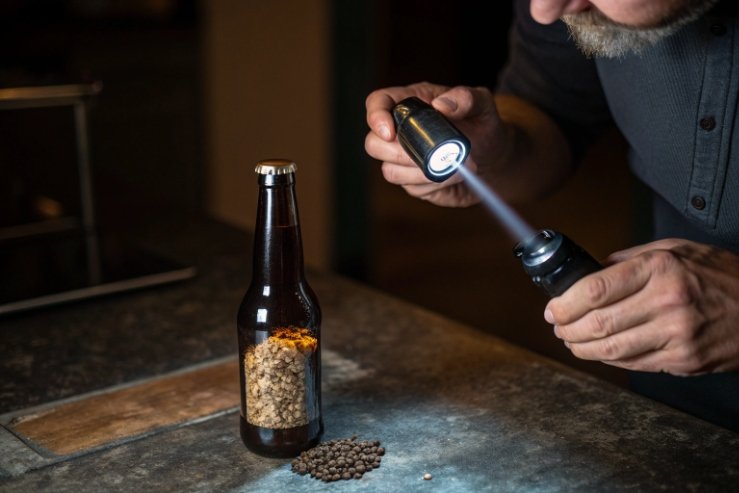
The 30-second light-table routine
1) Heel first (highest breakage risk):
- look for tiny bubbles clustered near the heel ring
- look for dark specks (stones/inclusions)
2) Shoulder next (flow and distribution zone):
- look for swirl-like streaks (cords)
- look for uneven optical distortion
3) Label panel (brand zone):
- look for haze, scuffs, and distortions that will show through labels
If you want quick visual examples for training, the section on a cord defect and other common glass packaging defects 6 helps align what “cord” and “stone” look like in practice.
How defects appear
- Seeds/bubbles: bright points; many small seeds can still be a premium reject if visible.
- Stones/inclusions: dark points; high risk if near heel or shoulder.
- Cords/striations: subtle streaks; they can look like “water lines” inside glass.
- Flow lines/waviness: optical ripples; often tied to heat/timing or mold conditions.
- Thin spots: brighter zones; often correlate with breakage under impact.
For deeper root-cause work after you spot defects, this overview of glass defect analysis techniques 7 is a good starting point.
| Defect | What you see on light table | Why it matters | Premium decision |
|---|---|---|---|
| Seeds | many bright pinpoints | weak zones + looks dirty | reject if visible in panel zones |
| Stone | dark speck | stress concentrator | reject |
| Cord | streaky “lane” | optical distortion, strength risk | reject in display zones |
| Thin zone | bright area | break risk | reject or investigate cavity |
Conclusion
With naked-eye checks—finish first, seams and base next, color consistency, then a light-table rotation—you can catch most leak and break risks fast before bottles reach filling or customers.
Footnotes
-
Defines seam fins at neck ring parting line and why they matter. ↩ ↩
-
Industry guide linking common container defects to causes and remedies. ↩ ↩
-
Explains neck finish inspection and how finish defects create slow leaks. ↩ ↩
-
Clarifies how L, a, b* describe color so teams compare lots consistently. ↩ ↩
-
Summarizes ΔE formulas used to set practical color tolerances and pass/fail limits. ↩ ↩
-
Visual examples of cord and mould seam defects to speed up sorting. ↩ ↩
-
Overview of inspection approaches for bubbles, stones, cords, and cracks starting with the naked eye. ↩ ↩






