
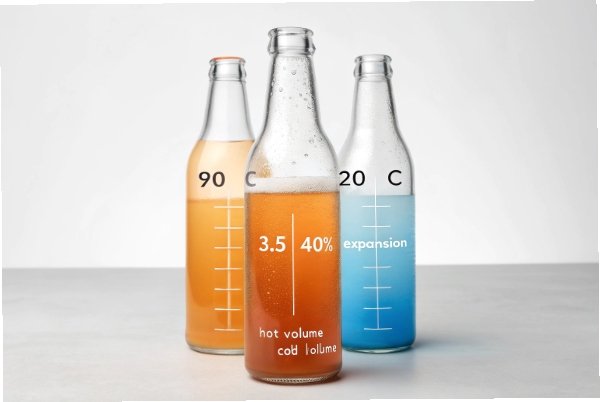
Filling a rigid glass bottle with hot liquid is a moving target. As the product cools, it shrinks significantly, turning a "perfect fill" at the factory into an "underfilled" bottle on the retail shelf. Controlling this requires managing the physics of thermal contraction 1 and glass manufacturing tolerances.
Fill-volume deviation is best controlled by implementing "Temperature-Compensated Filling" algorithms that adjust the dispensed volume in real-time based on the liquid’s current density. Additionally, minimizing the "Brimful Capacity" tolerance of the glass bottle mold is critical to ensuring that a correct weight does not result in a visually low fill line.
The Physics of Thermal Shrinkage
At FuSenglass, we remind clients that water (and most beverages) expands by approximately 3.5% to 4.0% when heated from 20°C to 90°C.
-
Scenario: You need to sell 500ml of tea.
-
The Mistake: If you fill exactly 500ml at 90°C, you are actually filling only ~482ml of product by mass. When it cools, the volume drops to 482ml. The customer feels cheated, and you face legal penalties for underweight product.
-
The Correction: You must fill ~518ml of hot liquid to achieve 500ml of cold liquid. The bottle must be sized to accommodate this larger hot volume.
How should headspace be set to avoid underfill appearance?
Headspace (vacuity) is the safety buffer. If it’s too small, thermal expansion breaks the bottle. If it’s too large, the customer thinks the bottle is empty.
Target a "Hot Headspace" of 5-7% of the total bottle volume. This accounts for the ~4% liquid volume shrinkage during cooling, ensuring the final "Cold Headspace" settles at a visually acceptable 8-10% (roughly 40-50mm from the top), preventing the "sold short" appearance.
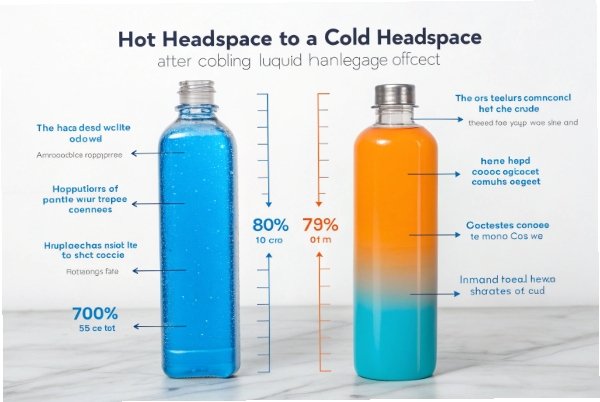
Calculating the Fill Level
-
Determine Target Volume: (e.g., 500ml @ 20°C).
-
Calculate Hot Volume: Multiply by density ratio 2 (~1.035). Target = 517.5ml.
-
Set Fill Height: Calibrate the filler to cut off at the height corresponding to 517.5ml.
-
Vacuum Factor: Remember that cooling creates a vacuum. The liquid level drops not just because of shrinkage, but because the vacuum sucks the meniscus down slightly (if the cap liners bow in).
What bottle capacity tolerances (nominal vs. brimful) should be required?
Glass blowing is not precision machining; the internal volume varies. If you use a Level Filler, this variation causes weight errors. If you use a Volumetric Filler, it causes visual level errors.
You must specify a tight "Brimful Capacity Tolerance" of ±1.5% to ±2.0% (standard is often looser). For premium products, require "Measured Volume Control" where bottles are sorted by mold number, as different molds in the same machine often have slight volume variances.
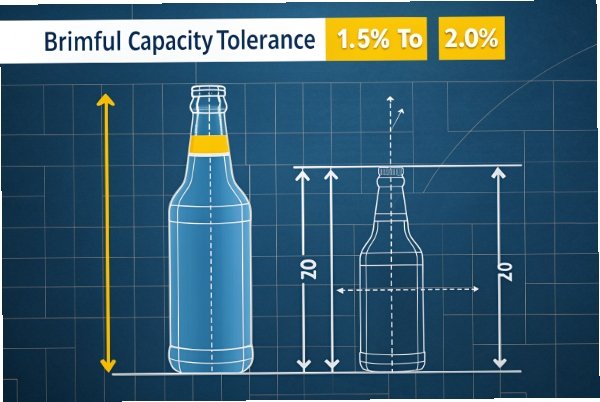
Nominal vs. Brimful
-
Nominal Capacity: What is printed on the label (e.g., 500ml).
-
Brimful Capacity: The volume when filled to the very top rim (e.g., 545ml).
-
The Problem: Two bottles might both look identical outside, but if the glass wall thickness 3 is 0.5mm thicker in one, the internal volume is smaller.
-
Impact:
-
Level Filler: Fills both to the same height. The thick bottle gets 495ml (Underweight). The thin bottle gets 505ml (Giveaway).
-
Volumetric Filler: Fills both with 500ml. The thick bottle looks full. The thin bottle looks underfilled.
-
Which filling approach is best for hot-fill accuracy in glass?
The choice depends on whether your priority is "Legal Weight Compliance" or "Visual Shelf Appearance."
"Net Weight" or "Mass Flow" filling is technically superior for Hot-Fill because it measures mass directly, ignoring temperature/density changes. However, "Vacuum Level Filling" remains the industry favorite for glass because it guarantees a consistent fill line (cosmetic perfection), even if it results in slight product giveaway to ensure minimum weight compliance.
1. Mass Flow / Net Weight (The Engineer’s Choice)
-
Mechanism: Measures the weight of liquid entering the bottle.
-
Pro: Precise dosage regardless of temperature (1kg is 1kg, whether hot or cold). Immune to aeration/bubbles.
-
Con: If the glass bottles vary in internal volume, the fill line will "shag" (jump up and down) on the shelf. Customers hate this.
2. Vacuum Level Filling (The Marketer’s Choice)
-
Mechanism: Seals the bottle, pulls a vacuum 4, and fills until liquid covers the vent tube.
-
Pro: Every bottle on the shelf is filled to the exact same height. Looks premium.
-
Con: You must "overfill" the target to ensure even the thickest bottle meets the legal weight. This is "Product Giveaway" (wasted money). Also, temperature fluctuations change the fill weight significantly.
3. Volumetric Piston (The Old School)
-
Pro: Accurate volume.
-
Con: Does not compensate for density changes. If the temp drops 5°C, you are suddenly overfilling by mass.
What in-line QC controls best prevent underfills and giveaways?
You cannot manage what you do not measure. A hot-fill line needs a feedback loop.
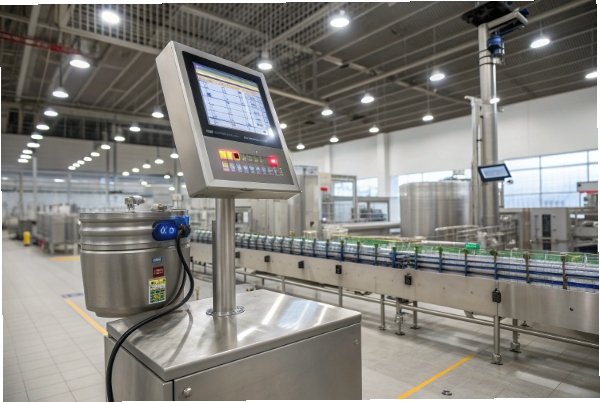
Install a "Feedback Checkweigher" after the filler to auto-adjust fill valves based on weight trends. Crucially, integrate a "Real-Time Temperature Probe" in the filler bowl to feed density data to the flow meters, and use "X-Ray or Vision Level Inspection" to reject visually low bottles.
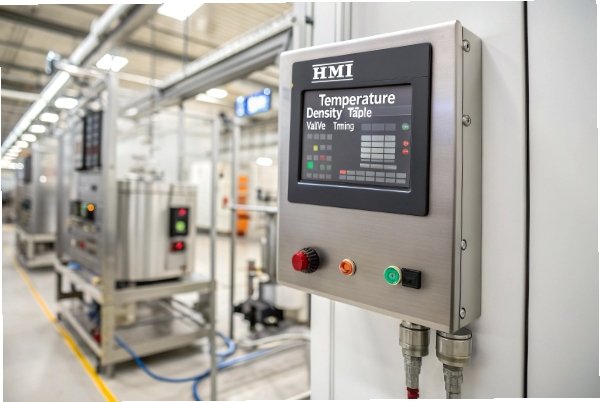
1. Temperature-Density Compensation
-
Sensor: Probe in the buffer tank or flow meter.
-
Logic: The PLC knows the density of your juice at every temp (e.g., 1.02 @ 90°C, 1.04 @ 80°C).
-
Action: If temp drops 2°C, the filler PLC system 5 automatically increases the dispense volume by 0.X% to maintain constant mass.
2. The Checkweigher Feedback
-
Position: After Capping.
-
Function: Weighs every bottle. Tares out the average bottle weight (which is risky) or uses a "Gross Weight" cutoff.
-
Feedback: If the rolling average trends low, it signals the filler to increase valve open time by milliseconds.
3. Vision/X-Ray Inspection
-
Position: After Cooling Tunnel.
-
Why: Checkweighers 6 can’t see "Level." After cooling, the level drops. A Vision system verifies that the final cold level meets the "Visual Headspace" standard (e.g., 45mm from top).
| Control Point | Technology | Purpose |
|---|---|---|
| Filler Tank | RTD Temp Probe 7 | Density Compensation (Critical for Hot-Fill) |
| Filler Valve | Mass Flow Meter 8 | Accurate Dosing (Independent of Bubbles) |
| Post-Capper | Checkweigher | Legal Weight Compliance (Reject Underweights) |
| Post-Cooler | Vision Inspection 9 | Visual Fill Level (Reject Low Fills) |
| Lab QC | Destructive Weight 10 | Calibrate the Checkweigher (Tare offset) |
Conclusion
For hot-fill glass, Mass Flow filling with Temperature Compensation is the most robust method for profit protection (minimizing giveaway). However, you must pair this with tight-tolerance glass molds to ensure the bottles still look full on the shelf. If aesthetics are paramount (e.g., clear spirits or premium juice), stick to Level Filling and accept the higher product giveaway cost.
Footnotes
-
Understanding Thermal Contraction: Learn how liquids and solids decrease in volume as temperature drops, a critical factor in hot-fill accuracy. ↩ ↩
-
Water Density and Temperature: A reference table showing how the density of water changes across different temperatures for precise calculation. ↩ ↩
-
Glass Container Manufacturing: Insights into the glass-making process and how wall thickness variations impact internal volume and capacity. ↩ ↩
-
Principles of Vacuum Filling: Explains the mechanics of vacuum-assisted filling systems commonly used for consistent fill levels in glass. ↩ ↩
-
Programmable Logic Controllers (PLC): Discover how industrial controllers automate complex filling logic and temperature compensation in bottling lines. ↩ ↩
-
Industrial Checkweighing Systems: Learn how in-line scales ensure every bottle meets legal weight requirements and provide filler feedback. ↩ ↩
-
Introduction to RTD Probes: Guide to Resistance Temperature Detectors used for high-precision temperature monitoring in industrial processes. ↩ ↩
-
Coriolis Mass Flow Meters: Highly accurate sensors that measure fluid mass directly, ideal for temperature-independent filling. ↩ ↩
-
What is Machine Vision?: Technical overview of using cameras and AI for high-speed inspection of fill levels and packaging defects. ↩ ↩
-
NIST Handbook 133 Standards: Official procedures for checking the net contents of packaged goods to ensure legal weight compliance. ↩ ↩






