
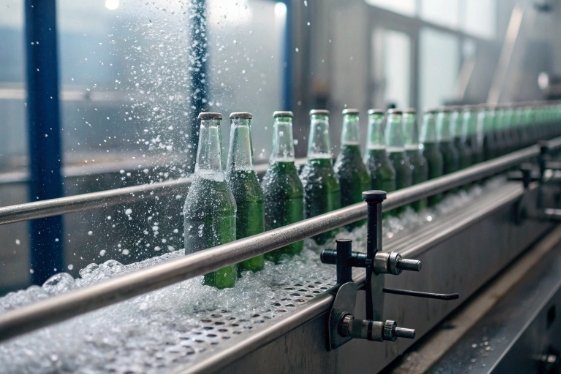
Hearing the "ping" of shattering glass during a fill line run is a factory manager’s worst nightmare. It signifies not just loss of product, but a fundamental misunderstanding of thermal physics.
A standard soda-lime glass bottle can withstand a sudden temperature change (ΔT) of approximately 42°C (75°F). In contrast, premium borosilicate glass can endure a ΔT of over 120°C (248°F). Exceeding these limits causes immediate catastrophic failure due to tensile stress.
The Physics of The "Ping"
When I walk through a client’s filling plant, specifically those new to hot-filling sauces or beverages, I often see them focused purely on the maximum temperature. They ask, "Can this bottle take 90°C?" The answer is always yes. Glass melts at over 1400°C. The heat isn’t the problem.
The problem is the speed of the temperature change—the Thermal Shock 1.
Glass is a poor conductor of heat. When you pour 90°C jam into a 20°C bottle, the inner surface expands instantly while the outer surface remains cool and contracted. This fight between expansion inside and contraction outside creates massive tensile stress 2. Since glass is weak in tension, it rips apart.
Critical Delta T Thresholds
Understanding $\Delta T$ (Delta T) is crucial for setting up your production line. It defines the safe operational window for washing, filling, and cooling.
| Glass Type | Coefficient of Expansion (COE) | Safe $\Delta T$ Limit | Common Application |
|---|---|---|---|
| Soda-Lime (Type III) | $\approx 9.0 \times 10^{-6} / K$ | $42^{\circ}C$ | Beverages, Foods, Cosmetics |
| Treated Soda-Lime (Type II) | $\approx 9.0 \times 10^{-6} / K$ | $45^{\circ}C – 50^{\circ}C$ | IV Fluids, Pharma |
| Borosilicate (Type I) | $\approx 3.3 \times 10^{-6} / K$ | $>120^{\circ}C$ | Labware, Premium Injectables |
In my twenty years at FuSenglass, I have found that 90% of breakage issues stem from the cooling tunnel, not the filler. Spraying cold water on hot bottles is far more dangerous than filling hot liquid into room-temp bottles, because glass is significantly weaker in tension (cooling) than in compression (heating).
What thermal shock (ΔT) limits are typical for soda-lime glass bottles vs. borosilicate bottles?
The material composition dictates the rules of engagement. Choosing the wrong glass type for your thermal process is an expensive mistake.
Soda-lime glass (standard commercial glass) typically fails if the temperature difference exceeds 42°C rapidly. Borosilicate glass, containing boron trioxide, has a much lower coefficient of thermal expansion, allowing it to withstand shocks of 120°C to 160°C without breaking.
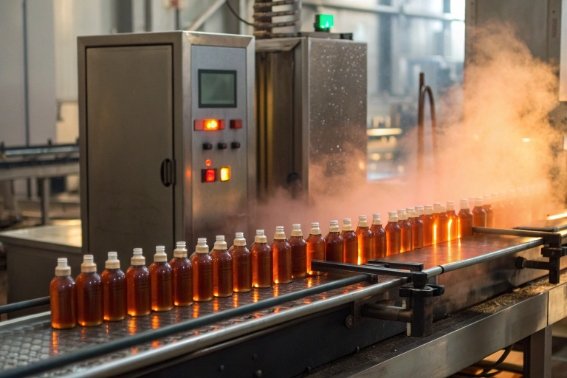
Soda-Lime: The Economic Workhorse
Most of my clients—whether they are John Smith packaging wine in the UK or Maria making salsa in Mexico—use Soda-Lime glass 3. It is cost-effective and clear. However, it is thermally sensitive.
The "Rule of 42" is our golden rule for Soda-Lime.
-
If your wash water is 60°C, your bottle cannot be colder than 18°C.
-
If your fill temp is 85°C, you must pre-heat the bottles to at least 43°C.
I once had a client in Russia, Katarina, who experienced mass breakage during winter. Her warehouse was -5°C. She was bringing bottles directly to a 60°C washer. The $\Delta T$ was 65°C. The bottles didn’t stand a chance. We solved it simply by creating a "tempering room" to bring the glass to 20°C before the line.
Borosilicate: The Thermal Tank
Borosilicate is a different beast. By adding boron, we reduce the glass’s tendency to expand when heated. This is why Pyrex measuring cups don’t shatter when you pour boiling water into them.
While excellent for thermal resistance, Borosilicate glass 4 is expensive and harder to melt. We generally reserve this for pharmaceutical clients or very high-end cosmetic brands that require autoclaving and rapid cooling cycles that Soda-Lime simply cannot survive.
Comparative Performance Analysis
| Feature | Soda-Lime Glass | Borosilicate Glass |
|---|---|---|
| Expansion Rate | High (Expands rapidly) | Low (Stable dimension) |
| Thermal Endurance | Low ($\Delta T \approx 40-50^{\circ}C$) | High ($\Delta T > 120^{\circ}C$) |
| Cost | Low | High (2-3x cost) |
| Visual Color | Clear / Flint | Clear / Slight Blue Tint |
| Primary Risk | Cooling Tunnel Shock | Physical Impact |
Which bottle design factors (wall thickness uniformity, heel/base geometry, shoulder radius) most affect thermal shock resistance?
Geometry dictates how heat moves through the container. A poorly designed bottle will fail even within "safe" temperature ranges.
Uniform wall thickness is the most critical factor; variations create stress differentials where thick parts hold heat while thin parts cool, snapping the glass. Sharp corners at the heel (base) and shoulder act as stress concentrators, reducing thermal shock resistance significantly.
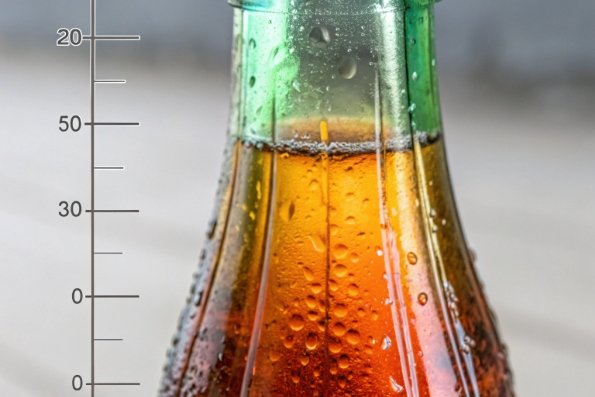
The Myth of "Thicker is Stronger"
Many clients ask me to "add more glass" to stop thermal breakage. This is often the wrong move.
For physical impact (dropping the bottle), thickness helps. But for thermal shock, thickness is the enemy.
-
Thin Glass: Heat passes through quickly. The inner and outer surfaces reach equilibrium fast. Less stress.
-
Thick Glass: The inside gets hot, the outside stays cold. The temperature gradient 5 ($\Delta T$ across the wall) is huge. High stress.
The worst scenario is Uneven Distribution. If one side of the bottle is 2mm and the other is 5mm, they expand at different rates. The bottle literally tears itself apart. This is why at FuSenglass, we obsess over mold design to ensure the "gob" (molten glass drop) distributes perfectly evenly.
Geometry Flaws to Avoid
-
Square Bases: A round bottle distributes stress evenly. A square bottle concentrates stress in the corners. If you are hot-filling, avoid sharp square designs.
-
Heavy Bottoms (Punts): A thick, heavy base looks premium (like a luxury spirit bottle), but it acts as a heat sink. It stays hot long after the sidewalls have cooled. This differential causes "bottom separation" where the base cleanly breaks off.
-
Sharp Radii: The transition from the body to the neck (shoulder) and body to base (heel) should be a gentle curve, not a sharp angle.
| Design Feature | Impact on Thermal Shock | Recommendation |
|---|---|---|
| Wall Thickness | Thin is better than thick | Aim for 2.0 – 3.0mm uniform |
| Shape | Round is better than square | Use large corner radii (>10mm) |
| Base Design | Stippling reduces contact | Avoid solid flat bottoms |
| Decorations | Embossing creates weak points | Keep embossing shallow |
How do annealing quality and residual stress change the maximum safe temperature jump for glass bottles?
Even the perfect design and material will fail if the manufacturing process leaves hidden tension in the glass.
Annealing is the process of slowly cooling glass to relieve internal stresses. Poor annealing leaves "locked-in" tension, which drastically reduces the available safety margin for thermal shock. A well-annealed bottle maximizes its ΔT potential, while a strained bottle may shatter with a ΔT as low as 20°C.
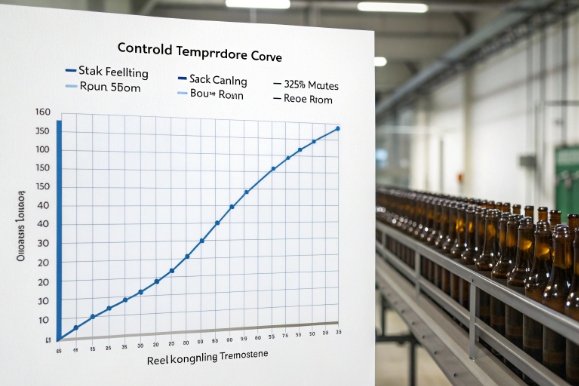
The Invisible Enemy: Residual Stress
When glass is formed, it cools from $1000^{\circ}C$ rapidly. If left alone, the outside hardens while the inside is still soft. As the inside eventually cools and contracts, it pulls on the already rigid outer shell. This is residual tension.
In our factory, every bottle passes through an "Annealing Lehr" 6—a massive oven that holds the glass at approx $560^{\circ}C$ (the annealing point) and then slowly cools it to room temperature over 45-60 minutes. This relaxes the molecules.
Detecting the Invisible
We use a Polariscope 7 to see this stress.
-
Grade 1-2 (Good): The glass looks uniform. It is ready for hot-fill.
-
Grade 4-5 (Bad): You see bright, colorful patterns. This bottle is a ticking time bomb.
If a bottle has high residual stress (Grade 4), it is already using up 80% of its strength just holding itself together. It has no "strength budget" left to handle a thermal shock. A simple 30°C temperature jump could shatter it. This is why cheap, poorly manufactured glass often breaks in the dishwasher, while quality glass survives.
Annealing and Production Speed
Sometimes, factories speed up the Lehr to increase output. This is a dangerous game. Cutting the annealing time by 10 minutes can increase production by 15%, but it ruins the thermal integrity of the glass. I always assure my clients that we never compromise Lehr times for speed.
| Annealing Grade | Internal Stress Level | Safe $\Delta T$ Estimate (Soda-Lime) |
|---|---|---|
| Grade 1 (Excellent) | Near Zero | $45^{\circ}C$ |
| Grade 2 (Standard) | Low | $42^{\circ}C$ |
| Grade 3 (Borderline) | Moderate | $35^{\circ}C$ |
| Grade 4 (Dangerous) | High | $< 25^{\circ}C$ |
Which thermal shock tests and validation protocols should you run for hot-fill, pasteurization, or sterilization applications?
Hope is not a strategy. You must physically simulate your process conditions to validate the glass performance.
For thermal applications, you must perform the ASTM C149 Thermal Shock Test. This involves heating bottles to a target temperature and plunging them into a cold water bath ($21^{\circ}C$) to simulate the worst-case ΔT. Validation should test at least 20-50 units to establish a statistical failure rate.
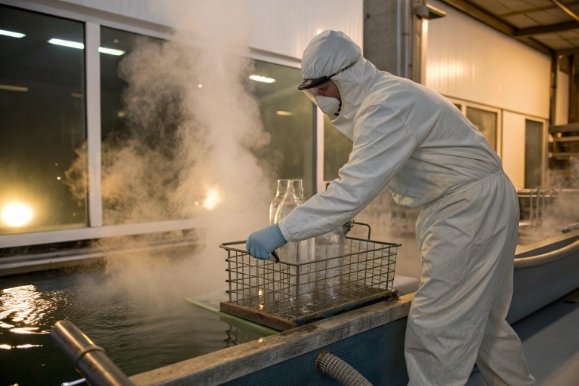
Protocol 1: The Standard Cold Shock (ASTM C149)
This is the industry standard. We use it for every batch destined for hot-fill.
-
Soak: Submerge bottles in a hot water bath (e.g., $63^{\circ}C$) for 5 minutes to ensure the glass is uniformly heated.
-
Transfer: Within 15 seconds, move the basket of bottles into a cold water bath ($21^{\circ}C$).
-
Inspect: Check for breakage.
-
Increment: If they survive, increase the hot bath to $66^{\circ}C$ and repeat. The "Passing" score is usually survival at $\Delta T = 42^{\circ}C$.
Protocol 2: Process Simulation (The "Real World" Test)
Lab tests are great, but your factory floor is chaotic. I recommend clients perform a "Line Simulation":
-
Run 100 bottles through the washer.
-
Fill with water at your target hot-fill temp (e.g., $85^{\circ}C$).
-
Pass them through your cooling tunnel.
-
Crucial Step: Measure the water temperature at the nozzles of your cooling tunnel. If the first zone sprays $20^{\circ}C$ water on $85^{\circ}C$ bottles, you will have breakage. You need to "step down" the cooling: $85^{\circ}C \rightarrow 65^{\circ}C \rightarrow 45^{\circ}C \rightarrow 25^{\circ}C$.
Validating for Autoclave/Retort
For sterilization, the test is reversed. We worry about the cool-down phase.
-
Protocol: Load filled, sealed bottles into a test autoclave.
-
Cycle: Run the actual sterilization cycle.
-
Focus: Monitor the "Cooling" phase. If the autoclave vents steam too fast, the pressure drops and the temperature plummets. This shock can crack the bottle or pop the cap (due to pressure differential).
| Application | Key Validation Test | Critical Parameter |
|---|---|---|
| Hot Fill | ASTM C149 (Cold Shock) 8 | Survival at $\Delta T = 42^{\circ}C$ |
| Pasteurization | Tunnel Simulation | Zone-to-Zone $\Delta T < 30^{\circ}C$ |
| Retort/Autoclave | Full Cycle Stress Test | Pressure & Temp Ramp Down |
| Cryogenic/Freezing | ASTM C149 (Hot Shock) | Expansion room for frozen liquid |
Conclusion
Glass is strong but temperamental. By respecting the 42°C limit for soda-lime glass, optimizing for uniform wall thickness, and verifying annealing quality, you can hot-fill and sterilize with zero breakage.
Footnotes
-
A phenomenon where rapid temperature changes cause different parts of a material to expand or contract at different rates, leading to stress. ↩ ↩
-
The internal force that pulls a material apart, which glass is particularly susceptible to during cooling. ↩ ↩
-
The most common commercial glass type, used for beverages and jars, with moderate thermal shock resistance. ↩ ↩
-
A specialized glass type with silica and boron trioxide, offering superior resistance to thermal shock. ↩ ↩
-
The rate of temperature change across a material, which drives the magnitude of thermal stress. ↩ ↩
-
An industrial oven used to heat and slowly cool glass to remove internal stresses incurred during forming. ↩ ↩
-
An optical tool used to visualize internal stress patterns in transparent materials like glass. ↩ ↩
-
Standard Test Method for Thermal Shock Resistance of Glass Containers. ↩ ↩






