
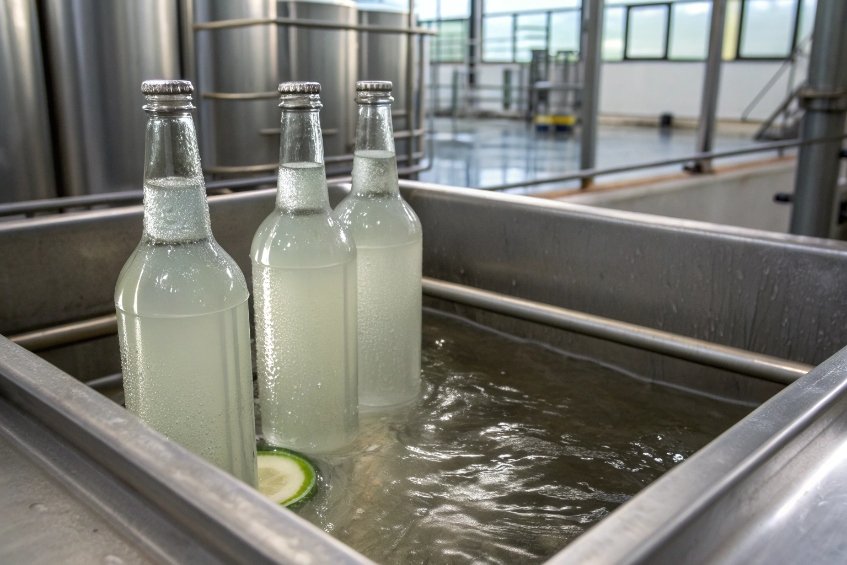
Caustic solutions do not smash bottles like impact does, but slowly eat the surface. This slow attack is easy to ignore until the glass turns dull or starts to shed flakes.
High borosilicate 3.3 reaches ISO 695 alkali resistance class A2 (moderately resistant), similar to good soda-lime, but it keeps its surface better under controlled caustic conditions and repeated cleaning cycles.
In daily projects, the question is simple: “Will this bottle survive caustic wash and CIP without going cloudy or rough?” The answer depends on glass family, wash recipe, temperature, and how long the bottle stays in that environment over its entire life.
Which alkali resistance classes does high-boro meet vs. soda-lime in caustic wash?
On paper, alkali resistance looks like a tiny line in a datasheet. In a caustic washer, it is the difference between a clear bottle and one that looks sandblasted after several loops.
High borosilicate 3.3 typically meets ISO 695 alkali resistance class A2 (moderately resistant), and many modern soda-lime packaging glasses also fall in class A2; the real difference shows up in long-term durability, not only in the class label.
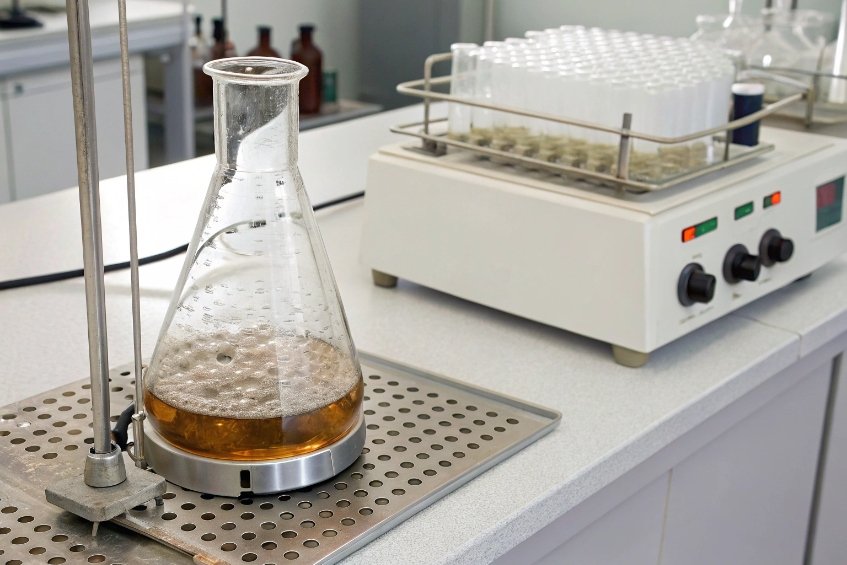
How ISO 695 actually defines “alkali resistance”
ISO 695 1 boils glass samples for 3 hours in a mixed carbonate/caustic solution: equal volumes of NaOH 1 mol/L and Na₂CO₃ 0.5 mol/L. After the boil, the lab measures mass loss per surface area (mg/dm²). Lower mass loss means better resistance.
The standard then groups glasses into classes (A1, A2, A3, etc.) from more resistant to less resistant (see the SCHOTT Technical Glasses View 2). Typical data look like this:
| Glass type | ISO 695 alkali class | Notes |
|---|---|---|
| Borosilicate 3.3 (DURAN, etc.) 3 | A2 | “Moderately resistant” to alkali |
| Soda-lime (lab / packaging) | Often A2 as well | Many datasheets show class A2 |
So on a simple “A1 vs A2 vs A3” table, high-boro and good soda-lime may both show A2. This can be confusing. The key differences are:
- Borosilicate has much better acid and water resistance; only alkali brings it down to “moderate.”
- Within class A2, real mass loss values differ; some borosilicate formulations sit at the better end of A2, some soda–lime packaging glasses 4 at the weaker end.
In caustic wash practice, this means both high-boro and soda-lime can survive a well-controlled bottle washer. But borosilicate keeps its surface gloss and optical quality better if the caustic recipe and temperature stay inside reasonable limits. It is safer against slight overdosing or small temperature drifts.
Do repeated CIP/returnable wash cycles haze or etch the surface over time?
One pass through caustic rarely shows anything. The real story appears after dozens or hundreds of wash cycles in a returnable system. That is when glass chemistry and washer discipline start to show.
Yes, repeated hot caustic or CIP cycles will slowly dull and etch the surface of high borosilicate and soda-lime alike; borosilicate ages slower, but strong alkali at ≥80–100 °C still produces haze, matting, and measurable weight loss over time.
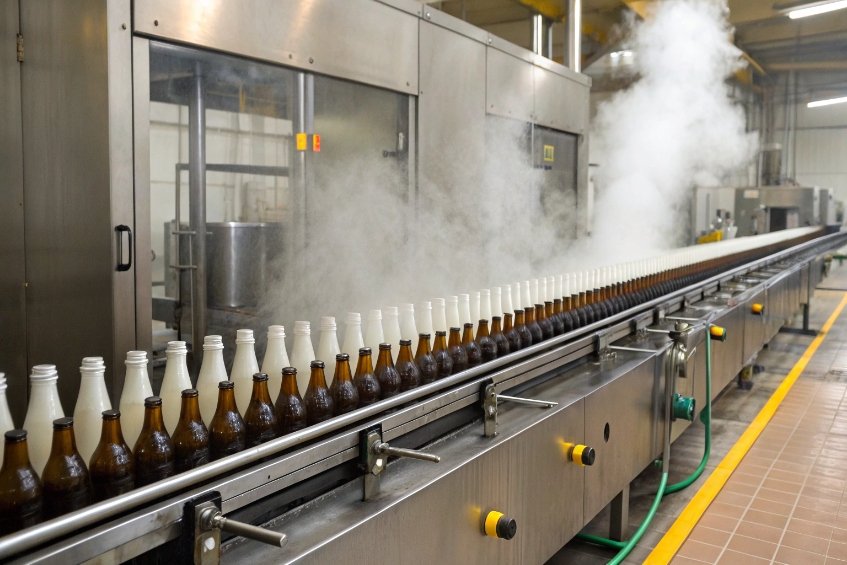
How alkali attack builds up over many wash cycles
Alkaline attack on glass is a diffusion and leaching process. The mixed caustic solution breaks Si–O–B and Si–O–Si bonds near the surface and leaches alkali ions out of the network. At moderate conditions, this stops after a thin layer forms and the attack rate slows down. At harder conditions, attack continues and the surface turns rough and cloudy.
Key factors:
- Alkali concentration – higher NaOH / KOH means faster attack.
- Temperature – attack rates rise steeply above ~80–100 °C.
- Exposure time and cycle count – long soaking and many loops accumulate damage.
- Mechanical abrasion – caustic plus bottle-to-bottle rubbing creates a frosted look.
In a returnable bottle washer, a typical recipe might be 1.5–2% NaOH at 60–80 °C for several minutes. Under such conditions:
- Soda-lime will show label ring attack, heel/base matting, and general haze after a certain number of cycles (exact number depends on washer discipline).
- High-borosilicate will look better for longer, but will still show dulling and etching if the same aggressive recipe runs for many cycles, especially at the top end of the temperature range.
For Clean-in-Place (CIP) 5 on process equipment, high-boro sight glasses or level columns handle standard caustic CIP at moderate temperatures quite well. Long-term issues appear when:
- CIP is done with very strong caustic or high pH additives,
- The cycle spends long time at high temperature,
- There is no proper fresh water rinse afterwards.
So, repeated caustic is not “free” for any glass. The question is: how many cycles, at which recipe, before optical and mechanical properties slip below your limit?
Is high-boro preferable for products with alkaline contents or cleaners?
Many alkaline products and cleaners look harmless in a catalog. In a real bottle or process line, the combination of high pH, heat, and time slowly eats glass. Here, choosing the right material up front saves a lot of trouble later.
High borosilicate is usually preferable to soda-lime when alkaline media are part of the process, especially if temperature is high or contact is frequent, but it is still not a perfect long-term material for strong, hot caustics.
When high-boro makes sense, and when it does not
Because of its high silica and boron content and low alkali oxides, borosilicate 3.3 (as defined in the ISO 3585 borosilicate glass 3.3 specification 6) is very resistant to water, most acids, and many neutral organic media 7. Bases are one of the few groups that clearly attack it.
In my projects, this leads to a simple decision map:
Good use cases for high-borosilicate
- Alkaline contents at room temperature or mild warmth, such as slightly basic formulations, buffers, or detergents with pH around 9–10, with reasonable shelf times and good rinsing.
- Process equipment with standard CIP (typical food/pharma recipes), where the glass only sees caustic for limited minutes per cycle and gets thorough rinsing.
- Applications that also need strong acid and water resistance and good optical quality, like pharma containers, lab bottles, or sight glasses.
In all these cases, high-boro resists alkali noticeably better than ordinary soda-lime and gives much better all-round durability.
Risky or poor use cases even for high-boro
- Long-term storage of concentrated NaOH or KOH, especially at high temperature.
- CIP or bottle wash systems running very strong caustic at ≥80–100 °C for long hold times.
- Aggressive alkaline cleaners with oxidizers (e.g., high-pH + chlorine) at elevated temperature.
For these, stainless steel, lined steel, or polymer contact surfaces (PTFE, PFA, high-grade PP, etc.) are usually better.
So the short answer: high-borosilicate is the better choice whenever alkali exposure is moderate and intermittent and you also care about clarity and thermal performance. It is not a cure-all for harsh caustic service.
What maintenance and testing confirm long-term alkali durability?
Choosing high-boro is only step one. To make sure the bottle or component stays safe and clear in real service, you need maintenance habits and simple tests that track the health of the glass surface over time.
Regular visual inspection, gloss/haze checks, control of wash chemistry, and periodic ISO 695-type mass loss or coupon tests are practical ways to confirm that alkali attack stays within acceptable limits.
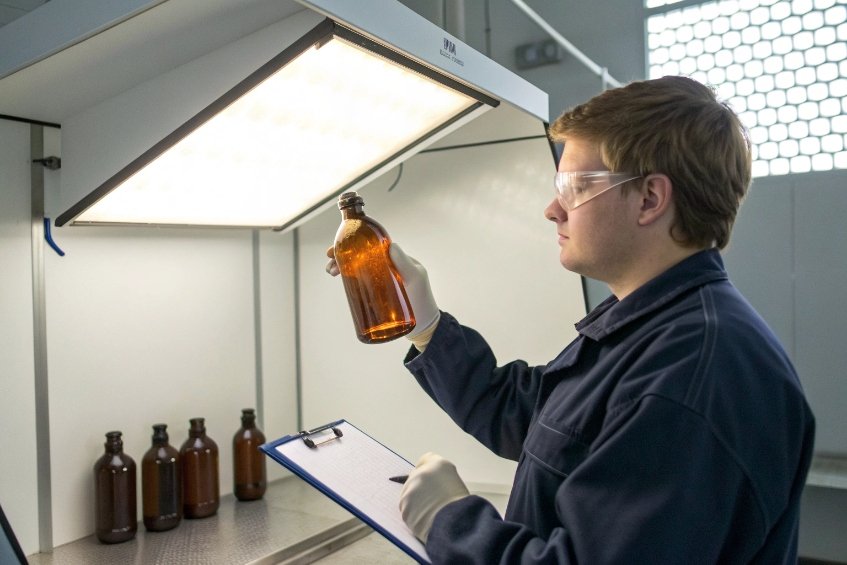
Practical monitoring tools for alkali durability
A full lab corrosion study is nice, but daily operations need faster signals. The most useful tools tend to be simple.
1. Visual and tactile inspection
Operators and QC staff can catch early signs of alkali attack:
- Loss of gloss, clouding, or “milky” zones.
- Fine matt ring in the label area or liquid line.
- Rough feel at heel, base, or shoulder where caustic contact is longest.
Building a simple visual standard board with “new,” “lightly attacked,” and “out-of-spec” examples makes training easy.
2. Washer and CIP chemistry control
Because attack rate depends strongly on concentration, temperature, and time, controlling these three is key:
- Regular checks of NaOH concentration and pH.
- Verified temperature profiles across the washer or CIP loop.
- Logged exposure time and cycle counts for returnable loops.
Small drifts (for example, caustic creeping from 1.5% to 3%, or temperature from 70 °C to 85 °C) can double or triple attack rate without anyone noticing.
3. Quantitative testing
When you need numbers, there are a few good options:
- ISO 695 mass loss tests on small glass coupons representative of your bottles or equipment.
- Surface roughness (Ra) measurements on critical zones after defined cycle counts.
- Haze / transmission tests for applications where clarity is important.
For long-running lines, sending samples periodically to an external lab for a standard alkali resistance test gives confidence that nothing has drifted.
4. Maintenance actions
If attack starts to grow, actions include:
- Tuning the wash recipe (slightly lower caustic, temperature, or time).
- Improving rinsing to remove caustic residues from glass faster.
- Replacing or refurbishing heavily etched components or retiring returnable bottles that pass a defined haze or cycle threshold.
With this kind of routine, high-borosilicate glass can perform very well in moderate alkali environments for many years without ugly surprises.
Conclusion
High borosilicate glass is only moderately alkali-resistant on paper, but with controlled caustic conditions, good washer discipline, and basic monitoring, it offers a robust and predictable solution for applications that see regular but not extreme alkaline exposure.
-
ISO 695 standard: boiling mixed-alkali test method and classification. https://www.iso.org/standard/4895.html ↩︎ ↩
-
SCHOTT reference on technical glass types, including chemical resistance guidance and DIN ISO 695 notes. https://www.schott.com/-/media/project/onex/shared/downloads/melting-and-hot-forming/390768-row-schott-technical-glasses-view-2020-04-14.pdf ↩︎ ↩
-
Background on borosilicate glass composition, typical properties, and common uses. https://en.wikipedia.org/wiki/Borosilicate_glass ↩︎ ↩
-
Background on soda–lime glass composition and why it dominates container glass production. https://en.wikipedia.org/wiki/Soda%E2%80%93lime_glass ↩︎ ↩
-
OSU fact sheet defining Clean-in-Place and key principles for validated cleaning systems. https://extension.okstate.edu/fact-sheets/what-is-clean-in-place-cip.html ↩︎ ↩
-
ISO 3585 specifies borosilicate glass 3.3 composition and key physical properties. https://www.iso.org/standard/23179.html ↩︎ ↩
-
De Dietrich summary of borosilicate glass benefits and chemical resistance in industrial equipment. https://www.dedietrich.com/en/borosilicate-glass ↩︎ ↩






