
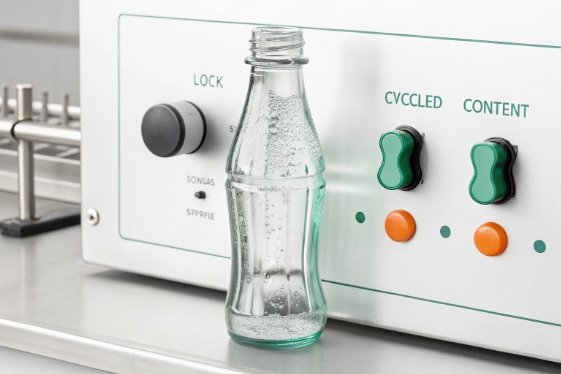
A bottle can pass drop tests and still crack during filling. Heat swings create stress. Small shifts in expansion can decide if that stress stays safe.
Yes. Higher recycled content can change thermal expansion behavior when cullet changes the melt chemistry or adds defects. Stable CTE needs controlled cullet streams, not just a higher recycled ratio.
How recycled content influences CTE in real factories?
Recycled content is not only “more glass,” it is “different glass”
In purchasing talk, cullet 1 is a percentage. In furnace talk, cullet is a chemistry input. Every load of cullet carries its own oxide mix. If that mix shifts, the bottle recipe shifts. CTE moves because CTE is a composition result, not a marketing label.
Most container bottles are soda-lime glass 2. Their CTE depends a lot on alkali level, silica level, and stabilizers. Cullet can raise or lower those oxides depending on what went into the recycling stream. Even small drifts can matter when a hot-fill line runs close to its thermal shock limit. That is why recycled content can be safe at 40% and risky at 40% in another plant. The difference is control.
CTE drift can come from two paths: chemistry drift and defect drift
Recycled content changes CTE in two main ways:
1) Chemistry drift: mixed cullet can push the melt toward slightly higher alkali or slightly lower silica. That usually raises expansion. The opposite drift can reduce expansion. Either way, variability is the real enemy.
2) Defect drift: cullet contamination can increase stones, ceramics, and cords. These do not always change CTE on a report, yet they raise crack risk during thermal cycling. A “stable CTE” bottle can still fail if defects rise.
A practical view for B2B buyers
The best target is not “maximum recycled content.” The best target is “recycled content that stays consistent week after week.” Consistency keeps CTE stable, and stability keeps the filling line predictable.
| What changes when cullet rises | Why it happens | What it can do to CTE | What it does to crack risk |
|---|---|---|---|
| Oxide mix drifts | mixed sources, variable cullet chemistry | CTE can drift up or down | higher thermal stress if CTE rises |
| More colorants and additives | amber/green streams, coatings | usually small CTE effect | can raise defects if not controlled |
| More non-glass contaminants | ceramics, metals, organics | CTE data may still look “normal” | crack starts rise, failures look random |
| More batch correction | plant adjusts recipe to match targets | can hold CTE steady | improves predictability when done well |
A recycled ratio can be a strength. It can also be a hidden variable. The difference is whether the manufacturer treats cullet as a controlled raw material, not as a cheap filler.
The next sections turn this into clear rules that buyers can use when writing specs and reviewing supplier reports.
Why can higher cullet (recycled glass) content change the glass composition and shift the CTE?
Higher recycled content sounds simple. Still, the furnace does not read percentages. The furnace reads chemistry, every hour.
Higher cullet content can shift CTE because cullet brings real oxides into the melt. If cullet sources vary, the melt’s alkali, silica, and stabilizer balance varies, and CTE varies with it.
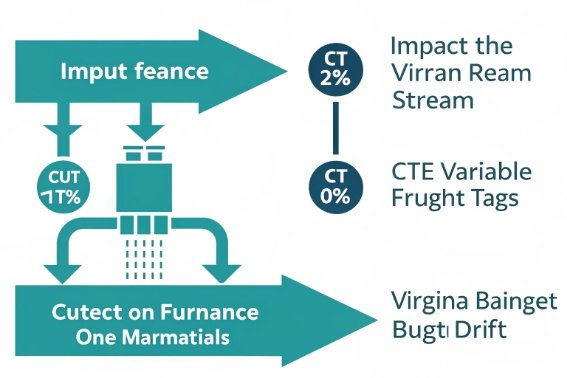
Cullet is a “pre-melted recipe” with a history
Virgin raw materials are controlled by suppliers and specs. Cullet is controlled by collection quality. That difference matters. When cullet rises from 20% to 60%, the cullet stream becomes a larger share of the final oxide budget. Any bias in that stream becomes a bias in the bottle.
Common examples that shift composition:
-
More alkali-rich cullet: some consumer glass streams can bring slightly higher Na2O/K2O. This tends to push CTE upward.
-
Different stabilizer balance: cullet can shift MgO/CaO balance or Al2O3 level. These can nudge CTE and also affect durability.
-
Colorant and refining carryover: amber and green streams bring iron and sulfur chemistry. The CTE effect is often small, but process stability can change.
The “ratio effect”: cullet increases sensitivity to variation
At low cullet ratios, variation is diluted by virgin batch. At high cullet ratios, variation gets louder. That is why high recycled content programs need better sorting, better raw material tracking, and more frequent chemistry checks.
What this means for purchase specs
Instead of writing “recycled content ≥ X%” only, a better spec includes:
-
a chemistry window for key oxides,
-
a CTE tolerance in a defined temperature range,
-
and a commitment to batch traceability.
| Buyer concern | What causes it at high cullet | What to lock in the contract | What proof to request |
|---|---|---|---|
| CTE drift | variable cullet chemistry | oxide windows + CTE tolerance | XRF + dilatometry tied to batch |
| “same bottle, new crack rate” | subtle composition drift | change control on cullet source | trend charts over time |
| surprise forming changes | viscosity and liquidus shifts | process stability plan | furnace campaign notes |
From a sourcing view, cullet is safe when the plant can show the same chemistry targets hitting month after month. Without that evidence, “more recycled” can mean “more variability.”
Which cullet factors matter most for thermal expansion (mixed colors, contaminants, different glass families)?
Cullet is not one material. It is a crowd. When the crowd is mixed, the bottle behavior becomes harder to predict.
The biggest cullet factors for CTE stability are glass family mixing (borosilicate vs soda-lime), chemistry drift from mixed streams, and contaminants that create defects. Color mixing matters more for aesthetics and furnace behavior than for CTE alone.
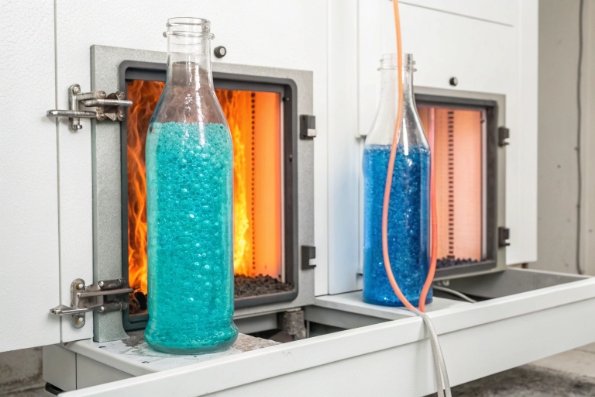
1) Different glass families are the highest risk for CTE stability
The most damaging mix is borosilicate cullet in a soda-lime container furnace. Borosilicate glass 3 carries boron and lower expansion behavior. Small amounts may not shift average CTE much, but they can create cords, stones, and local composition streaks. Those local streaks create local stress during temperature changes. That is a crack risk even when the average CTE looks fine.
Other family risks:
-
Lead crystal or specialty glass in mainstream cullet streams
-
Glass-ceramics or opal glasses in some consumer waste
2) Contaminants drive crack risk even if CTE looks stable
Contaminants often raise crack risk more than they change CTE. Examples:
-
Ceramics and stones: act as hard inclusions that start cracks
-
Metals: can create seeds or defects
-
Organics and coatings: can cause bubbles and cords if burn-off is uneven
A buyer may see a good CTE report and still see breakage because defects are not captured by an average expansion number.
3) Mixed colors matter mostly through process stability
Mixed color cullet can change redox and refining behavior. This can shift bubble content and cords. That affects strength and crack starts. The direct CTE effect from colorants is often modest, but the indirect effect through defects can be large.
| Cullet factor | What it changes | Direct CTE impact | Indirect crack impact |
|---|---|---|---|
| Borosilicate mixed into soda-lime | chemistry streaks, cords | can be small on average | high, due to local stress zones |
| Ceramics (CSP) | inclusions and stones | usually none on CTE report | very high, crack starters |
| Mixed colors | redox, refining, bubbles | small | medium to high if defects rise |
| Coated/printed glass | burn-off and foam | small | medium, via cords/bubbles |
| Wrong glass types (specialty) | oxide drift | variable | variable, often high |
For buyers, the simple rule is: focus first on family separation and contaminant control. A stable color stream helps, but it is not the first lever for thermal expansion stability.
How can manufacturers control batch consistency so recycled content doesn’t cause CTE variation across production lots?
High recycled content can be stable. It just needs discipline. The strongest plants treat cullet like a critical raw material, with rules and feedback loops.
Manufacturers control CTE stability under high cullet by qualifying cullet sources, tightening sorting standards, using frequent chemistry checks, and applying batch corrections within defined windows. Traceability and change control prevent “silent” drift across lots.
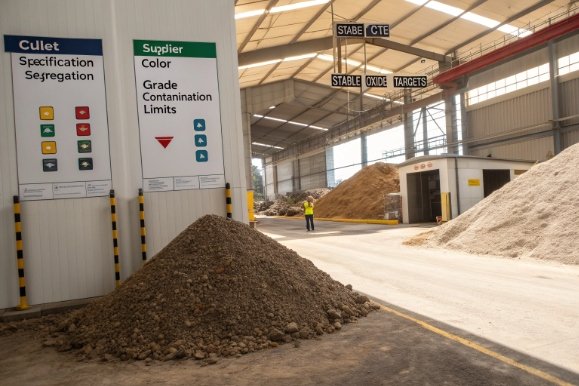
Control starts before the furnace: cullet specification and segregation
Good control begins with a cullet spec that is strict on:
-
glass family acceptance,
-
ceramic contamination limits,
-
moisture and organics limits,
-
and particle size distribution.
Segregation matters too. A plant that mixes several cullet piles “because it all melts” often creates drift. A plant that separates by supplier, color, and grade can hold chemistry more steadily.
Control continues in the furnace: chemistry monitoring and batch correction
Even with good cullet, there is natural variation. Strong plants monitor and correct:
-
XRF checks on cullet and/or glass samples
-
batch correction using virgin raw materials to pull oxides back to target
-
furnace stability controls so melting and fining stay consistent
The goal is not perfection. The goal is staying inside a window that keeps CTE stable.
Control must include process stress, not only chemistry
CTE stability is only one part. Annealing 4 stability matters too. If annealing drifts, residual stress changes, and crack risk rises even when chemistry is stable. So the best plants pair chemistry control with strain control.
| Control layer | Practical tool | What it stabilizes | What buyers should ask |
|---|---|---|---|
| Incoming cullet | supplier qualification + cullet spec | limits bad inputs | cullet COA + contamination limits |
| Sorting | optical sorting + CSP removal | reduces inclusions | defect rate metrics or audit notes |
| Melt chemistry | XRF + correction rules | keeps oxide targets | oxide trends by campaign |
| Furnace operation | stable pull rate + fining control | reduces cords and bubbles | furnace campaign summary |
| Annealing | lehr control + strain checks | reduces hidden stress | strain/anneal limits + logs |
When these controls exist, high recycled content becomes a strength. Without them, high recycled content becomes a variable that shows up as random cracks, rejected pallets, and long email threads.
What tests and documents should B2B buyers request to confirm stable thermal expansion (dilatometry/CTE reports, XRF chemistry, batch traceability)?
A bulk order should not rely on trust alone. A buyer needs paper that links performance to the exact production lot.
To confirm stable thermal expansion, request CTE reports from dilatometry with a defined temperature range, XRF chemistry with oxide windows, and batch traceability that ties every report to the shipment. Add trend data across multiple lots, not a single report.
1) Dilatometry / CTE: demand the range and the tolerance
A CTE number without a temperature interval is not enough. Hot-fill and cycling stress happen in a specific range. A good CTE report includes:
-
test method used (often dilatometry 5),
-
temperature interval,
-
specimen description (glass bar, bottle wall sample),
-
number of specimens and repeatability,
-
reported tolerance band.
A practical purchase rule is to lock the CTE target and tolerance in writing. If the supplier changes cullet sources or recipe, CTE must be re-verified.
2) XRF chemistry: control the drivers, not the story
XRF analysis 6 gives oxide percentages. That is the right tool for batch consistency checks. The chemistry report should include:
-
key oxides (SiO2, Na2O, K2O, CaO, MgO, Al2O3, and others as relevant),
-
totals and measurement method,
-
lot ID and date.
For recycled content programs, chemistry windows should be tight enough to keep CTE stable. A wide window invites drift.
3) Traceability: the link that prevents disputes
Traceability is what makes a report useful. A buyer should request:
-
batch or furnace campaign ID on every COA,
-
production dates,
-
packing list that references the same IDs,
-
change control notice when cullet source, recipe window, or furnace conditions change.
A practical request package for wholesalers
This is the request set that prevents most thermal expansion 7 disputes in bulk business:
| Document or test | What it proves | Frequency that makes sense | Common weak spot |
|---|---|---|---|
| CTE (dilatometry) report | expansion behavior in a defined range | per campaign or per major change | missing temperature interval |
| XRF oxide report | chemistry stayed inside windows | per batch or routine sampling | “typical composition” only |
| COA with batch ID | shipment matches tested lot | every shipment | reports not tied to packing list |
| Trend summary (multi-lot) | stability over time | monthly or quarterly | only one “good” report shown |
| Strain / anneal check | residual stress control | routine line QC | ignored during chemistry focus |
A recycled ratio claim is useful for branding. For production safety, stable CTE comes from controlled chemistry and traceability. When those are in place, recycled content stops being a risk and becomes a reliable specification.
Conclusion
Higher cullet can shift CTE through chemistry and defects. Stable expansion in mass production comes from cullet control, tight recipe windows, and traceable CTE plus XRF reports for every lot.
Footnotes
-
Explanation of how recycled glass (cullet) is processed and reintroduced into the melt. ↩
-
Properties of the most common glass type for containers, including its expansion behavior. ↩
-
Why mixing different glass families creates structural flaws and thermal stress points. ↩
-
The critical cooling process that removes internal stress to prevent spontaneous breakage. ↩
-
Standard lab method for measuring dimensional changes in materials under heat. ↩
-
A fast, non-destructive technique for verifying elemental composition in glass batches. ↩
-
Technical definition of how materials expand with heat and why this predicts failure. ↩






