
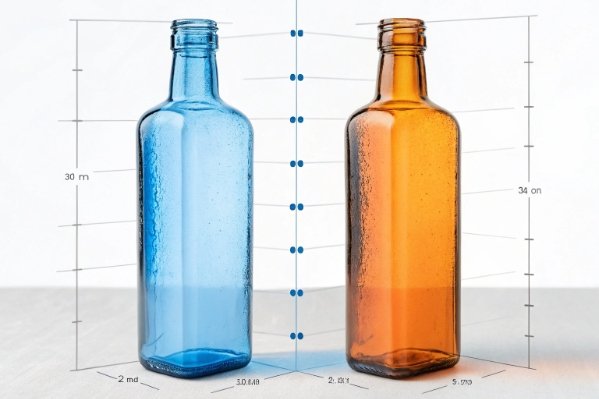
This is one of the most counter-intuitive concepts in glass physics. While brand owners often fear that a "thinner" lightweight bottle is weaker against heat, the laws of thermodynamics tell a different story.
Surprisingly, lightweighting actually increases a bottle’s resistance to Thermal Shock. Because thin glass conducts heat faster, it creates a smaller temperature difference ($\Delta T$) between the inner and outer surfaces, reducing the internal stress that causes cracking. However, it significantly increases the risk of "Panelling" (vacuum collapse) during cooling.
The "Thin Wall" Advantage
At FuSenglass, when we transition a client from a heavy standard bottle (BB process) to a lightweight one (NNPB process), we often see their thermal shock pass rates improve.
Why? Thermal shock breakage is caused by a Thermal Gradient.
-
Thick Glass: When you pour hot liquid (90°C) into a thick cold bottle, the inside expands immediately. The outside, insulated by the thick wall, stays cold and rigid. The inside pushes against the outside, ripping it apart.
-
Thin Glass: The wall is so thin that heat transfer 1 happens instantly. The inside and outside expand almost simultaneously. No gradient = No stress = No break.
However, the "Risk" mentioned in your question comes from structural rigidity and glass distribution. While the glass won’t crack from the heat shock, it might not have the strength to hold the shape under the vacuum pressure created when that hot liquid cools down.
Performance Trade-Offs
| Feature | Heavy Bottle (Standard) | Lightweight Bottle (NNPB) |
|---|---|---|
| Thermal Shock Resistance | Lower (Higher stress gradient) | Higher (Fast heat transfer) |
| Vacuum Resistance | High (Rigid walls) | Low (Risk of "Panelling") |
| Glass Distribution | Variable (Thick base/Thin wall) | Uniform (Consistent wall) |
| Manufacturing Defect | Base Cracks | Heel Checks / Thin Spots |
Why can thinner walls increase thermal shock risk in lightweight glass bottles, and which areas (shoulder, heel, base) are most critical?
While uniform thin walls are good, "lightweighting" often exposes the bottle’s Achilles’ heel: Uneven Distribution.
The risk in lightweight bottles arises from "distribution variance." If the manufacturing process leaves a heavy base (which retains heat) connected to a razor-thin sidewall (which cools fast), the stress concentrates at the "Heel" (the corner), causing circumferential cracks.
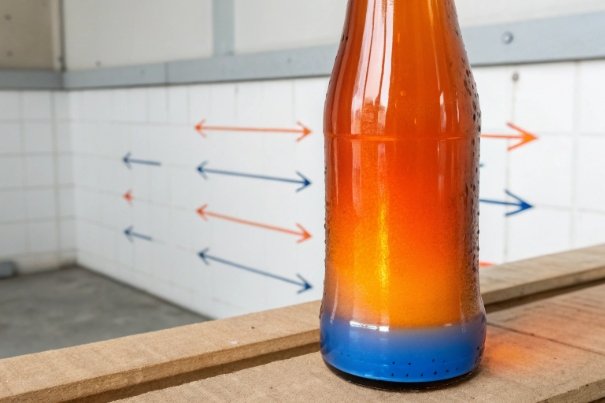
The Critical Zones of Failure
In lightweight glass, the margin for error is zero. A heavy bottle can hide a bad mold design with extra glass. A lightweight bottle cannot.
1. The Heel (The Danger Zone):
This is where the sidewall meets the bottom. In poorly made lightweight bottles, the "baffle seam" (bottom plate connection) creates a stress concentration 2. If the base is thick (to give stability) but the wall is thin (to save weight), the base stays hot while the wall cools. The resulting "tug-of-war" snaps the bottle at the heel.
2. The Shoulder:
This is the contact point. On a filling line, bottles bump into each other. Lightweight bottles have less material to absorb this impact. If a bottle is "bruised" (micro-cracked) at the shoulder while hot, the thermal stress will propagate that crack instantly.
3. The Base (Push-up):
During hot-filling, the liquid heat transfers to the conveyor belt through the base. If the base is too thin, it acts as a heat sink, shocking the glass. If it is too thick, it creates the gradient problem described above.
Failure Locations
| Zone | Failure Mode | Cause in Lightweight Glass |
|---|---|---|
| Heel | Circumferential Crack | Thickness difference between base and wall. |
| Sidewall | Panelling (Collapse) | Wall too thin to withstand cooling vacuum. |
| Shoulder | Vertical Check | Impact damage + Thermal expansion. |
| Finish | Crazing | Rapid cooling of the neck (thinnest part). |
How do design factors (uniform wall thickness, radii, push-up, finish design) help lightweight bottles survive hot-fill and rapid cooling?
To make a lightweight bottle safe for heat, you must design it to be flexible rather than rigid, distributing stress evenly.
The NNPB (Narrow Neck Press and Blow) process is essential for lightweighting because it ensures uniform wall thickness. Designers must also use "generous radii" (rounded corners) at the heel and shoulder to disperse stress, and optimize the "push-up" (base punt) to prevent the bottom from sagging under heat.
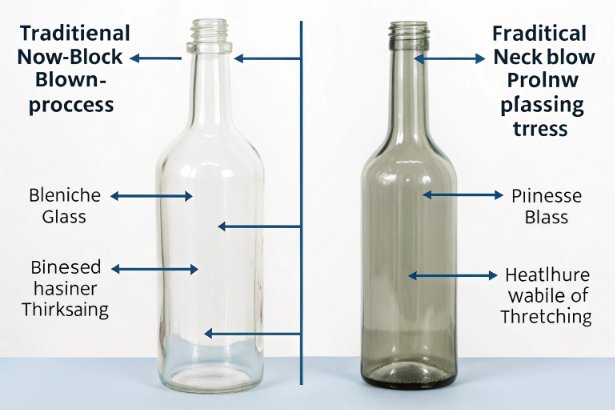
Engineering the Lightweight Geometry
At FuSenglass, "Lightweight" is synonymous with "High Tech." We don’t just use less glass; we use better geometry.
1. Uniformity is King (NNPB Process):
Standard "Blow-Blow" production leaves glass wavy—thick here, thin there. This is fatal for heat resistance. We use NNPB, where a metal plunger presses the glass to a precise, uniform thickness (e.g., exactly 2.0mm everywhere). This ensures the whole bottle expands and contracts at the same rate.
2. The "Soft" Radius:
Sharp corners focus stress. In lightweight designs, we make the curve from the body to the base (the heel radius 3) as large as possible. This spreads the thermal load over a wider area.
3. Vacuum-Resistant Shape:
When hot liquid cools, it shrinks, creating a vacuum inside. A flat-sided lightweight bottle will suck in (panel). To prevent this, we design the bottle with:
-
Ribs or Flutes: Add structural stiffness.
-
Cylindrical Shape: A circle is the strongest shape against vacuum. Avoid square lightweight bottles for hot-fill.
4. The Push-Up (Punt):
The indented bottom isn’t just for wine. It creates a "bellows" effect. It allows the base to flex slightly under pressure changes without cracking.
Design Rules for Heat
| Feature | Standard Design | Lightweight Heat Design | Reason |
|---|---|---|---|
| Wall Profile | Variable | 100% Uniform | Eliminates hot/cold spots. |
| Heel Radius | 3-4 mm | > 6 mm | Disperses stress concentration. |
| Body Shape | Square/Oval | Round / Ribbed | Resists vacuum collapse. |
| Base | Flat | Dome / Punt | Adds mechanical stability. |
How should manufacturers adjust annealing and forming controls to maintain heat resistance after lightweighting?
Lightweight bottles cool down much faster than heavy ones, meaning the standard factory settings will ruin them.
Manufacturers must accelerate the cooling curve in the annealing lehr because lightweight bottles have less thermal mass to retain heat. Additionally, "Gob Temperature" control must be precise to preventing "settle wave" defects that create thin spots prone to thermal failure.
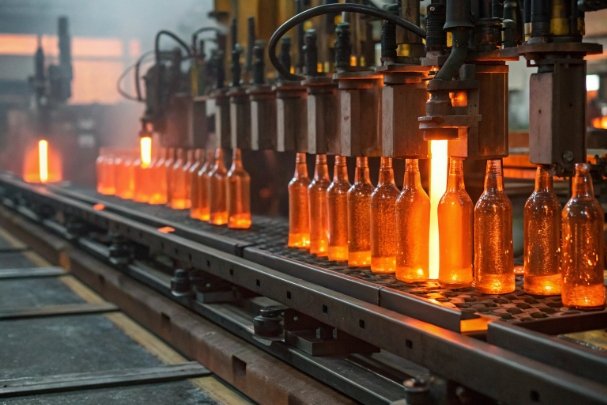
Process Adaptation
You cannot run a 200g bottle on the same settings as a 400g bottle.
1. Annealing Strategy:
A heavy bottle holds heat like a cast-iron skillet. A lightweight bottle cools like aluminum foil. If we run the lehr 4 slowly (standard setting), the lightweight bottle will cool too early in the tunnel, then get re-heated, then cooled again. This cycling adds stress.
- Adjustment: We speed up the lehr belt or lower the temperature of the initial zones to catch the bottle at the perfect "Annealing Point" before it cools naturally.
2. Mold Cooling:
In the forming machine, if we cool the mold too much, the thin glass freezes instantly upon contact. This creates "chill checks" (micro-cracks).
- Adjustment: We run the molds hotter and use "Vertiflow" cooling to gently extract heat, keeping the glass workable long enough to form a uniform wall.
3. Gob Weight Precision:
In a heavy bottle, a +/- 2% weight variance is fine. In a lightweight bottle, a 2% loss might mean the heel becomes paper-thin. We use automatic gob 5 weight control to ensure every drop of glass is exact.
What validation tests (thermal shock ΔT, hot-fill simulation, residual stress checks) should buyers require before switching to lightweight glass bottles?
The validation for lightweight glass is stricter because the structural safety margin is smaller.
Buyers must require a "Hot-Fill Simulation" to check for vacuum collapse (panelling), not just breakage. Standard Thermal Shock testing ($\Delta T$ 42°C) is mandatory, along with "Vertical Load" testing to ensure the thinner walls can withstand capping pressure without crumbling.
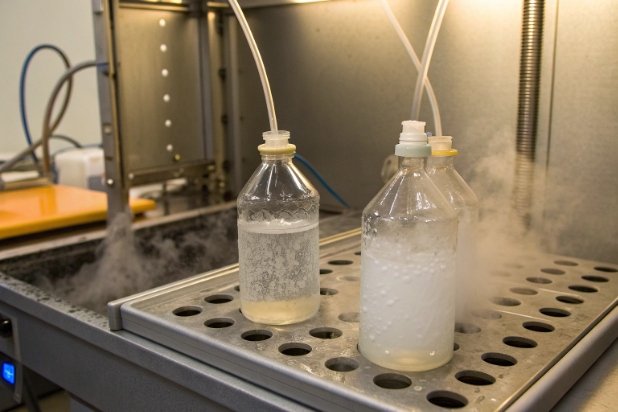
The Lightweight Validation Suite
Don’t just ask "Will it break?" Ask "Will it deform?"
1. Vacuum Collapse (Panelling) Test:
This is specific to lightweighting.
-
Method: Fill with water at 90°C. Cap immediately. Let cool to 20°C.
-
Failure: The bottle sides suck in, distorting the label panel.
-
Requirement: No visible deformation under standard hot-fill vacuum (~5-10 inHg).
2. Thermal Shock (The Heel Check):
-
Method: Heat to 65°C, plunge into 23°C.
-
Focus: Inspect the Heel. Lightweight bottles almost always fail at the heel first. If they pass this, the distribution is good.
3. Vertical Load (Top Load):
Since the walls are thinner, can they support the capping machine?
- Requirement: Must withstand > 40-50 kg of down-force without crushing.
4. Thickness Profile (Hall Effect Gauge):
Do not accept "Average Thickness." Require a minimum thickness spec.
- Spec: "No point on the bottle shall be less than 1.2mm." (Or whatever your safety limit is).
Testing Protocol Matrix
| Test | Objective | Pass Criteria |
|---|---|---|
| Thermal Shock | Check Heel/Shoulder integrity. | $\Delta T \ge 42^\circ C$ (No cracks). |
| Vacuum Sim | Check for Panelling/Collapse. | Max deflection < 0.5mm. |
| Vertical Load | Check Capping Strength. | Withstand Capper Force + 20%. |
| Section Weight | Check Distribution. | 4 Quadrants within 10% variance. |
Conclusion
Lightweighting is a double-edged sword. It offers superior thermal shock resistance due to reduced thermal gradients, but it introduces the risk of vacuum collapse. By partnering with a manufacturer who uses NNPB technology and understanding the design limits, you can have a bottle that is both light and tough.
Footnotes
-
The physical process of heat energy moving from a region of high temperature to low temperature. ↩
-
A location in an object where the stress is significantly greater than the surrounding area. ↩
-
The curved transition from the base of the bottle to the vertical sidewall. ↩
-
A specialized oven used in glass manufacturing to anneal and cool bottles under controlled conditions. ↩
-
A precise lump of molten glass cut from the feeder and delivered to the forming machine. ↩






