
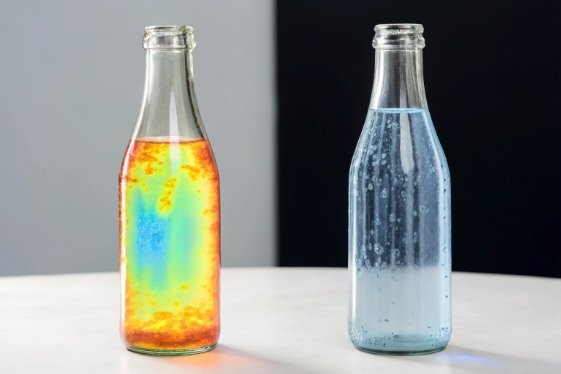
Every time I propose a "lightweight" solution to a client, I see the hesitation. They worry that using less glass means the bottle will shatter the moment hot liquid hits it.
Surprisingly, lightweight glass bottles often handle thermal shock better than heavy ones. While the Coefficient of Thermal Expansion (CTE) remains unchanged, thinner walls allow for faster heat transfer, significantly reducing the temperature gradient ($\Delta T$) that causes thermal stress cracking. The real conflict is not with heat, but with mechanical impact strength.
The Paradox of Glass Weight
In the glass industry, we have a saying: "Thick breaks, thin survives." It sounds counterintuitive.
When I worked with a major sauce manufacturer in Malaysia (let’s call him Chen) who wanted to reduce shipping costs, he was terrified that moving from a 300g bottle to a 220g bottle would ruin his pasteurization line 1. I had to explain the physics:
-
Heavy Glass (Thick Walls): The inside heats up, the outside stays cold. The "fight" between expansion and contraction is violent. High Stress.
-
Lightweight Glass (Thin Walls): The heat travels through the wall instantly. The inside and outside expand together. Low Stress.
However, lightweighting is not magic. It requires precision. You lose the "brute force" strength of thick glass, so the engineering must be flawless.
Thermal vs. Mechanical Trade-offs
| Feature | Heavy Bottle | Lightweight Bottle | Benefit of Lightness |
| :— | :— | :— | :— |
| Thermal Shock | High Risk (High Gradient) | Low Risk (Low Gradient) | Faster production speeds |
| Impact Strength | High | Low | Reduced shipping weight |
| Wall Uniformity | Variable | Must be Perfect | Consistent quality |
| Cooling Time | Slow (Heat Sink) | Fast | Energy efficiency |
Does reducing bottle weight change the CTE itself, or does it mainly reduce the safety margin against thermal gradients and cracking?
This is a fundamental chemistry vs. geometry question.
Reducing bottle weight does absolutely nothing to the CTE, which is a fixed chemical property of the glass mix. However, lightweighting increases the safety margin against thermal cracking by minimizing the thermal gradient, while simultaneously decreasing the safety margin against physical impact and vertical load.
The Chemistry is Constant
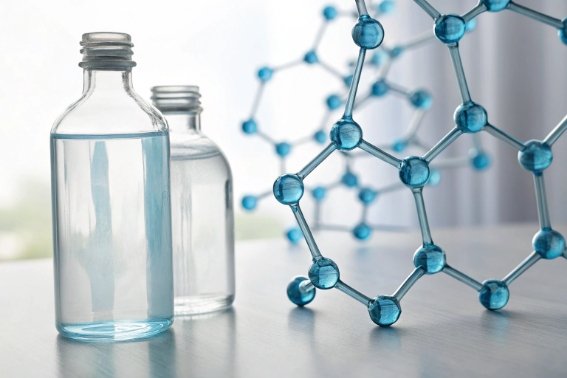
Whether we make a 1kg magnum wine bottle or a 150g hot sauce bottle, the soda-lime glass 2 recipe is the same. It expands at $\approx 9.0 \times 10^{-6} / K$. You cannot change this by using less of it.
The Geometry is the Savior
The danger in thermal processes (like hot-filling) is the Temperature Differential ($\Delta T$) across the wall thickness.
-
Scenario A (Thick Glass): You pour 90°C jam. Inner wall is 90°C. Outer wall is 20°C. Differential = 70°C. CRACK.
-
Scenario B (Thin Glass): You pour 90°C jam. Heat conducts through 2mm glass in milliseconds. Outer wall hits 85°C almost instantly. Differential = 5°C. SAFE.
So, for thermal shock 3, lightweighting is actually a performance upgrade. The downside? If you bang that thin bottle against the metal guide rail on your conveyor, it chips easier. That’s the trade-off.
Which lightweighting strategies protect thermal shock resistance best (uniform wall thickness, optimized heel/push-up, smoother shoulder transitions)?
You can’t just "make it smaller." You have to use advanced forming technology to redistribute the glass.
The single most critical strategy is NNPB (Narrow Neck Press and Blow) technology to ensure absolute Uniform Wall Thickness. Additionally, optimizing the "Heel Radius" to be gentle rather than sharp, and reducing the mass of the base (push-up), prevents the formation of "heat sinks" that trigger bottom separation.
The NNPB Revolution
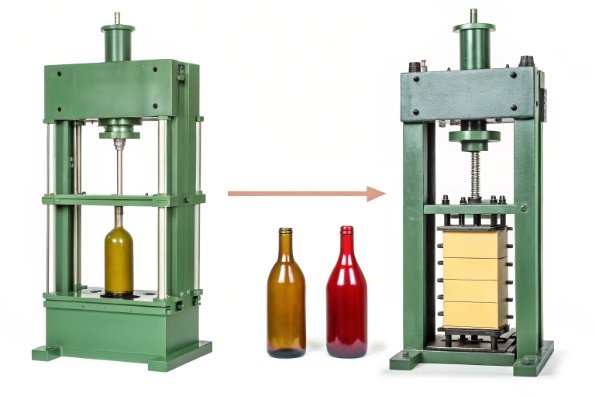
Old glass making (Blow-Blow 4) left walls thick at the bottom and thin at the top. This wavy unevenness is a death sentence for lightweight bottles in a sterilizer.
At FuSenglass, we use NNPB 5 for lightweight projects. A plunger presses the glass cavity, creating a controlled internal space. This guarantees that the wall is 2.0mm everywhere—top, middle, and bottom.
Designing the "Safe" Shape
-
The Heel (Base Corner): In heavy bottles, we can be lazy and have a sharp corner. In lightweight bottles, the heel must be a wide, sweeping curve. This distributes the thermal stress 6 over a larger area.
-
The Punt (Base Push-up): A deep, heavy punt holds heat. For lightweight thermal bottles, we flatten the punt or use "stippling" (little dots) to increase surface area and speed up cooling.
-
The Shoulder: We avoid "square" shoulders. A sloping shoulder allows the glass to expand upwards without concentrating stress at the neck.
| Design Zone | Traditional Approach | Lightweight Thermal Strategy |
| :— | :— | :— |
| Wall Thickness | Variable (2mm – 5mm) | Uniform (1.8mm – 2.2mm) |
| Base Radius | Sharp / Defined | Large / Smooth (>5mm) |
| Shoulder | Angular | Sloped / Conical |
| Forming Method | Blow-Blow | NNPB |
How do annealing quality and residual stress control become more critical as glass bottles get lighter?
Thin glass has zero tolerance for manufacturing errors. It is unforgiving.
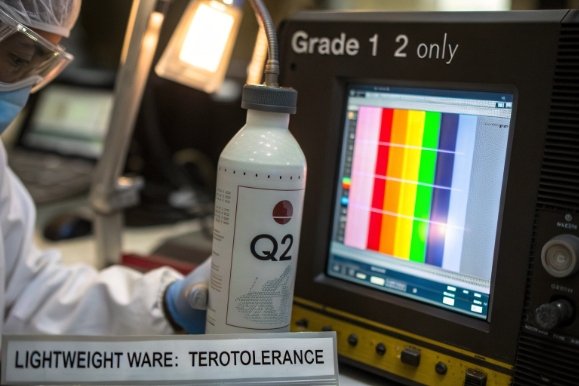
As glass gets lighter, the structural "buffer" to absorb internal tension disappears. Annealing must be flawless (Grade 1 or 2 max) because any residual stress combined with the mechanical pressure of filling or capping will instantly exceed the lower tensile strength threshold of the thinner wall.
The "Strength Budget"
Think of a glass bottle as having a "Strength Budget."
-
Heavy Bottle: Has a huge budget. It can have some bad annealing (residual stress) and still survive the filling line.
-
Lightweight Bottle: Has a tiny budget.
If a lightweight bottle comes out of the mold with Residual Stress (because we cooled it too fast in the Lehr), it is like a loaded spring. The moment you add hot liquid (Thermal Stress) or cap it (Mechanical Stress), you overload the budget.
Why Annealing Matters More
In my factory, when running lightweight ware, we actually slow down the Annealing Lehr 7. We give the bottles extra time to relax. We cannot afford even a Grade 3 stress rating.
For clients like "JEmma" who want eco-friendly, thin cosmetic jars: I tell them, "We can make it thin, but we must anneal it perfectly. Do not rush the production date."
What validation tests should you require for lightweight bottles used in hot-fill, pasteurization, or sterilization (ΔT, stress inspection, pressure/leak tests)?
Standard tests aren’t enough. You need to test for the specific weaknesses of thin glass: structural rigidity under heat.
You must validate Vertical Load Strength at elevated temperatures (simulating filling pressure when hot), perform precise Thermal Shock testing (ASTM C149), and conduct Vacuum Retention tests, as lightweight sidewalls can "panel" (collapse inward) under vacuum pressure during cooling.
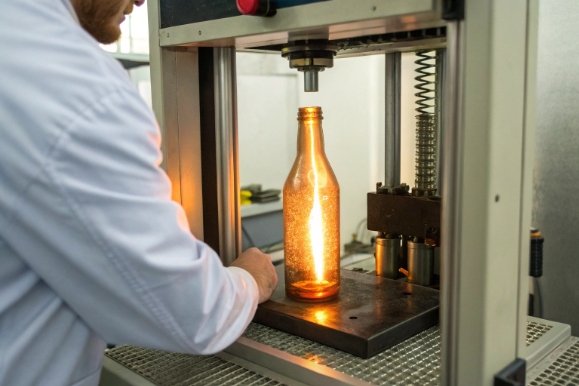
The "Paneling" Nightmare
Thermal shock isn’t the only risk. In lightweight bottles, the walls are so thin that they can suck inwards like a plastic water bottle if a vacuum forms inside. This is called "Paneling 8."
My Recommended Validation Protocol
-
Hot Vertical Load:
- Standard vertical load 9 tests are done cold. I insist on testing hot. Glass doesn’t get softer, but the lubricant coatings (cold end coating 10) might change friction, and we need to know if the bottle can take the capping force without crushing.
-
Vacuum Resistance:
- We seal the bottle hot and let it cool. Does the sidewall cave in? If yes, the design is too flat; we need to add curvature (ribs or camber) to stiffen it.
-
Impact Testing (AGR Line Simulator):
- Since we lost the impact protection of thick glass, we run the bottles through a simulator that mimics the banging on a filling line. We check for "bruises" or micro-cracks that could fail later under thermal stress.
| Test | Objective | Pass Criteria for Lightweight |
| :— | :— | :— |
| Thermal Shock | Verify $\Delta T$ handling | Survive $42^{\circ}C$ drop |
| Vertical Load | Check capping strength | Withstand >150kgf |
| Vacuum Panel | Check shape rigidity | No visual sidewall collapse |
| Polariscope | Check annealing | Grade 2 Maximum |
Conclusion
Lightweighting is actually a friend to thermal shock resistance, provided you respect the geometry. By using NNPB for uniform walls and validating vacuum rigidity, you can have a bottle that is both eco-friendly and thermally robust.
Footnotes
-
Industrial heat treatment system for product sterilization. ↩
-
The standard chemical composition for mass-produced glass containers. ↩
-
Material failure resulting from rapid temperature fluctuations. ↩
-
Traditional forming method creating variable wall thickness. ↩
-
Advanced forming process ensuring uniform glass distribution. ↩
-
Internal mechanical tension caused by temperature gradients. ↩
-
Continuous oven used to relieve residual stress in glass. ↩
-
Deformation where bottle sidewalls collapse inward under vacuum. ↩
-
Force applied downwards on the bottle neck, simulating capping. ↩
-
Lubricious layer applied to cool bottles to prevent scratching. ↩






