
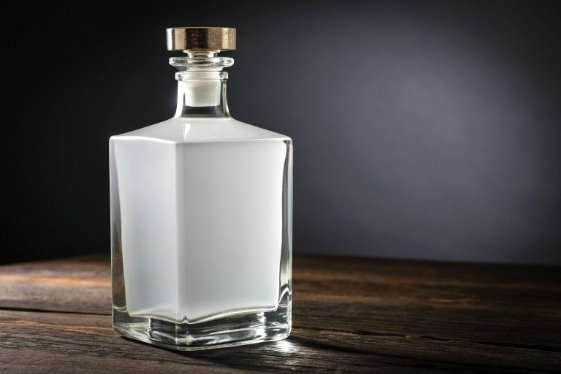
This is a classic case where "material science" meets "marketing perception." Many luxury brands assume their premium "High-White" (or Super Flint) bottles are more fragile.
Chemically, high-white glass has nearly the exact same Coefficient of Thermal Expansion (CTE) as standard flint glass ($\approx 9.0 \times 10^{-6} K^{-1}$). The base recipe (Soda-Lime-Silica) remains structurally identical. However, high-white bottles often perform worse in thermal shock tests not because of the glass material, but because of their typical design—thick bases and heavy walls—which creates severe thermal gradients.
The "Crystal" Illusion
Clients often confuse "High-White" with "Lead Crystal."
-
Lead Crystal: Has lead oxide 1, which changes the expansion and makes it softer.
-
High-White / Super Flint: Is just very pure Soda-Lime glass.
Because the chemical skeleton (Silica + Soda + Lime) is unchanged, the thermal expansion rate remains fixed at the industry standard of $9.0$. The glass expands the same amount per degree. The difference lies entirely in purity and geometry.
What composition differences define high-white glass, and why don’t they always change CTE dramatically?
The difference is subtractive, not additive. We aren’t adding a new magical element; we are removing the impurities.
High-white glass is defined by extremely low iron content (<0.02%) and the use of premium decolorizers 2 (like Selenium or Erbium) to achieve neutral clarity. Since the primary network formers (Silica) and modifiers (Soda, Lime) remain in the same ratios as standard flint, the atomic bond strength and thermal expansion characteristics remain unchanged.
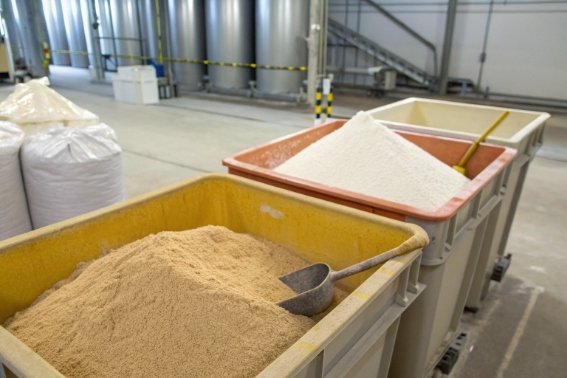
The Recipe Comparison
To understand why the CTE doesn’t move, look at the composition:
| Component | Standard Flint | High-White (Super Flint) | Role |
|---|---|---|---|
| Silica ($SiO_2$) | ~72% | ~72% | Network Former 3 (Structure) |
| Soda ($Na_2O$) | ~14% | ~14% | Flux (Controls Melting & Expansion) |
| Lime ($CaO$) | ~10% | ~10% | Stabilizer |
| Iron ($Fe_2O_3$) | 0.05% – 0.08% | < 0.02% | Colorant (Impurity) |
The Key Insight: The thermal expansion is primarily driven by the Sodium ($Na_2O$) content. As long as the soda levels are the same (which they must be to fit standard forming machines), the CTE stays at $9.0$. The removal of trace iron has zero impact on the expansion mechanics.
Can high-white glass be more sensitive to thermal shock due to higher clarity requirements and tighter defect tolerance?
Yes, but the culprit is usually the shape, not the glass.
High-white glass is almost exclusively used for premium spirits and cosmetics, which favor designs with heavy "punts" 4 (thick bases) and sharp shoulders. These thick, uneven geometries create massive thermal stress differentials during cooling, making the bottle far more prone to breakage than a uniform, thin-walled standard flint jar.
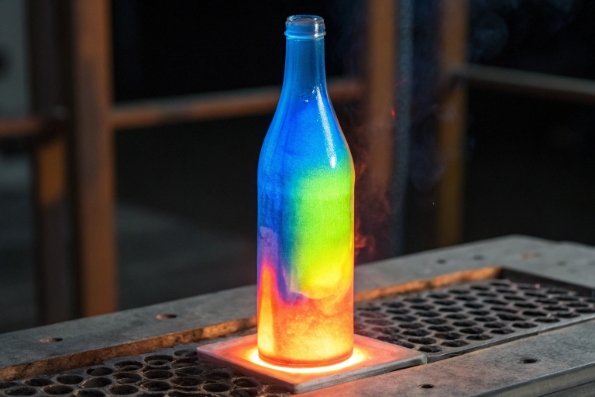
The "Heavy Bottom" Problem
I often have to tell luxury perfume clients: "You can have a 20mm thick glass bottom, or you can have high thermal shock resistance. You cannot have both."
-
Standard Flint Jar (Pickles):
-
Wall: 2mm. Base: 3mm.
-
Thermal Behavior: Cools evenly.
-
Result: Survives $\Delta T = 42^{\circ}C$.
-
-
High-White Bottle (Vodka/Perfume):
-
Wall: 3mm. Base: 15mm.
-
Thermal Behavior: The wall cools instantly. The base stays hot for minutes.
-
Result: The wall pulls away from the hot base. Breakage.
-
It is this geometric sensitivity that gives high-white glass a reputation for being "delicate."
How do cullet quality, redox control, and color stability requirements affect thermal performance for high-white bottles?
Purity comes at a price. The lack of recycled glass (cullet) changes the melting dynamics.
High-white production uses very low percentages of external cullet (recycled glass) to prevent contamination. This requires higher melting energy and creates a stiffer "virgin" batch that can be harder to homogenize. If not melted perfectly, this can lead to microscopic "cords" (striae) of different density, which act as internal stress risers and weaken the bottle thermally.
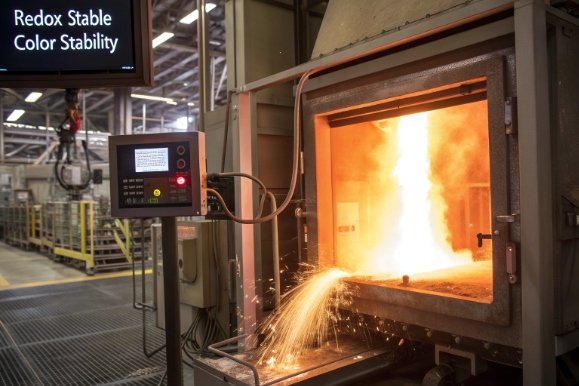
The Cullet Factor
-
Standard Flint: Uses 30-50% Cullet 5. Old glass melts easier than raw sand. It homogenizes well.
-
High-White: Uses <10% Cullet (mostly internal factory scrap). We are melting raw minerals. This requires more heat and residence time.
The Hidden Defect: Ream/Cord
Because we are melting "stiff" raw materials, if the furnace convection isn’t perfect, you get "Cords" 6—streaks of glass with a slightly different composition (and thus different CTE) swirled inside the bottle wall.
-
Visual: Invisible to the eye in clear glass.
-
Thermal: Under heat, the cord expands differently than the surrounding glass. Snap.
This is why high-white glass requires stricter Annealing and quality control. The material itself is less forgiving of process errors.
What tests should you run to compare high-white vs. regular flint bottles for hot-fill and pasteurization applications?
Don’t assume the premium bottle is stronger. It is likely weaker.
You must perform a Comparative Thermal Shock Test (ASTM C149) specifically targeting the thick-to-thin transition zones. Additionally, run a Polariscope inspection to check for "cord" stress (common in low-cullet glass) and a Section Analysis to map the base-to-wall thickness ratio.
The Validation Checklist
-
Thermal Shock Ramp-Up:
-
Don’t just pass/fail at $42^{\circ}C$. Test to destruction.
-
Expectation: Standard Flint might survive to $50^{\circ}C$. High-White (due to heavy base) might fail at $38^{\circ}C$. Knowing this limit is crucial for your filling line setup.
-
-
Cord/Striae Check (Polariscope):
-
Rotate the bottle under polarized light 7. Look for "swirls" of stress in the sidewall.
-
Standard: ASTM C148 8. For high-white, reject any visible cord stress (Grade C or higher).
-
-
Thickness Ratio Mapping:
-
Cut the bottle vertically. Measure the thickness of the base center vs. the heel vs. the sidewall.
-
Risk Rule: If Base Thickness > 5x Sidewall Thickness, you cannot run standard thermal cycles. You must use gentle heating/cooling curves 9.
-
Conclusion
High-White Glass is chemically the same as standard flint regarding thermal expansion 10 ($9.0$ CTE). However, its premium design features (heavy glass weight, thick bases) and manufacturing constraints (low cullet) make it structurally more vulnerable to thermal shock. Treat it like a luxury car: it looks beautiful, but you shouldn’t drive it off-road.
Footnotes
-
Component added to glass to increase brilliance and weight, now less common. ↩
-
Additives used to neutralize green/yellow tints in clear glass. ↩
-
The primary oxide ($SiO_2$) that forms the fundamental glass structure. ↩
-
The indentation at the bottom of a glass bottle, often thickened for stability. ↩
-
Recycled broken or waste glass used to facilitate melting. ↩
-
Compositional inhomogeneity within the glass appearing as streaks. ↩
-
Method to visualize internal stress patterns and defects in transparent materials. ↩
-
Standard Test Methods for Polariscopic Examination of Glass Containers. ↩
-
Controlled temperature profiles used to prevent thermal shock in processing. ↩
-
The rate at which a material expands with temperature increase. ↩






